

My least favorite non-native invasive species: the dirty half-dozen
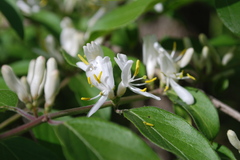
Beauty from the Beast - a colorful Honeysuckle (Lonicera spp.) flower
Rick Meader | Contributor
Well, due to the spread of invasive species, if you leave a big hunk of land alone today, there’s a good chance that it will become infested with invasive species at some point, and active management may be necessary to keep it in its previously natural state.
So, today I want to share with you my personal “dirty half-dozen,” the six invasive species I hate the most, based on my experiences in ecological restoration and walking in nature. You may or may not agree with these, and everyone is entitled to their own lists, but here are mine, in no particular order. Look for them in your post office.
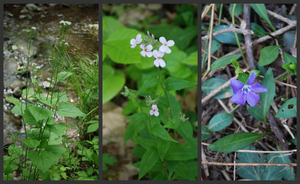
From left: Garlic mustard (Alliaria petiolata), Dame's Rocket (Hesperis matronalis) and Myrtle or Periwinkle (Vinca minor)
Rick Meader | Contributor
1. Garlic mustard (Alliaria petiolata): While it may be edible, unfortunately this scourge of woodlands has not become a favorite of woodchucks, deer, rabbits or any other wild animal in numbers that could decimate it. If you don’t know what this plant is, take a drive almost anywhere (city, country, suburbia) and you’re bound to see a cluster of single stalk plants with triangular leaves and a little four-petaled white flower at the top. That is garlic mustard. If you walk in many area woodlands, especially those with rich soils, you’ll find a two-foot tall carpet of the stuff where trillium, wild ginger, toothwort, columbine and a myriad of other native species once abounded. The garlic mustard sucks the life out of a forest, and puts out thousands of new seeds, per plant, every spring to continue its domination. A native of Europe and member of the mustard family, the plant is a biennial that forms a rosette the in the first year of life, which overwinters and bursts up to flower and produce seed in its second year. I hate this plant for its impact on woodlands and other native wildflowers.
2. Dame’s Rocket (Hesperis matronalis): Like garlic mustard, this fellow member of the mustard family also likes rich woods and woodland edges and puts out thousands of seeds. Its leaves are about 3-5” long and lanceolate shaped (fancy talk for sort of spear-head shaped). Unlike garlic mustard, this plant is a bit more insidious because it’s pretty. Its flowers can range from white to pink to lavender and the plant can get up to 3-4 feet tall. You can also go in some woods and find the floor covered with the rosettes early in the spring, or filling the forest with a plethora of color. While pretty, it’s still not a good neighbor as it can crowd out many other native species and take up the nutrients and sunlight that more native species could use.
3. Myrtle/Periwinkle (Vinca minor) - A groundcover that seems to run a close second in suburbia to lawn, this makes my list because of its ability to form dense mats of little, oval leaves that are a bear to get rid of completely, and, due to its dense cover, excludes native wildflowers from gaining a foothold in what used to be their home. It is a popular groundcover because of its dark green color and pretty purple flowers. It's also good at keeping other plants out of an area. Once a bed is established, it’s hard for any other weeds to move in, thus saving the homeowner labor in weeding that section of their property. But, if you want to use that area for something else, and you think you’ve pulled it all out (good luck with that), you can bet good money that it will resprout from its root fragments. And, due to its tough, waxy leaves, Roundup doesn’t seem to work - you need to keep pulling it, and pulling it, and pulling it. For natural areas with limited volunteer time and resources, this isn’t an attractive option. You can help by not dumping vines you’ve pulled in the woods out back, where they’re likely to begin their creep into the woods. Put them in a black plastic bag and let them bake for a few weeks, and then put them in your garbage (not in a compost bin).
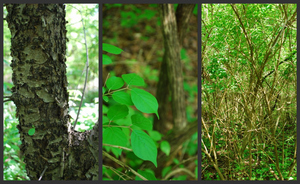
The nasty bark of Common Buckthorn (Rhamnus cathartica), the leaf and ropey bark of Honeysuckle (Lonicera spp.) and a characteristic honeysuckle tangle
Rick Meader | Contributor
4. Common buckthorn (Rhamnus cathartica): I’ve cut down a ton of this with glee in Nichols Arboretum. A nondescript, short tree with peeling bark, it’s neither beautiful in form, in bloom, or in fall. It leafs out earlier than native species and shades out the ground in oak forests so sedges, wildflowers and oak and hickory seedlings can’t get the sun they need to flourish and support the occasional wildfire or prescribed burn. It adds nitrogen to the soil through decomposition of its leaves, which gradually makes it more favorable to buckthorns and other species that need more nitrogen in soils and less favorable for species, which can’t compete with the nitrogen-loving species. On top of all this, it has annoying little spikes (thorns) that make walking through a buckthorn-infested area an exercise in face shielding and backing through to avoid getting spiked. There are many woods and thickets in this area where the woodsy understory is almost completely dominated by bucktorn.
5. Honeysuckle species (Lonicera spp.): Buckthorn and Honeysuckle are often found together, teaming up to choke a forest. I’ve noticed that honeysuckle seems to be more prevalent in sandier soils, while buckthorn seems to be more prevalent in richer soils. Of course, no rule is absolute, but that’s what I’ve noticed. Like buckthorn, honeysuckle is a relatively small shrub that leafs out earlier than native plants and holds onto its leaves longer than native plants. Unlike buckthorn, honeysuckle actually has a reason for being: Its flowers are quite pretty and smell good, and its red berries are very attractive in the winter whereas buckthorns fruits are just an ugly black. Still, this shrub has spread quickly across the land because of birds who eat the berries, fly away and poop out the seeds under a roost. Aside from those characteristics, the biggest positive in my mind is it’s very easy to cut down, and the wood is fairly light.
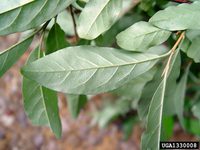
Shiny underside of the leaf of Autumn Olive (Elaeagnus umbellata)
Photo by Chris Evans, River to River CWMA, Bugwood.org
Of course, there are many, many more invasives that I detest, and if lived in the South I would probably have had kudzu at the top of my list, or mile-a-minute weed if I lived in the East. But, I don’t, so this is my list and I’m sticking to it. Still, I’d be remiss if I didn’t at least offer an honorable mention to these invasives that also plague our wild areas: Oriental bittersweet (Celastrus orbiculatus), Purple loosestrife (Lythrum salicaria), Bitter cress (Cardamine impatiens) - a real up-and-comer, Common privet (Ligustrum vulgare), Barberry (Berberis thunbergii), English Ivy (Hedera helix), Teasel (Dipsacus fullonum), Giant Reed (Phragmites australis), Reed canary grass (Phalaris arundinacea), Multiflora rose (Rosa multiflora) - a great clothes tearer, Bindweed (Convolvulus arvensis), Lily-of-the-valley (Convallaria majalis), Glossy buckthorn (Rhamnus frangula) and Canada Thistle (Cirsium arvense) are all trouble-makers and are worth avoiding in your garden or wild area. There are more, but I have temporarily put them out of my mind.
If you want to learn more about invasive species, I can recommend these websites:
http://www.nps.gov/plants/alien/, http://web4.msue.msu.edu/mnfi/education/invasives.cfm, http://www.invasivespeciesinfo.gov/plants/main.shtml, http://www.invasive.org/gist/
Now appearing in my yard: Wild geranium, Trillium, Hairy sweet cicely, Black raspberry, Golden Alexander, Alternate-leaf (Pagoda) dogwood, False Solomon’s Seal, Woodland phlox, Virginia waterleaf and Carrion flower.
Feel free to pull up an invasive for me as you wander around nature, and enjoy it!
Rick is a local landscape architect with a special interest in all things natural, including native plants and the critters that eat them. You can contact him at yourland1824@gmail.com.
Comments
81wolverine
Wed, Jun 2, 2010 : 7:42 p.m.
Rick, Yeah, those are some annoying plants. But, I'll take all the Vinca minor anyone will give me to replace the #$%&* bindweed in my yard. I call that stuff The Borg - resistance is futile! I don't know what planet it came from, but it spreads via an underground root system that is virtually impossible to dig out. I'm trying to avoid using powerful herbicides, but when I see it engulf some native perennials I'm tempted. Thanks for the informative article.
Rick Meader
Tue, May 25, 2010 : 10:26 p.m.
Thanks for your comments everyone. I did forget to mention Asiatic dayflower and Japanese knotweed (and probably many others). Regarding Lily-of-the-valley, I have seen it as a dominant groundcover in some sections of disturbed forests, and I can definitely attest to its persistence. I had a ton of it in my yard before I pulled it to put in natives, but it's still showing up 10 years later. I know Japanese knotweed is also tough to eradicate. I have some Asiatic dayflower in my yard too. It hasn't seemed to be a real dominating force, but it is persistent. As for the comment by Hemenway, he may be right, I don't know. It's tough to predict what can happen in that long a period of time, and I don't really want to chance losing a lot of native species as they're crowded out of their habitat by invasives possibly correcting a situation. It's a nice idea, and I hope it's true (especially that they will eventually subside), but in the meantime I'm going to keep fighting the fight for natives and pulling or killing off invasives where I can.
Peggy Lampman
Tue, May 25, 2010 : 1:22 p.m.
Thanks for the insightful article--esp. interesting about the vinca root system. Just transplanted some Lily of the Valley from a friend and myrtle was "involved"--better get it out while I can. Peggy
A2K
Tue, May 25, 2010 : 10:52 a.m.
Great article, thank you for the links as well. We've been (slowly) purging our backyard of invasive species...it certainly takes some doing, but well worth the effort.
Technojunkie
Tue, May 25, 2010 : 8:45 a.m.
In "Gaia's Garden, A Guide To Home Scale Permaculture", 2nd edition by Toby Hemenway, he argues that invasive species are taking advantage of and healing disruptions caused by man and will fall back after they've done their job. Nitrogen fixers will give way to nitrogen-loving plants, purple looseleaf will give way after it's cleaned the pollution it tolerates, etc, all of which may take decades without intervention. It's an interesting idea. This whole business of xenophobic botany seems a bit odd to me. His website is: http://patternliteracy.com/
Rork Kuick
Mon, May 24, 2010 : 10:22 a.m.
I've been looking forward to this article. Very nice and important. I am mortified to say I imported one or two of those into my yard many years ago, and still haven't extirpated some of the devils. If you grow lily-of-the-valley, put it somewhere where it's impossible for it to escape. At least try. One that I got accidentally, with a gift bush from a friend, is asiatic dayflower (Commelina communis), relative of spiderwort. Gosh it's hard to eradicate. Then there are some of the vigorous orange day lilies - just say no. They may not escape your yard (but they may) and you'll be sorry anyway. If you must have day lilies get ones that show some restraint. I don't have it but have helped deal death to friend's Japanese knot-weed. It was brutal.