

Garden Faerie: Perfect poinsettias in 5 easy steps
Monica Milla | Contributor
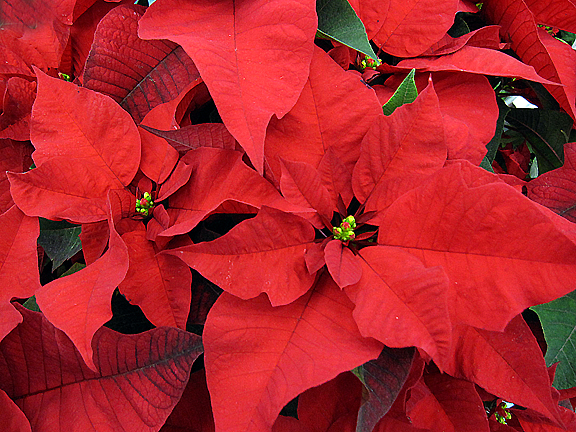
Poinsettias make any room look festive, and they are great gifts. You can keep them looking great by following five simple steps.
1. Cover your poinsettia when carrying it out of the store; its foliage is extremely sensitive to the cold. If any bracts wilt later, remove them.
2. Place your poinsettia in indirect light (not in sunny windows or under lights). Six hours of light each day is ideal.
3. Keep your poinsettia away from drafts, both warm and cold. (Do not set them near heating vents or registers, radiators, doors or windows.)
4. Keep your poinsettia cool. They prefer daytime temperatures between 60-70 degrees and nighttime temperatures around 55 degrees. High temperatures will shorten the plant's life. (No wonder they love my chilly 60-degree house!)
5. Let your poinsettia dry out between waterings. Check the soil daily, and only water when it feels dry. Poinsettias don't like to have "wet feet" (their roots like to dry out), so either remove the plant from the foil wrapping or poke drainage holes in the foil wrapping, and then place the pot in a saucer.
If you want to keep your the poinsettia after the holidays, start fertilizing it after the red bracts start to fade, and then follow these month-by-month poinsettia care tips and rebloom instructions from our friends at Michigan State University Extension.
Bracts and lips and flowers, oh my!
Monica Milla | Contributor
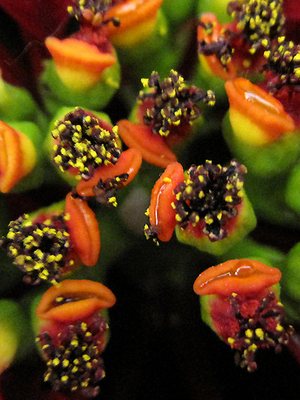
Poinsettias do have tiny flowers. Look really closely near the top of the red bracts and you'll see tiny red or yellow structures. The red parts are the flowers, and the yellow parts (as you can see in the photo to the left) are pollen. If the flowers are past bloom, you'll see either dried brown flowers or the green stems that once held the flowers before they dried and fell off.
The yellow/orange lip-shaped structures (in both photos) are nectar glands on the ovary that attract insects for pollination. The glands start off green and turn dark yellow as they develop. In the photo to the left, you can even see the nectar!
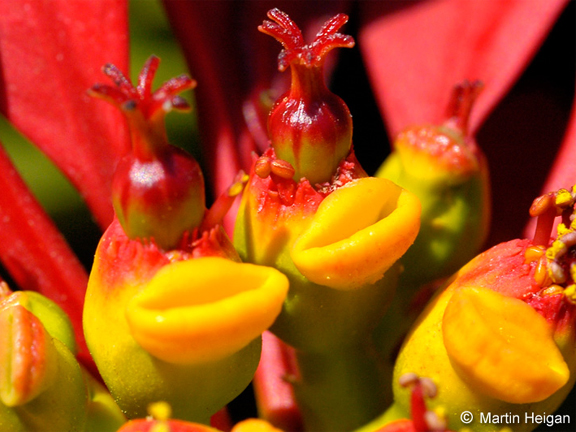
Photo by Martin Heigan
In the very magnified photo above (which looks like a scene with underwater aliens to me!), the red "tentacles" are the flowers coming up out of the bud.
Poinsettias are medium-sized shrubs native to western Mexico. There, they grow taller and less full than our greenhouse-grown plants. The naturally-growing ones also tend to flower without leaves.
Poinsettias are not poisonous!
Poinsettias are not poisonous. All parts of the plant have been studied extensively by Ohio State University, Children’s Hospital in Pittsburgh, Carnegie Mellon University, and other organizations. Even if swallowed in great amounts, the worst that will happen is stomach irritation and throwing up. The sap (which is exposed only if fresh leaves are broken off) may cause minor skin irritation for people with sensitive skin.
Monica Milla, the Garden Faerie, is a master gardener volunteer, garden speaker, garden coach and author of "Fun with Winter Seed Sowing."
Comments
ssgardengirl
Fri, Dec 17, 2010 : 9:14 a.m.
Very cool photos Monica! I think they're wonderful holiday decorations, and I really enjoy some of the more unusual bract colors and variegations. Don't buy one very many years, but love looking at them (except the strange dyed and glittery ones - definitely not my taste.)
Jim and Janice Leach
Fri, Dec 10, 2010 : 1:07 p.m.
Thanks for the tips, Monica! Poinsettias are festive and fun, even if they are only temporary. When I saw them growing outside in southern California, I realized they don't really stand much of chance for a long life in Michigan. My policy is to enjoy them while they look pretty-- then off the the compost!
Monica Milla
Thu, Dec 9, 2010 : 7:38 a.m.
DJC, I followed the directions one year and didn't get it to rebloom. If it did, I suspect it would have looked more scraggly like the ones that grow naturally. The reality is, poinsettias are more a decoration than a plant... Gonna do a follow=up post (as above) on this little rant.
djc
Thu, Dec 9, 2010 : 6:01 a.m.
Monica, Great article. However, folks should know that even if they follow the MSU instructions for care and rebloom, it will never look like the plant they bought. Poinsettias are grown in greenhouses with high intensity lights that the home grower can't duplicate. And when the directions say "complete darkness" daily for 15 hours they mean it. Street lights reaching an otherwise dark room, a brief flicker of light in the closet where you've stashed the plant, etc. will disrupt the flower making process. Best way to achieve the complete darkness is to move the plant to a room or closet you don't often use AND cover with a box. Most people lack the discipline to do that every day for the 2+ months required. All that said, it is fun to try.
Monica Milla
Wed, Dec 8, 2010 : 9:58 p.m.
Anne, if there were a secret way to keep pets away from plants, I'd be making a lot of money off it! I'm lucky that neither of my cats shows any interest in my plants. If yours likes to munch on greens, I recommend growing some cat grass for them. As a diversionary tactic.
Anne
Wed, Dec 8, 2010 : 7:05 p.m.
Beautiful photos! Just gorgeous. Question. How do you keep the Toomey-cat from playing with this gorgeous beauty? I would love to keep poinsettias (not to mention pothos, dumb cane etc. etc.) but I have a curious Toomey-cat who thinks everything green just needs to be batted about.
Ramon
Wed, Dec 8, 2010 : 12:43 p.m.
MM, ummm. Still do not want. I will totally love to read your rant against them. Saw an article about how their sales are increasing.
Monica Milla
Wed, Dec 8, 2010 : 12:37 p.m.
Pam, imagine what I could do with a *real* camera, lol. Thanks for the link to the story; I hadn't heard that before. MBT, I know you're a pointy hata, but did you see the nectar oozing? C'mon, that's classic! I'm thinking of doing a follow-up post wherein I rant against dyed and sparkly poinsettias.
Ramon
Wed, Dec 8, 2010 : 10:44 a.m.
Monica, When the revolution comes I'll remember how you were among those helping people keep these ugly things alive.