

Recycle Ann Arbor's Environmental House showcases how to live green


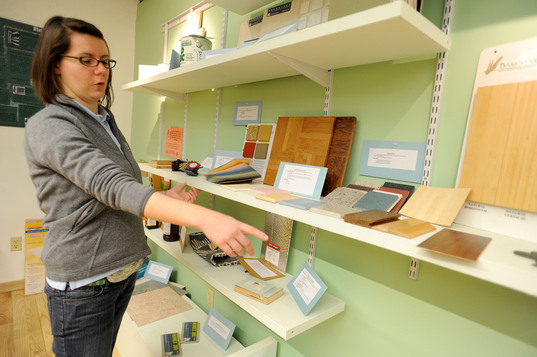
Jennifer Eschelbach, the Environmental House outreach associate at Recycle Ann Arbor, talks about different kinds of environmentally friendly flooring options at the Environmental House inside of the ReUse Center.
Angela J. Cesere | AnnArbor.com
But no one lives in this green house. Instead, it’s used as a model for energy efficiency and environmentally friendly living, from its metal roof to its natural linoleum floors. 

Housed within Recycle Ann Arbor’s warehouse, the Environmental House -- or En House -- is used as a community classroom, introducing homeowners to ways to save energy and improve indoor air quality. It can help do-it-yourselfers move toward green or save a little on energy costs or major remodelers looking for big ways to reduce energy costs or take a leap toward green living.


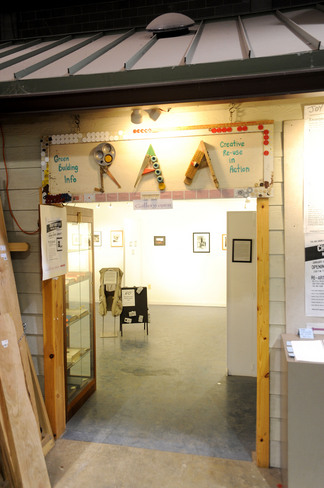
The outside of the Environmental House features a metal roof and a solar tube inside of the ReUse Center.
Angela J. Cesere | AnnArbor.com

On top of En House sits a dome-shaped Solatube that captures sunlight using a prism lens and brings it like Luke Skywalker’s lightsaber into the house, reducing the need for electric lights.
“They can be installed between existing rafters for easy installation,” Eschelbach said.

Inside, the natural linoleum flooring, made from pressed flax seed has no off gassing, the evaporation of harmful chemicals into the air. The linoleum comes in a variety of colors.

Other flooring options include bamboo and cork, both made from rapidly renewing resources, usually seven to 10 years rather than the 50 or more years it takes an oak or other tree to grow. While much bamboo is grown overseas, some is grown in the United States, which makes it a better option because fewer resources are used in transportation, Eschelbach said.
“And cork floors have a bit of give. We had one homeowner in here raving about it because she has never broken another dish when she drops it on the floor.”
Both can be sealed with water-based sealants, eliminating harmful VOCs (volatile organic compounds) of traditional sealants that leach into the air. 
While carpet can be a dust collector, EN House displays some environmentally friendly carpeting made from recycled plastic bottles.

The house also uses urban wood - city trees, many felled by the emerald ash borer - in its flooring. The ash floors even show the tracks of the invasive beetle, adding decoration to the wood in spots.
“This is wood that would have ended up in the chipper or the landfill,” Eschelbach said. 

The green overhead lighting system uses T-8 florescent lights that burn 35,000 hours and use far less electricity than typical incandescent bulbs. “They use less energy that comes from coal burning plants,” she said. 

The walls of En House are painted in a low-VOC paint, now offered by most large paint companies such as Benjamin Moore along with AFM Safecoat, a company that specializes in environmentally friendly paint and building products.
En House, even though it exists within another structure, also uses environmentally sound insulation with its structural insulation panels. The panels, with either Styrofoam or spray foam tucked inside, have no seams, making them energy-smart by eliminating drafts that make their way inside typically insulated houses through the seams.
These insulation panels are used for new construction and not generally for existing houses, Eschelbach said.
For retrofitting existing houses, there are a few insulation choices, she said.
Cellulose made from recycled newspaper that can be blown into walls or Icynene, a name brand of spray foam that has a high R-value, the measure of an insulation’s effectiveness. They also have recycled cotton insulation and mineral wood insulation on display at En House.

It doesn’t take much effort to improve a house’s energy efficiency, said Eric Bruski, residential energy services coordinator. Caulking around windows and weather striping doors can save energy and money, he said.
So does installing a programmable thermostat and dialing down three or four degrees when the house is empty or at night.
In addition to showcasing ways to live green, EnHouse and Recycle Ann Arbor offer home energy audits. While they cost $400, much of the cost can be offset by rebates from DTE along with the federal government, Eschelbach said.
Comments
pvitaly
Thu, Jan 28, 2010 : 8:48 a.m.
I'm really glad to see annarbor.com do a piece on this. It's an extremely informative organization and Jen does a great job of educating people on how to make homes more sustainable.