

Reuse and recycle - do-it-yourself style
So we all know the mantra of the green movement: Reduce, reuse and recycle.
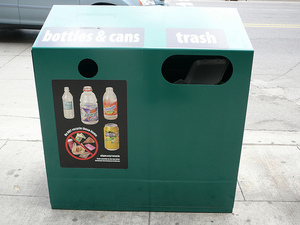
A recycling container downtown Ann Arbor.
But what if ‘reusing’ and ‘recycling’ meant something different that allowed you to save money (instead of costing more, which is a known side effect of recycling) and gave you a new product at the same time?
We purchased a fireplace blower a few years ago to make good use of the large, brick fireplace our home has. Knowing that our fireplace had gas and we wanted to burn wood in it to save on the gas bill, we took out the gas plumbing (a feat in and of itself) and installed a cast-iron unit that takes in room air, circulates it around the burning wood in the fireplace and shoots warmed air back to the room. As efficiency goes, it’s not nearly as good as a wood-burning stove or insert, but it also ran us about $500, not $2500. So we make it work.
But in our quest to make starting fires that much easier, we bought fire-starters in a box from Lowe’s.
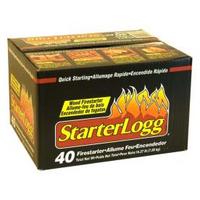
Commonly available fire-starter product
I have a friend who moonlights as a wood-worker, and I thought about collecting sawdust from his workshop - but what to bind it with? I discarded that idea just from a mess-containment perspective, although it would be interesting to attempt. One day, as I was cleaning out the lint from the dryer-screen, it hit me: Dryer lint is famously flammable, evidenced by the fires that can occur from not cleaning out one’s ducts and hoses on the dryer.
I was still left with the question of a binding-agent that was flammable and wouldn’t mar the inside of the fireplace badly, smell awful or put nasty things in the air as it was burning. Paraffin was okay, but I’d prefer something that I had already used and didn’t have to buy specifically for this purpose. I’m big on getting more than one use out of a product - our milk becomes kefir or yogurt, and we skim the cream off of it for our coffee, etc. This is just the way I roll.
And so when I used coconut oil for a Japanese meal and had it left over, I figured it couldn’t hurt to try burning it. Coconut oil is a naturally saturated fat that we love here; its health benefits are incomparable, and because it hardens naturally at temperatures below 76 degrees Fahrenheit, disposing of leftover (used) oil means we need to throw it away. When I tried burning it in the fireplace, it was perfect. And here’s the beauty of it: It burns cleanly, evenly, without smoking and leaves no residue that I have to contend with or clean up.
So I had two components: something to burn (lint) and something to allow it to burn longer and catch more quickly (used coconut oil). I chose to try toilet paper rolls as the object to hold the oiled-lint and found that it worked well.
Now when we need fire-starters, I have a store of dryer-lint and I put aside coconut oil after it’s been used. I don't fry food often, and when we don’t generate enough used coconut oil, I’ve found that saved bacon grease also works, except that it makes us crave bacon as the fire gets going.
The technique I use is to soak the lint in slightly warmed oil (to liquefy the saturated fat), stuff the lint in a toilet paper roll (somewhat tightly), and then chill the final product. Once the oil has re-solidified, we cut the rolls in thirds and bag them up for use in the fireplace. One fire-starter per fire is about all we need. And if I ever run out of toilet paper rolls (unlikely, but still…), cardboard egg cartons can be used in the same method; the final product is one egg-holder-space per fire.
A friend of mine teases me a little about always finding more than one use for stuff in my world. I’m okay with the teasing - because it means that the stuff in my world serves me & my family and not vice-versa. It’s the ultimate in recycling for us - and then it’s all reduced to ash in our fireplace, the ashes go out to nourish the garden soil and make better vegetables for us to eat. It’s all good.
Sue is a photographer and free-lance writer/editor. She is known for being a DIY-nut and looks for ways to care for her family while spending less to do it. You can reach her via e-mail and read her regular ramblings at A Mother's Heart.
Photo credit: JPWBees
Comments
Adam Jaskiewicz
Thu, Feb 11, 2010 : 12:37 p.m.
HappySenior, newer stoves are pretty light on the particulates. Modern catalysts and baffle designs that pre-heat incoming air are used, and you typically only see heat distortion coming from the stack, at least once the fire is going well. I think the EPA mandates something like 7 or 8 g/h of particulates and many higher-end stoves emit much less. In many areas there isn't much choice. It's either heat with wood, or haul in LPG or heating oil.
Sue Talbert
Thu, Feb 11, 2010 : 7:48 a.m.
I appreciate the time you took to write, but I think you missed the point. I never claimed that burning wood to heat a home is 'green'. Instead, I'm using materials that would otherwise be thrown away to help start a fire to warm my home. I'm not going to debate whether or not heating my home with wood is "ecologically responsible," because until there's an economically feasible (i.e., inexpensive) way to warm my home that satisfies the 'green concern,' it is what it is. We live in Michigan - and we are known for cold winters here. I don't ask for hand-outs, but until someone else foots the bill for my home's warmth, I'll continue burning wood and keeping my family warm & healthy.
HappySenior
Thu, Feb 11, 2010 : 7:15 a.m.
A wood fire is not green. From a 11/14/05 article in USA Today: Scientists have long known that wood smoke contains carbon monoxide and cancer-causing chemicals. But research shows that wood smoke's major ingredient tiny particles of soot and liquid pollution worsens heart disease and triggers asthma attacks. This "particle pollution," also emitted by diesel engines, kills thousands of Americans a year. Alarmed by such findings, and required by federal law to cut particle pollution, officials across the USA are trying to reduce the smoke from the nation's 37 million home chimneys and 10 million wood stoves. The broader wood smoke pollution problem becomes acute in winter. In some communities, mostly in the West, 30% to 80% of the wintertime particle pollution is attributed to wood burning in the home, regional and federal agencies say. From burningissues.org/car-www/index.html: Burning solid fuel yields particulate pollution - solid particles smaller than a red blood cell which have been implicated in 30,000 deaths in the US and 2.1 million deaths world wide per year.. "Particulate pollution is the most important contaminant in our air....we know that when particle levels go up, people die1. " Indeed, wood smoke is chemically active in the body 40 times longer than tobacco2. 1. Joel Schwartz, Ph.D., Harvard School of Public Health, E Magazine, Sept./Oct. 2002 2. Wm. A Pryor, Persistent Free Radicals in Woodsmoke: An ESR Spin Trapping Study, Free Radical Biology and Medicine 1989, 7(1): 17-21
Sue Talbert
Wed, Feb 10, 2010 : 8:12 p.m.
I love the ideas of foraging for wood - and if you ever decide to 'try honeysuckle,' contact me. We've got a mass of overgrown honeysuckle bramble out back that is the bane of our backyard - most of it is dead, but we're unsure what to do with it or how to rid ourselves of it. Thanks for the ideas! :)
KJMClark
Wed, Feb 10, 2010 : 7:16 p.m.
We're too lazy for that! We buy the Meeco's SureStart cubes (used to be from Rutland), which are 11c each in boxes of 144, from Carpenter Bros. For kindling, we buy big bags of oak trim from Fingerle Lumber. Two of those bags last us all winter when we cut the pieces in half and split them. We mostly heat with wood, so we only have to start once or twice a day. Often we can start the afternoon/evening fire with coals left from the morning fire. So a box of the starter cubes usually lasts all winter too. We thought of using sawdust and beeswax from our bees to make firestarter, but haven't taken the time to figure that out. We tried the pictured firestarters, but even when I cut them in quarters, it wasn't worth it. The SureStart cubes work much better. But the really fun part is going to a semi-park near our house and cutting some of our own firewood. Buckthorn is a pestilence on the world, but it's actually decent firewood. Siberian elm is also burnable, but not splittable. You have to cut that at a good log size and season for two years. One of these days we'll have to try honeysuckle.
Sue Talbert
Wed, Feb 10, 2010 : 6:38 p.m.
Thanks, Adam! I've never had very good luck with sharp things like knives or hatchets (my hands bear the scars from my attempts - LOL), but I love the idea! :) Makes me wonder if we (and by "we," I mean "my husband") can manage whittling some sticks for me. :) If it works, I'll need to find a new use for used coconut oil, but hey! I'm pretty sure I can manage that.;) Thanks for taking the time to post. :)
Adam Jaskiewicz
Wed, Feb 10, 2010 : 6:16 p.m.
I've always just used a sheet or two of newspaper and some thin sticks. Build up from the smaller twigs to bigger sticks and finally your logs as things catch. If you don't have thin twigs use a sharp knife or hatchet to shave thin strips off a larger piece of wood. You can also make "feather sticks" by shaving curls of wood off a stick but leaving them attached at one end. A couple feather sticks or a pile of small twigs and a wad of lint or newspaper ought to do fine, no coconut oil, paraffin, or expensive fire starters required.