

The greener home: What to consider before going solar
Since 1996, the use of solar power has steadily grown in Michigan. Businesses and universities have put in large installations in the effort to go green.
But is it worth it for the average homeowner? Here are a few things to consider before you decide to go solar.
Solar systems
When going solar, the homeowner will generally choose between two different systems.
The first — and most expensive — is probably what most people think of when talking about solar. Photovoltaics (PV) can be used in conjunction with the usual power system to provide electricity to the home.
On a smaller scale, solar can also be used to provide your home with hot water.
When choosing between the two, the homeowner needs to look at their utility bills and see where they are spending the most money.
Solar hot water may be a good choice for the homeowner who is not ready to invest in the larger, more expensive PV system, some experts say. With solar hot water systems running at an average of $7,000, it is easier to cover the cost. But in the long run, by storing electricity the PV system can have the biggest payoff.
“For most people, their return is better with solar electric,” said John Wakeman, owner of SUR Energy LLC. Wakeman installs residential and commercial solar and wind systems.
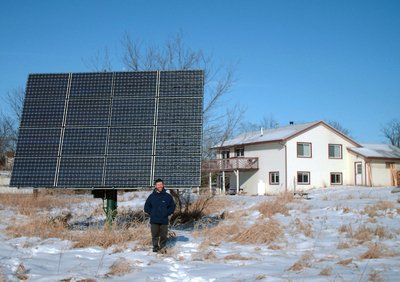
Joshua Barclay outside of his Dream Farm house in Whitmore Lake. His solar PV array is 18 feet wide and 12 feet in height, mounted on a 9-foot tall pole. The array consists of 16 Sanyo HIT-200 panels, each producing 200 watts, generating a total of 3,200 watts. The array is on a Wattsun AZ-225 dual-axis tracker so it follows the sun.
Photo courtesy of Joshua Barclay
Reduce energy loss/waste
Because PV systems are sold per kilowatt (kW), you will want to tailor your system to best fit your home’s needs.
To spend less and get the most out of your PV system, everyday actions, such as blocking air leaks and using compact fluorescent lights, should be practiced to ensure that energy use is lowered and not wasted.
“For the average homeowner, efficiency measures are key,” said Joshua Barclay. Barclay owns the Dream Farm house in Whitmore Lake, which he has worked to make completely carbon neutral.
Looking back, Barclay wishes that efficiency measures had been his very first step in the process.
According to Barclay’s Dream Farm website (dreamfarm.org), his home only uses 12 kWh per day. In 2005, the U.S. Department of Energy found that the average American used 29 kWh per day.
“Spending a couple hundred bucks can save you as much as one of these [solar] systems,” Barclay said.
DTE offers incentives and ways to test your home for potential energy losses at www.dteenergy.com/residentialCustomers/saveEnergy/.
Cost
For most people, the only thing standing between them and solar is the cost. While a $35,000 price tag may make many homeowners look the other way, there are government and energy company incentives that can bring that cost down significantly.
Systems range in price depending how many kWs purchased. The average cost per watt averages between $7 and $8.
The Michigan.gov “Homebuilder’s Guide to Going Solar” suggests using this formula to get an idea of the cost of a PV system for your home: number of homes (this number will most often be 1 in the case of individual homeowers) × south-facing roof area in square feet per home × 10 W/ft squared × $8/W = estimated total retail installed cost.
Keep in mind that the equation estimates are for covering the whole south-facing roof. This is not necessary for installing a system. A trusted installer can help you decide what is right for you and your home.
Currently, homeowners can receive a 30 percent federal tax credit “for the purchase and installation of solar photovoltaic, solar water heater, geothermal heat pumps and residential small wind systems,” according to the Michigan.gov website.
Additionally, homeowners can take advantage of DTE’s Solar Currents program. After purchasing a PV system, DTE “will help offset your installation cost by an average of $22,000 (based on an average system size of 4.5 kW, over 20 years),” according to the utility company’s website.
“For us in DTE territory, it’s a good time [to go solar],” Wakeman said.
You can also check for local incentives at the Database of State Incentives for Renewables and Efficiencies (DSIRE) at www.dsireusa.org.
Along with these incentives, those who choose to go solar can make their money back by letting the solar cells do what they were meant to do — power the house.
Many Michigan homeowners may not realize that even with the lack of sun in the winter, their solar system is still working for them.
“Net metering” allows the homeowner to "store" unused solar power with the power company that they can then use as a credit in the winter or whenever the system is not receiving much sunlight.
This is why efficiency measures are so important. The faster you can get your electric meter to spin backwards and start storing power, the more free electricity you can expect in the winter when you’ll need to run the furnace and keep the lights on longer.
There are other cost advantages to going solar that people don’t often think of.
Bob Goodsell of Ann Arbor said that while away on vacation, his neighborhood lost power for four days. Because his solar system continued to provide electricity, his home stayed heated.
He believes that the system paid for itself by preventing his water pipes from freezing and bursting.
Is it for you?
Even with the incentives, there are other issues to consider before going solar.
How long are you planning on staying in your home? Installers say it can take anywhere between 10-15 years before homeowners can break even. However, solar systems can increase a home’s value when it’s time to sell.
But, many who install solar systems say that while money savings are nice, their biggest concern is reducing their carbon imprint.
“The biggest benefit is helping society to change and to cut down on carbon emissions,” said Wakeman.
Comments
shepard145
Sat, Feb 5, 2011 : 3:18 p.m.
I love the idea of solar. Durable, dependable line power at the price of coal that also makes the earth colder. NOT! Solar cowboys in Michigan are like the Prius driver – a poor victim of eco hype and an amusement to those who know the difference. "The biggest benefit is helping society to change and to cut down on carbon emissions," said Wakeman." Where he picked up this gem is anybody's guess but it's never been true and sad to say, solar panels will not make the planet colder. Solar panels are not dependable so he needs ye old nuclear or coal power when the weather fails to cooperate. Current PV cells last about 20-25 years before they drop off and need to be replaced – figure that into your 20 year payback! LOL Michigan gets about 100 days of sun a year, the rest of the time the panels will function fractionally. Nobody wants to drive a forklift with a pallet of lead batteries into their basement so typically these systems feed a panel that supplements the house or goes back into line when the meter is running backwards. A line shut-off is required so that during a power failure on a sunny day, the panels do not energize dead lines and taze line workers. The farm house is a cobbled together aesthetic nightmare few Americans would home at any price so I would avoid bragging about the next standard for housing. The tax incentives are an embarrassing waste of our grand children's money and need to be stopped.....see the E85 disaster for politics meeting obvious engineering failure.
EBL
Fri, Feb 4, 2011 : 11:16 p.m.
Interesting article. But the gentleman with the 3.2 KW solar panels at the Dream Farm is Josh Barclay, not John.