

Rooms with a view: Historic Manchester farmhouse keeps the old charm but adds modern conveniences
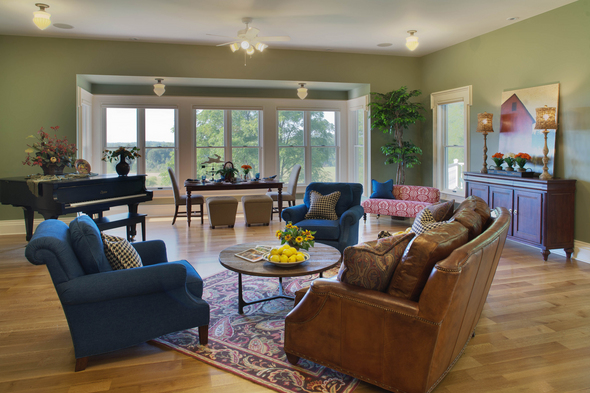
The great room in Hal and Katherine Walter's farmhouse near Manchester.
Photo courtesy of Fred Golden Photography
While Hal and Katherine Walters wanted to add a master suite, library, great room, closet space and garage to their 1850s Italianate Victorian farmhouse west of Manchester, they wanted to keep their eye on the view. Literally.
The rear of the house opens onto a scene ripped from the pages of an Irish travel magazine: Rolling hills of green dotted with ponds with a dark line of trees in the distance.
“The most important message we heard throughout the project was that it was always about the view,” said project architect Keith Fineberg, principal with KSF Architects. “They wanted to make the view accessible as much as possible.”
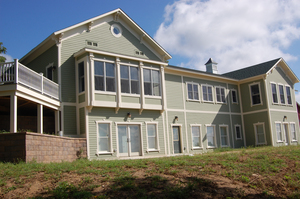
The rear view of Hal and Katherine Walter's farmhouse near Manchester.
Janet Miller | For AnnArbor.com
The addition more than doubled the size of the 1,800-square-foot farmhouse built by the English family and includes 21st century touches such as whole-house sound system that interfaces with i-pods, radios and CD players; an induction cooktop that uses magnetism and doesn’t get hot and a built-in vacuum system.
And then there’s the view. Each room of the addition has a front row seat to the hills and water and open rolling spaces. With no walls to separate them, the kitchen leads into the great room, with bay windows that open outside.
The library, with natural cherry trim, includes a built-in stone-topped counter that runs the width of the room and is used for desk space. It also looks over the view. And the master suite, which includes one of the two decks, also looks out over the rolling hills.
The couple also wanted the house to be environmentally green. With energy efficient building techniques such as geothermal heating and cooling and the installation of a large array of solar panels on the house and an adjacent barn, the house will be close to zero-net energy use, even with the substantial energy use from being a working farm, said Doug Selby, president of Meadowlark Builders. It should come close to producing as much energy as it uses. The system offers 20 kilowatts total.
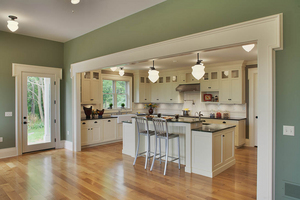
The kitchen in Hal and Katherine Walter's farmhouse has an induction cooktop that uses magnetism and doesn’t get hot.
Photo courtesy of Fred Golden Photography
The house, built into the side of a hill, even has a dark basement floor that acts as a solar battery and captures the sun’s energy in winter to help warm the house.
Before the renovation and addition, annual heating costs for the propane reached $18,000, Selby said. The annual propane costs are expected to drop to $1,800, he said. The cost of the green features should pay off in seven years, Selby said.
The 14-month project that is just wrapping up offers a 3,000-foot addition that uses interior and exterior trim to help tie the new to the old. The existing 2 ½ baths were each given a facelift, with new floors and fixtures, the fir and oak floors of the original house were refinished and the single light bulb that hung above the dining room table was replaced with a period-appropriate chandelier.
It was important that the addition keep with the 19th century period, Katherine said, such as the Victorian style tile and wallpaper in the new front foyer. “Our goal was to open the door, walk in and get the feeling you were in an old house,” she said.
But there were elements of old house that needed to be changed.
The original house had only two closets, and armoires were needed for storage. Closets were added to the original house and the addition is bursting with closet space.
And a mudroom, a modern-day amenity, was added. The large mudroom has storage, a slate floor for easy clean-up and a shower, used for the family dog and for the sheep when they need some TLC.
Comments
Gyll Stanford
Thu, Oct 14, 2010 : 8:03 p.m.
Dear Keith and the Walters, I saw your project during the tour and wanted to congratulate you on such a successful project outcome. As a Design-Build contractor myself I know how many client meetings it takes to achieve these spectacular results. I was impressed with the design details copied into the addition, truly a seamless transitions between the old and new. The interior design details are so appropriate for this "Period" home. Way to go!!! Gyll Stanford Stanford Enterprises
Keith Fineberg
Fri, Sep 3, 2010 : 9:09 a.m.
Actually, there often is a "boot jack caked with manure" at the back door and Mudroom. It truly is a working farm. I often made site visits during the course of this project where the owner greeted me from atop the tractor. This is the first client I ever had that warned me at the outset that sheep would be brought inside from time to time to be cared for and interior finishes needed to be selected to withstand this use. There are numerous unique utilitarian features. For example, the owner requested a special door and pathway for those working on the farm to have direct access to the shower located in the Mudroom. It is a generous accommodation but a farm house nonetheless. I hope you'll come see it at the Home Tour. Keith Fineberg KSF Architects
kmgeb2000
Thu, Sep 2, 2010 : 8:57 a.m.
I find the term "farm house" rather quaint, especially with a 3,000 sq ft addition. Granted its most definitely a beautiful home but farm house - no, not any more. Is there a bag of feed in the mud room and a boot jack caked with manure at the rear entrance?