

Tips for a mixed flower border
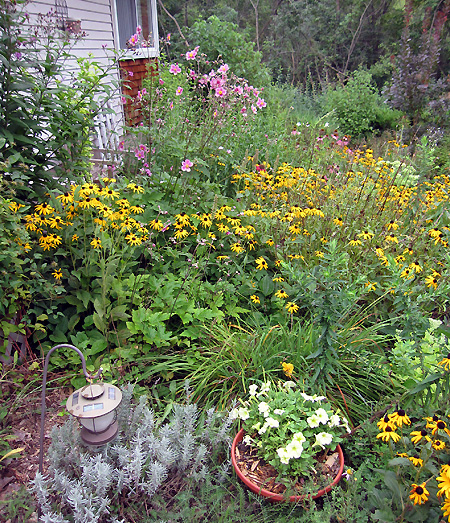
This mixed border combines annuals, perennials, shrubs, and vines of different shapes, sizes, colors, and textures.
Monica Milla | Contributor
A mixed border is a flower bed that combines multiple types of plants (such as annuals, perennials, shrubs, trees, and groundcovers) and multiple colors, shapes and textures. It is planted so that there is something of interest every month during the growing season, including winter.
Different kinds of plants are treated as equals, so a dwarf tree, for example, may be balanced by a large grouping of perennials. A larger tree may be balanced by a birdfeeder on a tall stake.
Janet stressed thinking about plants not only in terms of their flowers, but also in terms of their shape or form and the size, color and texture of their leaves. Plants with short-lived flowers may still provide plenty of visual interest with their foliage.
For example, most people don't even notice hosta flowers and grow the plants for their leaves. Zebra irises (the kinds with variegated leaves) also provide all-season interest well after the flowers have died back.
Janet also shared lists of her favorite plant combinations for mixed borders (the first two pages of this link are a talk outline; the plant combinations start on page 3). They maximize color throughout the seasons and are specific for all kinds of conditions (full sun, part shade, moist soil, dry soil, etc.).
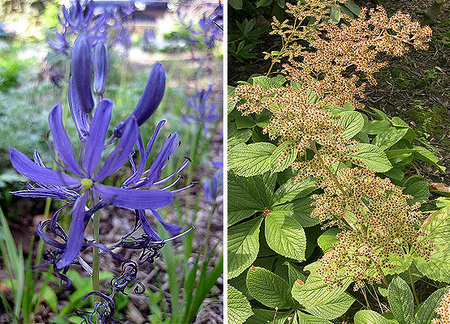
Camas bulbs (left) add some blue to the spring garden. Rodger's flower has large textural leaves and blooms in late June.
Photos by Anne Heidemann (left) and Washington Sate University
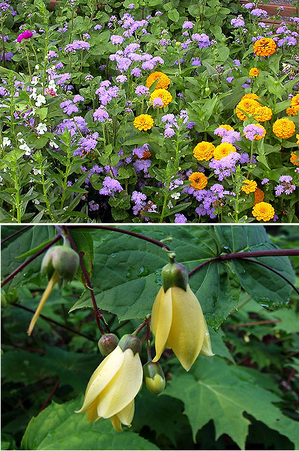
Flossflower (top) complement marigolds. Japanese wax bells brighten a shady area.
Photos by Missouri Botanical Garden (top) and Lotus Johnson
Camas (Camassia quamash, see photo above): This spring-blooming bulb produces stalks of star-shaped blue flowers up to two feet tall. It is native to the western U.S., but is hardy here in Michigan. It prefers moist soils and sun to part shade. The bulb is planted in fall, so it's too late to add it for this spring, but keep it in mind for October!
Rodger's flower (Rodgersia spp., see photo above): This perennial has large, nicely-textured leaves and tall stalks (up to six feet) of flowers in white or shades of pink, depending on the cultivar. In fall, the leaves turn yellow or orange. It prefers moist to wet soils and shade to part shade. It blooms in late June/early July.
Flossflower or tall ageratum (Ageratum houstonianum): I tend to think of ageratums as those low-growing varieties sold everywhere in flats in spring. But there's also a taller version (18 to 24 inches) of these annual flowers. It needs full sun, has a nice scent and attracts butterflies.
Japanese or yellow wax bells (Kirengeshoma palmata): Gardeners with a lot of shade are always looking for brightly-colored flowers that thrive in dark conditions. Yellow wax bells do just that! The foliage is mounding and can get three to four feet tall and two to three feet wide. In June and July, the bright yellow, bell-shaped flowers emerge.
My favorite tip of the evening was an alternative way to overwinter tender bulbs such as cannas, dahlias and gladiolas. Instead of digging them up and storing them inside, you can bury them in the garden instead! Wait at least until the first frost to kill the foliage and dig up the bulbs. Then remove the dead foliage and replant the bulbs in a deeper hole, at least 18 inches deep. (For Janet's instructions, go to page 16 of this newsletter.)
Janet says it's not too late to do this even now, since we've had a mild winter. I'm personally going to go out and move my glads, which I had left to die!
If you have a veggie bed, this would be the perfect relocation spot. The soil is usually easy to work and nothing else is growing there over winter anyway!
Be sure to mark where you buried the bulbs because in spring, you will want to dig them up from their deep storage location and move them to your preferred location, at their preferred growing depth.
(Note: This does not work for elephant ears, which are less cold tolerant. You would have to dig at least two feet down to store them safely outdoors.)
For more gardening tips, stop by Janet's newly-launched website. It offers a ton of gardening information with over 800 articles and 1,000 photos; plus, you can connect with other Michigan gardeners in discussion forums.
Monica Milla, the Garden Faerie, is a master gardener volunteer, instructor, speaker, garden coach and author of "Fun with Winter Seed Sowing."
Comments
Monica Milla
Mon, Jan 16, 2012 : 2:35 p.m.
ArgoC, Good question! :) I'm a cheap gardener and don't have any of these four plants in my garden--that's why they stood out for me in the talk. I usually start most of my plants from seeds or get them as divisions, so I'm not a huge nursery shopper. I also don't like to list pant sources in articles in case people view that as an endorsement or recommendation of one store over another. But since you asked... Old House Gardens has the camas bulbs, but that's mail order even though it's in Ann Arbor. Downtown Home and Garden may have them in fall; they're the only place I know of that has good variety in bulbs. As of last year (dunno what they'll carry this season), Bordine's (Brighton) has a Rodgersia aesculifolia and Plymouth Nursery has two kinds of Rodgersia. PLymouth Nursery also has the yellow wax bells. The tall ageratum is in the heirloom flowers section at Nichols ARb in the Peony Garden, and as such, it may be available at their annual plant sales in May. In general, Telly's has really good selection overall, and will order stuff for you sometimes, but they are in Troy and Shelby Township. I like Coleman's Farm Market (2 locations in Ypsi) for annuals, veggies, and perennials--good selection and reasonable prices. There's also a seasonal "stand" in Whitmore Lake off US-23 Territorial Rd. exit (head west) but I forget the name--ooh, Alexander's maybe? I know Project Grow/Ann Arbor 350 is hosting a seed swap in a month or two, which I will write about. There are also plant swaps and plant sales by various local garden clubs. I will cover all of those later in spring.
ArgoC
Mon, Jan 16, 2012 : 2:07 p.m.
Where would someone new to this area go to buy these (not mail order)? What nurseries or plant stores carry real variety? All this is tempting, but seems out of reach.