

Why do I like native plants? Part deux
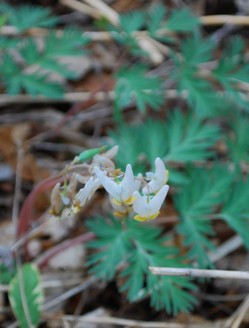
Dutchman's breeches (Dicentra cucullaria) in my front yard
Rick Meader|Contributor
Along the way, I’ve made friends with folks who are surprisingly friendly in their low-key way, and always glad to pass along information about plants I don’t know. Rescues and nature walks give new opportunities to learn more and continue my “native” friendships. It’s always a kick to discover plants in the wild that are growing in my yard, especially since none of them, except the Dutchman’s breeches, were there before.
But what do I really like about the native plants, and especially the ones in my yard? I like the fact that I’m helping out an underdog.
Despite the fact that they’ve had thousands of years to adapt to the Great Lakes environment, they’re often crowded out or shaded out by invasive marauders like garlic mustard. Their homes are being decimated or forced into decline by development, either of the land on which they reside themselves or of nearby properties, which are more often landscaped with non-native lawn, shrubs, trees and flowers.
They are being pressured for survival, and by creating an island of oak barrens, I hope that the seeds from my plants will spread around the neighborhood, populating idle spots with asters and goldenrods, instead of dandelions and lamb’s ear. I’ve already seen a new patch of wild ginger across the street, in a shady area that was previously bare dirt. Thank you, squirrels (or maybe ants)!
I also like the feeling of being in nature my little yard gives me. My little “barrens” are the most diverse, native area within a quarter mile of my house. I go out there on a fall day and see a constant buzz of activity provided by at least six different types of bees, some small enough that it’s hard to tell that they’re actually bees. Lightning bugs emerge from the “forest floor” to find each other on a romantic summer evening. Butterflies find my milkweeds and blazing star, although they haven’t decided to lay down eggs yet, much to my consternation.
I don’t get out in nature as much as I used to, but a step outside my door into my “garden” gives me at least a hint of a walk in the woods, without using any oil to get there.
And, I love the diversity that diversity brings. There is rarely a time when there is nothing blooming, although early summer is pretty well limited to woodland tick trefoil. My yard has “color seasons.” Spring is mostly white - bloodroots, rue anemones, trillium, spring beauties and, of course, Dutchman’s breeches, dominate the scene on the barrens floor.
Later, in the later summer, yellows dominate, with the brown-eyed Susan, woodland sunflower and woodland tick trefoil spreading their color around. And, finally, fall abounds with yellow, white and purple as the bluestem goldenrod and asters finally explode into color after building up their strength all year. Bumblebees, honeybees and little moths all add to the color as well.
My nephew once asked my brother “How come Rick doesn’t mow his lawn?”
Well, to tell the truth, I do have some lawn, and I do mow it because I still like the look of a well-kept lawn, and my daughters like to play on it. That said, I’m much more excited about the diversity and lack of unwanted weeds that the “wilder” lawn borders bring to the table.
The lawn is a small part of my yard now, and is actually more a mix of tiny broadleaf plants and grass than a truly monoculture lawn would be. (Many of the tiny lawn weeds are actually offspring of my native plantings.) The neighbors like my yard, too, although none have joined in with the look yet. My native plantings make me feel part of nature and help me “walk the talk” every day.
Finally, native plants are a gauge of the seasons. Within a couple of weeks, you can set a calendar by them. And, things get taller as the year moves on. First the bloodroots, spring beauties and trout lily creep out of the ground, later the trillium, early meadow rue, jack-in-the-pulpits and columbine add some height to the forest floor.
Later, the jewelweed, goldenrods, Rudbeckia and bottlebrush grass overshadow them. Finally the asters and goldenrods throw their blooming heads above them all, bringing the final fireworks to the growing season. The decline of the sunny days and the weight of the snow brings most of them slowly back to earth again, with the annual climb to the sun competition getting underway the following April.
Native plants give me a sense of place, a feeling of accomplishment that I’ve “done good”, and a calming influence at the end of the day. Not a bad return from some persistent little buggers who like it where they are.
Rick is a local landscape architect with a special interest in all things natural, including native plants and the critters that eat them. You can contact him at yourland1824@gmail.com.
Comments
amsims
Wed, Feb 10, 2010 : 10:06 p.m.
Can we see some pictures of your landscape? Looking for ideas for my own subdivision yard here....
Your Neighbor
Wed, Feb 10, 2010 : 1:50 p.m.
Nice story, nice description of the seasonal changes in plant life to watch for.