

Social safety net: Do whites and blacks agree?
Editor's note: This post is part of a series by Dr. Baker on Our Values about core American values. This week Dr. Baker is discussing the social safety net.
A major theme of OurValues.org is unity: In many ways, we have shown that Americans agree on many core values, despite all the rhetoric about polarization. Yet, research also shows that Americans are divided on some issues.
The social safety net divides us. Yesterday, I discussed the vast differences between Republicans and Democrats when it comes to views about the government’s role in providing for those who can’t take care of themselves. Today, we look at another divide: How African Americans and white Americans view the social safety net.
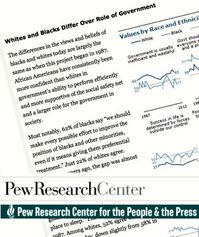
Black and white Americans have held consistent views on the role of the government over the last 25 years, according to the Pew Research Center’s continuing American Values survey. This means that they have consistently disagreed with one another about the efficiency of government, the government’s role in providing a social safety net and the government’s role in helping to improve the position of minorities.
Overall, African Americans are less likely than white Americans to say that the government is usually inefficient and wasteful. In 1987, eight of 10 African Americans said the government should guarantee everyone enough to eat and a place to sleep; the figure is about the same today. Just a little more than half of white Americans agree.
Black Americans are more likely to say that “success in life is determined by forces outside our control.” About 50 percent feel this way, and the figure has been pretty constant over the last quarter century. Less than one-third of white Americans feel the same way.
One of the largest gaps occurs in beliefs about the government’s role in helping minorities get ahead. Two-thirds of African Americans say that the government “should make every possible effort to improve the position of blacks and other minorities, even if it means giving them preferential treatment.” Only 16 percent of white Americans say the same today.
Perhaps the most striking pattern in the Pew data is consistency: There has been little change over the last 25 years in how blacks and whites view these matters. Their differences in 1987 were the same as they are now.
Do you find these differences surprising or unsurprising?
Why have these differences been so consistent over the years?
Wayne Baker is a sociologist on the faculty of the University of Michigan Ross School of Business. Baker blogs daily at Our Values and can be reached at ourvaluesproject@gmail.com or on Facebook.
Comments
Hmm
Wed, Sep 5, 2012 : 4:07 p.m.
When you say "Black Americans are more likely to say that "success in life is determined by forces outside our control." About 50% feel this way, and the figure has been pretty constant over the last quarter century. Less than one-third of white Americans feel the same way." I read that to mean that African Americans are more willing to ascribe success to a spiritual higher power than their white counterparts. As in black people feel that God or a higher power influences their lives more so than anything else like say the government. If you worded your biased poll in that way I'm sure more white Americans would answer along the same lines. A question for you Dr Baker, do you have any African Americans working with you on this project?
Renee S.
Thu, Sep 6, 2012 : 12:46 a.m.
It's a Pew poll. The author of this article did not write the question. In fact, the question was written at the no later than 1987. All of this should've been obvious to anyone with a modicum of reading comprehension.
SEC Fan
Wed, Sep 5, 2012 : 4:16 p.m.
that's a very interesting point.