

Pondcast 10: Spring rains bring reproductive rumpuses in local ponds
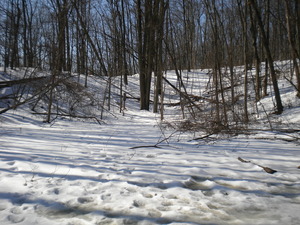
Black Pond on 8 March 2010.
Stefan Szumko | Contributor
So that I could better produce this weekly pondcast, I finally officially registered as a volunteer in the City of Ann Arbor’s Natural Areas Preservation (NAP) 7th Annual Salamander Survey at Black Pond. Training is held in late February or early March of each year, and preregistration is required since space is limited. As a participant, I’m required to head out to the pond several times this spring, on rainy spring nights once there is liquid water on the pond - at least on the edges. Later this spring and early summer, I’ll be trapping and releasing salamander larvae (tadpoles) that hatched in the pond.
On warm, rainy nights each spring, salamanders head to the pond in which they were hatched. These nights are frequently the only time you can see them, for once they mate, adult salamanders disappear back into the surrounding woodlands. Their young, called larvae, metamorphose in the pond, leaving it once they reach maturity. Since they rely on both a pond and woodland for survival, it is imperative to keep both habitats undisturbed - note to developers.
According the Michigan Department of Natural Resources, our state is home to 10 species of salamanders. In Ann Arbor, NAP has observed seven, plus an entirely female hybrid species, the silvery salamander, at Skyline High School - the only known population in Michigan. At Black Pond, four species have been observed: blue-spotted salamander, red-spotted newt, spotted salamander and red-backed salamander.
However, the red-backed salamander is an entirely terrestrial species, laying eggs on land. Their young go through complete metamorphosis in the egg and never enter the water. The red-back is lung-less and breathes through its skin.
Salamander skin is very sensitive and must be kept moist, hence the reason they travel on rainy nights. Salamanders can also absorb chemicals through their skin and can die if they come in contact with bug repellent, hand sanitizer, lotions, etc. So if you do find a salamander, it is best to leave it alone. But if you must, please pick it up only if you are wearing latex gloves.
Please do not lick salamanders. Many species can produce toxic chemicals, which apparently taste bad and can sicken small predators. It’s probably best to leave these secretive amphibians alone.
One way to find salamanders outside of the breeding season is to look under logs. Please be sure to place the log back exactly the way you found it, even if you don’t find one. Placing a log upside down can destroy the microhabitat found below.
In these rainy nights of early spring, salamanders migrate to ponds to breed. In a good salamander year, hundreds of these critters will be in the edges of ponds, seemingly dancing in the water. Male salamanders will lay small, white blobs of reproductive material, called spermatophores, on the bottom of the pond. Depending on the species, a male salamander will court interested females through a variety of means including: pheromones, visual displays like "dancing" in the water, or nudging her with his head and grasping her with his forelegs. Once a male has been selected, a female will pick up his spermatophore and place it inside her bodies to fertilize eggs. She will then lay a number of eggs (one to 12 or more), protected in a clear jelly-like mass, onto sticks or other vegetation in the pond. But in a given night, a female salamander may lay several hundred eggs. She may remain in the pond, laying fertilized eggs for several days.
Once the eggs hatch, salamander larvae possess external gills that look a lot like moose antlers. Young larvae feast upon zooplankton, like copepods or other aquatic organisms, including their amphibious cousins and siblings. Older larvae eat algae, decaying organic matter and plankton.
Monday, March 8, 2010, 10:15 a.m.; T = 42.4°F, 5.8°C, my son, Alex (age 8), and I headed to the pond on an early spring/late winter day to scout out the pond for salamander potential. The trail to the pond was very slippery, still covered with ice. Only the hill on the north of the pond was free of snow, but the ground there was still solid. The pond was entirely frozen, except for a narrow band of liquid water on the south side of the floating boardwalk. Alex collected a water sample, which was teeming with copepods and other small aquatic macroinvertebrates. One large, wormlike creature, about one centimeter long and dark brown in color, was observed. It appears to have been some sort of midge larva, though not a phantom midge larva. We’ll try to monitor its
development.
Wednesday, March 10, 5:38 p.m., I received an email from Ethan Bright of the University of Michigan Museum of Zoology Insect Division and School of Natural Resources and Environment. Ethan is the caretaker of the Web site Aquatic Insects of Michigan. I had asked for his assistance in identifying an organism we found under the ice back in January. It turns out that this is most likely a harpacticoid copepod and not a fly larva. Based on the image I made with the digital microscope, it was most likely a female and probably died soon after laying eggs. The larva of the green fly that got away was probably hidden somewhere else in the sample jar.
Harpacticoid copepod, collected from under the ice at Black Pond, January 18, 2010.
Thursday, March 11, 9:49 a.m.; T = 48.4°F, 9.1°C, my younger son, Jameson (age 3), and I headed back to see how much ice had melted with the previous warm days. The north edge of Black Pond was ice-free, and on the pond the snow had melted, leaving only gray ice. Jameson enjoyed collecting his own water sample of zooplankton and was quite impressed with finding large leaves in the water. We did spot one of the first chipmunks of the year. The presence of this hibernating mammal indicated that spring was here.
Thursday, March 11, at 10:10 p.m., the report came in that the first salamander of the season was spotted in Washtenaw County! A small-mouthed salamander was seen outside the city limits. This species is not likely seen in Ann Arbor City Parks, according to Sean Zera, who braved the first rainy spring night to make the observation. During his foray to several ponds, Zera also encountered a wood frog and an eastern garter snake. It was definitely time for spring.
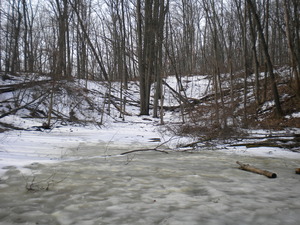
Black Pond on 11 March 2010.
Stefan Szumko | Contributor
Join us next week for Week 11 of the Pondcast. Perhaps the weekend rain will yield salamanders? Why did we find dead frog tadpoles? What else will we discover?
Stefan Szumko is a middle school science teacher by trade, an outdoor environmental educator by calling and a homedaddy by choice. Stefan can be reached at slugwhisperer@gmail.com.