

Pondcast 8: Scientific inquiry discussed with day campers
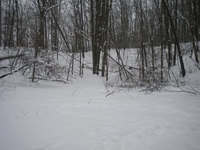
Black Pond, Feb. 21, 2010
Stefan Szumko | Contributor
Week 8 started out with a massive heat wave. Temperatures approached 50 degrees F; it felt almost like spring. Participants from the Leslie Science and Nature Center’s “Take Your Best Shot” photography safari joined me. We discovered minimal action of organisms on the surface of the pond. This segment did not make the final cut of this week’s video pondcast due to time constraints. I’m trying to keep these videos at about five minutes. I do appreciate their company and hope they had a good time in their photographic endeavors.
On Monday, Feb. 22, Ann Arbor was inundated with nine inches of snow. This is great news to Black Pond, a vernal pool, which only fills with water from precipitation. The thick layer of snow did provide a minor challenge when I headed out to the pond with a group of day campers from the Leslie Science and Nature Center’s Mid-Winter Break Day Camp.
We chipped through the ice to collect a water sample filled with aquatic organisms and measured the depth of the pond on the north side of the floating boardwalk on Black Pond. We had a wonderful discussion about parts of the scientific inquiry: observation and data collection.
Observations are made through the use of all five senses, when appropriate. Chipping through the ice, we came to a layer of leaf litter. Instead of smelling like sulfur, as in the middle of the pond, this layer smelled of feces, commonly known as poo. I was a bit concerned that we had uncovered a deposit left by an unleashed canine visitor to the pond but was relieved that we only met with frozen leaves. Perhaps in the early stages of decomposition, decaying leaves in the pond do smell like feces. We’ll have to keep this thought in mind for future weeks.
As we chipped through the ice, the campers made a hypothesis or prediction about whether or not there would be liquid water under the ice. There was water, and it was cold.
Once a sample was collected, we measured the depth of Black Pond, using a non-standard measurement device: a bamboo pole. Campers predicted how many segments deep the pole would go. It turned out to be just under 7-segments, or about 1.6 meters, once we used a standard tape measure to get an accurate measurement.
We then took the sample to the critter house where we blew up the organisms - enlarged the organisms under the microscope. This discussion and organism identification will be presented in next week’s episode.
Stefan Szumko is a middle school science teacher by trade, an outdoor environmental educator by calling, and a homedaddy by choice. Stefan can be reached at slugwhisperer@gmail.com.
Comments
tmacek
Fri, Mar 12, 2010 : 12:42 a.m.
this also shows the patience it sometimes takes to be a good scientist.
kaitgraf
Mon, Mar 1, 2010 : 9:47 p.m.
The kids had great inquiry about how the pond froze and why there was liquid water underneath! It was a great opportunity for the kids to explore the outside world and take measurements, traditional and non-traditional. We had LOTS of fun!
Stefan Szumko
Mon, Mar 1, 2010 : 12:04 p.m.
The video settings have been changed to public, so it's now ready to view by all. Darn technology and all the little boxes to check, buttons to click, and data to be repeatedly sent...