

Pioneers for a day: Mitchell students learn winter survival skills
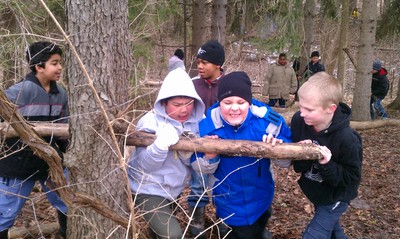
From left, Benson Hang, Owen Nikischer, and Joey Brilla use a tree to get leverage in an attempt to break up a log for their fire as Sofaine Benhamida and Riley Warren gather sticks in the background.
Andrew Turner I Intern
Fifth graders from Mitchell Elementary School put the lessons they’ve been learning in class into practice on a winter survival trip on Friday.
As part of the fifth grade curriculum, the students have been learning about energy transfer in science, and what life was like for the pioneers in social science. On the trip they got the chance to experience some of those things for themselves.
“Out here they can get experiences they could never get in a classroom,” said Dave Szczygiel, environmental education consultant for Ann Arbor schools.
Szczygiel and his volunteers demonstrated how to build a fire, then sent the kids out to gather their own fuel. Working in small groups, the students collected as much dry brush, twigs, sticks, and logs as they could to fuel the fire they would use to cook their lunches.
Matt Krigbaum has been teaching fifth graders in the district for 20 years and said he sees them struggle with the same problem every year.
“The kids always think they have enough fuel, and every year we tell them they need more,” Krigbaum said.
It took the groups about an hour on average to gather their fuel and get the fires burning. Knowing it would be struggle initially, the staff and volunteers let the kids make mistakes while they tried to figure it out.
“Learning from their mistakes is part of the process here,” Szczygiel said.
After getting their fires going, the students began cooking the food they brought with them. Each student brought a different part of the meal to share with the rest of the group.
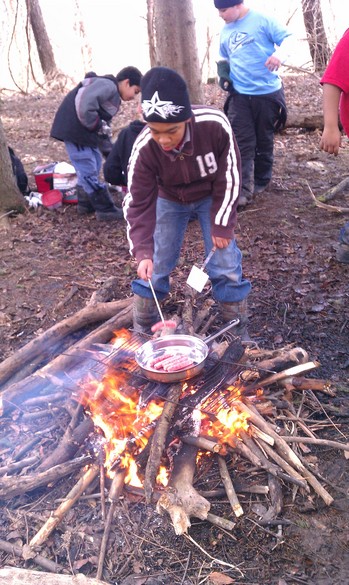
Riley Warren cooks some sausages for his group at Winter Survival.
Andrew Turner I Intern
A group of six students, Ka’saada McDonald, Delana Hill, Alexis Slovinski, Jayci Gottlieb, Adriana Brenen, and Tiana Corrao, were among the first done and celebrated with smores as appetizers before starting on the main course.
“This is why I love the great outdoors,” said Slovinski, admiring the crispy marshmallow she had just roasted.
The girls credited their success in building the fire so quickly to good teamwork. Each team member was responsible for a different task in gathering and organizing their fuel, Corrao said.
Not that they thought it was easy. They didn’t relish the idea of having to build a fire every day to cook.
“It was hard,” Hill said.
“Yeah, it was a lot of work,” agreed McDonald.
Teacher Bernadette Swanson was at her second Winter Survival trip. Last time she was on the other end though, as a student in 1984. She said she was happy to see the way the kids responded to the environment.
“The kids are so fired up,” Swanson said.
Once the groups had their fires going, they started cooking up the food. The menu included hot dogs, hamburgers, sausage, steak and bacon. And of course, lots of smores.
Steak kabobs were one of the more creative items of the day, although the volunteers said it didn't surpass the most creative dish they’ve seen at Winter Survival.
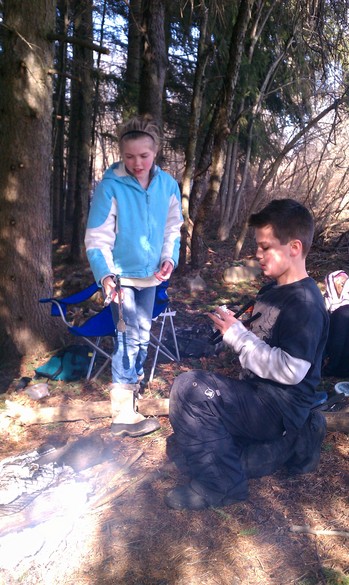
Trevor Dial checks to make sure his hamburger is done while Jackie Underwood works the grill.
Andrew Turner I Intern
“I saw one group melt all their chocolate in a bowl, and they used it to dip their marshmallows in like a fondue,” said Tom Jameson, a retired professor who has been volunteering with the district's Environmental Education program for 20 years.
After lunch the students put out the fires, cleaned up their sites and prepared to end the trip. They’ll continue to learn from their experience in class next week, as their teachers plan to have them write about what they learned on the trip.
The Winter Survival trip is a part of the Environmental Education program that all fifth-graders in the district participate in. The Environmental Education department also organizes field trips for all students in first through sixth grades throughout the year.
About 80 volunteers help with the 350 trips for almost 10,000 kids every year, Szczygiel said.
Andrew Turner is an intern with the Community Team at AnnArbor.com. Have a neighborhood news tip? Email community@annarbor.com.
Comments
KJMClark
Mon, Feb 21, 2011 : 2:26 a.m.
This is great for the kids at Mitchell. The kids at Northside did this a week and a half ago, same site, when there was at least 8" of snow on the ground and windchills around zero. There were gusts to 25mph toward the end. I was with the kids on that trip. They had to dig half the firewood out of snow. I have to say, the schools coverage is a little carried away. Our kids at Northside do a terrific job - things like a *serious* winter survival challenge, and all we get is some half-cocked "bully" coverage. Why doesn't the News try covering some of the good things kids are doing at Northside? Where's the balance? Our talent show is March 2nd, and our Winter Carnival is March 17th. How about it AA.com? I hope the kids at Mitchell had a good time and learned a lot. I know our kids did.
Jen Eyer
Mon, Feb 21, 2011 : 2:38 p.m.
Thanks for the news tips! I will put them on our calendar. We should be able to get a reporter out for at least one of those events.
Jim Pryce
Mon, Feb 21, 2011 : 2:12 a.m.
I helped chaperone one of these trips, when my daughter Sarah was in 5th grade at Carpenter School with Mr. MacMillan. These kids were better prepared than my daughters class 4 years ago. I was in charge of the girls, so we had meat, while the boys were eating peanut butter & jelly, s'mores, chips, etc. The Girls had burgers, it wasn't until they had finished their burgers that Sarah let them know it was Venison. Some were non-believing but still said it was very good. It just goes to show, you don't know what you're missing if you don't try it.
keith_urbanFan93
Sun, Feb 20, 2011 : 11:23 p.m.
I remember doing this with Mr. Krigbaum in my 5th grade class! It was so fun, and I learned a lot :) I'm glad these kids had an opportunity to do this!
local
Mon, Feb 21, 2011 : 1:21 a.m.
Every 5th grader in Ann Arbor has this field trip experience. It is one of the most well liked experiences that these kids get.