

Campus Ethnography: U-M's Diag
Chris Gerben | Contributor
Today on the Diag...
The Diag is a singular place. Yet, if you asked someone who walked through its sinewy sidewalks at any given time to complete this sentence, they'd fill in the blank in a near-infinite number of ways. Today—at the first sniff of spring—students sat on any damp, softening patch of grass they could find to soak up the late afternoon sun. Others tried incessantly to hand out flyers for some cause of utmost importance to them. And of course, others—like me—simply lowered our heads and pushed forward, seemingly oblivious to everything around us, but undoubtedly unable to fully escape the impression such a place leaves.
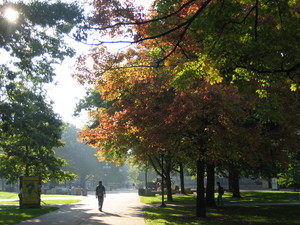
As a place, the Diag is emblematic of the University. On local maps it’s represented simply as a large M amongst all the surrounding academic buildings. Its landscaping is sparse, composed of interlocking bricks, monolithic concrete benches, and patches of maple tree-shaded grass encompassing the main artery of campus. While other schools have quads, courtyards, or grassy areas where students congregate and pass between classes, the University of Michigan holds this area of concrete and brick to its heart. It’s here, at the center of the campus, where I’m standing today observing the chaotic traffic of backpacks and bikes on a school day afternoon.
But to simply describe it as a place—albeit central, both in geography and identity for the University, and perhaps all of Ann Arbor—is to miss what the space means to so many people, and why pausing even just a few extra minutes here reveals insights so singular yet so transient when completing that initial statement:
Today on the Diag…
There are differences between places and spaces. Places can be inert, waiting to be filled, autonomous in self-efficiency. But spaces, like the Diag at U-M, are charged with frenetic energy. Ebbing and flowing with masses of people, it’s like a giant sampling device, taking intermittent snapshots of life in a midwestern city. Some days you're stuck walking behind daft people prattling on their cell phones, some nights you quicken your pace as ominous teenage skaters get just a little too quiet when you approach, and on more days than not, students try to push small slips of paper into your hand as if to say, "Here, you throw this away" (as my favorite comic, Mitch Hedberg, used to joke.)
As the temperatures rise and the tree buds pop and the Diag repopulates itself for spring, it's hard to believe that only a few weeks ago Ann Arbor was buried under half a foot of snow. Back then, I stood in the middle of the Diag listening to the acute silence buffeted by stray students marching to class in the early morning hours. The falling snow that day was light and small, creating a moving veneer of particles that collected at odd angles on the ground while wrapping around freshly shoveled piles. That day the Diag was solace, still and guarded by the large buildings blocking the wind and seemingly protecting the space, and its occupants, from the outside world. It was closed, and private. It was mine.
But on other days, it’s an opening to the world, a kind of ad hoc town square. This is a space where people jostle for direction, convinced that their way is the right of way. It’s a space where student groups solicit signatures or chant for their teams; where religious fanatics hoist signs unconvincingly imploring us to repent. It’s a space where you can hear music in the summer, rallying cries in autumn, and in winter—silence. Especially after a fresh blanket of snow, like the one I looked out on in early March, you can hear nothing at all, spare your lone footsteps or muffled voices carried on the cold wind.
On the map, the Diag is a place, easily identified. But in this article—and the many to follow—I want us to be interested in spaces.
In other words, this article is meant as an introduction, both to me and to these spaces. My forthcoming articles will be campus ethnographies: prose snapshots of what one sees and experiences when he sits still and lets the world come to him. In this case, the world is this campus, wrapped loosely by the other world of Ann Arbor. Perhaps nowhere do these worlds mesh (or collide) as much as they do on the Diag. Because of the public nature of U-M, temporary students own a place like the Diag no more than permanent residents do.
At first it’s just a place, but beginning a story with "Today on the Diag..."—whether in a snowstorm or on a sunny spring afternoon—reveals a space that is at once quintessential U-M and Ann Arbor, all drawn up in concrete, brick, and humanity. So, taking my cue, here's the story I'm sharing with you.
Chris Gerben writes about spaces on and around U-M where the campus meets the city. He is a writing instructor and PhD student in the Joint Program in English and Education, where he studies the connection between students' online and academic writing. He can be reached at a2cgerben@gmail.com .