

We the People: A more than spoken word performance
The sound of listening filled Clements Library. Some eyes looked ahead at the person illuminated by an elegant chandelier while others looked away, allowing their minds to feel the words. Each member of the audience was absorbing the words in a different way.
We the People: A Spoken Word Performance was part of the MLK Symposium at the University of Michigan. It was an event with a title that in my opinion does not do it justice; words were so much more than spoken. Angel Nafis and Val Gray Ward had traveled from New York to be here with us.
Angel, who is a Huron High School graduate, had come from New York City where she is a student at Hunter College, and Val had come from Syracuse, even though her daughter-in-law was being buried that day. Their performances had come together to create “an evening of storytelling, song, poetry and spoken word.”
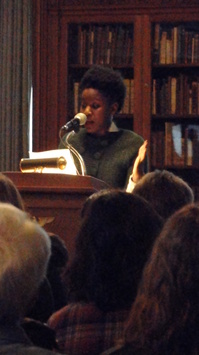
Angel Nafis read her poems about the contemporary American experience.
People had gathered from all realms of the Ann Arbor community as well to be a part of the event and to see their amazing performances; a diverse group of University of Michigan students, kids and adults filled the chairs and the library. More chairs were brought out to accomodate the flow of people. It was impressive how many people had taken the time to come and to be there to listen.
Just listening to Angel speak before she began to perform her poems was amazing in itself. When she explained how there is “nothing like coming home and feeling at home in every corner of the city,” I knew her poetry was going to be beautiful. But I could never have predicted the greatness of it, nor could I ever capture its greatness with a description.
I had planned to write down a few favorite phrases from her poem, but I found myself writing every word she said, which didn’t work out too well. Each phrase was beautiful, and each word fit. Angel’s poems went together neatly as a combination of personal and more general poems.
Her poetry was more than just words strung together; it had a rhythm and a tune to it. The words rolled off Angel’s tongue as she produced each word, each sound, each pause with perfection. She didn’t just read the poem; she performed it, breathing life into it with her voice and her body. It was lovely; lovely to hear, to watch, to feel.
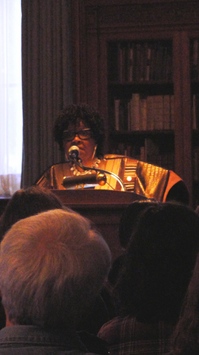
Val Gray Ward uses songs to tell stories of the civil rights movement.
After Angel had left the audience astounded, Val Gray Ward stepped into the light of the chandelier. Val incorporated storytelling and poetry and song all into one. Her voice was constantly changing, adapting to the different voices that she embodied with precision. Her facial expressions followed her words as she acted out her emotions. The texture of her voice gave it life as her voice vibrated and took on different pitches.
Her performance was like a medley incorporating the lives of a variety of significant figures in the civil rights movement. From Langston Hughes’ poem The Negro Speaks of Rivers to the story of Harriet Tubman’s journey in starting the Underground Railroad, Val’s words and her voice brought their stories to life.
The words that Angel and Val used were not just spoken. They were sung. They were whispered. They were declared. They were filled with emotion. They were brought to life.
And that is one of the great things about words and about poetry — there is so
much that you can do with them.
“Poetry is a recorder,” Angel explained. “An emotional recorder.”
Trisha Paul is a freshman at the University of Michigan who writes about her first year at college. She is a former editor of The Emery, Huron High School's student newspaper.