

2010 Census: Ann Arbor's student population is hard to count, but key
The 2010 Census forms are now in residents' hands, but the U.S. Census Bureau faces a formidable challenge in and around Ann Arbor: students.
Students are more mobile and live in residence halls, rental units or other crowded housing arrangements - and they're typically gone by May. Those factors make students hard to count for the big decennial survey, but anyone who isn't counted translates into lost dollars.
In 2000, the lowest Census response rates in Ann Arbor were in student neighborhoods. The city had an overall participation rate of 78 percent in 2000, while the statewide average in Michigan was 77 percent.
"Students are really hard to follow up with," said Lisa Neidert, a senior research associate with U-M's Population Studies Center. "They're transient populations, so you really have to get them when you can."
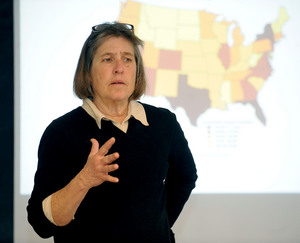
Lecturer Lisa Neidert spoke during her class about the U.S. Census on Monday, March 22. The University of Michigan mini-course, titled "Census 2010," is about the history and purpose of the Census.
Angela J. Cesere | AnnArbor.com
Getting students counted is no less important than tallying the city's permanent residents. Students may not stick around for the next 10 years, but just like townies, each is worth $826 a year for the next decade to Washtenaw County, according the Brookings Institution, which estimated how much U.S. residents who are counted are worth per year in federal dollars, based on 2008 data.
A total of 41,000 students are enrolled at U-M's Ann Arbor campus. And while it's difficult to say how many live within the city limits, at least 10,000 reside in university housing around town.
Complicating matters further is a misconception among many parents and students, officials say. Students from outside Ann Arbor often believe they should be counted back home or not counted at all - but that's not true.Â
The U.S. Census Bureau wants everyone counted where they live for the majority of the year - including college students living away from family and even foreign students with no legal standing as residents.
U-M's Institute for Social Research launched a video contest to spread the word to students about getting counted in Ann Arbor.
"The Census on Michigan Time," by U-M College Democrats, took the top honor and a $1,000 prize for reminding students to fill out their forms as part of the daily grind. The video illustrates it's just as easy to fit a Census form into a student's day as typical student activities like waiting for a clothes dryer, checking Facebook or riding the bus.
Peter Logan, the director of housing communications, said he hopes posters in residence halls, fraternities and sororities and e-mails to all students and their parents help to get the message out, too.
Why getting counted is important
Because the Census determines the flow of more than $400 billion federal dollars to states, it is especially critical in Michigan, said Neidert, who co-teaches a course called Census 2010: Moving Power and Money, with fellow population studies researcher Reynolds Farley.Â
In 2008 alone, Census-related statistics determined federal funding for $287 million worth of programs in Washtenaw County - from highway planning to energy assistance for low income households, according to the Brookings Institution.
But netting federal cash isn't the only thing the count will do.
The purpose of the Census is to re-allocate power among seats in the U.S. House of Representatives, although based on demographic projections, Michigan is set to lose a congressional seat regardless. The year following the Census, state legislatures will also re-draw their districts.
Overall, low participation can equate to inaccurate population counts, weakened representation in Washington and in Lansing, lower federal funding for programs and a more expensive Census, Neidert said.
The U.S. Census Bureau will send out workers beginning in May to knock on doors and complete the count, an expensive endeavor it estimates will cost about $56 per household - compared to $0.42 it will cost the government if the form is mailed back. The Census Bureau will base plans for in-person follow-up on the number households that haven't mailed back forms by April 19.
Meanwhile, the forms from Ann Arbor and elsewhere are trickling in. As of Friday, 26 percent percent of residents in Ann Arbor had returned their forms by mail.Â
Five key informative Census Web sites:
- Learn about how the 2010 Census works.
- Follow live participation rates for the 2010 Census for your community from the Census Bureau Web site with this interactive map.
- Get questions about residency and the Census answered.
- View informative Census videos targeted at college students, created by University of Michigan students.
- Read about why the government says it's important to mail in your Census form by April 1 and other topics on this blog by Census Bureau Director Robert Groves, a U-M professor and former director of the U-M Survey Research Center.
Juliana Keeping covers higher education for AnnArbor.com. Reach her at julianakeeping@annarbor.com or 734-623-2528. Follow Juliana Keeping on Twitter
Comments
Juliana Keeping
Tue, Mar 30, 2010 : 8:09 a.m.
Thanks you for clearing that up, Mr. Farley. Reynolds Farley is sociology professor and research scientist with U-M's Population Studies Center.
Ren Farley
Mon, Mar 29, 2010 : 7:58 p.m.
Students who live in dormitories and others who live in group quarters such as jails will not receive census forms in the mail. They will, however, be delivered by the administators of the groups quarters where these people live. I believe that students in U of M dorms will get a census form on April 1.
Mick52
Mon, Mar 29, 2010 : 6:33 p.m.
Way to go Laura
LauraM
Sun, Mar 28, 2010 : 8:17 p.m.
I have 2 kids in different colleges. One lives in a dorm and the other in an apartment. Neither received a census form so I included them on my form. They will both be here for breaks and summers for several more years.
treetowncartel
Sun, Mar 28, 2010 : 4:24 p.m.
The census form says not to count people at college on April 1, 2010.
Mick52
Sun, Mar 28, 2010 : 2:44 p.m.
Sure in4, but once they are here, they are paying taxed. They are paying sales tax, gasoline tax, booze tax for sure, parking fees and fines, and indirect property taxes thru rent for those who live in off campus housing. If they work, they pay income tax too. So they are paying taxes. Change this because they have not "been" paying taxes? Once you are a resident, taxes apply. The problem is there are differing definitions for residency, and here its okay to be a "resident" so the city can benefit, but not so the person can benefit. For the census, they are residents, well almost residents, sort of residents, but not really residents. Paying taxes residents, but NOT been paying taxes residents!
Mick52
Sun, Mar 28, 2010 : 1:32 p.m.
Something stinks here. If you can be counted as a resident in A2, just because you are in school here, how come out of state students have to pay out of state tuition? It seems like students away from home should be counted where their permanent residence is, not their college address. If they can be counted for the financial benefit of A2, they should be considered residents of Michigan and pay in state tuition.
msddjohston
Sun, Mar 28, 2010 : 11:52 a.m.
Hello my friend, It is my understanding that the date that COUNT(s) APRIL 1, 2010. Where are you on that date? IMPORTANT, and very simple. If as a parent I have a youngster in college close to that date I MIGHT direct the student to count at home base (folks home). This very likely might be a total disregard for the law. (There are margins?) My advise to all students on behalf of education: Where are you on April 1, 2010: Complete the form (extras all over town) and mail in: Take to the postoffice and possibly "Frank" the envelope. Your friend, Dawn
Anonymous Due to Bigotry
Sun, Mar 28, 2010 : 9:44 a.m.
I seem to remember that the census form that I received stated that students in residence halls shouldn't use the form. I'm unsure exactly what that means for how students in dorms are actually counted.
MyOpinion
Sun, Mar 28, 2010 : 8:57 a.m.
Interesting logic about wasting tax dollars. According to the article, if the Census Bureau has to send enumerators out to get your census information, you are a burden on the Census Bureau ($56 vs 42 cents).
cinnabar7071
Sun, Mar 28, 2010 : 8:41 a.m.
voiceofreason Thats why I throw my census in the trash, I will not be apart of my local gov't wasting my tax dollars. When and if they start acting responsible with my tax dollars, I'll do my part.
voiceofreason
Sun, Mar 28, 2010 : 7:03 a.m.
Every additional person counted allows another City Council blunder off the hook! Heck, if we can find an extra 1000 people within city limits, we might even be able to have functional bridges! Golly, I can hardly contain myself!