

$30 million HDC lawsuit against city of Ann Arbor thrown out of federal court
A judge has dismissed a federal lawsuit brought against the city of Ann Arbor by the developer of the William Street Station project once planned for the old YMCA site downtown. The lawsuit filed in October by HDC LLC claimed the city blocked the developer from building the project because it would have included 100 units of low-income housing, in addition to a hotel and transit center.
HDC claimed the city’s decision to pull the plug on the project violated federal law and was intentional discrimination against the type of people who would live there.
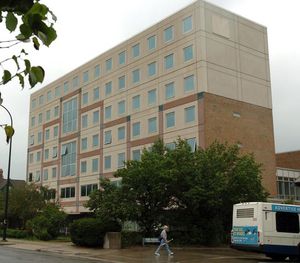
The old YMCA site was the subject of a lawsuit dismissed today in federal court.
File photo
U.S. District Court Judge Bernard Friedman on Thursday dismissed those claims, citing lack of evidence.
HDC disclosed in February it was seeking compensation for damages of more than $30 million after the city didn't extend an option agreement for the city-owned property three blocks south of city hall.
Three counts of the complaint were brought against the city based on federal Fair Housing Act claims. The remainder of the counts were state law claims.
The court dismissed the federal claims, opining that they lacked factual and legal merit. The court decided the company presented only speculation about the handicapped status of the hypothetical tenants and couldn't make a plausible claim regarding the failed project's impact on handicapped people.
The court decided the city’s decision not to issue an additional extension of the option agreement with HDC didn't demonstrate intentional discrimination.
The court dismissed the remainder of the state law claims for lack of jurisdiction. HDC still could file those claims in state court.
An attorney representing HDC could not be reached for comment.
City Attorney Stephen Postema applauded the federal court's decision to throw out the case because of lack of factual or legal merit.
"We spent a lot of time on this case," Postema said. "And we took the unusual step of having the judge rule on just what they filed. There was no discovery on the case and the judge slam-dunked them. Even taking everything they said as true, the judge decided they don't have a case."
Postema disputed the allegation that the city didn't want mentally disabled people living downtown.
“To bring such a pile of accusations against the city in federal court and disparage a council that worked so hard on this project with groundless claims of discrimination is simply wrong," he said.
HDC and two partner companies with offices in Ann Arbor filed the 26-page lawsuit in U.S. District Court in October, claiming the city intentionally put up roadblocks for two years that caused the developer economic harm.
A surface parking lot exists today on the site at 350 S. Fifth Ave. The city purchased the former YMCA property in 2003 in an attempt to preserve at least 100 units of low-income housing.
In 2004, the city issued a request for proposals to select a developer to construct a low-income housing project. HDC proposed redeveloping the property and the adjoining site owned by the Ann Arbor Transportation Authority.
The project was to include 100 units of affordable housing, four stories of office and retail, market rate housing, an enclosed terminal for the AATA and underground parking. The occupants of the affordable housing units were to be residents with continuing mental or emotional impairment, documented substance abuse problems and chronic homelessness, according to the lawsuit.
In June 2005, HDC's proposal was chosen by the city over five other applicants. The City Council passed a resolution accepting HDC's proposal and agreed to a purchase price of $3.5 million for the property.
Following the city's acceptance, HDC established a company named XY to develop the project. It set up another company, 200 East William, to be the developer and owner of the affordable housing. Both are listed as co-plaintiffs in the lawsuit.
In October 2006, the state awarded the developer more than $18.5 million in tax credits for the project. Soon after, the developer asked the city if it could modify the project to include a hotel and conference center and eliminate the market rate housing and offices included in the previous plans.
The plaintiffs claim the city "provided no formal response," and the issue lagged for months. In January 2007, the plaintiffs claim they advised the city the state required the revised project to be formally adopted by the City Council for it to process a $6 million tax credit.
What followed were several "months of frustration in attempting to secure approvals and agreements from the city," until the City Council finally approved the revised project in March 2007, the lawsuit stated.
Between 2005 and 2007, the plaintiffs spent more than $2 million on architectural and engineering fees, feasibility studies and other expenditures, the lawsuit claimed. In April 2007, the developer was awarded $7.5 million in Brownfield credits, but dealing with the city continued to be a formidable process, the lawsuit claimed.
In October 2007, the city finally agreed to grant the developer an option to purchase the property, but required the developer apply for demolition permits by no later than Oct. 15 — just three days after the execution of the agreement, the lawsuit claimed. The plaintiffs claim when they went to apply for the permits, they were advised by the city they couldn't because the city still owned the property.
In November 2007, the City Council denied the developer's request to modify the demolition permit deadline and sent a notice from the city attorney's office terminating the option agreement, according to the lawsuit.
The court ruled today that HDC's complaint was "devoid of any factual allegations to plausibly demonstrate a discriminatory state of mind" by the city.
The court ruled there was an “obvious alternative explanation” to the allegations of discrimination, which is that the city just made a business decision based on HDC's failure to meet a stated deadline in the option agreement.
"Plaintiffs admit that they did not meet this milestone, and that they admitted this default to the City Council," the opinion reads. "Further demonstrating a lack of discriminatory intent is the fact that the deadline for the milestone at issue was negotiated and agreed to by plaintiffs. Plaintiffs were fully aware of their obligations under the option agreement, and defendant’s decision to enforce the ramifications of non-compliance can plausibly be described as a business decision."
Ryan J. Stanton covers government for AnnArbor.com. Reach him at ryanstanton@annarbor.com or 734-623-2529.
Comments
townie
Fri, May 28, 2010 : 7:59 p.m.
I won't go into the various conspiracy theories, but the DDA, the City, and the Chamber of Commerce made it very clear that they were gung-ho for a hotel/conference center and certain officials were willing to use public land and public money to make it viable. In a down-market with little private financing available, what developer wouldn't drool over the chance to cash in on a project fully guaranteed by tax-payers? At the same time, we have much whining by local developers who want to put over-sized apartment buildings into neighborhoods (cheaper land) on the claim that they will fill what they say is an unmet need for "young professional" housing. Supposedly that consists of affordable 1-2 bedroom units, but so far these projects have featured mostly 3-4 bedroom units, more suited to undergraduates. Also at the same time, we have many people calling for more residential density in the downtown core, which they perceive will fight suburban sprawl and promote sustainability. A hotel/conference center will not increase density, will not provide housing for young professionals, and in my opinion, will only hurt the local hotels that are already struggling. It is not sustainable, nor is it financial feasible without huge public subsidies. So, I think its time for those who've been touting density and young professional housing to put their dollars (or political clout) where there mouths are and put together a package of young professional housing for the YMCA site. City politicians who claim this type of housing is an urgent need should have no qualms about reducing the asking price for the land for this type of development, because it will be a "public benefit," right? They should also have no problem deed restricting it to residential housing that is appealing and affordable to young professionals, since that is apparently such a pressing social problem.
Lokalisierung
Fri, May 28, 2010 : 5:59 p.m.
"As some might say, you, sirs, are allowed your opinion, but you are not allowed your own facts." This is part of a standard message board rant how no one but poster X has all the facts or knows anything about a topic. Of course Poster X will consistantly state "things," or "facts" without any basis of proof behind them. But somehow Poster X always knwois a little more than everyone becasue they "remember back then" when these things happened...eventhough there is no proof of it.
Lokalisierung
Fri, May 28, 2010 : 5:41 p.m.
"What you're spouting is Hieftje's party line spin. What we'll hear next is how good Ann Arbor is doing compared to other cities in the state, that we haven't had any lay offs or service cuts and we're so lucky to have Roger Fraser as administrator. All lies in my opinion." Yeah I don't know what cities you are looking at that are doing so much better than Ann Arbor. "Offers from Washtenaw County to partner on a new police and courts building or finding existing space were rebuffed by the city because if the idea did not come out of city hall it wasn't worth much." Can I see a link, or a quote, or any proof of this?
logo
Fri, May 28, 2010 : 5:22 p.m.
Yea right Moose.. Proof? Across the state, layoffs and or tax increases. The shining star of West Michigan - Grand Rapids? They cut 50 police and fire in February, now a big income tax increase was approved but still $8 million short, there will still be layoffs, close pools, etc... Troy, failed millage increase so big layoffs (1/3 of workers?)and facilities closing, Sterling Heights, tax increase on the ballot, etc. Ann Arbor: 43% of the land non-taxable, loss of 5% of revenue hit with UM buying Pfizer but no tax increase on the ballot, no police laid off, no firefighters either if 3 out of 8 eligible take retirement, no layoffs at all. Police and fire chiefs: "no service cuts". Millage lower now than it was 10 years ago. Police & Courts building? Whatever you say... but the county ended the lease and the courts had to move. What were they supposed to do? The Police have needed a new place for 30 years. I think it was smart to put them both on the same foundation and save infrastructure costs. They are saving a lot in rent too and putting a bunch of people to work. All Good. A2 quality of life? No comparison with the rest of the state. Always winning awards. Most recent - 4th most livable city from Forbes. Ann Arbor = a great place to live.
Vivienne Armentrout
Fri, May 28, 2010 : 3:39 p.m.
HDC proposed to combine the affordable housing tower with a commercial development and also had a tentative agreement with AATA to develop adjacent property for AATA's use in replacing/expanding its Blake Transit Center. HDC had partnered with Hope Network, a nonprofit organization that had experience in running such facilities (that require a level of management, especially for the supportive housing aspects, beyond ordinary rental management). So the affordable housing part would not have been managed by HDC directly. The news story has a good summary of the history of the development. I gave a slightly expanded one in my blog post, The Old Y, the Conference Center, and the Inside Track, in which I suggested that the timing of HDC's turndown by the city and the emergence of a new conference center proposal suggested a linkage. It is speculative, of course.
Moose
Fri, May 28, 2010 : 2:27 p.m.
The fix was in for a new city hall at the same location because when Roger Fraser was hired about 10 years ago, if your memory of events goes back that far, promised to build something new for his political masters. Hieftje and his bunch on council had building envy because Washtenaw County was on a construction tear. Hieftje and his bunch on council also wanted to leave their imprint on the development skyline. In other words their hearts were set on some new construction and a fountain to put in front of it. Offers from Washtenaw County to partner on a new police and courts building or finding existing space were rebuffed by the city because if the idea did not come out of city hall it wasn't worth much. What you're spouting is Hieftje's party line spin. What we'll hear next is how good Ann Arbor is doing compared to other cities in the state, that we haven't had any lay offs or service cuts and we're so lucky to have Roger Fraser as administrator. All lies in my opinion. It's guaranteed that we'll hear this same tripe from the same apologists from here to election time.
logo
Fri, May 28, 2010 : 1:45 p.m.
Ummm, Moose, "Rushed?" Don't know where you've been. The police/courts building that is going up because the city had to move its courts out of the county courthouse was talked about for over a decade. In the few years before it was built they had a task force that looked at putting it next to the Library but people came to a public hearing and said they didn't want it there. They looked at 10 other existing buildings but none of them could be redone to work for police and courts. There were numerous public all along hearings along the way. Then the process was held up for another year to sharpen the financing plan. The proposals for on top of the new parking structure came to respond to an RFP that was written in the summer of 09. It looks like they are going nowhere since the council and mayor said they would not finance a conference center. They are nowhere near any kind of rush to get going. Hardly "rushed."
Moose
Fri, May 28, 2010 : 1:22 p.m.
Actually, the Library Lot development timeline of events indicates that Roger Fraser and the inner circle on council actually encouraged and preferred Valiant's proposal of a conference center on the underground parking before any other proposal was introduced. Both of those projects, one public (parking), one (allegedly) private (conference ctr) were under consideration far in advance of any other proposal for residential or public use. Both projects, once again and not unlike the new city hall (Police and Courts), were rushed and being prepared to be jammed down our throats with only token public input.
unrulyfan
Fri, May 28, 2010 : 11:15 a.m.
Jeffersonian, Affordable housing is a business like any other. Avalon is a not-for-profit developer whereas HDC is a for-profit developer. It is true that there was a requirement for 100 units of affordable housing, but the rest of the use was up to the developer to decide. HDC started with commercial units on the 1st and 2nd floor with two towers of residential, one market rate and one affordable. All HDC does to make money is build affordable housing, some of which also has mixed use portions and some of which does not, it all depends on the business plan and the purpose of the development. Townie, Again, the conference center/hotel was the decision of the developer, not the city. I love the fact that you say the city should not require such facilities, and then you go on to say that they should put deed restrictions on the land. I think your logic may be a bit flawed.
townie
Fri, May 28, 2010 : 8:38 a.m.
Attention developers, elected officials, Chamber of Commerce Public Policy Committee, DDA, and "young professionals" everywhere: Large development site available in Downtown Ann Arbor close to public transportation, downtown nightlife, library, and UM. Come build your dream project, chock full of affordable one and two bedroom apartments for twenty-somethings. Brand new D1 zoning means the sky (almost) is the limit, and clear concise regulations will make approval a breeze... Now we just need our City Council and DDA to drop any notions of a hotel or conference center on this site, and instead focus on the residential density and young professional housing they claim to be so concerned about. They should put a residential restriction on the deed and sell the land--then get out of the way and let the private sector take it from there.
Moose
Fri, May 28, 2010 : 8:33 a.m.
I wonder how many pro "free" market, pro business and pro development folks would approve of a "free market" private developer that relies tax dollars for private property and profit. That kind of thinking seems to fly in the face of their "politics".
Jeffersonian
Fri, May 28, 2010 : 6:01 a.m.
According to Moose people who fail to tow the party line should not be allowed express their opinions. While I think the state has a responsibility to treat its vulnerable people with care, forcing the private sector into socially engineered schemes is not the way to accomplish this service. When investors are encumbered by government mandates then they are much more likely to take their money elsewhere.
voiceofreason
Thu, May 27, 2010 : 7:47 p.m.
If there's any silver lining to this story, it's the fact that we've avoided a misguided effort to build a "homeless hotel" on some of the most valuable real estate in Ann Arbor.
The Picker
Thu, May 27, 2010 : 6:17 p.m.
Too bad the developers hadn't worked on an earlier project with city gov't. They would have learned what building in A2 is like and they could have run the other way when this project came up. In reality the city did them a favor and saved them millions by running them off before they sank mega bucks into this dog of a project. I'm sure it will serve as a lesson to other future developers, of what it's like to collaborate with city hall.