

New law gives students more time to find best deal on college textbooks
A new federal law has brought good news for students hoping to avoid the sticker shock typically associated with shopping for books.
Textbooks have skyrocketed in cost at twice the rate of inflation for 20 years, according to the U.S. Government Accountability Office, with the average student spending $700 every year.
But now, a new federal law requires publishers to tell professors how much books costs, and forces schools to identify the books needed for every class at registration time.
This way, students should have time to shop around.
From the AP, here are four ways students can do so:
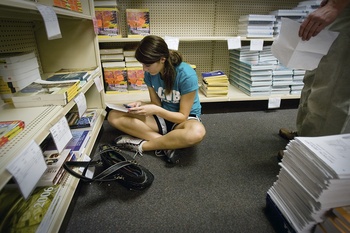
With a new federal law requiring professors to disclose books at registration time, students should have more time to shop around for textbook deals.
Associated Press
1. At the bookstore: Most textbooks are still sold through the campus bookstore, according the National Association of College Stores. The trade group recommends shopping early, buying used and checking your store's website for deals.
Also try the stores' Facebook pages and Twitter feeds for specials. And remember to recoup some of your cash at the end of the term by selling your books back to the store.
2. Comparison shopping: The new law guarantees students easy access to the ISBN, the international standard book number that identifies the textbook, making it easier to comparison shop. Try Amazon.com, efollet.com, iChapters.com and Half.com, which is part of eBay. Also check sites that let students search several retailers at once, like Bigwords.com and Bestbookbuys.com.
Some students turn to Craigslist, and at Campusbooks.com you can find the best prices for both buying books at the beginning of the term and selling them at the end.
3. Electronic reading: This format is growing but remains limited, aside from books whose copyright has expired, some of which can be found free through Google Books, Project Gutenberg and other websites.
Flat World Knowledge, founded by former textbook industry leaders, provides free online access to some textbooks plus print-on-demand, audio and downloadable versions. This fall it is adding versions for electronic book readers. The company said its customers routinely spend 80 percent less than they would on traditional textbooks.
Also offering versions for e-readers are sites such as Coursesmart.com, which also provides online tools for highlighting or taking notes in electronic books.
Digital books were available for about 15 percent of courses last year, according to the National Association of College Stores. Experts expect the format to keep expanding.
4. Renting a book: Numerous websites — Chegg, BookRenter, CollegeBook Renter and others — have popped up to lend textbooks for a fee. The services typically operate through the mail — like Netflix for books. Barnes & Noble also plans to expand its textbook rental program.
Renting allows students to read a printed book without extra equipment and — in many cases — still highlight and take notes in the text.
BookRenter, which says its customers can save 75 percent off buying a book, now offers rental services in partnership with more than 250 campus bookstores.
Some colleges also loan textbooks through campus libraries but availability can be limited.
Do you have additional suggestions on ways to save on college textbooks? Thoughts about the textbook industry? Tell us what you think in the comments section below.
Juliana Keeping is a reporter for AnnArbor.com. Reach her at julianakeeping@annarbor.com or 734-623-2528. Follow Juliana Keeping on Twitter