

AATA gets $2.2 million for projects, including continuation of service to Ypsilanti
The Ann Arbor Transportation Authority has received a $2.2 million award from the Federal Transit Administration, Congressman John Dingell, D-Dearborn, announced this afternoon.
The money comes from the American Recovery and Reinvestment Act.
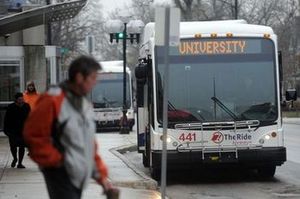
The AATA received additional federal stimulus dollars.
The grant will fund four projects around Ann Arbor: a Central Campus Transit Center, an expanded AATA bus storage facility, improvements to bus stops, and a continuation of existing service in Ypsilanti and Ypsilanti Township that would otherwise have been reduced because of the decline in local revenues.
“I appreciate the Federal Transit Administration’s commitment to improving transportation and safety in Ann Arbor,” Dingell said in a statement. “... All of these projects will help the AATA operate more efficiently and effectively, working to better public transportation for those in Ann Arbor.”
AATA CEO Michael Ford added in the statement: “These stimulus funds have made it possible for AATA to acquire buses and facilities to increase transit ridership, invest in transportation infrastructure that will provide long-term economic benefits, and avoid reductions in essential transit service in part of our service area.”
Comments
Val Losse
Wed, Mar 17, 2010 : 2:01 p.m.
I wonder if AATA will ever upgrade any of the bus stops. Maybe ridership would increase if one didn't have to wait in the rain, snow, cold wind, muddy area by the bus sign, puddle by the bus sign, cars driving by splashing people waiting, wheelchair access from any bus stop. How about a schedule at each bus stop so people will know when a bus will arrive or if they missed the bus. How about some enhancements for the ridership? H'mmm do you think people might use it more?
belboz
Sat, Mar 6, 2010 : 8:58 p.m.
What is interesting is that fares would have to increase tenfold if the riders were to cover the cost of AATA. Which means, a monthly pass would be over $500 this May. Now that - to me - is a true indication that AATA does not appear to be a financially effective proposition. I sure hope that at least the busses and their engines are made in America.
John Galt
Sat, Mar 6, 2010 : 12:47 p.m.
If the roads continue to crumble (and the bridges, too), there will be no place to drive the buses. Infrastructure is a disaster in large areas around town. Each winter the cracks get larger. Pot holes form. And the stop-gap "lines of tar" they use to avoid resurfacing look like a pattern of "webs" holding the pieces (temporarily) together. Police, Fire and infrastructure need to be prioritized.
krc
Sat, Mar 6, 2010 : 12:34 p.m.
Maybe they could buy their former space at Arborland? Now that would be a good use for some of that money.
David Cahill
Sat, Mar 6, 2010 : 11:54 a.m.
Finally some good news! We're getting some of our federal tax dollars back via the stimulus package.
Craig Lounsbury
Sat, Mar 6, 2010 : 10:32 a.m.
"I would be interested to know how many other public services are so very, very heavily subsidized as is AATA." An interesting question that depends in part on how we define "subsidized". If its defined as requiring funds beyond those directly paid by users then I suppose one could argue the police and fire department could meet that criteria as could public parks. And yes I realize the police and fire department are necessary while parks and buses are not absolutely necessary...if you can afford a car.
movingontoarealpub
Sat, Mar 6, 2010 : 10:29 a.m.
The AATA has some information regarding funding on their site: http://www.theride.org/faq.asp, under "How is AATA funded? Approximately 20% of operating expenses come from fares. The rest comes from local governments and universities. Operating expenses are not paid out of federal grants, only capital purchases (buses, buildings, etc). The Federal Transit Administration (granter) site explains what they do and why they do it: http://www.fta.dot.gov A large amount of state and federal assistance is needed to maintain roads. Public transportation helps by reducing traffic congestion an average of 27% (nationwide). That's less wear-and-tear on roads, faster commutes for drivers, and more available parking downtown. Also, having a decent public transportation system -- ours is actually pretty good -- is a crucial piece of the puzzle for attracting businesses and economic growth. Studies have show that most companies prefer public trans and quality labor pools over economic incentives, which to me says we are on the right track.
sbbuilder
Sat, Mar 6, 2010 : 8:44 a.m.
Full buses, empty buses. Vital service, wasted tax dollars. The debate on those terms will just go in circles. What I look at is the percent of this service that is subsidized by either local tax, or State or Federal grant money. That number is currently around 84%. So the question I have is where is the tipping point? How much does a society subsidize a service before it becomes too much? Sure, AATA provides a needed service to many people. Sure, public transportation is part of a basic infrastructure for healthy communities. Sure, it provides an option to those who chose to park their cars. But, at what cost? I would be interested to know how many other public services are so very, very heavily subsidized as is AATA.
Your Neighbor
Sat, Mar 6, 2010 : 8:30 a.m.
I ride AATA buses several times a week, and that makes it possible for my wife and I to get by with only one car. The drivers are courteous and the passengers friendly, and I have almost never ridden a bus alone, even in the middle of the day. Buses and the people who ride them make it possible for YOU to park your car.
Craig Lounsbury
Sat, Mar 6, 2010 : 7:48 a.m.
@AlphaAlpha Interesting questions. The truth is no mass transit anywhere is self sustaining from user fees. But, and this is the important part IMO, neither are roads and bridges. The user fee for roads and bridges in the form of gas taxes has never fully covered the cost of building and maintaining said roads and bridges. Further more the percent they do cover has been getting smaller and smaller over the years. As a disclaimer I drive a car, to date I haven't used the bus system in 30 plus years. I do chip in for the AATA in my property tax bill and I am OK with that.
J. Sorensen
Sat, Mar 6, 2010 : 1:20 a.m.
Boy, the anonymity of the internet sure brings out the nasty in people. I used to be so proud of being an Ann Arborite. As far as the buses go, I hope some of the funds can be used to build a proper stop/shelter to replace the displaced Arborland one, and as far as the bus fee's (@alphaalpha) a lot of folks I know in town use the bus as their major mode of transportation. When compared to the yearly cost of vehicle payments, maintenance and insurance it's actually a lot cheaper than car ownership or leasing. With the Hybrid buses it's becoming a lot more Earth friendly as well. Some people don't mind the short walk to a bus stop. Unfortunately Ann Arbor now has a large population of folks who fancy themselves too good, or entitled, elite, or whatever to consider public transportation a good thing!
Grand Marquis de Sade
Sat, Mar 6, 2010 : midnight
Super. The cesspool known as the Ypsilanti Transit Center on Pearl is a blot on our fair city and will continue to be. Fantastic.
AlphaAlpha
Fri, Mar 5, 2010 : 9:57 p.m.
What is the true cost of a bus ride? Anybody know? Perhaps $1 per rider per mile? Is it appropriate to obscure the true ride cost? Should bus riders pay for the actual cost of their ride? Truth in fares? Should people who don't ride a bus pay for those who do?
InsideTheHall
Fri, Mar 5, 2010 : 9:46 p.m.
More pork, more waste. This does not create sustainable jobs this is a band aid. When the money runs out then what????? Wake up America!
MyOpinion
Fri, Mar 5, 2010 : 7:58 p.m.
Not true. I ride buses on the west side of Ann Arbor and they are near capacity in the morning and at capacity in the afternoon. Some of the riders are making the trek from Ann Arbor to WCC. And, as AATA has added more capacity so that some of the routes run every 15 minutes instead of every 30 minutes, the ridership goes up even more. That makes buses even more attractive to those that own a car. I'd love to see more of this 15 minute wait times, but rightfully, that is only available at peak rider times.
B
Fri, Mar 5, 2010 : 7:08 p.m.
What a waste of money. The busses could be replaced by minivans with the number of riders they have. This money should have gone to our schools instead.
Phillip Farber
Fri, Mar 5, 2010 : 6:32 p.m.
I wonder how packman will be getting around when gasoline is $5/gal? How about when it's $10/gal? How about when shortages kick in and there's simply none to be had on a given day? The bus is going to look a lot more attractive. It's a real advantage to have a good public transit system in place for the coming times. Locales that don't have one will be hard pressed to function. You can't just pull a mass transit system out of a hat.
phdeez
Fri, Mar 5, 2010 : 6:24 p.m.
I would argue that this a great use of funds. I ride the buses almost everyday and see the hundreds and thousands of people that rely on their efficient operation. I do not know what packman's "empty" comment refers to, but the routes that I ride are never empty, even though there may only be a handful of people on them at off-peak times (like 1-3 pm).
packman
Fri, Mar 5, 2010 : 5:56 p.m.
What a waste of my tax dollars...no wait...what a waste of money borrowed from China. Dingell got us no money for education, but plenty of $$$ for buses that run to nowhere empty (with GPS guidance).