

AATA looks to add airport shuttle service, expand bus service between Ann Arbor and Ypsilanti
The Ann Arbor Transportation Authority's governing board voted Thursday night to endorse a comprehensive 30-year transit master plan and authorize the agency's staff to forward it to a preliminary regional board expected to oversee its implementation.
AATA officials said the resolution approved by the board marks an important step in turning the agency's countywide transit master plan into a reality.
The master plan documents are available at www.MovingYouForward.org.
"It basically says to everybody in the county, 'This is where we want to be in 30 years,'" said Chairman Jesse Bernstein. "We've listened, we've evolved, we've changed, we've done what people want, and this is going to be the goal. Now we have to figure out how to get there."
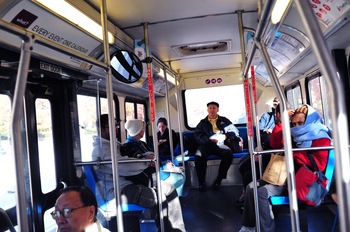
AATA officials are working to expand services throughout the county already, even before the creation of a new countywide transit authority.
Ryan J. Stanton | AnnArbor.com
"We're making progress on actually moving forward with the early parts — some aspects of the transit master plan — even in the absence of any new funding," Nacht said. "So we currently still plan on having airport service beginning in October, even though our proposed federal funding source was denied. It may not be at the scope or level that we hope to eventually have, but we are working with partners and this is going to be a significant new service."
CEO Michael Ford said AATA officials have been in talks for several months with representatives from Michigan Flyer, a motor coach service providing frequent shuttle trips to and from East Lansing, Jackson, Ann Arbor and Detroit Metro Airport.
Ford said AATA officials are aggressively pursuing funding for an airport shuttle service with an Oct. 15 target start date. While the AATA wasn't able to obtain a federal grant for which it applied, it has received notice from the Michigan Department of Transportation that airport service will be eligible for state operating assistance. That would cover about 30 percent of the cost.
The idea, Ford said, is to provide a service to residents that's convenient and affordable. It currently costs about $10 a day to leave a car parked near the airport.
"Right now the proposal is 16 trips a day," Ford said. "Basically the concept is leaving from Blake Transit Center, probably no more than two stops from there, and being able to complete that service within 40 to 45 minutes. I'm trying to work on something that will allow parking at a minimal cost at Fourth and William or even potentially free. I'm also talking to other private and public sector folks to see what other funding we can come up with."
As far as service between Ann Arbor and Ypsilanti, the AATA extended its Night Ride service outside of Ann Arbor east to Golfside Road on April 4. Ford said staff is monitoring the service to assess what it would mean to expand it all the way to Ypsilanti.
The AATA also is working to obtain funding commitments from public and private partners to increase the frequency of service on the Washtenaw Avenue route between Ann Arbor and Ypsilanti. The earliest new service would begin is January 2012, primarily due to the need for additional buses, Ford said. An order of new buses is scheduled to arrive later this fall.
"We've got some different scenarios on how much it's going to cost," he said, adding it could be as much as $300,000. "Part of that will be getting some private sector dollars to make that happen. We're trying to work with good community partners that see the value in that. We'll continue to work on that and our hope is to have something solidified by August."
Carolyn Grawi, the director of advocacy and education for the Ann Arbor Center for Independent Living, told AATA officials she's excited about their expansion plans.
"I personally cannot wait for us to have transit that runs everywhere through this county so that we can all work, live and commute effectively," she said.
The 30-year master plan outlines a strategy that addresses various public transit needs in the county. It's expected to be implemented in incremental steps with continuous input from the communities, government entities and other local transit service providers.
Bernstein said endorsement of the 30-year plan is the first step in moving toward implementing the plan to create a regional body that will empower local communities in Washtenaw County to work together to determine transit services and funding levels.
What hasn't been determined is how to pay for the plan. Implementing it is estimated to require $465 million in capital costs over 30 years, and net operating expenses are estimated at $52 million annually. Not included is the current $27 million in base operating expenses.
"The question of funding is a question that needs a lot of discussion and study," Bernstein said. "As far as I'm concerned, we're nowhere near saying to the public, 'Here's what we're gonna do and when we're gonna do it.'"
AATA officials are working with local government officials from all of Washtenaw County’s townships, cities and villages to develop a preliminary regional board that will refine the transit service plan, by-laws and funding sources.
The preliminary regional board will work toward implementing the transit master plan and will take steps to formally incorporate a countywide authority.
Each community will have a 30-day window to decide if it wants to continue participating in the countywide authority. Should a community choose not to participate as a member of the incorporated authority, it would not contribute funding or receive transit service.
Nacht said the AATA hopes it can rely on its reputation for providing efficient transit services when officials potentially go to voters with a millage request.
"We're making progress in a way that we're going to be able to show the community, 'look what we've done without any additional funding — look at how we're accomplishing turning ourselves into a regional organization already,'" Nacht said. "And we think that will help make the case that we deserve the community's trust for some funds to proceed with the TMP."
Ryan J. Stanton covers government and politics for AnnArbor.com. Reach him at ryanstanton@annarbor.com or 734-623-2529. You also can follow him on Twitter or subscribe to AnnArbor.com's e-mail newsletters.
Comments
Eric
Fri, Sep 16, 2011 : 2:36 p.m.
I strongly support the new shuttle. My search for post grad schools was nationwide, and although I settled on U of M, it was a lot closer than it should have been. I specifically remember being stunned when I found out there was no public transit from AA to DTW, even though it's only a 30-40 minute trip; it made me question Ann Arbor as a serious city. Now my wife and I are here, paying property tax through our rent. I have no problem if some of that money goes to build a service that makes Ann Arbor more competitive and attractive, and that I will definitely use.
PatK
Mon, Jun 20, 2011 : 11:02 p.m.
The Night Ride Service and the shuttle to the airport ect. are all well and good but you still have not addressed a major & immediate problem on Washtenaw Ave. by Arborland. I live at Glencoe Hills Apt. and the only way I can get to Meijer is take the #7 to Briarwood and then the #6 to Meijer because I find it next to impossible with my physical limitations to cross Washtenaw Ave. near Arborland. All your talk about a 30 year plan does nothing for me and many other riders who are elderly or physically unable to cross a very busy and dangerous road to get where we need to go. If you can't solve this minor little problem in the near future, I don't hold out much hope for your ability to execute a 30-year plan
Peter Baker
Sun, Jun 19, 2011 : 4:10 p.m.
The airport shuttle is a no brainer. Every major American city that's trying to compete for jobs and companies looks at their infrastructure and major travel hubs as a place for investment. Modern American knowledge workers that are not tied to one company for thirty years choose where they work based on where they want to live, and public transportation ranks high on the list for the post-auto lifestyle. Ann Arbor gets it, and is trying, but Michigan's attitude towards anything non-personal-transport is hindering progress and making the state less competitive.
SonnyDog09
Sat, Jun 18, 2011 : 3:07 p.m.
So, let me see if I understand this. After spending several hours in a crowded airplane surrounded by crying babies and smelly people that take their shoes off, I am going to spend another 45 minutes to an hour on a cramped bus surrounded by crying babies and smelly people? No, thanks. I can't wait to get into my car after a long flight to escape from annoying people. The biggest problem with public transportation is being immersed in the public. Until they solve that problem, I'll keep driving.
sbbuilder
Sat, Jun 18, 2011 : 2:38 p.m.
A name change is in order. From now on, AATA will be called SEMTA, or South East Michigan Transportation Authority. Soon to be re-named WWTA, or World Wide Transportation Authority. Before you know it, they'll be offering space rides. But don't worry, they'll subsidise your parking fee while you are in space.
D
Sat, Jun 18, 2011 : 3:08 a.m.
And people in this state question why so many recent graduates leave Ann Arbor and the state of Michigan. Its because people refuse to solve the straight forward problems such as transportation. A simple mass transit option to the airport exists in virtually every large metropolitan area in this country except Detroit. Its really a huge expense to drive to the airport and park or pay the exorbitant fees for a taxi or shuttle. As a life long Michigander it is disappointing to see that our region routinely tries to avoid solving problems like these when other regions have found a way to solve them decades ago. Maybe this is why Michigan is the butt of so many jokes and Metro Detroit is the poster child for the failure of urban policy in the U.S...
blahblahblah
Sat, Jun 18, 2011 : 2:16 p.m.
#1 reason why grads are leaving the state is lack of jobs. #2 reason is our state's largest city, Detroit has been on a downward spiral for the last 40 years, so we should stop trying to compare an apple (Chicago) to an orange (Detroit). Mass transit is not a "straight forward" problem which can be easily resolved. The unemployed youth will still leave our state whether riding public or private transportation. Let's just boil this argument down to the chicken or egg thing, which comes first? Jobs or public infrastructure? For now since the state and fed government are essentially broke and huge debtors, no one has identified where the funding will come from other than an additional millage vote.
John B.
Fri, Jun 17, 2011 : 10:09 p.m.
As a point of comparison regarding getting to the airport: the last time I was in Minneapolis, I rode the bus to a business meeting (ticket cost: about $1 or $1.50, I forget) the last morning I was in town. That ticket automatically included one free use of any other city bus/train for the next four hours. Three hours later, I rode the excellent train to the airport at no charge. It arrived inside the terminal, maybe 200 yards from the ticketing agents. Wow. We are light-years behind them. Let's get moving on this.
Sallyxyz
Fri, Jun 17, 2011 : 9:30 p.m.
If the AATA airport shuttle plans to leave from Blake, there needs to be some serious clean-up of that station and area. If business people, students, professionals, retirees, etc., are going to take the shuttle to the airport and return to A2, they are not going to want to sit in a dirty bus station with sketchy types hanging around (some asking them for money), especially if arriving in the evening. The Blake station is not clean and not safe at night.
bunnyabbot
Fri, Jun 17, 2011 : 9:14 p.m.
why take up parking in downtown for people that want to go to the airport? if they want to ride the bus let them take the bus to the connecting bus that goes to the airport and have them leave their cars at home. AATA wouldn't provide the necessary security of having long term cars parked in a lot like the parking lots at the airport do (which is something you are paying for). Most of the parking lot services at the airport by the way have coupons on their websites, so generally you can get a free day of parking if you buy two (coupons change monthly) or something like that. They also usually have coupons printed in the entertainment coupon books that come out once a year. Meanwhile you can look for rideshare to and from the airport, try craigslist. If you are leaving ask a friend or relative to drive and pick you up and then spot them a 20 for their effort or something.
John B.
Fri, Jun 17, 2011 : 7:14 p.m.
I nominate this for Comment Of The Day (thank you, Big B): @InsideTheHall Right, that's (how) most government services work. I'm a tax payer and happy to see my money going towards something like this. I suppose you'd like us to have a private military, have all roads be toll roads, pay the fire department with a credit card each time we call them and so on. There are some things that need to be subsidized, public transportation is one of them. Public transportation helps to avoid wear and tear on roads, which saves tax payers money. It also allows lower income workers to get where they need to be without the expense of owning a car, which allows everyone to have cheaper services from the public and private sector. Established bus (and train/light rail) stops also spur real estate investment and growth. Things relating to public transportation, and other government services, are much more interconnected than simply looking at whether fares cover operating costs.
John B.
Fri, Jun 17, 2011 : 7:04 p.m.
Oh, the poor privateers that will lose their monopolies/oligopolies! Oh, the horror! Kind of like the Moroun family losing theirs - I'm all for both occurring. Don't buy the misinformation.
Tru2Blu76
Fri, Jun 17, 2011 : 6:35 p.m.
Can't blame people for being confused by our economic system:but it's a purposeful conflict made up to favor "private enterprise" over "public services." On one hand, we see the impossibility of a "pure" free market system: Privatizing everything, supposedly reducing costs but failing, first fragmenting the supply-side, then consolidating it through monopolization. That, and by fiat, moving -all - "property" into the hands of a few people who have only the profit motive in mind: is what the "Free Market" actually produces. I agree that taxing only homeowners is the real flaw in this (and similar) schemes. That can be changed so that a combination of user fees and properly conceived, broader, taxation provides all the funding. This flaw is NOT reason to toss the whole program out (as is wanted by Free Market Mavins). "Public transport puts private jobs at risk" - this old argument is just part of the above bogus assumptions about the "virtue" of the Free Market. It's also argued that: "private jobs here can be traded for private jobs overseas." - Dangerous propaganda nonsense. The NEW public transport jobs created by expanding AATA services would offset the private transport jobs now in existence. It's costs $8 to go 1.6 miles by taxi in this town. It costs at least $25 for a seat on a private airport shuttle. Do the math!
John B.
Fri, Jun 17, 2011 : 6:44 p.m.
Precisely. (minor correction, though - that would be 'mavens').
Pika
Fri, Jun 17, 2011 : 5 p.m.
PLEASE add the Airport Shuttle. It is so long overdue. It is almost impossible to get to the airport these days now that the taxi driver syndicate has blocked any other Limo-service transportation. It is a minimum of $40 to get from AA to the Airport. And unless you know somebody who can drive you you have no choice - that is outrageous.
Marvin Face
Fri, Jun 17, 2011 : 4:51 p.m.
I'm at the airport 2-3 times a month and since I dont drive, I take Metro Cars. It's only about $60 each way including tip. The last thing I want to do after getting back from a trip at 11pm is wait an hour in the Sky Club for a trip back to AA on a hard-seat bus. Since the nearest bus route is about a quater mile away (and who knows if they will run that late anyway), I haul my luggage in the snow/rain home. Not for me, thank you.
a2scio
Fri, Jun 17, 2011 : 4:39 p.m.
I vote for a bus route that goes out Liberty to Wagner and/or Zeeb. This us an unserved area. Than you.
Jennifer
Fri, Jun 17, 2011 : 4:14 p.m.
There needs to be service options in the townships as well. Where I live in Ypsi Township I have to basically drive to then catch the bus. It would be great to have some public transportation options out in the township.
Wolf's Bane
Fri, Jun 17, 2011 : 3:31 p.m.
What we really need is a high speed rail service to the airport, not a eco diesel bus!!!
mun
Fri, Jun 17, 2011 : 3:12 p.m.
To all the opponents of AATA offering shuttle services, I'll support your position when you stop driving on the GOVERNMENT roads and highways.
Veracity
Fri, Jan 20, 2012 : 4:50 p.m.
Right! And we support these routes with our taxes. Well, guess what? Expect our taxes to go up because the new airport shuttle service will not be self-sustaining financially and no one wants other AATA services to be reduced in order to allow funding of the airport service. Have you ever checked out the plentifully available private shuttle services in Ann Arbor which have similar fees but are more flexible and convenient?
Wolf's Bane
Fri, Jun 17, 2011 : 2:57 p.m.
Useless going to the airport if they don't improve sticking to an actual schedule.
mun
Fri, Jun 17, 2011 : 1:50 p.m.
As an Ann Arbor resident and taxpayer, I'm looking forward to AATA shuttle service. 2 months ago, I used a private shuttle and as soon as the driver picked me up from my home, he had a crappy attitude. He said he tried callling my home saying he was coming but I didn't answer (he NEVER called me, his dispatcher did).
mun
Fri, Jun 17, 2011 : 2:43 p.m.
@JSA The private shuttle charged me $40 one way. For that kind of money, he should be professional. I've rode AATA and had no problems with their drivers.
JSA
Fri, Jun 17, 2011 : 2:16 p.m.
And you think an AATA can't have a crappy attitude?
Thomas
Fri, Jun 17, 2011 : 1:48 p.m.
Thanks AATA for moving forward on this! I can't wait for the shuttle to the airport - when my family comes in, I'm telling them to hop on and I'll pick them up closer to home! I also plan on using it. I've always had to either ask friends for early morning rides or get an expensive car service. I'll gladly trade an extra 20 minutes in travel time for the money I save. Thank you!
Veracity
Fri, Jan 20, 2012 : 4:46 p.m.
Thomas, I dislike bursting your enthusiastic bubble but private airport shuttle services exist that will charge you a similar fee but pick you up at your front door and at any time of your selection. Google "airport shuttle Ann Arbor" to find a list of available services.
JSA
Fri, Jun 17, 2011 : 1:20 p.m.
Does anyone have any idea how much money AATA has wasted trying to shove their vision down our throats? I wouldn't put them in charge of a sandbox much less a county wide transportation system. They show a lot of ambition and a total lack of understanding of public opinion on a county wide transportation millage. They mayor and his buddies must plan to make a fortune the way they keep pushing his choo choo's.
tdw
Fri, Jun 17, 2011 : 1:15 p.m.
Geez....Ann Arbor wastes a ton of money.But I live in Ypsi Twp so I don't care.Let you guys foot the bill for the entire county. BTW I have never used the bus.
John B.
Fri, Jun 17, 2011 : 7:07 p.m.
Guess you missed the part about each area having the capability to opt-out of the county-wide system, huh?
Ignatz
Fri, Jun 17, 2011 : 12:53 p.m.
I'd like to point out the privately owned transportation operate in order to make a profit. Nothing wrong with that, but they tend to do that by utilizing the times and routes that will maximize those profits. Public operated services strive to serve the whole community regardless of profit. There's more to life than just money.
Mike D.
Fri, Jun 17, 2011 : 12:44 p.m.
Competing on a route where private industry already offers compelling, inexpensive service is all the proof I need that this "master plan" is a costly bad acid trip.
Mike D.
Sun, Jun 19, 2011 : 2:27 p.m.
If you can't afford $40 to get to the airport, don't fly.
John B.
Fri, Jun 17, 2011 : 7:02 p.m.
Nice talking points, those - but false. The current services are not inexpensive.
Big B
Fri, Jun 17, 2011 : 3:19 p.m.
Inexpensive is relative. Cheapest round trip service with a shuttle or bus I've found is $40-$50
Christopher LeClair
Fri, Jun 17, 2011 : 12:02 p.m.
The only thing I care about is that Airport Shuttle! :) It's perfect for Ann Arbor, especially during the school year when so many out-of-state students fly in and out. Think about how much easier it would be to host conferences in Ann Arbor, with all the upcoming public transport ideas coming out.
grye
Fri, Jun 17, 2011 : 12:58 p.m.
I can see all those people wanting to come to Ann Arbor for a conference just clamoring to get aboard an AATA bus. Do you not realize that the majority of these people would be business oriented and that the expense of shuttle service is deductible? Most will take a private car or taxi. They will not want to wait for the "BIG" aata bus.
blahblahblah
Fri, Jun 17, 2011 : 12:38 p.m.
Yes, we need to lower the commuting costs for those poor out of state U of M students so they can still afford their luxurious new apartments downtown.
Christopher LeClair
Fri, Jun 17, 2011 : 12:33 p.m.
*for Ann Arbor
Christopher LeClair
Fri, Jun 17, 2011 : 12:31 p.m.
You are ignoring the benefits of Ann Arbor as a whole. We do not live in a vacuum but rather as a society. The economic fortunes of Ann Arbor are wholly tied to the economic fortunes of each individual living here.
InsideTheHall
Fri, Jun 17, 2011 : 12:23 p.m.
Mr. LeClair, when you begin paying taxes your views will change. A bus shuttle to the airport can hardly be considered..."Well you know, its for the public good."
Brad
Fri, Jun 17, 2011 : 12:17 p.m.
The great idea being ... a shuttle to the airport where someone else is paying part of *your* tab. Is that what you mean?
Christopher LeClair
Fri, Jun 17, 2011 : 12:13 p.m.
Government subsidies are sometimes required in order to facilitate cheap options for people. The current shuttles seem rather pricey but if the price was halved I can bet you more people would be taking it. I feel like even their predictions on how many people use the service are low, and we will all be surprised at how great of an idea this was.
InsideTheHall
Fri, Jun 17, 2011 : 12:08 p.m.
Perfect? It can only be perfect if the service can cover operating expenses without government subsides. AATA admits that it cannot.
SonnyDog09
Fri, Jun 17, 2011 : 12:02 p.m.
regarding the new, aata airport shuttle: "...being able to complete that service within 40 to 45 minutes." Note that the drive from a2 to the airport takes twenty minutes. Why on earth would I want to drive my car downtown and then take twice as long to get to the airport as it takes me to drive there directly from my house? I don't understand who they are marketing this new aata service to. And I really don't understand how they expect to compete with existing options.
John B.
Fri, Jun 17, 2011 : 7:10 p.m.
The drive to Metro from where I live takes 35 minutes. Twenty sounds a bit unrealistic, but it is whatever it is. Time is money, so trading a bit of time to save quite a bit of money sounds fine by me.
mun
Fri, Jun 17, 2011 : 1:53 p.m.
The private shuttles cost at least $30-$40. I'll happily take AATA if it means paying less.
Thomas
Fri, Jun 17, 2011 : 1:45 p.m.
And, I'll happily trade 20 minutes for 40 minutes if I don't have to pay $10 a day to store car as well. For a weeks vacation, you'd rather make the drive in 20 minutes and then pay $70 to store your car at the airport just to save 20-25 minutes in travel time?
Big B
Fri, Jun 17, 2011 : 12:42 p.m.
If you live near a bus line, you wouldn't have to drive downtown, you could just hop on the bus and take it downtown, leaving your car at home. No other shuttle offers that. They'll compete by offering a no car option and most likely by being cheaper. In other cities I've lived in a $3 fare would get you to the airport.
Big B
Fri, Jun 17, 2011 : 11:57 a.m.
Love the idea that I could get to the Airport from any bus route. Just walk out the door and in about an hour be at the airport.. awesome. Michigan Flyer is nice, but it's still $20-30 per person round trip to the airport, plus baggage fees. And you have to drive to and pay for parking at the hotel. So it doesn't break even against parking at the airport until you're taking a trip that's longer than 4 or 5 days. The van shuttles are similar, about $60 round trip for the first person. I can't wait for a service like this. It'll help keep cars of the road, save travelers like me money and aggravation, and will be great for people without cars, like students. Thank for for the progressive thinking AATA.
mun
Fri, Jun 17, 2011 : 1:55 p.m.
@Inside The Hall, I am one of those taxpayers and I look forward to using this service, especially after my bad experience with one of the private shuttles driver.
Big B
Fri, Jun 17, 2011 : 12:24 p.m.
@InsideTheHall Right, that's most government services work. I'm a tax payer and happy to see my money going towards something like this. I suppose you'd like us to have a private military, have all roads be toll roads, pay the fire department with a credit card each time we call them and so on. There are some things that need to be subsidized, public transportation is one of them. Public transportation helps to avoid wear and tear on roads, which saves tax payers money. It also allows lower income workers to get where they need to be without the expense of owning a car, which allows everyone to have cheaper services from the public and private sector. Established bus (and train/light rail) stops also spur real estate investment and growth. Things relating to public transportation, and other government services, are much more interconnected than simply looking at whether fares cover operating costs.
InsideTheHall
Fri, Jun 17, 2011 : 12:06 p.m.
Reality Check: If it saves you money who is picking up the tab for you???? The taxpayer! AATA admits that the 30 year plan cannot cover operating expenses without government subsidies and that means taxpayer dollars.
cbirm
Fri, Jun 17, 2011 : 11:56 a.m.
The bus had better expand its route to come further down Jackson rd next fall to pick up kids for Skyline High, if it is truly the case that school busses will not be picking up high school kids next fall.
Thomas
Fri, Jun 17, 2011 : 1:43 p.m.
A half a mile is not that far. Buy him a neon green vest and give him a flashlight. If you don't think he can handle it, you haven't done a very good job of teaching him how to be self sufficient and independent.
kms
Fri, Jun 17, 2011 : 1:14 p.m.
There will still be busing but with significant changes. Bus stops will be at centralized locations at least 1/2 mile apart. I'm worried about what that means for my son, walking 1/2 mile in the pitch dark with no sidewalks.
blahblahblah
Fri, Jun 17, 2011 : 11:49 a.m.
AATA CEO said, " I'm trying to work on something that will allow parking at a minimal cost at Fourth and William or even potentially free." So now we are not only subsidizing the ride, but subsidizing the parking too? It seems this plan would encourage people to drive their cars downtown, take up prime downtown parking space for weeks on end while taking off on vacation. Sounds a bit like the Fuller Station parking garage plan, let's encourage even more people/commuters to drive their cars to the center of town. All in the name of public transportation!
ypsi
Fri, Jun 17, 2011 : 11:42 a.m.
Its a shame to put local airport shuttle's out of business.
Tintin Milou
Fri, Jun 17, 2011 : 8:26 p.m.
Well, maybe I shouldn't be that sarcastic next time. But sometimes it helps to make the point of how inconsistent people's comments are about AATA on the one hand, and the discussion about cutting public schools' budget for school buses on the other hand: "Let's put AATA into jail for wasting our taxpayer money... . Oh, they wanna cancel the school buses! No way, we need public transport (=school buses) to get our kids to school. Let's cut the teachers' salaries." I hope I made clear which side I'm on.
mun
Fri, Jun 17, 2011 : 3:59 p.m.
So why not let us consumers decide if we want to use private or public airport shuttle? Why not let the market forces work themselves out? And I thought pro-business people are for competition.
mun
Fri, Jun 17, 2011 : 3:10 p.m.
"AATA officials have been in talks for several months with representatives from Michigan Flyer, a motor coach service providing frequent shuttle trips to and from East Lansing, Jackson, Ann Arbor and Detroit Metro Airport." Where in the article does it saythey are using public school buses for airport transit?
mun
Fri, Jun 17, 2011 : 2:48 p.m.
@Tintin Milou, The school buses are a necessity to take kids to school. You think it's a luxury?
mun
Fri, Jun 17, 2011 : 2:47 p.m.
"Let's leave the bus in the depot and let the kids take the cab." You think parents of AA school kids should trust their kids with a cab driver? At least the AA school bus drivers know the routes.
Tintin Milou
Fri, Jun 17, 2011 : 2:39 p.m.
Yeah. I have similar thoughts on the school bus story: There are several dozen cab services in Ann Arbor. Let's leave the bus in the depot and let the kids take the cab. The drivers are friendly, the cabs are clean and the costs very reasonable. I doubt public school busses could compete on anything but price and then only because of the subsidy that they get. It is a shame to put a private business out of business with tax payer dollars. DonBee, thanks for your comment and it's great to have so many people in this forum agreeing with us on that!
DonBee
Fri, Jun 17, 2011 : 11:19 a.m.
There are 6 or 7 door to door van services from Ann Arbor to the airport. Leave your car and home and take the van. The drivers are friendly, the vans are clean and the costs very reasonable. I doubt AATA could compete on anything but price and then only because of the subsidy that they get. It is a shame to put a private business out of business with tax payer dollars.
Steve
Sun, Jun 19, 2011 : 3:26 a.m.
You're forgetting about people who aren't from Ann Arbor. Having a low cost and predictable option to and FROM the airport will be one less obstacle to attracting business to the area. Think big friend.
DonBee
Sat, Jun 18, 2011 : 2:52 a.m.
Mun - I am all for fair competition, but if I give you 75 percent of your cost so you can offer your service for 25 Percent of the cost of your competition, is that fair? I like the van services - the one I use costs $25 round trip, with door to door service each way. Way better than the Metro Cars at $70 each way. The drivers are nice and helpful, getting baggage on and off. On early runs they typically have fresh coffee, on pickups water. If AATA could offer the same service for $7 or 8 per round trip it would put all the vans out of service and they would do it by using taxpayer money.
mun
Fri, Jun 17, 2011 : 3:58 p.m.
"It is a shame to put a private business out of business with tax payer dollars" So why not let us consumers decide if we want to use private or public airport shuttle? Why not let the market forces work themselves out? And I thought pro-business people are for competition.
mun
Fri, Jun 17, 2011 : 3:07 p.m.
If AATA can do it cheaper than the private shuttle companies, which charge $30-$40 plus, than I'm all for it. As a taxpayer, I view it as getting more out of public services.
Thomas
Fri, Jun 17, 2011 : 1:42 p.m.
I would MUCH rather pay $10 and get a ride to the airport than $50 and then feel like I have to tip the guy.
blahblahblah
Fri, Jun 17, 2011 : 12:01 p.m.
Agreed. We are very fortunate to be so close to the airport. In addition to the many fine shuttle services, relying on family and friends for rides is definately the least expensive option (as long as your willing to return the favor of course).
DonBee
Fri, Jun 17, 2011 : 11:24 a.m.
"Your car and home" should read "your car at home"
McGiver
Fri, Jun 17, 2011 : 10:55 a.m.
I just looked at the Michigan Flyer service website and find this an attractive alternative for transportation to/from the airport. With $2.00 parking fees per day, it can make the cost of the bus ride ride cost effective. My only question for AATA, is why they think they need to horn in on this business.
5c0++ H4d13y
Fri, Jun 17, 2011 : 9:35 p.m.
@Pika If you can afford a plane ticket you can afford the bus or the cab to get to where MF picks up on Boardwalk.
Pika
Fri, Jun 17, 2011 : 8:14 p.m.
So if you don't have a car you are just out of luck?
sh1
Fri, Jun 17, 2011 : 10:47 a.m.
Like the idea of an airport shuttle. Would like to know the cost.
Steve Hendel
Fri, Jun 17, 2011 : 10:30 a.m.
They will have to do a lot of persuading if they expect Ann Arbor taxpayers, who already pay @ 2 mills in property taxes for public transportation, to pay an additional amount as part of a County-wide levy.