

AATA officials say countywide transit tax could go to Washtenaw County voters in May
Ann Arbor Transportation Authority officials predict ridership would increase by 3.6 million trips per year — to an estimated 9.6 million — within five years of a new countywide transit system.
That's if all of the proposed service improvements included in a new five-year countywide transit plan released on Wednesday are implemented.
To finance those improvements, AATA officials said on Wednesday they're planning to seek a countywide levy of 0.584 mills — an amount that would cost about $1 a week for most Washtenaw County taxpayers — and the millage could go before voters as soon as May 2013.
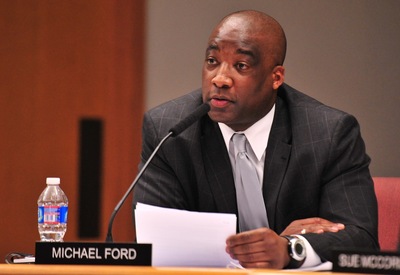
AATA CEO Michael Ford
Ryan J. Stanton | AnnArbor.com
"Our residents and our communities have to connect to prosper and thrive," Ford added. "This plan will serve the transit needs of residents and businesses regardless of where they live in Washtenaw County, while also promoting regional economic development and a better quality of life.”
AATA officials are confident funding for countywide mass transit has support from a majority of Washtenaw County residents. They cited a March survey showing 59 percent of likely voters would support a 1-mill tax to fund a new countywide transit agency.
Ford noted the plan released on Wednesday calls for a new millage that is almost half that amount, which should strengthen support for a 2013 millage request.
The new five-year plan includes projected operating and capital expenses that total nearly $223 million over the five-year period. The five-year expenditures would be offset by an estimated $184.2 million in revenue, resulting in a gap of $38.8 million.
The plan proposes an array of public transit improvements throughout the county, including a 56 percent increase in service hours in Ann Arbor and Ypsilanti, more frequent service, more routes and fewer transfers, more affordable fare choices, and extended weekend and late-night service.
It also includes more service for Chelsea, Dexter, Milan, Saline and other communities that are going to be asked to pay into the system through the new countywide millage.
AATA officials said safeguards are in place to ensure current transit services will be maintained. Should a new countywide authority be formed, they said, Ann Arbor's 2-mill transit tax and Ypsilanti's 1-mill transit tax would be used to fund ongoing services within each community.
The new plan represents a short-term vision for public transportation in Washtenaw County and creates a blueprint to begin implementing the 30-year vision previously developed.
AATA officials said the vision is a culmination of more than two years of work in obtaining input from citizens, officials and civic leaders representing local governments from throughout county.
In order to ensure all communities that wish to participate in countywide transportation will have a voice in the decision-making process, the AATA established districts representing every local government unit in the county and each district selected a representative.
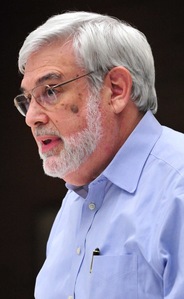
Jesse Bernstein
All Washtenaw County residents are invited to learn about the five-year plan at any one of eight public meetings scheduled in September. The dates and locations are located at MovingYouForward.org.
Meetings are being held in each of the eight districts throughout the county. The one in Ann Arbor takes place from 6:30-8:30 p.m. Sept. 24 at the downtown library.
The next major step in the countywide transit expansion process involves having the AATA board and representatives from other communities serving on the “unincorporated 196 board” request that the county clerk file incorporation papers to create a new authority.
The AATA will notify all local governments of the filing. Each local government will have 30 days to respond as to whether it will participate in the new authority. Communities that opt out will not be part of the authority nor receive any services paid for with voter-approved funding.
If approved by voters, the AATA's assets would be transferred to the new authority, which would be governed by a new 15-member board. Ann Arbor would receive seven appointments to the new board, with the other board members representing other parts of the county.
Ryan J. Stanton covers government and politics for AnnArbor.com. Reach him at ryanstanton@annarbor.com or 734-623-2529. You also can follow him on Twitter or subscribe to AnnArbor.com's email newsletters.
Comments
shepard145
Thu, Sep 6, 2012 : 10:31 p.m.
Nobody who has a choice wants to or will ride buses to work every day. Those with no choice, no money and little luck will do what they must to get around and that's who we are paying for here. The results of this "study" were per-determined by the massive committee that wrote it. Most were bus people, many others where politicians and professional seat fillers who probably had little idea what was going on in those meetings but were happy they were on the list. A small minority of actually understand the value of permanent mass transit and had the displeasure of sitting at the table while buses were smashed into the lamest transit plan yet that once again successfully ignores what the rest of the country figured out decades ago. ...but I'm sure it made the auto industry happy and they are true masters of Michigan's future whether voters like it or not.
Lastand
Thu, Sep 6, 2012 : 4:30 p.m.
"The new plan represents a short-term vision for public transportation" In other words this millage is just a down payment. The really big tax comes later.
Razor
Thu, Sep 6, 2012 : 4:06 p.m.
"NO" vote coming from this county voter!!!!!
Basic Bob
Thu, Sep 6, 2012 : 3:50 p.m.
They should start building the moat around Ann Arbor now. Toll bridges too.
SEC Fan
Thu, Sep 6, 2012 : 5:23 p.m.
ooohh...ooohhh...with gators! that'd make me feel right at home :-)
outdoor6709
Thu, Sep 6, 2012 : 3:44 p.m.
I have checked into who pays. If your community opts out you will not pay the tax. You also will not get to vote on the milage. Also the current proposed milage is a proposal and could end up on the ballet as high as 1 mil. Since several townships have already said they will opt out. Higher rate is more likely than lower rate.
CynicA2
Thu, Sep 6, 2012 : 3:28 p.m.
Stomp on this incredible boondoggle with both feet - send a message to these thieves. Vote NO, whether in November or May or whenever.
Top Cat
Thu, Sep 6, 2012 : 3:12 p.m.
My "vision" is that they stick to running their near empty buses in Ann Arbor and let the rest of keep more of our own money. Put this on the ballot so we can reward your arrogance.
mr_annarbor
Thu, Sep 6, 2012 : 1 p.m.
I wonder how other communities like Ann Arbor have tackled this problem. On the one hand, there are some real opportunities here. Having a first class transportation system would be a big plus for us. Public transportation is a big draw for young people these days. Not having one will hamstring us when it comes to attracting new companies and talented young people to Ann Arbor. On the other hand, I think the AATA is being just crazy in thinking that some of the outlying townships will want to participate in this expansion. At best, those townships will get minimal service that will be very inconvenient to use.
Ricardo Queso
Thu, Sep 6, 2012 : 12:53 p.m.
I'll say it again. Another attempt to build union coffers and pension plans.
Basic Bob
Thu, Sep 6, 2012 : 3:52 p.m.
That should encourage some progressive votes.
Ron Granger
Thu, Sep 6, 2012 : 12:50 p.m.
It seems that transit cost projections are Never, Ever correct. Just look in any other city for the long list of excuses that will be used for the never ending requests for more funds to support transit. Ann Arbor is just a tiny little town, where the politicans have absurdly huge fantasies of monorails and trains and buses to every little village. There is no vision, no plan. It is more like "anything we can get". All paid for by your tax dollars. I support public transit in a limited way. But not "Buses, trains and monorails to Nowhere".
walker101
Thu, Sep 6, 2012 : 12:19 p.m.
Progressives just do not when to stop, keep taxing and within 5 years you'll be taxed at 50% of your income for the have nots, don't you just love it. A new 15 board members, are they volunteers or are they paid staff, maybe thats why they need the milage increase.
a2trader
Thu, Sep 6, 2012 : 12:03 p.m.
The AnnArbor.com poll back in February - follow the links in this story - showed 50% of people said they were Definite NO on a millage for the bus. I'd say that when you add the other 13% Probably NO voters, this millage is just a big waste of time. Either that or AATA is just better at doing surveys that find the rare person who thinks this is a good idea. Wish I could vote it down in November rather than waiting for the inevitable.
Jeffersonian Liberal
Thu, Sep 6, 2012 : 11:56 a.m.
Cold day in Hell.
outdoor6709
Thu, Sep 6, 2012 : 11:51 a.m.
So do we get to opt out of the service and milage or just opt out of the service and still have to pay the tax when the tax passes?
acme
Thu, Sep 6, 2012 : 11:18 a.m.
This plan is bad for everyone except the employees of AATA. I live in the outlying area of Ypsi Township and we get very little benefit for our money. It would be quicker and easier to walk to the city than to rely on a first come - first served van that would drive in circles to pick up random riders scattered across a low density population just to be dropped off at a bus stop that runs once every 40 minutes. Here's a likely scenario: Spend 30 - 60 minutes on a van (if you're lucky enough to be one of the first to call) to be dropped at a bus stop for a 40 minute wait. 10 - 20 minutes to get to the transit center,5- 10 minute wait for a 45 minute bus ride to the AA transit center, and then a 5-45 minute wait for the bus to arrive for your destination, and finally the transit time to your destination where you will probably be dropped off at some distance from where you want to go and have to walk to get there. Could possibly be a 3 hour plus commute to a destination easily reached in less than 30 minutes by car. And this "service" is very expensive due to the low density population, fares wouldn't pay for costs, and would be heavily subsidized by Ann Arbor residents due to their high property values. I sure hope that each community gets to vote this transit plan down individually and that if the majority in the township doesn't want this "service" then the majority in the 2 cities can't force the whole county to pay. If I wanted bus service, I would have moved to a high density, urban environment. Keep your buses/high priced vans out of my rural neighborhood.
HB11
Thu, Sep 6, 2012 : 11:01 a.m.
Why wait until May? I'd like to vote NO in NOvember.
SEC Fan
Thu, Sep 6, 2012 : 5:18 p.m.
@Dilbert...all depends on the result you're trying to manipulate.
Dilbert
Thu, Sep 6, 2012 : 2:36 p.m.
http://annarborchronicle.com/2012/06/19/differences-on-countywide-transit-debated/ Conan Smith said he had two objections. The first was philosophical – the idea that a larger election is a better election "doesn't fly with me." In a presidential election year, for example, turnout is higher but there's a significant drop-off in votes for ballot proposals. For elections with lower turnouts, he said, you might get more informed voters. So restricting the timing of ballot proposals based on highest turnout might not be the best way to go, he said.
SEC Fan
Thu, Sep 6, 2012 : 12:22 p.m.
lower voter turnout in May, better chance of passing...November is a presidential election.
GP
Thu, Sep 6, 2012 : 5:33 a.m.
Each local government has to opt in to the service. Dexter, Chelsea, and Saline will probably not do this for reasons I could only speculate and get censored if I put them in writing.
outdoor6709
Thu, Sep 6, 2012 : 3:49 p.m.
GP you are incorrect. The charter says governments have 30 days to opt out. If they fail to opt out it takes a 2/3 vote to opt out after 30 days. You are correct that most of the rural communities will opt out.
Dilbert
Thu, Sep 6, 2012 : 2:32 p.m.
Wrong! Each local government can decide to OPT-OUT, if Dexter/Chelsea/Saline do nothing, they are automatically included.
Veracity
Thu, Sep 6, 2012 : 3:46 a.m.
The 4-Party County Transportation Authority (4-PCTA) will come into existence only if Ann Arbor voters approve an additional 0.584 mills. The millage deserves to be defeated for at least the following three reasons: First, the predicted increase in the use of public transportation in the county has not been supported by factual information nor its documentation. Though the creation of jobs in Washtenaw County has increased in the past two years, more rosy predictions by UM economists for continued job growth over the next few years have been reduced. And few pundits predicted the great recession that hit us during 2007 and 2008. No one can be sure that another recession will occur in the near future that will destroy all expectations for population growth and the need for expanded transportation services. Secondly, the AATA projects the cost for the five year transportation plan without providing details such as the number and type of new equipment, roadway improvements, and increased salaries for additional staff. The basis for revenue estimates is not explained. And if the proposed millage is insufficient to sustain financial viability of the 4-PCTA no assurances have been offered that further millage or taxation will not be sought. Thirdly, Ann Arbor will have only a minority representation on the new 4-PCTA governing board which will allow Ann Arbor only seven representatives on its 15 member board. Though transit services for Ann Arbor citizens is purportedly "protected" no specific guarantees are written into any document. Nothing can prevent the 4-PTCA board from reducing and eliminating services within Ann Arbor and using Ann Arbor millage funds elsewhere. Ann Arbor tax payers will consider two other millages in November and tenuous city finances may soon require additional taxation considerations, the 4-PCTA millage in May should be defeated.
Veracity
Thu, Sep 6, 2012 : 2:47 p.m.
Ann Arbor citizens will use more than half of the services provided and provide more than half of the revenue to support its operations.
GP
Thu, Sep 6, 2012 : 5:36 a.m.
Please explain why Ann Arbor should have a majority of representatives when this is a county-wide initiative.
braggslaw
Thu, Sep 6, 2012 : 1:18 a.m.
A misguided waste of public funds to fund a personal empire. There is absolutely no value in this proposal.
Dog Guy
Thu, Sep 6, 2012 : 12:49 a.m.
We May voters (the few, the self-interested) never met a tax we didn't love. Sucking on government teat beats working for a living.
Ricardo Queso
Thu, Sep 6, 2012 : 11:14 a.m.
GP, we could probably buy each cab fare and it would still be less expensive. What is being created here is another funnel for union dues and pension obligations,
GP
Thu, Sep 6, 2012 : 5:43 a.m.
What about the people who are low income and use the bus service to get to work? They are contributing to society and paying taxes. Would you rather they stay at home and do nothing but live off the system? There are thousands of folks in the county that need the bus and many who can't hold a job because they need a bus route near them. I know this as fact.
Vivienne Armentrout
Thu, Sep 6, 2012 : 12:35 a.m.
Thank you very much for providing the text of the nw 5-year plan. I followed the link from the press release today and found on their moving you forward website no more than a very sketchy map without any full explanation of route chages. I will study this 200+ page plan eagerly.
Ricardo Queso
Thu, Sep 6, 2012 : 12:25 a.m.
What other organization can go "forward" knowingly running a deficit? Once again, screw the property owners.
annarboral
Thu, Sep 6, 2012 : 12:01 a.m.
Another classic example of an unelected bureaucracy running wild. More and more money for a problem that doesn't exist. If people want to ride and pay for bus service that's great. If people want ME to pay for THEIR usage of bus service that's WRONG.
Elijah Shalis
Wed, Sep 5, 2012 : 11:57 p.m.
My friend complained that bus service stops at 9pm when most jobs end. They should be running bus service to 10pm to accommodate people.
Mike
Wed, Sep 5, 2012 : 11:08 p.m.
Raise my taxes please! After watching the Democratic convention I am a convert that the governemtn can solve all of my problems and lift me up; as long as we tax more we ca expect more from opur government and benevolent president................makes me want to go out and get some Barack-ely for dinner (Michele is so cute)
SEC Fan
Wed, Sep 5, 2012 : 11:01 p.m.
maybe I don't understand (possible as I'm from the South), but all this talk about "transit", "transportation authority", and "ridership"...aren't we just talking about bus service? If so, why not state that clearly? My guess is if you re-worded the survey to say "would you support an extra tax for county wide BUS service", many of those positive responses would change. I do support public transportation...but I'd like to see a mix...something besides buses which takes 4 times as long as driving my car. Maybe I'm spoiled by having lived in Europe for so many years, but I frequently used it there as the travel time difference was not so significant. yeah, I guess adding a trolley to downtown AA might sound expensive, but what if it had been instead of the underground parking garage? How about doing that and adding service to some existing Park and Rides on the outskirts of town? It all comes down to convenience...whether you like it or not. Those who have an option will most often take the convenient mode.
Subroutine
Wed, Sep 5, 2012 : 10:58 p.m.
No.
sbbuilder
Wed, Sep 5, 2012 : 10:34 p.m.
I will vote NO. I will encourage everyone I know to vote NO. Forget the rhetoric. We're past that at this stage. I sincerely hope that this goes down by a huge margin. That way they'll be more hesitant to bring this folly to the table ever again.
RUKiddingMe
Thu, Sep 6, 2012 : 12:06 a.m.
sbbuilder; thanks for telling people; I think that's been the vital missing piece in bringing sense back to A2 spending; they rely on the trust, ignorance, or apathy of the voters. Please make sure you tell everyone to ALSO tell everyone THEY know, and so on. Unfortunately, no matter how badly it's beaten, they never seem hesitant to bring the folly.
David Cahill
Wed, Sep 5, 2012 : 10:17 p.m.
It is a violation of the state's Campaign Finance Act to use public funds to campaign for a millage. I hope the AATA and other transit boosters are careful to keep public funds (including staff time) away from the campaign. The AATA has already used substantial federal funding in putting together this unnecessary plan. Let's hope it doesn 't use such funds for its campaign. Or has it already started doing so? The Library is being scrupulously careful in avoiding such an overlap in the campaign for a millage for a new downtown library. The AATA should do the same.
outdoor6709
Thu, Sep 6, 2012 : 11:53 a.m.
You are kidding. AATA will have signs on its busses.
RUKiddingMe
Thu, Sep 6, 2012 : 12:03 a.m.
Mr. Cahill, I didn't know about that part of the Act, and thanks for mentioning it. Do you think that includes the wages paid to city council members? I wonder, now, if the Council members who are ALSO on the Public Art Commission, were using public funds, e.g their pay for being either a council member or PAC member, to plan their millage vote and campaign to sell the public art millage to STUDENTS and RENTERS.
RUKiddingMe
Wed, Sep 5, 2012 : 10 p.m.
This quote is representative of the entire project: "officials predict ridership would increase by 3.6 million trips per year — to an estimated 9.6 million — within five years of a new countywide transit system." They PREDICT. Give them this money, give them the ability to establish a whole new group of people being paid with tax money, AND WITH THE POWER TO ESTABLISH NEW AND/OR INCREASED PROPERTY TAXES WITHOUT PUTTING IT TO A VOTE, and they PREDICT ridership will increase. Keep in mind that the DOUBLED service along an ALREADY POPULAR route, and ridership increased 14%. They increased the service by 100%, they got a 14% ridership increase. And that was on an already popular, well-used route. That's the kind of info they use to justify this plan. They also did a survey with deliberately skewed and deceptive questions, like "is bus service important?" Please go to these public meetings and ask the questions that need to be asked, then, based on the answers (things like "we're not sure of that right now, but it's important, and we'll find out," or "we are confident that...") vote no. Ask them what evidence they have that people are waiting to make use of these new routes and buses. Ask them how many people take a bus that travels from distant communities NOW. Ask them how many dollars are necessary to pay for the increase in ridership they are predicting (e.g. even if their predictions are correct, is the money worth it). Ask them WHAT THE PLAN IS IF IT TURNS OUT THEIR PREDICTIONS WERE WRONG. Start noticing when AATA buses go by you, and look in them to see how many people are in them. There is no justification for this. It is establishing more people in roles that will consume more tax dollars. It is solving a problem that does NOT exist. If it's not overstaffed now, it WILL be. People will get raises. They will increase or make new property taxes. Vote NO
Brad
Wed, Sep 5, 2012 : 9:57 p.m.
Transit tax, art tax, new downtown library tax, Tomorrowland monorail tax ...
Homeland Conspiracy
Thu, Sep 6, 2012 : 11:54 a.m.
Rain water tax
outdoor6709
Thu, Sep 6, 2012 : 11:33 a.m.
Phase 3 of this project is portal to portal transport, don't forget the tax for that.
davecj
Wed, Sep 5, 2012 : 9:49 p.m.
So we lucky tax payers in Ann Arbor will continue to pay our current 2 mil tax, and get the joy of paying an additional .584 mil in taxes to expand service to Chelsea, Dexter, Milan, Saline and other places. Are they for real!
Mick52
Thu, Sep 6, 2012 : 12:52 a.m.
Huh? Baloney. Those of us in western Washtenaw are going to be taxed to support Ann Arbor and Ypsilanti for squat. All along I have against this since I have no idea how much service we will get. Without more than one or two buses a day it is pretty much worthless. I see this as a subsidy paid county wide for the higher populated areas with not enough service in return to to make it worth it. If I could see how much service we would get that might change my mind. You can't complain about paying more if your level of service is higher.
tdw
Wed, Sep 5, 2012 : 9:11 p.m.
Don't they realize that they are just wasting their time ?