

ACLU sues AATA over refusal of anti-Israel bus advertisement
The American Civil Liberties Union has sued the Ann Arbor Transportation Authority and CEO Michael Ford over the agency’s refusal to accept an advertisement calling for a boycott of Israel from pro-Palestinian activist Blaine Coleman of Ann Arbor.
The lawsuit filed Monday in federal court in Detroit alleges AATA violated Coleman’s First Amendment right to free speech and 14th Amendment right to due process. It argues AATA’s policy is vague and overly broad. It asks the court to order AATA to display the advertisement under the same terms offered to other advertisers and to award Coleman damages, court costs and reasonable attorney fees.
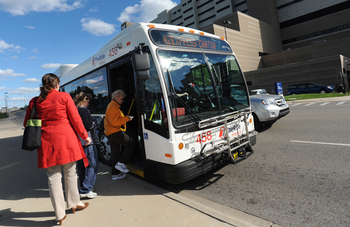
The American Civil Liberties Union has sued the Ann Arbor Transportation Authority over its refusal to accept an ad from pro-Palestinian activist Blaine Coleman.
Coleman sent AATA an email in December 2010 requesting information about how much it would cost to purchase an ad on the side or back of the bus that runs along State Street, South University, and North University on and near the University of Michigan campus, the lawsuit alleges. No one responded immediately, the lawsuit said, and Coleman sent several more emails in January and included a copy of the proposed ad with the words “Boycott Israel, Boycott Apartheid,” and a cartoonish black-and-white image that depicts a skeleton-like figure holding a skull in its right hand and a bone in its left.
In February, Randy Oram, president of the company that handles advertising for AATA, emailed Coleman telling him AATA’s advertising policy prohibited Coleman’s ad. Oram and the advertising company, Transit Advertising Group AA, are also named as defendants in the case.
The lawsuit alleges that AATA “almost never rejects advertisements for failing to comply with its advertising policy” and offers several examples to support that claim. As evidence, it notes that advertising policy prohibits ads supporting or opposing any candidate for political office or any ballot proposal, but the lawsuit alleges AATA ran political campaign advertisements supporting Joan Lowenstein and Margaret Conners for district court judge in 2008.
The suit also notes that AATA has accepted ads from religious organizations and run ads with messages such as “Breastfeeding makes babies smarter,” and “Two-Faced Landlords Can Be Stopped. Housing Discrimination Is Against the Law.”

The ad Blaine Coleman wanted to place on AATA buses.
The lawsuit goes on to state that ACLU lawyers wrote AATA’s board of directors in August telling them the advertising policy is unconstitutional and the refusal to run Coleman’s ad violated his rights to free speech and due process. The board on Nov. 17 then reaffirmed the decision to reject Coleman’s ad and stated that the ad violated AATA’s policy prohibiting any advertisement that “defames or is likely to hold up to scorn or ridicule a person or group of persons.”
The board also cited the wording in its policy that states AATA does not “intend to create a public forum,” that AATA reserves the right to approve all advertising and “all advertising must be considered in good taste and shall uphold the aesthetic standards as determined by AATA.”
The lawsuit alleges Coleman has suffered and continues to suffer mental anguish and distress as a result of AATA’s decision.
“For generations, boycotts have been an effective tool to raise awareness and effect change, and I personally believe that a call to boycott Israel is the best way to empower the Palestinian people,” Coleman said in a news release from the ACLU. “However, you can't have a boycott if the government won't allow you to speak like everyone else.”
Comments
bedrog
Mon, Dec 5, 2011 : 8:18 p.m.
The ultimate trump card against Blaine Coleman (and for the AATA's decision to reject his ad) is his quote in the article in which he expresses his outrage at "not being allowed to speak like everyone else". Anyone who has seen him in action knows that it his HIS---not the AATA's--- fault alone that he has NEVER chosen to speak "like everyone else", instead opting for defamatory, obscene signage , meeting disruption ( often violent) and utterly irresponsible and libelous accusations against those who disagree with his views, instead of civil informed discourse. If the AATA loses this it would be a further travesty of the judicial system ,which this lawsuit initiated by the ACLU dignifying Coleman's laughable claims with their imprimatur for Blaine's ( well deserved) "anguish" .
bedrog
Thu, Dec 1, 2011 : 2:01 a.m.
@contremilice...while I can see your point for a counter ad with suicide bomber trainees, it's a bit too broad a brush and would be prejudicial to innocent palestinians targets innocent . We don't want to be as ham fisted as Blaine and his supporters here. How about one like a T-shirt some were wearing a the coop anti- boycott actions awhile back: i.e. one with caricatures of the local hate mongers and the message to stand up for civic sanity and against anti semitism....or at least that's what i remember.
ContreMilice
Thu, Dec 1, 2011 : 4:48 a.m.
Bedrog, I'm sure you understand the irony in my comments about counter ads. I'm also certain that you realize that my hope is that no opposing placards will be necessary as, like in Seattle, this idiotic lawsuit will be defeated on the very strong arguments, merits, and precedent set by that fairly recent case. I think I know the t-shirt you're talking about. Yes, it accurately lampoons the cast of characters it depicts if I remember correctly. All the same, I think most people are blissfully unaware of who the monomaniacs are, what their fixation is, and how they have been manifesting that obsession over the years. That is, I fear that the subtlety of such caricatures will not be understood by any but those who are already familiar with this crew's shenanigans and their ongoing spectacle.
bedrog
Thu, Dec 1, 2011 : 2:28 a.m.
@ myself typos/ run on in my above: i meant to say simply the proposed suicide bomber ad would be prejudicial to those palestinians who do not support such activities... Unlike Coleman, I and others who despise his approach do so because it is so indiscriminate in its malice and i prefer my malice to be focussed on deserving targets.
Roadman
Thu, Dec 1, 2011 : 1:19 a.m.
Per the Ann Arbor Chronicle, the ACLU has filed a 154-page request for a preliminary injunction yesterday to allow the ad. The case has been assigned to U.S. District Judge Mark Goldsmith, a Harvard Law School alumnus and Obama appointee. He previously served on the Oakland County Circuit Court bench. Before that he was a partner in the Honigman Miller Schwartz & Cohn law firm.
demistify
Mon, Dec 5, 2011 : 10:27 p.m.
I am sure it would not take one page, never mind 154, to explain why putting Blaine's obscene placard on city buses would be detrimental to the public welfare and public safety.
demistify
Wed, Nov 30, 2011 : 7:27 p.m.
After reading some posts in support of the hate ad (not all bothering to hide behind the ACLU), I ponder the wisdom of the City Council decision that Ann Arbor needs a resolution condemning Islamophobia but not one condemning Antisemitism. Thank you, Interfaith Council for Peace and Justice.
Henry Herskovitz
Wed, Nov 30, 2011 : 5:27 p.m.
I think there's credible grounds to establish a conflict of interest present in this lawsuit, surprised the ACLU hasn't yet investigated it. AATA Board chair Jesse Bernstein is on the Board of Directors of the Michigan Israel Business Bridge. From their website they are an "organization established to facilitate business and investment opportunities between Michigan and Israel for their mutual economic benefit." He is also a donor to Kehillot B'Yahad/Congregations Together (KBY), whose aims include: "STRENGTHENING THE JEWISH STATE". This places him in the awkward position of voting on an ad that is critical of the very state he supports. Seems like a conflict of interest to me.
demistify
Mon, Dec 5, 2011 : 10:37 p.m.
I think you do not understand what a conflict of interest means. It does not mean everything that is contrary to your interest. At least, this is true in democratic countries like the United States and Israel, if not in the tyrannies that you prefer.
ContreMilice
Wed, Nov 30, 2011 : 9:52 p.m.
Unless this smelly hate ad gets forced on us, it's a guarantee the AATA would also turn down an ad that shows little Arab children in those cute little suicide bomber costumes as their doting parents send them off to blow themselves up for a nebulous paradise and kill as many innocent people that they can with maximum injury to those who survive including and showing actual photos of their victims with body parts and blood strewn all over a once peaceful scene, now dead silent. of course, if this ridiculous lawsuit wins, it's no holds barred. I think the AATA riders--I ride it every day--and the people of Ann Arbor deserve better than a bitter war of words and pictures to determine who is the more injured party.
bedrog
Wed, Nov 30, 2011 : 7:18 p.m.
dear Henry: All sorts of nonsensical things seem sensible to you...while any number of sensible things meet with your disapproval. Which NEVER can stop with "agreeing to disagree".... Nooooo! when Henry disagrees its time to bring out the libelous signs and to let the picket/boycott/"vigil" ( aka harassment) begin.
a2chrisp
Wed, Nov 30, 2011 : 1:04 p.m.
This is why the ACLU no longer has any credibility. The organization was originally purposed to fight on the side of victims of disenfranchisement, not villians. Now it seems like all they do is spend time suing reasonable people for insane reasons. This advertisement is sick, and this guy and the ACLU have some problems they need to work out.
ContreMilice
Wed, Nov 30, 2011 : 5:30 p.m.
Could not agree with you more, A2Chrisp. A look at freedom of speech--and as applicable with off-campus provocateurs as it is with those on campus, although I think things are quite a bit calmer at UM than say, UC Irvine or Berkeley or at Columbia or at Concordia U in Montreal--from the perspective of a Moslem Palestinian Arab Israeli journalist who communicates with Moslem and Christian Arabs including Hamas and Fatah members on a regular basis and who experienced the total lack of freedom of speech and press under the PA and the amazing freedom of speech and press that he enjoys in Israel: "Over the past 15 years, much has been written and said about the fact that Palestinian school textbooks don't promote peace and coexistence and that the Palestinian media often publishes anti-Israel material. "...There is no ignoring the fact that the anti-Israel campaign on U.S. campuses is not less dangerous. What is happening on these campuses is not in the frame of freedom of speech. Instead, it is the freedom to disseminate hatred and violence. As such, we should not be surprised if the next generation of jihadists comes not from the Gaza Strip or the mountains and mosques of Pakistan and Afghanistan, but from university campuses across the U.S." —Khaled Abu Toameh More at <a href="http://www.hudson-ny.org/424/on-campus-the-pro-palestinians-real-agenda" rel='nofollow'>http://www.hudson-ny.org/424/on-campus-the-pro-palestinians-real-agenda</a> and <a href="http://www.hudson-ny.org/author/Khaled+Abu+Toameh" rel='nofollow'>http://www.hudson-ny.org/author/Khaled+Abu+Toameh</a>
ContreMilice
Wed, Nov 30, 2011 : 6:57 a.m.
The AATA rejected the ad because it is offensive on every level, violates their policies, and would possibly lead to decrease in ridership and other detrimental results. There is nothing laudable about the ACLU taking this on. The only thing accurate about Roadman's predictable cyber-applause for Debbing is that Blaine Coleman would undoubtedly agree with him. What a revelation! Basic rights on the West Bank are denied by the Palestinian Authority who control most of that land and not only tightly limit the free speech Debbing and Roadman claim they advocate but allow such outrages as "honor" killings. In theocratic, terrorist Hamas-controlled Gaza—from which Israel unilaterally withdrew in 2005; this gesture of peace was rewarded with constant Qassam missile barrages arbitrarily aimed at its civilians—no rights exist. To compare multiracial, multiethnic, multicultural, multi-national, multi-religious Israel—the only true and stable democracy in the Middle East—with former apartheid South Africa is specious. And loaded terms like "Occupied Palestine" are far removed from reality unless, of course, you're referring to the PA occupation of most of the West Bank and Hamas's violent and ruthless reign in Gaza. As no agreement between the Palestinian Arabs and Israel over borders was ever set, it is fallacious to call Israel's presence anywhere in their ancient homeland an "occupation." The only accurate term that can be employed is _disputed_ lands. Finally, this is laughable, "I expect the Pro Israel Political Machine to rally and oppose these peaceful means to liberate millions but freedom is worth fighting for!" Suicide bombings, missile launchings, brutal suppression of any dissent are "peaceful means?" And what kind of "freedom" is offered by the PA and Hamas? If millions of Palestinian Arabs are to be liberated, it is from their autocratic Hamas overlords in Gaza and their venal, corrupt PA rulers in the West Bank that this liberation must take place.
debling
Wed, Nov 30, 2011 : 2:41 a.m.
I commend the ACLU for taking on this important issue. It is vital that Americans be allowed to express their political views without fear or intimidation. It seems likely to me that the AATA rejected this advertisement primarily based on a fear of political groups in America advocating on behalf of a foreign country. As for Mr. Blaine Coleman, your campaign and message is a deeply important one and timely as Israel runs out of excuses as to why it must deny basic rights to the Palestinians in East Jerusalem, the West Bank and Gaza. We defeated Apartheid once in South Africa, now let's finally erase it once and for all from Occupied Palestine. Of course I expect the Pro Israel Political Machine to rally and oppose these peaceful means to liberate millions but freedom is worth fighting for! Liberty is worth defending.
bedrog
Wed, Nov 30, 2011 : 1 p.m.
@ my friend roadman: for once we agree. Blaine would of course applaud debling ( and you and henry h. and stuart. and soebbling ...i think that's the full team). After all, "Birds of a ( particularly unattractive) feather!!!..".. But re Blains'non- posting that you note: quite apart from his ACLU handlers keeping him under wraps, he's been so outcast in so many venues ---and for damn good reason!--that his at least partial muzzling ( and his resulting "pain and suffering " thereby....." boo hoo" by the way!!) obviously preceded this case . I hope the case goes on forever since it spares the sensible among us of at least some of his spewing.
Roadman
Wed, Nov 30, 2011 : 3:10 a.m.
I am sure if Blaine Coleman could post, he would be applauding your position right now. Most posters on this thread have argued against the ad on political or aesthetic grounds - something the U.S. Supreme Court and Sixth Circuit Court of Appeals says is immaterial in a "public forum" First Amendment Free Speech Clause analysis. Once the AATA opened the floodgates to political and religious free speech ads it became a public forum and must post the Coleman ad.
bedrog
Wed, Nov 30, 2011 : 2:35 a.m.
@ Roadmans re Coleman 'winning" because of the publicity being generated: Moderators please note that I am NOT going to call Roadman an "idiot' for his comment , lest i be moderated. What i will simply do is note that Colemans "winning" is of the likes of Charles Manson "winning" as a result of the notoriety produced by his crazy cult's activities; Jeffrey dahmer "winning" at his dubious fame or.... well you get the idea even if roadman is incapable of same.
bedrog
Wed, Nov 30, 2011 : 11:32 a.m.
reply to myself./roady..i said 'fact to face" when i meant 'face to face'...but that may have been a freudian slip ( myself = fact)
bedrog
Wed, Nov 30, 2011 : 11:30 a.m.
@ Roadman: see? I knew you wouldnt get it. I was referring to winning via infamy not by narrow legalisms. Even in unlikely event this colmaniac toxin prevails in court ( and we must meet fact to face lay some bets!!) his p.r. victory will be of the dubious O.J. simpson variety.
Roadman
Wed, Nov 30, 2011 : 3:11 a.m.
Unlike Manson and Dahmer, Coleman is reasonably likely to win his case against the government in the U.S. District Court.
Roadman
Wed, Nov 30, 2011 : 12:08 a.m.
After the Associated Press began carrying this news it has gone worldwide. Check out <a href="http://www.jta.org" rel='nofollow'>www.jta.org</a> It describes itself as the "Global News Service of the Jewish People"; it is carrying the Blaine Coleman item. CBS Detroit and a Lansing news station have also carried this story on their online sites. If the AATA had simply accepted the ad along with Mr.Coleman's fee payment, it would have hardly been noticed. Mr.Coleman has already "won" due to the intense publicity this narrative is generating.
demistify
Mon, Dec 5, 2011 : 10:59 p.m.
"Check out <a href="http://www.jta.org" rel='nofollow'>www.jta.org</a> It describes itself as the "Global News Service of the Jewish People"; it is carrying the Blaine Coleman item." I checked the item you referenced. It does indeed briefly describe the Coleman caper. JTA tries to cover allbits of news that mention Jews, particularly those (like this one) that express hostility to Jews. You attempt to deliberately create the false impression that any of the news sources you list are in any way endorsing Coleman's repugnant message. They are not. They have just picked up a factoid that they think would entertain their readers.
David Spence
Tue, Nov 29, 2011 : 11:55 p.m.
How is this a violation of the first amendment? Can't AnnArbor.com, for example, refuse to run advertisements not in line with its policies? Is it because the AATA is government funded? Is there no advertisement that AATA couldn't refuse? Could they refuse to display pornographic images on their buses? Would the ACLU defend me if I wanted to run an ad bashing homosexuals?
demistify
Wed, Nov 30, 2011 : 8:29 p.m.
"Would the ACLU defend me if I wanted to run an ad bashing homosexuals?" The answer is no, judging from a recent local case. A student in an EMU program that trains counselors expressed discomfort at dealing with a homosexual client and referred him to someone else, citing her religious beliefs. EMU expelled her from the program. The ACLU intervened -- against the student.
demistify
Wed, Nov 30, 2011 : 5:49 p.m.
Roadman says: "Pornography is not protected by the U.S. Supreme Court, neither is libel, nor fighting words, nor incitement to violence..." As a Supreme Court Justice famously said, "I know pornography when I see it" and I see it in the proposed Coleman ad as well as in the version with which he has paraded in front of the synagogue that had a swastika instead of the skull. Also, libel certainly. The "incitement to violence" is thinly veiled.
David Spence
Wed, Nov 30, 2011 : 1:21 a.m.
Thanks, Roadman. You've explained a lot of things.
Roadman
Wed, Nov 30, 2011 : 12:25 a.m.
The ad was a "public forum" established by a governmental entity. They previously accepted political and religious ads for posting and ignored Mr. Coleman's requests for information for about two months. Pornography is not protected by the U.S. Supreme Court, neither is libel, nor fighting words, nor incitement to violence under the Free Speech Clause of the First Amendment. However the proposed ad is protected as political speech. What if everyone in support of Free Speech enforcement called the AATA and tried to place a controversial ad and then notified the ACLU if they were denied? Jury's out.
bedrog
Tue, Nov 29, 2011 : 11:03 p.m.
A key question in all of this: Where would the funding for Coleman's hate ad come from?? Following that little paper trail ( into the swamp) would be a " must-do" for the FBI/ Homeland Security, one would imagine..
bedrog
Tue, Nov 29, 2011 : 6:34 p.m.
Moderator/Tony Dearing : my response to "hat trick" was accurately substantive and should not have been deleted. I simply answered his query as to colemans identity and provided additonal factual public record data. Please reinstate it.
demistify
Wed, Nov 30, 2011 : 5:58 p.m.
The Annarbor.com conversation guideline is "See no evil, hear no evil, speak no evil". It makes for a difficult conversation when the subject is evil.
demistify
Wed, Nov 30, 2011 : 5:55 p.m.
During Harry Truman's campaign, he was greeted with "Give 'em Hell, Harry". President Truman explained "I tell the truth and they think it is Hell".
hat trick
Tue, Nov 29, 2011 : 5:14 p.m.
Isn't the plaintiff the same guy who harasses worshippers and assaults locals? And he is the one suffering mental anguish because he can't get his hate speech on a particular set of vehicles instead of just posting it elsewhere?
walker101
Tue, Nov 29, 2011 : 5 p.m.
Why not post a banner with Boycott Palestine on the other side with a similar portrait depecting Palestine's history. Equal opportunity.
demistify
Tue, Nov 29, 2011 : 4:03 p.m.
I have a simple challenge for those who advocate for the Blaine Coleman hate ad with its intentionally gross-out cartoon. There has been far more extensive controversy over another gross-out display, anti-abortion billboards featuring a dead fetus. If you defend both, I will concede you the benefit of the doubt that your motives are libertarian (charitably assuming that you are not aligned with the Nazi sect that was excommunicated by the Catholic Church). If you object to the latter, I can only conclude that you are in sympathy with Coleman's message and that the libertarian pose is just spin (though some of you claim to prefer a more tasteful presentation of the hate message). I await your reply. The fetus display was denounced as giving children nightmares. The giant spider and skull cartoon is likely to be even more traumatic, and not just to Jewish children.
bedrog
Tue, Nov 29, 2011 : 4:45 p.m.
Watch it, " demistify"...Roadman will for sure support both with his legalistic "truthiness", and Coleman probably will too, since both sorts of ads ( and the individuals who utilize/defend them) are ---far more than anything else-- exhibitionists who confuse " attention via obnoxiousness/shock " with sound social policies. All virtues to the "Roadcolemaniacs".. That both roadster and Blaine have legal background places them in the same lawyerly category as Fred "god hate fags" Phelps and his spawn..all of whom use their legal tricks to keep their hate cult afloat financially by suing , (and sometimes winning, sometimes losing,) those who oppose them . Blaines main ally on this thread--henry herskovitz-- has repeatedly expressed his view of the Phelps' as tactical ( among other ways) role models.
bedrog
Tue, Nov 29, 2011 : 3:13 p.m.
Boycotting the ACLU ( by non- donations) is more to the point than baselessly libeling and boycotting an allied country which ironically provides alot of the computer technology that the hate mongers utilize in their "electronic intifada". The ACLU, with frivolous actions like this, is less the "good fireman saving the 1st amendment from harm " than the pyromaniac fueling hate mongers.
sun runner
Tue, Nov 29, 2011 : 1:59 p.m.
That "ad" is ludicrous and juvenile. I created better artwork in high school. I wonder if it will have the desired effect of pushing people to "boycott" Israel. How is one supposed to "boycott" Israel--- an entire country thousands of miles away--- anyway? I don't currently have plans to visit the country; I guess I'm "boycotting" Israel without even knowing it!
Henry Herskovitz
Wed, Nov 30, 2011 : 5:32 p.m.
We boycott the entire country the same way we boycotted South Africa in the 1980's, and to achieve the same result: an end to Apartheid. For more information on how and who to boycott, please visit <a href="http://www.bdsmovement.net" rel='nofollow'>www.bdsmovement.net</a>
bedrog
Tue, Nov 29, 2011 : 11:55 a.m.
This is literally ( given those involved) reminiscent of an old ONION headline: "ACLU Defends Right of Nazis to Burn Down ACLU Headquarters".
Carole
Tue, Nov 29, 2011 : 11:37 a.m.
The ACLU is totally insane -- they make more dollars off individuals for such inane lawsuits. This world needs to be more accepting of all avenues of life and the bus company certainly has a right to accept or reject whatever advertisements they wish.
Daniel Soebbing
Tue, Nov 29, 2011 : 4:43 p.m.
It's a publicly funded bus company. If they accept one type of political speech they have to accept all types. They don't have the right to pick and choose. If they were a private company it would be a different story. The ACLU is totally sane and has a lot of legal precedent backing it up.
bedrog
Tue, Nov 29, 2011 : 11:35 a.m.
After the previous, and seemingly interminable, A2.com thread on this ( which was wisely closed by the editor) in which the usual local synagogue harassing extremists ( including the ad's proposer) were repeatedly beaten down , numerically and vote- wise, by wiser ( note : I avoided saying "saner" lest i be moderated ) heads...and a related thread on the Michigan Daily with the same results ( and some of the same people) , it's enough already!!! Blaine Coleman's "pain and suffering" is well deserved, given the irritation he incessantly causes to everyone in the presence of his defamatory signage and verbiage---from innocent synagogue goers to city council to the UMICH student assembly to the Food coop and on and on. Stand firm AATA...and a big "feh" *to the ACLU -------------------------------------- * a yiddish term of disgust
Roadman
Tue, Nov 29, 2011 : 7:26 a.m.
A few hours ago the Detroit Free Press covered this story. The Associated Press wire service has also just picked up the story and by tomorrow Blaine Coleman may be a national phenomenon.
Robbo
Tue, Nov 29, 2011 : 1:29 p.m.
He's a national embarrassment - like those "Christian" clowns that show up at soldiers' funerals.
bedrog
Tue, Nov 29, 2011 : 11:36 a.m.
Blaine is already a national phenomenon in some circles--- and so are you.
M.
Tue, Nov 29, 2011 : 4:31 a.m.
From a business standpoint, this advertisement is WAY more controversial than an ad for breastfeeding (which has scientific studies backing it) or even for local political ads. For AATA to run such an ad would put riders and drivers at risk of violence at the most, or boycotts at the least.
Macabre Sunset
Tue, Nov 29, 2011 : 4:31 a.m.
I think the ACLU needs to learn a little bit about how the First Amendment works. Maybe a little more brainpower and a little less personal politics would bring that organization back from irrelevance.
Ron Granger
Tue, Nov 29, 2011 : 2:39 p.m.
"I think the ACLU needs to learn a little bit about how the First Amendment works." -- Maybe you could explain it to us.
kenUM
Tue, Nov 29, 2011 : 3:58 a.m.
Perhaps it is the cartoon that is offensive more so than the wording. Maybe Mr.Coleman and the AATA could compromise and run the ad minus the cartoon.
demistify
Tue, Nov 29, 2011 : 8:40 p.m.
ken, Coleman is a provocateur, not a compromiser. The cartoon was not an accidental slip of bad taste. It is quintessential Blaine.
Ron Granger
Tue, Nov 29, 2011 : 2:38 p.m.
Did AATA run the ads for the "Bodies" exhibit? I found those images of disected human bodies, on parade by a for-profit corporation, very offensive. Many allege that those are the bodies of political prisoners, and the bodies often lack source documentation. Some cities have passed laws prohibiting the exhibit of undocumented bodies. The body images were far more offensive, to me, than the mere drawing of a skull and bones.
nicole
Tue, Nov 29, 2011 : 3:28 a.m.
And another thing. The ad goes beyond any standard of decency. I certainly wouldn't want children looking at this on a bus that's going through town.
bedrog
Fri, Dec 2, 2011 : 12:50 a.m.
@Roadman.."coleman booked in full view of his wife"?? Of course, and so what?. She eggs him on, often outdoes him in strident obnoxiousness , and dresses him in his obscene sandwich board ( buckles are hard for him to reach i guess....excess rigidity probab)ly These people ( and you too clearly) are incapable of embarrasment. Do you actually think you make points worth listening to, with such faux "insider ( non) scoops", Roadman??
Roadman
Tue, Nov 29, 2011 : 3:57 a.m.
That's what City Council said when the Mayor ordered Blaine Coleman removed from City Council chambers while he clutched a placard in January of 2007 containing a vulgar language in conjuction with his criticism of Israel. Mr. Coleman was grabbed by his collar and dragged backwards by a police lieutenant to the police station for booking in full view of his wife; he objected to the "collar", citing a U.S. Supreme Court decision. He was later released without the City Attorney filing criminal charges. The incident was videotaped and received press coverage.
nicole
Tue, Nov 29, 2011 : 3:25 a.m.
The liberal ACLU sticks it to AATA. They deserve each other.
bedrog
Tue, Nov 29, 2011 : 11:41 a.m.
Nicole we are on the same side of this case...but please don't confuse blaine coleman with a 'liberal".. I'm a liberal. Blaine and his cronies are "so far to the left that they are actually on the far right"( in their support for jihadism) .
average joe
Tue, Nov 29, 2011 : 3:21 a.m.
. A previous story on this subject stated that the revenue from ads were .25%, or one quarter of one percent of the AATA's budget. For what AATA profits from these ads, I don't know why they would even bother being in the ad business.
Roadman
Tue, Nov 29, 2011 : 3:28 a.m.
Bingo! The $80,000 in revenue received is subject to overhead costs. Attorney fees could be very hefty here.
genetracy
Tue, Nov 29, 2011 : 2:40 a.m.
Say your average citizen wanted to purchase ad space on an AATA bus which was critical of Obama. Due to the liberal sensitivities in A2, the AATA says, "No". Does anyone out there actually believe for one second the ACLU would file a lawsuit on the citizen's behalf?
Ed Kimball
Tue, Nov 29, 2011 : 1:14 p.m.
Absolutely! The ACLU defends the right of citizens to take unpopular positions in public, both on the right and on the left. The right to take POPULAR decisions doesn't need defending, from the ACLU or anyone else. Note that I am not defending Coleman's (or Herskovitz's) positions, with which I strongly disagree, only their right to present those positions.
Roadman
Tue, Nov 29, 2011 : 2:38 a.m.
Check out the AATA website at: <a href="http://www.aata.org/Advertising.Asp" rel='nofollow'>www.aata.org/Advertising.Asp</a> That link indicates how to purchase advertising space. It is addressed only to commercial clients for business ads so maybe the AATA's standards have changed as to who they accept ads from? So if I approached the AATA and wanted to place an ad to protest the Rwandan government's treatment of ethnic minorities, they would deny me and I could file a federal lawsuit for damages? What if the KKK wanted to buy ad space to promote their agenda on SEMTA buses traveling thru Detroit? It could seriously hurt ridership if those residents boycotted the buses. Could SEMTA say "no" without fear of a federal suit by the ACLU? These are some of the interesting questions raised by the ACLU lawsuit.
Roadman
Tue, Nov 29, 2011 : 7:44 p.m.
@demistify: Anything can be wiped off a map with Liquid Paper, White-Out or a very strong eraser.
demistify
Tue, Nov 29, 2011 : 3:52 p.m.
Stuart Brown, Now that you have reaffirmed your limitless hatred of Israel (and of Israelites?), please confirm or deny the implication that you advocate wiping Israel off the map.
Stuart Brown
Tue, Nov 29, 2011 : 4:01 a.m.
demistify said, "...as well as the campaign to wipe Israel off the map?" Wipe Israel off the map? Are we talking about the same Israel with over 100 nuclear warheads in its arsenal? It is the Palestinians who are being wiped off the map, not the other way around. Blaine Coleman is trying to promote a boycott in the tradition of the Anti-Apartheid movement. Notice that South Africa is still here today and was never wiped off the map although Apartheid was ended.
Roadman
Tue, Nov 29, 2011 : 3:26 a.m.
@demistify: I am asserting that the parameters of the Free Speech Clause of the First Amendment appear to be wide open on what can and cannot be allowed until decided by a federal judge. Content neutrality is a paramount concept in applying the First Amenedment.
demistify
Tue, Nov 29, 2011 : 3:11 a.m.
Please clarify: Are you coming out in favor of the KKK and the Rwandan genocide as well as the campaign to wipe Israel off the map? Or have you concluded that the Coleman caper has gone too far?
demistify
Tue, Nov 29, 2011 : 2:35 a.m.
By choosing to give aid and comfort to Blaine Coleman, the local ACLU chapter has become an accessory to his campaign of hate. Coleman has a law license and can represent himself in court. The ACLU is providing him free legal services, a donation that indirectly finances the payment for his ad. It also unquestioningly supports the cartoon in his ad, for which every single Commenter on the earlier version of this story expressed disapprobation. The use of that graphic is also likely to be a copyright violation. The pain and suffering claims of the lawsuit are particularly outrageous. Furthermore, they are hilarious to anyone that knows Blaine Coleman.
bedrog
Tue, Nov 29, 2011 : 6:02 p.m.
re Soebbling: The graphic is a rip-off from a mexican revolution era artist , jose posada, and although the property of the U.new mexico, is old enough to be public domain; However it is as obnoxiously out of context as the nazi swastika ( that Blaine and wifey often use in their public act-ups) is to the ancient sansrkit symbol of cosmic unity it derives from.
Daniel Soebbing
Tue, Nov 29, 2011 : 4:37 p.m.
Copyright violation? Now you're reaching. Care to provide supporting evidence for that one?
Roadman
Tue, Nov 29, 2011 : 2:48 a.m.
The ACLU has previously represented attorneys. A prominent example was Sirhan Sirhan's defense counsel, Abdeen Jabara, who was later placed under surveillance in Detroit by the FBI and National Security Agency The ACLU sued on behalf of Jabara for FOIA enforcement and invasion of privacy; the case wound up in a settlement and a landmark U.S. Sixth Circuit Court of Appeals opinion which restricted the power of the federal government in similar cases.
amlive
Tue, Nov 29, 2011 : 2 a.m.
Letting this actually go through to court would be foolish on the part of the AATA, in more ways than one. I think their best route currently would be to accept the ad for now, as it does sound like they've set precedent in their own interpretation and enforcement of current rules which should allow this ad if followed consistently. Then they need to get to work rewriting their ad guidelines, and enforce those guidelines consistently once they go in to effect. Yes, this would mean allowing this ad on buses for the time being, but I think the end effects would be a lot cheaper than fighting a court case they would likely loose.
InsideTheHall
Tue, Nov 29, 2011 : 1:49 a.m.
OCCUPY ACLU! Let's storm and occupy their offices!
InsideTheHall
Tue, Nov 29, 2011 : 1:47 a.m.
ACLU defending anti semitic expression. Now that is showing your true colors!
FredMax
Tue, Nov 29, 2011 : 1:38 a.m.
Breastfeeding makes babies smarter," and "Two-Faced Landlords Can Be Stopped. Housing Discrimination Is Against the Law."" Weak. Hatespeech should appear on public buses? ...and guess who ultimately picks up the bill after the ACLU finishes bullying AATA?
Usual Suspect
Tue, Nov 29, 2011 : 1:31 a.m.
As usual, the ACLU is on the wrong side of an issue again.
Daniel Soebbing
Mon, Dec 5, 2011 : 8:44 a.m.
In a previous thread I stated, and I continue to maintain, that I do not know Blake Coleman. I don't know if I would support him or not if I did know him. I do know that the AATA has accepted political advertisement in the past. Being that the AATA is a public institution they do not have the right to accept some political messages and reject others. That is the point that I am trying to defend. Inasmuch as the ACLU is defending that principal I am with them. I don't see how you can construe that to be equivalent to support of bigotry or terrorism.
bedrog
Sat, Dec 3, 2011 : 7:58 p.m.
to soebbling: the ACLU routinely ignores all sorts of cases , either by choice or unawareness, as i'm learning from the "horses mouth" and will learn more when i shortly meet with a board rep.. This 'punting' absolutely should have been the case here , as they are promoting and supporting a clear and present ideological evil and an equally noxious individual( both of which you clearly also support to your great discredit) in the name of some potential "greater good" around "free speech" that is free of any standards whatsoever.... and which absolutely should have limits in an age of rampant bigotry-based terrorism by word and deed ( by the likes of Coleman and company...incl.you!!) .... this per justice Holmes' 'falsely crying fire..." axiom.
Daniel Soebbing
Tue, Nov 29, 2011 : 4:35 p.m.
The ACLU is supporting equal protection under the law. What side should it be on, the side of censorship?
demistify
Tue, Nov 29, 2011 : 3:14 a.m.
Let us just say, more concisely: The ACLU is on the wrong side.
snapshot
Tue, Nov 29, 2011 : 1:30 a.m.
This opens the door for a lot of "anti"------"boycott" verbiage........to be displayed on taxpayer supported public transportation if the ACLU is successful. I can envision some pretty provocative and offensive commentary in the future. If this image is meant to be the face of Israel as Coleman sees it, what other faces could be conjured up for public display?
Henry Herskovitz
Tue, Nov 29, 2011 : 1:13 a.m.
As an AATA rider and financial supporter (property tax assessment for "mass transit"), I'm hopeful that my Transportation Authority will see the error of their ways, and place Mr. Coleman's ad on their buses ASAP! That should provide the quickest and most morally-responsible resolution to their self-inflicted problem.
bedrog
Tue, Nov 29, 2011 : 11:42 a.m.
...and with this endorsement the ACLU case bites the dust.!!
Roadman
Tue, Nov 29, 2011 : 12:38 a.m.
I thank annarbor.com for providing a link to the federal court complaint filed in Detroit that contains the operative allegations. One thing that is noteworthy is that Mr. Coleman directed numerous e-mails to the ad agency for information on how to place an ad over a period of approximately two months (Dec.2010 to Feb 2011) and got no response. This conduct alone is inexcusable and will likely be played to the hilt by ACLU counsel as indicative of bad faith toward Mr. Coleman. One other salient feature of the complaint is that the ACLU is playing the "public interest" aspect of the proposed ad, citing the public positions of Jimmy Carter and others over the Palestinian human rights controversy and also alluding to U.S.polls taken on the issue. It was the public interest angle that the U.S. Supreme Court in their recent Westboro Baptist Church (WBC) opinion relied upon heavily in protecting the freedom of expression, however obnoxious, of members of the WBC leadership since they were speaking about matters of public controversy (gays in the military). Finally, Blaine Coleman is seeking monetary damages under the Federal Civil Rights Act of 1871, plus attorney fees.
demistify
Tue, Nov 29, 2011 : 3:43 p.m.
The one thing that the Wesboro Church has in common with Blaine Coleman and Henry Herskovitz (Is that what you like about them?) is that they have also paraded in front of synagogues while holding up messages of hate. A significant difference is that Coleman's board featured a swastika, unlike the WBC.
Roadman
Tue, Nov 29, 2011 : 3:49 a.m.
@demistify: The WBC were Defendants and were awarded some $16,000.00 in court costs for prevailing on appeal in the U.S. Court of Appeals. The did not file a counterclaim as they exercised the Free Speech they wanted. The father of the slain Marine,Mr. Snyder, actually claimed emotional distress damages. The Plaintiff, Mr. Snyder, did not actually pay for these court costs awarded the WBC as TV personality Bill O'Reilly paid them on behalf of Snyder.
demistify
Tue, Nov 29, 2011 : 3:26 a.m.
The Westboro Baptist Church did not seek monetary damages. Coleman is no more worthy than they are.
Roadman
Tue, Nov 29, 2011 : 12:12 a.m.
This case is reminiscent of the Yick Wo vs. Hopkins decision of the U.S. Supreme Court in 1886. The San Francisco Board of Supervisors enact an ordinance requiring all wooden laundry houses to obtain a business license. Caucasian applicants, dozens of them apply, and are all granted licenses; all Chinese ancestry license applicants, several dozen of them as well, are denied. Supreme Court holds that the Equal Protection Clause of the Fourteenth Amendment is violated. The Yick Wo case becomes one of the landmark constitutional law decisions in U.S. history.
grye
Tue, Nov 29, 2011 : 12:01 a.m.
This "ad" is a political statement. Should city buses be used as venues for political statements? I can see them as a billboard for advertising but not for political statements.
Billy Bob Schwartz
Tue, Nov 29, 2011 : 2:06 a.m.
You either do it or you don't do it. You don't get to allow some and deny others, especially ads that are politically loaded. Common sense would tell you that the whole idea is a bad one, as you will eventually have to draw a line, and it won't hold up.
average joe
Tue, Nov 29, 2011 : 12:19 a.m.
That is the problem- AATA started accepting other political/religious ads & now they find themselves backed into a corner.
Roadman
Tue, Nov 29, 2011 : 12:05 a.m.
The trouble is the AATA let Margaret Connors and Joan Lowenstein post political ads previously.
Peter Jameson
Mon, Nov 28, 2011 : 11:54 p.m.
this is laughable
Roadman
Tue, Nov 29, 2011 : 2:49 a.m.
The AATA board will not be laughing when they get the legal bill for the defense of this case.
Roadman
Mon, Nov 28, 2011 : 11:53 p.m.
This case has all the factual nuances to make it a landmark federal case interpreting the Free Speech Clause of the First Amendment. Content neutrality is the key to passing First Amendment muster when the govenment tries to abridge free speech. A major problem I see is that the AATA prevoiusly allowed the ads as a "public forum" inasmuch as political, religious, and other controversial topics which could sway ridership were allowed on the buses, but they arbitrarily drew the line at Mr. Coleman's ad. According to a conrolling 1994 U.S. Sixth Crcuit Court of Appeals case such abridgment violates the First Amendment. The Fourteenth Amendment is also implicated because there are vague and ambiguous AATA ad standards that are enunciated which are unevenly enforced. Ironically, the Connors and Lowensteins campaign ads that got a free pass, although technically proscribed, represent government officials who have been opponents of Mr.Coleman in the past; Margaret Connors prosecuted Mr. Coleman for his alleged conduct at the Raymond Tanter speech at U-M in November of 2006 and Joan Lowenstein was a frequent target of Mr. Coleman during the Public Commentary period at City Council meetings over her putative support of Israel. This is going to be a real donnybrook of a legal fight - one I predict the City of ann Arbor should settle out-of-court, as the ACLU has a very reasonable argument and a decent likelihood of at least a partial victory.
bedrog
Tue, Nov 29, 2011 : 11:48 a.m.
yohan..your request to "roadman" to "pay attention" will fall on deaf ears. He and his clients/ heroes ( coleman and herskovitz) all operate in a looptape echochamber, not conducive to good hearing ( or clear thinking)..
Roadman
Tue, Nov 29, 2011 : 2:16 a.m.
@yohan: The AATA is an agency of the City of Ann Arbor whose board members are political appointees of the Mayor and are approved by City Council. Taxpayer monies fund its operations, among otehr revenue sources.
yohan
Tue, Nov 29, 2011 : 1:57 a.m.
The City of Ann Arbor is not involved in this dispute. Please pay attention.
bunnyabbot
Mon, Nov 28, 2011 : 11:35 p.m.
"The lawsuit alleges Coleman has suffered and continues to suffer mental anguish and distress as a result of AATA's decision." I continue to suffer mental anguish and distress over the stupidity of this frivalous lawsuit.
cinnabar7071
Tue, Nov 29, 2011 : 2:02 p.m.
I can only imagine the mental anguish and distress I will suffer if they use this add on the buses, I better lawyer up now this could be worth $millions.
bedrog
Tue, Nov 29, 2011 : 11:50 a.m.
Bunny: A class action suit by those adversely impacted by the coleman/herskovitz crew is worth contemplating. e.g. There are people at the synagogue they harass who have suffered anxiety/stress related ailments because of their noxious activities.
Gorc
Mon, Nov 28, 2011 : 11:31 p.m.
Coleman got what he wanted....another five minutes of attention.
ContreMilice
Wed, Nov 30, 2011 : 9:57 p.m.
Too bad it isn't _just_ 5 minutes; it's been more like 10 years of trying to foist an unwanted extremist agenda and message on everyone and anything in Ann Arbor and vicinity.
bedrog
Tue, Nov 29, 2011 : 11:44 a.m.
Roadman...i mistakenly voted for yours . Consider yourself ( and your Mich Daily avatar) "unliked" sorry for getting your hopes up.
Roadman
Mon, Nov 28, 2011 : 11:53 p.m.
So did David Nacht and the AATA.