

Affordable Care Act: Before Supreme Court ruling, Ann Arbor's hospitals and insurers made adjustments
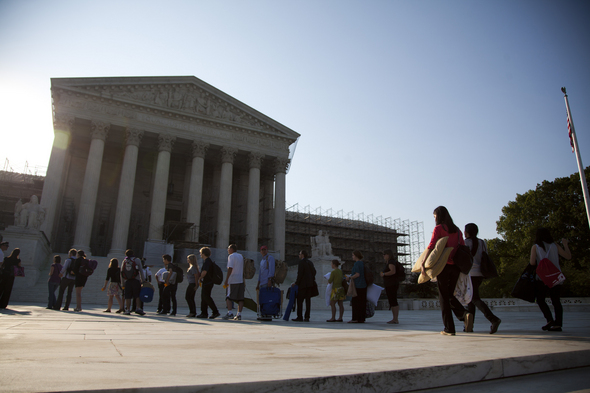
People who waited in line overnight to hear the Supreme Court on a landmark case on health care hold their belongings as they make their way into the court in Washington on Thursday.
Evan Vucci | The Associated Press
The court could strike the entire law down, eliminate the individual mandate portion of the act that would require nearly every person to have health insurance after 2014, eliminate the mandate and some provisions, or dismiss the case.
Proponents of the Affordable Care Act, an initiative by President Barack Obama that first began rolling out a series of changes in 2010 that will continue through 2014, state the law will extend health care coverage to millions of people.
“The health care reform bill is about insurance reform as well as delivery reform. It’s about who we insure and how we insure people,” said Dr. David Spahlinger, the senior associate dean for clinical affairs at the University of Michigan Medical School and the executive director of the Faculty Group Practice at U-M Health system.
Hospitals have had to ready themselves for a mass expansion in the number of people that will be seeking medical care in the future, given the expanded insurance coverage to individuals through wider benchmarks that will make more people eligible for Medicaid in 2014.
Currently, those that are uninsured don’t seek care until they get sick enough that they need to see a doctor, Spahlinger said.
“The overall constant is that we’ll have to deliver more care to individuals and do it more cost-effectively,” he said.
To become more efficient, Spahlinger said the U-M Health System recently implemented an electronic health record system to streamline patient data.
“From my perspective, the individual mandate is a requirement in order to be able to deal with some of the other issues you want to deal with,” Spahlinger said. “You have to guarantee issuance if you want insurance. Right now, (insurance companies) can price it so you can’t afford a policy or be denied one for pre-existing conditions.”
Some insurance companies have begun to adopt provisions of the Affordable Care Act into their policies - the most popular being allowing people until the age of 26 years old to remain on their parents’ insurance plan.
“In the end, higher quality, lower cost care is something that’s beneficially for everyone,” Spahlinger said.
Should the law be deemed unconstitutional, Spahlinger said the tragedy would rest at the individual level, not with the health system, hospitals or insurers.
“I’ll better be able to care for patients - it’s sometimes difficult to care for patients who don’t have adequate resources because they can’t afford it or don’t have access to the system,” Spahlinger said, noting his perspective is “…based from the stories and faces of patients I’ve seen and who I’ve wished they’d had insurance.”
Rob Casalou, president and CEO of St. Joseph Mercy Ann Arbor, Livingston and Saline, said the healthcare system is making changes independent of the Affordable Care Act because of past mistakes when conforming to previous reforms.
“Everything we’re doing is independent of the health care reform act,” Casalou said.
The Trinity Health System has been investing in expanding its network of physicians and adding providers by merging with IHA, Casalou said.
Building capacity on the primary care side would help accommodate for the anticipated increased volume of patients that would start seeking care earlier than an emergency room visit, Casalou said.
IHA has about 300 providers right now - a number Casalou said will probably double in the next three to four years.
The ingredient to the “secret sauce” that will make hospitals successful in the future is integrated information technology systems to connect the records of all levels of care, Casalou said.
The Trinity Health System has spend hundreds of millions of dollars switching to electronic records, as has the U-M Health System.
“It’s all about quality and efficiency. People move from doctor to doctor, system to system,” Casalou said, noting all of the movement results in repeated tests and added costs without electronic health records.
Those that are working in the Washtenaw Health Plan to connect the nearly 30,000 uninsured, low-income Washtenaw County residents with health care said they’d like to see the law upheld.
Small business organizations recently clashed with the release of a new poll on small business owners' opinions of the Affordable Care Act.
The Supreme Court is expected to hand down its decision at 10 a.m. Thursday on the Affordable Care Act. This story will be updated.
Amy Biolchini covers Washtenaw County, health and environmental issues for AnnArbor.com. Reach her at (734) 623-2552, amybiolchini@annarbor.com or on Twitter.
Comments
Jeremy Engdahl-Johnson
Thu, Jun 28, 2012 : 11:35 p.m.
Health exchanges have implications for benefits, especially cost and utilization. http://www.healthcaretownhall.com/?p=4018
Lou Perry
Thu, Jun 28, 2012 : 9:17 p.m.
People who don't want the Affordable Care Act do not know what's in it. Among other things we all pay for all those who go to emergency rooms for care. With Affordable Care Act we will not be paying and health care costs will go down.
Unusual Suspect
Fri, Jun 29, 2012 : 2:54 a.m.
If we're not paying for it, where does the money come from? A big money tree? Does it fall from the moon? Where exactly does the money come from that goes to the doctors they will go see instead of the emergency rooms they used to go to?
deetdeedee
Thu, Jun 28, 2012 : 4:36 p.m.
Anything else I can pay for you with my tax dollars that you need? When is enough, enough............. List o' free shi# provided by the man: Low cost housing Abortion Cell phones Food stamps Now health insurance Maybe we should cover your car insurance, oh wait, you need a car, one will be provided for you too........
David Briegel
Thu, Jun 28, 2012 : 4:07 p.m.
Who knew John Roberts would vote with the civilized justices?
talker
Thu, Jun 28, 2012 : 8:15 p.m.
Last night I told my spouse that I thought John Roberts would leave politics aside to save the reputation of "his" court (he's chief justice for those who don't know). He voted on the legal case and wasn't thinking about helping insurance companies gouge people.
Unusual Suspect
Thu, Jun 28, 2012 : 4:09 p.m.
He didn't. He voted with the libs.
dading dont delete me bro
Thu, Jun 28, 2012 : 4:05 p.m.
i'll quit my job. might make a decent living then not having to pay everyone's portion of my healthcare.
dading dont delete me bro
Thu, Jun 28, 2012 : 6:06 p.m.
no problemo atticus, i can live amongst the tent people and collect unemployment.
Atticus F.
Thu, Jun 28, 2012 : 5:17 p.m.
Let us know how not having an income works out for you... I'm sure you will be basking in a life of luxery. On a side note, perhaps I should have quit my job long ago, since I have no children and cant stand the thought of paying for someone else's education.
Atticus F.
Thu, Jun 28, 2012 : 3:33 p.m.
Supreme Court upholds Affordable Care Act!
Erocypsi
Thu, Jun 28, 2012 : 3:31 p.m.
Insert Angry "Sky is falling" rhetoric here _________________________.
treetowncartel
Thu, Jun 28, 2012 : 3:12 p.m.
There is nothing to await, the opinion has been released.
G. Orwell
Thu, Jun 28, 2012 : 12:36 p.m.
If Obamacare is so great and it stands to benefit the public, why was the 3,000 page bill introduced the day before it was to be voted on? Obviously the Obama admin. and the Democratic and Republican leaderships did not want us to know what was in the bill. This should be illegal. Obama promised that we would get at least five days to review bills before it was voted on. I guess he lied. Also, why have the Obama admin. given over 2,000 companies and organizations waivers from the Obamacare. Companies like Walmart, McDonalds, etc. Obamacare is a fraud. How can companies and individuals get waivers if it is meant to cover everyone in the U.S. For those of you uninformed, Google, "Obamacare waivers." The media just happened to miss this fact. Finally, the "death panel" does exist. It is called, the Independent Payment Advisory Board. Bureaucrats that make up this board will decide whether or not people will get treatment. Thus, rightly called, "the death panel." Health care reform is definetly needed to bring down the cost and insure more people but the Obamacare is a monstrosity. Go to YouTube and search Obamacare. Some people have read the 3,000 page bill and summarized parts of the bill. It is a very dangerous piece of legislation.
SEC Fan
Thu, Jun 28, 2012 : 6:17 p.m.
@Mr. Orwell. I must say, I absolutely love your Nom de Plume...so sad some don't get it.
dading dont delete me bro
Thu, Jun 28, 2012 : 4:59 p.m.
@david, george? i see no george.
David Briegel
Thu, Jun 28, 2012 : 4:10 p.m.
The death panels exist in the corporate board rooms of every insurance company. George, Obama doesn't run congress.