

Controversial alcohol energy drinks to be banned in Michigan
Updated 3:45 p.m. Thursday
Alcohol energy drinks — the fruit-flavored, caffeinated, alcoholic beverages in brightly colored cans that have raised widespread community concern — are on their way to being banned in Michigan.
A Michigan Liquor Control Commission order was signed today. Manufacturers of alcohol energy drinks will have 30 days from the date of the issuance of order to remove those products from Michigan, said commission spokeswoman Andrea Miller.
• Download a copy of the motion here.
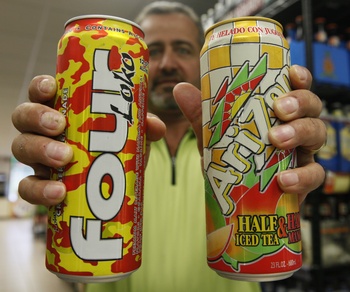
Ronnie Jamil, owner of Bella Vino Fine Wine and Spirits in Farmington Hills, holds up a can of Four Loko Cranberry Lemonade alcohol energy drink, left, and AriZona Ice Tea and Mango drink.
AP Photo
Miller said the commission voted 2:1 in favor of the ban at a licensing meeting about 1 p.m. Wednesday.
"I think it's a good step for the state," said Mike Tobias, executive director of Michigan Alcohol Policy. "It helps, particularly, teenagers and young adults. ... I think they're clearly marketed toward teenagers and young adults."
The commission's decision was made in light of several studies of the drinks, "widespread community concern" and the FDA's ongoing investigation of the products, according to the release.
Several states have considered outlawing the drinks and at least two universities have banned them from campus while the U.S. Food and Drug Administration reviews their safety, according to The Associated Press.
Justin Bishop, prevention specialist with a non-profit organization called Clean Teens, said groups and concerned citizens have been pushing for change for the past few years.
"I feel pleased. I feel health and safety have increased (as a result)," he said. "Each week, there are stories in the news about problems with alcohol energy drinks."
Bishop cited such "high profile tragedies" as an incident, reported by The Associated Press, in Washington in which nine students who drank an alcohol energy drink called Four Loko were hospitalized with blood-alcohol levels ranging from 0.12 percent to 0.35 percent, and a female student nearly died. And another incident in Melvindale, reported by the Detroit Free Press, involved a 14-year-old girl who was raped at a post-homecoming dance hotel party after drinking Four Loko mixed with rum.
According to a statement from
"We disagree with the recent decision by only two members of the Michigan Liquor Control Commission to rescind the approval of all 'alcohol energy drinks' in the State of Michigan," the statement reads. "The Commission did not provide advance notice of its proposed action, voted on the ban with only 3 of the 5 Commissioners in attendance (2-1 vote), and did not give parties who will be affected by the ban any opportunity to be heard on whether the ban is warranted or authorized by law."
The statement continues, "No one is more upset than we are when our products are abused or used illegally, and we do everything in our power to prevent the sale of our products to anyone under the age of 21 and to educate consumers about how to enjoy them responsibly. When consumed responsibly, our products are just as safe as any other alcoholic beverage."
Therese Doud, a substance abuse prevention coordinator for the Washtenaw County Public Health Department, said there are inherent risks when combining alcohol, a depressant, and caffeine, a stimulant.
"You're intoxicated, but you don't think you're intoxicated," she said. "The feeling is, I'm alert and I can handle this."
And while the alcohol content is noted on the can, she said, "you have to look for it."
Doud said it's pretty clear marketers of the drinks are selling to a young crowd.
"When you think about what's appealing ... it's clearly sort of a youthful market, they may be going toward college kids, but it's going to have (broader) appeal," Doud said.
According to the Phusion Projects statement, the company "complied with the (FDA's) requests" and submitted a "Generally Regarded as Safe" study, "which affirmed that the addition of caffeine to alcohol is indeed safe."
Brad Christman, who graduated from Ann Arbor's Huron High School this spring and is now a freshman at St. Olaf College in Northfield, Minnesota, spoke on the issue at one of the commission's meetings last year. He helped form a group called Students on Alcohol Prevention during his sophomore year of high school.
Christman said the labels on alcohol energy drinks — which look similar to those of non-alcoholic energy drinks — "take the fear out of buying" for people who are underage because they can "have a back-up plan to play dumb" if they are asked for ID.
"You could say, 'Oh, I'm sorry. I made a mistake. I thought this was a normal energy drink,'" he said.
Christman said the volume and alcohol content of these types of drinks also may influence people to binge drink because a typical alcohol-energy drink is 24 ounces and has a 12 percent alcohol content — compared to a 12-ounce can of beer, which normally has an alcohol content ranging from 4 percent to 7 percent.
"It's almost four times the alcohol content of a (regular) beer," Christman said. "One can, one serving, is enough to get you intoxicated."
Lorin Brace, manager at Ann Arbor's Village Corner on South Forest Avenue, said the store caters mostly to 20-somethings. He said it's difficult to tell whether the alcohol-energy drinks he sells are more appealing to that group than any other alcoholic beverage.
"Most of our alcohol sales, other than wine, is to a younger crowd, 21 to 25 (years old), because we're right on campus," Brace said.
Brace said Village Corner sells Four Loko and Joose, which he said are located near the wine coolers and hard lemonade in the store.
"I don't really see how (the packaging) would be misleading," he said. "Other alcoholic beverages have brightly colored labels and it says right on there the alcohol percentage."
Heather Lockwood is a reporter for AnnArbor.com. Reach her at heatherlockwood@annarbor.com or follow her on Twitter.
Comments
Jeff
Mon, Nov 22, 2010 : 9:57 p.m.
Those darned happy meals from McDonald's, filled with unhealthy burgers, fake chicken nuggets, and cheap (clearly designed for consumption) plastic toys. The clever packaging on them made my son want to buy one(although, I was tempted to get one for myself, it was clearly designed for youths, and thus turned off my temptations). He just wanted some lunch! Not only did he gain weight from eating 18 of them in one sitting, but he also choked on all the toys he tried to eat! My question is, how are these still legal? Did you hear about the child that had to be hospitalized because his body couldn't pass the plastic from the meal? These need to get removed from McDonald's, because obviously they have the ability to harm our youth. Granted I never taught my son how to eat responsibly, or that plastic shouldn't be eaten, but come on! What the heck are we paying our government for? They should make it more obvious that eating these things are dangerous. If they can't do that, we should strongly consider banning them. A lot of things in the world can be dangerous if misused, it doesn't mean we should get rid of them. Instead, lets make an effort to teach our youth how to use things responsibly and not be idiots.
Brian
Sat, Nov 20, 2010 : 11:07 p.m.
is it possable to start a petition for this lame ban, if so many people here vote against the ban it is possable the ban can be removed with enough effort. state wide vote on keeping the little things that keep our moral up like FOURLOCO. via facebook, myspace twitter. thats enough to wipe it out right?
Brian
Sat, Nov 20, 2010 : 10:46 p.m.
it is clearly obvious when something has alcohal in it, its going to be in the alcohal section of any store, if this is not blind enough for people against alcohal, there is even a alcohal label on it and it is not any smaller the what it is on a normal beer can. for people who cant read it, im sorry, maybe the mid life group who cant read without there perscription glasses should not be drinking in the first place. But common people have you ever thought there may be dirty party stores out there somewhere not getting i.d.'s from costumers i know of few. its a group like this and a group who cant handle there liquar that has messed it up for the rest of us. if alcohal is the cause of most deaths, fights and accedents take it all away, this is not any different from any other drink with alcohal. what soccer moms need to start doing is having us learn a lesson the old way, we'll learn from it, trust me. i was whooped from the paddle back in the day learning the hard way. Now a days children can not be slapped or padded on the but with a paddle, guess what happends now a days, they get sent to a time out, THATS IT?? put some fear in those eyes and they'll listen alot faster, kids these days are little brats. anyway look at the vote, it is obvious that more people vote against the ban and as far as im conserned this is a good reason why our freedoms get taken away, it is because people are to worryed about what may happen rather then learn a good lesson on after it happens. ever think theres a reason why your daugher wants the guy you grounded her from seeing, even more then before. its because you didnt punish her you just put up an imaginary line. and when ever you let her out of the house, you know shes on her way to see him again. anyway this is long enough and iv vented to something that should be handled by the average joe, and not the novice paniced soccermom.
Rick
Wed, Nov 10, 2010 : 4:15 p.m.
So after reading many of these comments, there a couple of things that is bothering me. 1: Everyone is upset that the drinks are banned. 2: Everyone is upset that Michigan is doing the banning. 3: (and this is the good one) NO ONE is worried about the fact that a fourteen girl was raped after consuming one (or more) of these drinks. Yes I know that number three happens more often with young girls than this. How come no one cares about the girl and all they are worried about is getting their alcohol? Something is not right.
Susan
Mon, Nov 8, 2010 : 11:32 a.m.
It's never a good idea to add caffeine to alcoholic beverages that are aimed at young drinkers. It is obvious that they are not marketed at older drinkers or all the sugar would have been left out. I believe that some are reacting as if they are being targeted by this, when they don't understand it is their younger siblings that are being offered the drinks and then winding up in the emergency rooms after being raped or blacking out, having no idea what happened to them. These kids are victims of a 'big brother state' all right - it's called "big alcohol" folks. Time to wake up and smell the caffeine. Watch out for our youth and they will be alive to take care of us in our old age.
Sandman
Sun, Nov 7, 2010 : 11:05 a.m.
How in the world does this kind of law making go through? Every comment is against the ban and yet our elected officials allow the mindless law-making to continue. Even the poll is way in against the law. Who is actually to blame for this great waste of public money. Call your state representative, you know who it is, the election was last week. Mark Ouimet, Pam Byrnes, please get the government out of my alcoholic energy drinks and back on some pertinent issues. 1. Why not ban alcohol over 100 proof or ban ungoverned manufacturing and selling of alcohol? 2. Mandate cross-walk attendants during elemantary school start and stop times. 3. Limit election spending, per position. 4. Require petition signing for candidate eligibilty, no buy-ins. 5. Mandatory physical drivers license testing for renewal after a certain age. Alcoholic energy drinks are another great idea, why are the law makers jumping on this...? Outlaw Rum Cake, fruit bread, wine coolers, fruity vodka...come on..?
Jerome Blue
Sat, Nov 6, 2010 : 12:40 p.m.
"That government governs best that governs least of all." - Henry David Thoreau. For crying out loud, THIS is what we pay politicians for? This is the kind of government we want?
Silly Sally
Sat, Nov 6, 2010 : 7:43 a.m.
It should not be banned, but perhaps the labeling should be changed so underage kids cant use the excuse of "Oh, I thought that it was an energy drink".
Troy K
Fri, Nov 5, 2010 : 8:04 p.m.
Ok as an expert(edjunkie.com) on energy drinks I have to chime in. First off not many energy drinks come in a huge can like that. The guy in the photo is holding a can of tea not an energy drink! Second every can of these types of drinks have the % of alcohol clearly printed on them. A lot of the also have text that reads "Must be 21 to purchase", "We Id", "contains alcohol" ect. Only a moron or a politician would be confused. I would love to debate someone about this subject. They would lose.
joe average
Fri, Nov 5, 2010 : 6:40 p.m.
So just these alcohol-containing energy drinks are to be affected, right? Oh, thank goodness -- I can still score a couple of cases of Zima for next years Super Bowl. Whew.
dading dont delete me bro
Fri, Nov 5, 2010 : 11:10 a.m.
prohibition is so early 1900's-ish.
robyn
Fri, Nov 5, 2010 : 9:34 a.m.
A simple solution would be for the stores that carry these types of drinks to put a sticker on the can stating "ID REQUIRED" - the clerk would see it, as would the customer. If someone uses a fake ID - then it becomes a legal matter.
Ypsi Gizmo
Fri, Nov 5, 2010 : 9 a.m.
How ridiculous! The Washtenaw County mental health system is $20 million in the hole & yet its employees are heading out on senseless witch hunts instead of providing much needed treatment???
kraiford12
Fri, Nov 5, 2010 : 8:30 a.m.
Easy fix for the Government-babysitters new rule: Step1: Buy an energy drink -easy for under 21 Step2: Get some liquor -Easier for under 21 than trying to purchasing an alcoholic energy drink i.e. fake id/trying to look over 21. -Parents liquor cabinet/someone that already has liquor (because it's so potent a little goes along ways as compared to an alcoholic energy drink where if 6 kids/teen wanted to have some they each would have to get their own) Step3: Mix & enjoy I don't drink those types (Four loco/sparks) of alcohol drinks but that's out of preference. If this is a problem, then more should be done on the retail/selling end. Banning them isn't going to stop the issue. It may in certain instances make it worse seeing as now kids will have to mix their own drinks. Since they've had minimal experience with alcohol they may mix way to much liquor per. mixer (energy drink).
MissArborM
Fri, Nov 5, 2010 : 8:23 a.m.
Banning this will only end up like everything else thats banned-they will still get it one way or another. We are only thirty minutes to the Ohio border and fourty five to windsor. Take the fireworks issue for example. Every year people go to Ohio, Indiana, Illinois just to get what we consider illegal fireworks. You can keep trying to close of all the doors, but there is always a crack people can wiggle between.
krc
Fri, Nov 5, 2010 : 7:57 a.m.
@Forever: what kind of coffee ended up in your keyboard? Irish, perhaps? @sbbuilder: I spent a summer in Europe when I was 11 and my sister was 10 and while we were in France we were allowed a watered-down glass of wine every night at dinner. I'm not sure what the ratio was. To this day, I don't care for wine unless it is in a cooler. However my dear sister became an alcoholic less than 6 years later. I wonder if this had anything to do with that? As far as the Catholic Church, the amount of wine they give is infinitesimal, like about a tablespoon. No problem there.
Chase Ingersoll
Fri, Nov 5, 2010 : 7:24 a.m.
It is "Joe camel" marketing. The libertarian in me figures the law of Darwin will weed out the weak who will adapt to an alternative risk and destruction. But since the market and products are already regulated and the distributors have the benefits and protection of the regulated market, then they are stuck with the the playing field and decisions of the regulators. Also, energy drinks have a lot more than caffeine that could interact with alcohol. It can't be the same as a rum and coke or Irish coffee.
Jeffersonian
Fri, Nov 5, 2010 : 6:39 a.m.
I make better alcohol in my bath tub. Chemistry class wasn't a waste after all.
Jimmy McNulty
Fri, Nov 5, 2010 : 5:45 a.m.
Not that I care for this beverage, but what happens when the tide turns and the gov't wants to ban your favorite drink? Maybe scotch is next. I know it is a real stretch, but think about it.
dading dont delete me bro
Thu, Nov 4, 2010 : 9:11 p.m.
am i going to need a medicinal card to purchase some of these? come on, it's an alcoholic drink, just card and dont sell to under 21.
robyn
Thu, Nov 4, 2010 : 9:01 p.m.
Since when is it the government's job to 'parent' the kids? Or anyone else? Sure - I can see them pulling something off of the shelves if it contains ingredience that are illegal. But to ban a product because some kids are abusing it??? At what age do people begin to take responsibility for their own choices? These kids are not held down and forced to drink this garbage - they obtain it because they want to - in many cases illegally (if they are under the drinking age). If anything - they should be hauled off to jail for underaged drinking - and face the consequences of their actions. If their parents are upset by this - perhaps they need to hold their child's hand all day long to teach them 4-LOKO (or LOKO-4) is bad for them; it's not only unhealthy but it is ILLEGAL for them to buy or drink! And yes - I do realize underaged kids will drink - not every single one of them - but a lot do. They know they're doing something they aren't supposed to do... Let them face it.
Baker
Thu, Nov 4, 2010 : 8:46 p.m.
I think that this is a good move. Most of your comments don't give much thought to this other than "The MAN is trying to take our booze away!" and "Another lost opportunity for revenue!" When reading any information about Four Loko it is apparent that the mixture of its high caffeine content AND alcohol content seems to be something awesome, when in reality its effects on the body are adverse. With 12% alcohol by volume per can, one can of Four Loko is equivalent in alcohol content to 4 beers. With a Four Loko being just under 24 ounces, that's the equivalent of physically consuming only 2 beers. The caffeine makes you want more, so most who drink this have more than one. Plus its cheap too! It can make anyone a victim. Drink 2 in less than 2 hours and see how you feel, then re-comment. Under-aged kids are becoming victims from this all over the country, so does this move REALLY shock you? Michigan's Liquor Control Commission is simply stepping in for the greater good, because regulation obviously hasn't worked to keep Four Loko away from under-aged kids.
robyn
Thu, Nov 4, 2010 : 7:25 p.m.
Just wondering - after reading the more 'serious' responses (but the funny ones are great)... Do you think that the decision to ban this drink is a politically conservative choice? I sure hope not - because it's not even close. I'm conservative - I do NOT want the government telling me (or banning products) because they think something is bad for me. I make my own choices and am responsible and accountable for those choices. If that means I CHOOSE to drink some messed up barf inducement in a can - it's MY decision - and I have to deal with the consequences of that decision. Now - if stores are selling that garbage to minors - they should be held accountable. If minors are drinking that garbage - they should be held accountable (if they're old enough to know they need a fake ID to buy it - they're old enough to know they are not legally allowed to be drinking it). The last thing we need is more government telling us what THEY think is good or not good for us. Every time they take something away it gets easier to take away something else. I don't buy those drinks (my addiction to McDonald's coffee won't allow me to drink anything else) - but if they are allowed to ban it - something else I DO like will be next! I live in fear each day that French Fries will be banned because of the "husky people"... Once the government steps in to your 'personal decision making space' - they will NEVER go away. I like my space.
robyn
Thu, Nov 4, 2010 : 7:05 p.m.
@ frazeria: You got that right... @ Hot Sam: UUUmmm - it isn't the Irish Coffee that makes them talk that way - that's NORMAL... LOL! Gotta love a Scottish brogue. Now if there are kilt'issues' - that COULD be the Irish Coffee... Nanny state knee jerk reaction. People do stupid things all the time, you can ban EVERYTHING someone uses to abuse, kill or otherwise practice brain cell management. I saw a program where kids used Air in a Can to get high... Strange.
Ram
Thu, Nov 4, 2010 : 6:40 p.m.
@sbbuilder: Yes, its extremely easy to get alcohol underage. From fake IDs, to older friends, to stores that just don't care, government attempts at prohibition are a joke. 4 Lokos are particularly easy to obtain, their packaging makes them look like an average energy drink so it is also easier to have them out in the open. It has been my experience that these drinks are targeted towards females (any male who drinks these gets the reputation of not being able to hold down their liquor). @chase: The reality is that anybody can make their own caffeine/alcohol combination.
Subroutine
Thu, Nov 4, 2010 : 6:33 p.m.
@Our Government Stop trying to ban things and worry about the problems we already have. This is a fad thing just like caffeinated water and will go away just as quickly if you leave it alone.
David Briegel
Thu, Nov 4, 2010 : 6:01 p.m.
Government and thus, corporate approved legal substances that kill while "Reefer Madness" prevails simultaneously. Why don't we teach resposibility for use of all substances. I use it, it doesn't use me! Think I'll have a rum and coke! Sam, when you're that big you need MORE!
lukary
Thu, Nov 4, 2010 : 4:54 p.m.
"This ban is just another example of lost jobs and revenue." Revenue gained in one area that results in a significant burden to society in another (increased alcohol related harm in the community-including alcohol related transports, etc.) is not a good state-wide business model. There are lots of rights that get infringed upon when there is harmful alcohol use.
Chase Ingersoll
Thu, Nov 4, 2010 : 4:48 p.m.
It is "Joe camel" marketing. The libertarian in me figures the law of Darwin will weed out the weak who will adapt to an alternative risk and destruction. But since the market and products are already regulated and the distributors have the benefits and protection of the regulated market, then they are stuck with the the playing field and decisions of the regulators. Also, energy drinks have a lot more than caffeine that could interact with alcohol. It can't be the same as a rum and coke or Irish coffee.
Tymm
Thu, Nov 4, 2010 : 4:33 p.m.
I absolutely Love how you will hear about 1 or 2 people or in this case in washington; how 9 people were hospitalized due to a product that has the ability to hospitalize you if you don't drink responsibly. FEAR Mongers run world. But you never hear from the million other people that consume the drink in a RESPONSIBLE manner and have no problems. Ignorant fools need to stop banning products. Mcdonalds has hot coffee, put on a label. Cigarettes cause cancer put on a label.
sbbuilder
Thu, Nov 4, 2010 : 4:27 p.m.
Perhaps some of the younger crown could chime in here, but it is my understanding that it's still extremely easy for minors to obtain alcohol. The alcohol content of these drinks should make anyone sit up and pay attention, though. 14%? Not even a good French Bordeaux has that high of an acohol content. Of course, if the kids can get this stuff, you can bet they can get the much stronger stuff too. I wasn't aware that the liquer control commision could hold a quorum vote of only three members. That seems kind of thin. Growing up part of the time in Europe, we were often sent out to get that evening's bottle of wine. If you were tall enough to put the money on the counter, you could walk home with a bottle. It may be different now, but that's how it was back then. And, occasionally, dad would let us have a 'gasp, horror, great intake of breath here' sip. When I came here to go to UM, I couldn't understand the fascination with booze. If it's treated matter of factly, and responsibly, our youth would begin to understand that alcohol isn't this giant mysterious taboo thing. The Catholic Church gives communion wine to youth every Sunday. I don't perceive any deleterious effects.
Ram
Thu, Nov 4, 2010 : 4:16 p.m.
nickcarraweigh, you just made my day!
BigMike
Thu, Nov 4, 2010 : 3:39 p.m.
This might be a tough issue, since this drink is a virtual poison for some (young) people. But if they can just mix Red Bull and Vodka to get the same result, what's the point in banning 4Loko? To score political points with some voters?
leaguebus
Thu, Nov 4, 2010 : 3:18 p.m.
When I was 18, I spent more time in Toledo than I did in Ann Arbor drinking that ugly 3.2 beer and buying fireworks. To the Republicans, talk about needless government, you need to get rid of the Liquor Control Commission and all of its bureaucratic folderol. It would be great to be able to buy a beer in every restaurant in town!
liekkio
Thu, Nov 4, 2010 : 3:09 p.m.
"a 14-year-old girl who was raped at a post-homecoming dance hotel party after drinking Four Loko mixed with rum" There are several components of that event that could be considered for banning, too: home-coming, dances, hotels, hotel parties, and rum.
Anthony
Thu, Nov 4, 2010 : 3:04 p.m.
What's next? Is the state of Michigan going to tell me its illegal to put some pills in a girls drink then proceed to have my way with her? I mean come on, when does it end?
nickcarraweigh
Thu, Nov 4, 2010 : 3 p.m.
It's about time. So insidious are these caffeinated alcoholic beverages, the Washtenaw County Health Department representative alertly informs annarbor.com readers, that you actually have to read the label to discover the contents. This is outrageous, and too much to ask. If we read the labels on virtually any party store product, why, we wouldn't drink it. And then where would the party store owners be? Once, in my younger and more vulnerable years, I failed to read the label on a half-gallon bottle of what I thought was innocent rum, and when I woke up I was in Coatzoalcos married to the 14-year-old half-sister of a local henequen magnate. The experience has scarred me for life, and it cost almost 50 dollars to have the tattoos removed. Remember people, chances are that at any given moment somewhere in Ann Arbor someone is enjoying themselves. We have to put a stop to that. Man up!
Keepsitreal
Thu, Nov 4, 2010 : 2:53 p.m.
A bunch of bs, the government needs to step off. I don't drink thast crap but then why not take all liquor away? Ya because they know what happened last time. Makes me sick!
ClaytonB Johnson
Thu, Nov 4, 2010 : 2:53 p.m.
It's ridiculously naive to think such a ban will have any real effect. When I was a kid it was Orange vodka. Tasted like kool aid and it was a cheap drunk. Should we ban that too? Ever heard of Red Bull and Vodka? Should we ban that too?
Forever27
Thu, Nov 4, 2010 : 2:49 p.m.
@A2Westsider, that was hilarious. I just spit coffee on my keyboard.
A2Westsider
Thu, Nov 4, 2010 : 2:46 p.m.
With all the new lawmakers and judges just elected, dancing will surely be next on the chopping block.
treetowncartel
Thu, Nov 4, 2010 : 2:44 p.m.
@C6,I believe you are correct. i was merely pointing out that Michiganders go south for fireworks and then come back to light them off here without any real enforcemnt of the so called illegal fireworks. This ban is just another example of lost jobs and revenue.
Hot Sam
Thu, Nov 4, 2010 : 2:37 p.m.
I had some Scottish (yes Scottish) friends that used to pound Irish Coffee...they slurred their words very fast...
fraziera
Thu, Nov 4, 2010 : 2:33 p.m.
" 14-year-old girl who was raped at a post-homecoming dance hotel party after drinking Four Loko mixed with rum." There's a lot more wrong with that than the Four Loko. Agreed this is a waste of time, I can make plenty of drinks with alcohol and caffeine in them.
Ryan
Thu, Nov 4, 2010 : 2:32 p.m.
Another example of Michigan's liquor law being outdated and out of line with citizen's expectations. Beer and Wine are food. The law needs a complete overhaul to drag to out of the 19th prohibition era thinking. For example, why is it in the "land of the free" we you can't walk around with a beer or glass of wine -- yet in other less democratic countries it's perfectly ok. Why can't we have a wine and cheese picnic or a BBQ on the huron without a permit? We can't even teach our children to drink responsibly (until they are 21 when they are out of the house) less we break the law, risk CPS taking them away, and possible jail time. Hopefully Michigan's new administration will have a more reformed forward thinking approach.
C6
Thu, Nov 4, 2010 : 2:27 p.m.
treetowncartel: That fireworks store I believe you're thinking of is at the Sterns Road exit off U-23. That's Exit 1... in Michigan. The first exit in Ohio is at Alexis Road, and I don't believe there is a fireworks store there.
Gaboo
Thu, Nov 4, 2010 : 2:25 p.m.
If alcohol isn't banned, why should drinks containing alcohol be banned. Just do a better job policing at the cash register.
Huron74
Thu, Nov 4, 2010 : 2:19 p.m.
I guess I'd better stop with the Irish Coffee on sunday mornings.
Forever27
Thu, Nov 4, 2010 : 2:04 p.m.
for all those out there decrying the nanny-state for this, this is not an unprecedented move. This is more about the marketing of the product rather than the product itself. Similarly, cigarette companies can't use cartoons to sell their product anymore because it is believed to be targeting children. What is seen as the problem with this product is that it misleads the potential consumer as to what, exactly they are buying. I'm not saying I agree with this, but it is the logic in use here.
Woman in Ypsilanti
Thu, Nov 4, 2010 : 2 p.m.
or Irish Coffee.
Top Cat
Thu, Nov 4, 2010 : 1:48 p.m.
Perhaps they never heard of a rum and coke.
Ram
Thu, Nov 4, 2010 : 1:33 p.m.
ThaKillaBee is correct, a common substitute is just a mixture of Red Bull and Vodka. So banning 4 Lokos isn't going to do much...
treetowncartel
Thu, Nov 4, 2010 : 1:31 p.m.
Hmm, Time to open up a party store at the first exit off US 23 in Ohio. It can be located right next to the fireworks store. I love all this lost tax revenue.
ThaKillaBee
Thu, Nov 4, 2010 : 1:27 p.m.
I have found a pretty ingenious workaround for those interested: Take some Redbull, or Monster, or whatever. Add alcohol.
Ram
Thu, Nov 4, 2010 : 1:24 p.m.
I agree that most college kids don't know what they are getting themselves into when they drink these beverages. However, prohibition does not work. Marijuana is illegal, and its not exactly impossible to obtain. So I this as a waste of the government's time when they have more important issues to tend to.
Peter Baker
Thu, Nov 4, 2010 : 1:21 p.m.
Or is it just because it was invented by Ohio State students?
cinnabar7071
Thu, Nov 4, 2010 : 1:20 p.m.
More big brother telling us how to live cause we don't know any better.
Ignatz
Thu, Nov 4, 2010 : 1:02 p.m.
More fear and loathing. What's next for government, tucking me into bed at night and making sure I get 8 hours of sleep?