

Rabid skunks on Ann Arbor's west side: 'Small spikes' in reports expected to taper off
The frequency of rabies-infected skunk reports in west Ann Arbor is not unusual and will likely "burn out," a Washtenaw County Public Health Department official said today.
Public information officer Susan Ringler-Cerniglia said the health department followed up with animal disease experts from the Michigan Department of Community Health after the fourth rabid skunk in six months was found last week near the Miller Nature Area.
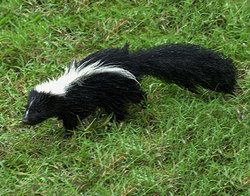
Officials say the temporary cluster of rabid skunks on Ann Arbor's west side is not unusual.
From the Grand Rapids Press
“Having a temporary cluster of rabies like this in a skunk population is not unusual,” Ringler-Cerniglia said. “The zoonotic disease epidemiologist told us cases like these tend to burn itself out. We might have small spikes in reports because of more skunk activity earlier because of the mild winter.”
She said they will continue to monitor rabies-related cases in the area, but said it's not prompting additional investigation into the animal population.
In the most recent instance, Courage, a red-gold English Mastiff owned by Catherine Shaffer, had a skirmish last week with a pair of skunks, one of which he killed. Shaffer learned Monday that the skunk tested positive for rabies. She wasn't concerned that Courage would get rabies because he's up-to-date on his vaccines, and received a booster shot.
Ringler-Cerniglia said earlier this week the skunk is the first animal in Washtenaw County to test positive for rabies in 2012.
Ringler-Cerniglia said one possible method of rabies control is the use of consumable rabies-vaccine baits, but said it doesn’t tend to work well in attracting skunks.
“The take-home message here is to keep your pets up-to-date with their vaccinations,” she said. “If a pet is not up-to-date and it get exposed, there’s not a lot anyone can do.”
Ringler-Cerniglia said the primary concern for the health department is human contact with rabies. If there is an animal-related concern with rabies, she recommended contacting local animal control, and they will investigate the situation.
Fewer than 10 human rabies fatalities occur in the United States per year, according to national data. However, as many as 40,000 Americans receive the vaccine each year after contact with animals suspected of being rabid.
The viral disease affects the central nervous system and is nearly always fatal.
In 2011, six animals were confirmed to have rabies in the county. That's the 2nd-highest total since 2004, with the highest coming in 2007. In that year, 11 cases of rabies were identified - and all of those involved bats.
Contact reporter Danny Shaw at 734-623-2544 or dannyshaw@annarbor.com.
Comments
Honey Badger Don't Care
Sat, Feb 25, 2012 : 12:37 a.m.
I love me some fried skunk. Finger-licking good!
N. Todd
Sat, Feb 18, 2012 : 4:13 a.m.
That's ironic, my basement smells skunky right now.
G-Man
Sat, Feb 18, 2012 : 12:16 a.m.
My little Colt Woodsman 22 would make quick work of the little rabid bastid's........
jcj
Fri, Feb 17, 2012 : 9:10 p.m.
If anyone "gets wind" of the truth let us know.
A2comments
Fri, Feb 17, 2012 : 8:37 p.m.
This story STINKS!
getmoney
Fri, Feb 17, 2012 : 8:18 p.m.
@jcj I agree with you. It is not right. Something smells bad.
jcj
Fri, Feb 17, 2012 : 6:46 p.m.
Dec 7th 2011 3rd rabid skunk of 2011 found on west side of Ann Arbor Posted: Wed, Dec 7, 2011 : 12:07 p.m. That incident makes a total of three rabid skunks found in Ann Arbor so far this year. By comparison, an average of five can be found statewide in a typical year. Today The frequency of rabies-infected skunk reports in west Ann Arbor is not unusual Which statement is correct? I don't think both can be correct!
Washtenaw County Public Health
Tue, Feb 21, 2012 : 4:26 p.m.
To clarify, the second statement "The frequency of rabies-infected skunk reports in west Ann Arbor is not unusual" - was intended in the context of Michigan as a whole. Locally, yes - it is a small spike in numbers. State health authorities have confirmed that these sorts of clusters are "not that unusual" for Michigan. There are areas of the state where skunk rabies recurs fairly regularly, often with several years in between detection of cases. Again, maintain rabies vaccination for pets, and always use caution around wildlife.
jcj
Fri, Feb 17, 2012 : 7:47 p.m.
Sorry but I do not believe there were any "reports" that were not confirmed cases.
Tesla
Fri, Feb 17, 2012 : 7:17 p.m.
I think the distinction is "reports" vs actual diagnosed skunks.
smokeblwr
Fri, Feb 17, 2012 : 6:14 p.m.
This whole rabid skunk situation stinks.
Tru2Blu76
Fri, Feb 17, 2012 : 5:44 p.m.
Chapter 10 of To Kill A Mockingbird: Atticus steps into the street and dispatches a rabid dog with a rifle. Memories! Today of course, Atticus would be the target of a SWAT team after doing that. Sigh.