

Ann Arbor agrees to spend $550K for next phase of work on new Amtrak train station
As the federal government makes hundreds of millions of dollars in high-speed rail improvements along the Detroit-to-Chicago corridor, Ann Arbor is putting its own money on the table.
The Ann Arbor City Council decided Monday night to spend another $550,000 from its general fund cash reserves to study options for a new Amtrak station somewhere in the city. That comes on top of $307,781 the city already had included in its current fiscal year budget for the project.
"Yes, we need a new train station," said Council Member Sabra Briere, D-1st Ward. "The one we have is inadequate. I have felt that way for a long time."
The vote was 8-2 with opposition from Jane Lumm and Mike Anglin, who remain skeptical about the need for a new train station. Council Member Stephen Kunselman was absent.
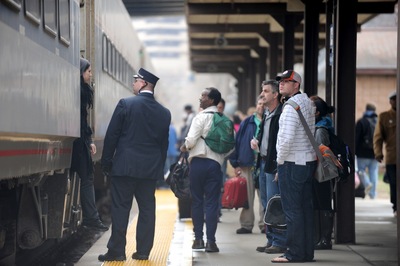
Passengers board a train headed toward Chicago at the current Amtrak station on Depot Street in Ann Arbor.
AnnArbor.com file photo
"We need a new train station," said Mayor John Hieftje, pointing to the growing number of people coming to work in Ann Arbor. "Ann Arbor is growing jobs. We may be in a situation where we're growing 1,000 to 2,000 jobs a year. What other city of our size would not welcome that scenario?"
He said the alternative to a train station is more parking structures, more pollution and more congestion on the city's roads.
Eli Cooper, the city's transportation program manager, presented council members with the latest cost estimates for what's being dubbed Ann Arbor Station, showing about $31.7 million in short-term construction costs, plus another $11.1 million for a new south rail platform and crossover in a future phase, which Cooper described as "post-2020" when rail volume picks up more.
Overall, including contingencies and escalation, the report Cooper provided shows $66.3 million in total long-term construction costs.
City officials are hoping to find other partners to help share $300,000 of the $550,000 the council budgeted Monday night for the next phase of work. The $550,000 is a local match for a $2.8 million federal high-speed rail grant the city was awarded by the Federal Railroad Administration.
The city previously thought expenditures already made going back to fiscal year 2009-10 would cover the local match, but FRA determined that wouldn't be allowed.
The Michigan Department of Transportation has indicated a willingness to review possible avenues of matching assistance, the city's staff indicated in a memo to council.
The next phase of the project, including conceptual planning, environmental documentation and preliminary engineering, could take 18 to 24 months, according to the latest estimates. The completion of those tasks will allow for future final design and construction of an improved intercity passenger rail station replacing the current Amtrak station on Depot Street.
The city's preferred site is along Fuller Road on the footprint of a surface parking lot in front of the University of Michigan Hospital. The land is considered part of Fuller Park.
Representatives of a grass-roots group called ProtectA2Parks showed up to Monday night's meeting to lobby council. They released a white paper on Friday that outlines arguments against building a new train station on Fuller Road and instead retaining the site on Depot Street.
Lumm and Anglin thanked the residents for coming out. Lumm said she read the group's report and found it tremendously informative.
"It's interesting, Council Member Lumm, because I had the exact opposite take on that," Hieftje responded. "I felt there was a great deal of misinformation in that document."
Running the numbers
Lumm argued that with the resolution approved Monday night, the city will have invested more than $2.7 million in the Ann Arbor Station project, including $1.4 million in sewer and water improvements on the Fuller Road site, which city staff has said would have been done with or without the project.
"I don't know what the hurry is," she said. "At some point, one concludes it's time to stop throwing good money after bad, or at least hit pause until there's a plan."
Lumm recalled that when the City Council voted to accept the $2.8 million federal grant this past summer, the rationale was that no additional city money was required.
"That was the primary argument my colleagues used in voting for accepting the grant. 'It's a freebie,' they said. 'No new city money, and how can you not vote for that?' " she said. "Well, guess what? The past costs don't qualify and we need to put up another $550,000 of your tax dollars."
Lumm said that's a huge amount of money on a project where the basic need hasn't been established, the preferred site is pre-determined but isn't necessarily the optimal choice, and there has been no real indication that federal funding for construction will be forthcoming. A majority of council members argued against her on all of those points.
With three of Hieftje's allies on council — Carsten Hohnke, Sandi Smith and Tony Derezinski —stepping down next month, it's unlikely the Ann Arbor Station project would have had the eight votes needed to proceed if the decision was left to the new council. Incoming council members Sally Hart Petersen and Sumi Kailasapathy have been opposed to spending money on the project.
Hohnke said he thinks the consensus in the community is that moving forward with investments in high-speed rail is the right thing to do.

"Yes, we need a new train station," said Council Member Sabra Briere, D-1st Ward. "The one we have is inadequate. I have felt that way for a long time."
Ryan J. Stanton | AnnArbor.com
Hieftje noted there has been a significant increase in Amtrak ridership in recent years and Ann Arbor remains the busiest stop between Detroit and Chicago. He said this might be a once-in-a-lifetime opportunity to take advantage of federal funding for a new train station.
"We are looking at a method to move the Midwest into a new era as we see fuel prices continue to go up, as we see more and more people coming into places like Ann Arbor to go to work," Hieftje said. "We're going to have brand-new trains running at much higher speed through Ann Arbor from Detroit on the way to Chicago with stops in between."
While some of the future ridership projections are dated at this point, Cooper said the FRA is funding a Detroit-Chicago corridor study that will take another look at ridership forecasting.
He said right now there are six roundtrip trains on the corridor and that's expected to go up to 10 within a few years, and that's not counting MDOT's plans for Ann Arbor-to-Detroit commuter rail service. He said within 25 years there could be as many as 50 trains a day coming to Ann Arbor.
"The current Ann Arbor station is overcrowded," he said. "I invite folks to come out on a Sunday or a Monday early in the morning. The cars are parked hither and yon on the lawns. Clearly there are parking issues. Anyone who has been in and around the station when a train arrives, there's not nearly enough seating in the current station for the current passenger load."
Hieftje said one problem with the current site is there's really no way enough buses can get in and out in the morning or the afternoon because traffic is backed up on Depot Street. Hieftje asked Cooper about the possibility of building on the other side of the tracks at the current site.
"The other side has challenges, the first of which is property ownership … so there's an acquisition issue," Cooper said. "And then beyond that, those lands are, in fact, contaminated."
Cooper acknowledged some of the adjoining lands owned by DTE Energy are being cleaned up, but he said that's not the area where a potential station or parking use might be.
"Beyond that, that is the floodway. Not the floodplain, but it's actually an area that's under water many times a year due to flooding events," he said. "I for one wouldn't want to park my car on a level where if it rains while I'm gone, I'm going to come back and have a submarine."
Briere lives relatively close to the Amtrak station on Depot Street and said the area floods all the time and parking is a hassle. She said one thing is certain: the current station is inadequate.
"The particular building we have now is amazingly unimaginative and unattractive, but it's functional. The question is, is it functional in the future?" she said, going on to describe its shortcomings.
"Taking your luggage across the Broadway bridge at 10 o'clock at night in January is extraordinarily difficult," she said. "You must do that in order to get to your car after you've come back from that wonderful trip to Chicago."
She said a new Amtrak station in Dearborn is being built with federal dollars because city officials there had a plan in hand when the stimulus package became available.
"If you don't have a plan in hand, you're not prepared when opportunity strikes," she said just before Monday's vote. "This helps us create a plan in hand."
Connector funding approved
The City Council also voted Monday to approve a $30,000 contribution toward another transit project: the Ann Arbor Connector study. The city has been partnering with the Ann Arbor Transportation Authority, Downtown Development Authority and University of Michigan since 2009 to look at options for an advanced transit system — including bus rapid transit, light rail or an elevated automated guideway system — from northeast Ann Arbor through downtown and down to Briarwood Mall.
The vote came toward the end of a five-hour meeting and at first didn't pass. It fell short of the eight votes required when Marcia Higgins joined Anglin and Lumm in voting no.
Shortly after midnight, Higgins changed her mind and called for a reconsideration of the vote, and Anglin then changed his vote, too. The AATA is the lead agency on the project and is using a $1.2 million federal grant to complete an upcoming $1.5 million study.
The AATA is putting up $90,000 in local matching dollars, U-M has committed $150,000, and the city was asked to pay $60,000, but the City Council previously rejected paying that much. The DDA stepped up this month and agreed to pay half the city's share.
Ryan J. Stanton covers government and politics for AnnArbor.com. Reach him at ryanstanton@annarbor.com or 734-623-2529. You also can follow him on Twitter or subscribe to AnnArbor.com's email newsletters.
Comments
1bit
Thu, Oct 18, 2012 : 2:29 a.m.
It's always easy to spend other people's money. The mayor believes he can dip into the general fund as his personal piggybank. He's losing his majority and this is a cynical attempt to force his opinion. Why exactly is a train station at the footsteps of the hospital, but far removed from everything else in town, the best location? It may be the best location for the University but traffic along Fuller is already a mess and this will make matters worse. A beautification of the current station makes more sense. A revitalized north side with a gateway train station makes more sense. The one track mindset and predetermined thinking of the city council needs to end.
LXIX
Thu, Oct 18, 2012 : 12:07 a.m.
Lumm.
Townspeak
Wed, Oct 17, 2012 : 6:13 p.m.
Incredible that we would spend 500k to study options for another train station in the city. We have a great station, expand it. they could probably do a lot with 500k. Oh wait, they want to pay to have "experts" prepare studies for them. the answer is easy. Save the existing station, upgrade it, and expand the parking. Why is this so difficult. Without U of M, this would be a no brainer.
dia
Wed, Oct 17, 2012 : 10:27 a.m.
Write in Lumm for Mayor when you vote in the November Election
Karen
Wed, Oct 17, 2012 : 12:01 a.m.
Since when do new jobs require a train station? Where are the riders going to come from? And since all previous projections have assumed the ticket costs are subsidized by 100-200%, it will never pay for itself (but the taxpayers will be paying for decades).
Kai Petainen
Tue, Oct 16, 2012 : 9:58 p.m.
Question on clarification. In the Michigan Daily article about this http://tinyurl.com/9egg75z It states: "The idea for the additional rail station, which will join the current station located on Depot Street, stems from a proposed plan in 2008 between the University and the city to pursue supplementary transportation and parking services. " Clarification on the word 'join'? The station will go on Depot?
Ryan J. Stanton
Wed, Oct 17, 2012 : 10:45 a.m.
Probably just a bad choice of wording or a misunderstanding on their part.
Goober
Tue, Oct 16, 2012 : 8:57 p.m.
Yes - deep pockets, we have!
Classof2014
Tue, Oct 16, 2012 : 7:47 p.m.
I don't think there is a need for a new train station. On other stories covering this, more than 50% of the people said that they didn't like this plan. 550K to study?!? seriously? there are more important things that that money could go toward (like hiring teachers, fire fighters etc). This whole project is a big boondoggle. Too bad this November both of the candidates are not very good choices, but the Mayor needs to step down!
jmac
Tue, Oct 16, 2012 : 7:32 p.m.
Well I have taken the train to Chicago a few times on the weekend and can't say the train station was busting at the seams. It is small but so is train travel these days. Unlike the Major I can't imagine why train travel should be expected to grow by leaps and bounds, it's not happening in major urban areas, why expect it to happen here??? Also I have to say I don't like the location of the Amtrak station and always felt that worked against it. Nowhere to park, nowhere for buses (as noted above) and not much nearby in case you get stuck waiting for a train ... which happens a LOT!!!
Larry Baird
Tue, Oct 16, 2012 : 9:31 p.m.
"...not much nearby in case you get stuck waiting for a train.." Next time you get stuck waiting, I would suggest walking across Depot St. to Casey's Tavern for a bite to eat and/or a drink if you are so inclined. But if you really want to splurge, walk next door to the Gandy Dancer. Last time I checked, the other station site alternative being considered at Fuller Park was completely surrounded by city parks, so definately less options there unless visiting the hospital is considered a good way to kill time?
Hospadaruk
Tue, Oct 16, 2012 : 7:22 p.m.
Aww... get off the couch and go somewhere. And when you do, you'll discover how much gas costs and then you'll be whining for trains. We need to grow train infrastructure so we can start using them. they are not going to sprout full size out of our cake-holes. Walk, bike, train - that is our future, let's grow up!
nekm1
Tue, Oct 16, 2012 : 8:40 p.m.
time for all of these train riders to get out an atlas and look at the distance from city to city in Europe and Japan. Of course trains make sense there...like traveling from Ann Arbor to Plymouth to go from Paris to Brussels, but here in the US? except for Boston/Philly/NewYork, it makes very little economic sense. Buses maybe, but train stations? If you want Europe so badly, I suggest you move there!
deb
Tue, Oct 16, 2012 : 7:35 p.m.
yes because train tickets for a family of four are so cheap. If it costs one person $50 for gas to chicago, and $40 to take the train, they may take the train. If it is a family of four and it costs $50 for gas . . . Even if you add in other costs of car ownership (insurance, payments if the person has them, etc.?) it still dosen't make sense for the family of four. when using a train, once at your destination, usually more transportation is needed. Once again $2 for a light rail ride is not bad, but when you are taking a family of 4 it becomes $8 a trip. Throw in other economic factors, such as TIME .. . . . . Im not going to finish. The above post's logic is so thoughtlessly spewed out it does not warrant it
Linda Peck
Tue, Oct 16, 2012 : 7:03 p.m.
Zags, I love your idea. Take the old train station (now Gandy Dancer) and make it into a very appealing and workable new station, keeping the historic character and quality of the building. It is so obvious and yet I have never seen this mentioned before. Does anyone remember doing their laundry in the old train station? It was sort of funky with water on the floor much of the time, but we got the job done there. I have always loved that building. Give Zags the $500,000 and call it a deal.
Linda Peck
Tue, Oct 16, 2012 : 6:57 p.m.
May I respectfully submit that a person's feelings about a train station should not enter into the ultimate decision to spend taxpayers' money. This project has not been voted on yet, and so no money needs to be spent until that time happens, if it does happen. Our taxes are too high as it is. Now is not the time for a new train station. Let's build our community and provide basic services to the people who actually live here. Down the road, if we have enough police and fire personnel and good streets and roads, lets take another look.
Ron Granger
Tue, Oct 16, 2012 : 6:20 p.m.
Have they said how or when they will solve the issue of freight traffic causing passenger service from A2 to Chicago to regularly take 5 to 6+ hours? That has been a huge problem for years and years, and yet they pretend like it isn't an issue.
Ron Granger
Tue, Oct 16, 2012 : 6:17 p.m.
"He said within 25 years there could be as many as 50 trains a day coming to Ann Arbor." In my experience, it needs to be said that Never, EVER, in the history of the US, has a mass-transit utilization forecast been met. They are always pie in the sky dreams. Whenever you hear someone spouting about how they "project" a certain number of riders, it is hogwash. Right now you can find articles from the past week about unmet ridership projections in other cities. It is always that way and there are always "barkers" trying to huckster us into spending millions, and even billions. And I just read an article about how Amtrak can't even make money on snack service. They've lost over $80 million each year for the past 10 years on snacks. Anyone who thinks this pork-barrel railroad grants aren't in for major cuts is dreaming. And I say all this as someone who lived without a car for over a year, and who supports and uses mass transit.
RUKiddingMe
Tue, Oct 16, 2012 : 8:34 p.m.
This is also what they're doing with the AATA expansion, by the way. Except they actually have real data that refutes the expectations; they increased the service along a popular well-used and known route by 100% (they DOUBLED the service), and ridership increased only 14%. But they still think that's enough to start driving empty buses all over Washtenaw county (oh, and creating a big new staff of people...and getting new buses...and building new depots...and new maintenance shops...and on, and on, and on).
Jack Campbell
Tue, Oct 16, 2012 : 5:15 p.m.
What an obscene waste of money. The poll on the previous story indicated that over 50% opposed spending more money on this.
annarboral
Tue, Oct 16, 2012 : 4:35 p.m.
Whoosh!!! That's the sound of a toilet flushing your tax dollars. Whenever I think I've already seen the silliest wastes of tax payer money Ann Arbor always comes to the rescue with even crazier ideas. When these guys get booted out of offce (I can only hope) their futures are secure as writers for comedy shows.
Ron Granger
Tue, Oct 16, 2012 : 6:21 p.m.
"Whoosh!!! That's the sound of a toilet flushing your tax dollars." It's okay - the toilet no longer dumps directly on to the tracks. They catch it in a tank.
demistify
Tue, Oct 16, 2012 : 4:01 p.m.
"We need a new train station," said Mayor John Hieftje, pointing to the growing number of people coming to work in Ann Arbor. There is a huge logical gap in that statement: No clue is provided as to how many of these people would find it practicable, or would have any desire, to commute by rail.
Daniel Piedra
Tue, Oct 16, 2012 : 3:29 p.m.
Passenger rail is a boondoggle. Why government agencies continue to sink billions of dollars into high-speed rail transportation method is one of the greatest failures of 21st century planning.
SonnyDog09
Tue, Oct 16, 2012 : 4:52 p.m.
Here's why. The train stations will be built by union labor. Those labor unions will make contributions to the politicians that "support rail." The choo choo trains and the tracks are also built by union labor. Their unions also make contributions to politicians that "support rail." Once built, the employees that operate and maintain the system are all dues paying union members. Their unions also make contributions to the politicians that "support rail." Government agencies are more than happy to spend taxpayer money on boondoggles if it helps to keep them employed.
Laura Jones
Tue, Oct 16, 2012 : 3:28 p.m.
I would love to see a train station with a retail area and food court! Hopefully we will see more train service into Detroit and then up north.
Z-man
Thu, Oct 18, 2012 : 5:44 p.m.
Huh? More people will have a need to travel to Detroit if they can shop and eat at the train station?
Gerry
Tue, Oct 16, 2012 : 3:18 p.m.
I applaud the new Fuller Road Station. Aside from parking issues at the present location, Fuller Road is adjacent to the Medical complex, and thus allows future commuter rail to serve one of our largest employment centers. Anyone who has seen Huron Ave at rush hour has seen the need for improved transit. I fear that the opponents of this project are pushing a vision that has favored urban sprawl at the expense of vibrant city centers, leaving torn up countryside, congested suburbs, and a dead downtown Detroit in the tsunami of a failed 1950s era vision that is entirely dependent upon $1.50 gas.
SonnyDog09
Tue, Oct 16, 2012 : 4:48 p.m.
"...a failed 1950s era vision" Choo-choo trains are a failed 1800s vision. Wake up.
CynicA2
Tue, Oct 16, 2012 : 3:32 p.m.
... And I suppose that encouraging workers to commute from afar via rail doesn't encourage sprawl?! If you wanna work at the med center, get a place in the vicinity - then you can be a peddle-pusher like the mayor. Detroit failed because all the good jobs left, and the people along with them, not because some urban planner had the wrong vision ( or nightmare?). Obamunism enabled high-priced gas, and when he goes, we'll make it right again.
justiceforeach
Tue, Oct 16, 2012 : 2:45 p.m.
Dear Mayor Hieftje and Ann Arbor City Council, Remember that this is a Democracy where people may have differing viewpoints. Like it or not, there is strength in that and there are weaknesses in that. One thing is certain - folks care deeply about their Parks. The same sort of forces and circumstances that have kept Parks from being turned into something other than what was originally intended are at work here in Ann Arbor as well. I dare say each of us have enjoyed the benefits of those forces and circumstances -folks who have asked questions. Don't forget , Mr Mayor - you were one of them - at Bluffs Park. Please refrain from vilifying them or demonizing them. Whatever the case, oppositional forces presenting their viewpoint were respectful last night, weren't they? Return the favor, please. You represented your assessment of their White Paper last night. The respect they have afforded you and your Council is the respect you should give them. So here is the question - respectfully asked: What - in your opinion - in their white paper qualifies as what you have labelled misinformation? Please bear in mind that this sort of discourse is informative to the public. It has been decided that a public vote will occur. Please bear in mind that a well informed public is better at making a good decision with the stroke of their voting pen than an ill-informed public. Thank you.
Ross
Tue, Oct 16, 2012 : 2:10 p.m.
Ugh. I am so sad that i moved to Ypsi since I can't vote these dumbos off the council now. PLEASE, citizens of Ann Arbor, vote out all incumbents this November.
Z-man
Thu, Oct 18, 2012 : 5:41 p.m.
Not ALL incumbents. Ms. Lumm is doing her best to keep the lunacy in check!
dotdash
Tue, Oct 16, 2012 : 1:52 p.m.
Every time an elected body votes something in at the last minute to avoid facing predictable election results, it stinks up politics a little more. Even if they are right, and they may well be. It still stinks up the place.
Veracity
Tue, Oct 16, 2012 : 1:33 p.m.
Voting for the $550,000 matching funds is like voting to spend $66 million on the new railway system. Since when has a paid study ever provided a negative report? The vote last night committed Ann Arbor tax payers to paying whatever the Federal government will not provide in the cost of construction and operation. Expect the final bill to be well above the $66 million. And by the way unless large and success corporations have announced their intention to build manufacturing plants and offices along the railway corridor do not expect future railroad ridership to justify the expansion. And a new railway system that may guarantee a fifteen minute reduction in travel time from Detroit to Ann Arbor is unlikely to attract more riders from the present commuters. Also remember that commuters must travel from their homes to the few railway stations in order to use the railway system. The inconvenience along with an inconsequential savings in travel time can not be expected to increase ridership.
Brad
Tue, Oct 16, 2012 : 1:25 p.m.
I can't decide if I'd rather have Marcia Higgins at the meetings or staying at home. Not much help in either either event. Council - way to find a way to work around what you certainly know the majority wants (or doesn't want, in this case).
zags
Tue, Oct 16, 2012 : 1:23 p.m.
At this point it would be cheaper to buy the original Michigan Central Depot from the Gandy Dancer owners and renovate it. Lots of parking, a bus pull through, and it will look better than anything you could design today.
murphthesurf
Tue, Oct 16, 2012 : 1:22 p.m.
$550k to study options? is this for real? where was kunelman? the longer i live,the more im confused about our local city counsel ! why does it seem that their more concerned about trees,or trains or open spaces than they are about the people in this area who are living on the street or the familys that can't pay the utilitily or rent bills or put food on the table? the u of m throws in $150k ? how f-------ing generous can they get ! must be a public relations ploy as they could care less about this city or the people in it! they have more money than the denver mint but won't contribute a cent to fix up the area around the stadium which,by the way,nets them untold MILLIONS of $s every year. lets focus on the real problems around town and not on things that aren't really important!
Goober
Tue, Oct 16, 2012 : 1:30 p.m.
As long as our city leaders win their offices by majority vote, they will do as they wish. You see, they have the majority of AA voters behind them. AA voters are apathetic to change. Anytime there is a major issue to be voted on, only a small percentage of AA voters show up to voice their right. So, what do we expect? Tax, waste and no visionary leadership. Oh - except the visions of buying more art!
Unusual Suspect
Tue, Oct 16, 2012 : 1:13 p.m.
"He said within 25 years there could be as many as 50 trains a day coming to Ann Arbor." What the heck? What kind of fantasy world do these people live in?
Brad
Tue, Oct 16, 2012 : 1:26 p.m.
I certainly hope we have something better than 19th century technology in 25 years.
golfer
Tue, Oct 16, 2012 : 12:56 p.m.
i still think we start and do not finish projects. if you guys had a real job they would fire you for not finishing a job. take crosswalks lights. i still see lots without blinking lights. this does not bring in jobs. it cost lives when people try to walk across and almost get hit. i will not even go into bike paths. i can say one thing about the current members. spend spend and more spend. not complete complete and complete what you are currently working on.
jcj
Tue, Oct 16, 2012 : 1:01 p.m.
'take crosswalks lights.' Yes take them and put them ...
Craig
Tue, Oct 16, 2012 : 12:48 p.m.
Stop one party rule in Ann Arbor Vote for Stuart Berry - Ward 5 Glad one of the Ward 5 council members voted it down.
Ron Granger
Tue, Oct 16, 2012 : 12:34 p.m.
'With three of Hieftje's allies on council — Carsten Hohnke, Sandi Smith and Tony Derezinski —stepping down next month, it's unlikely the Ann Arbor Station project would have had the eight votes needed to proceed if the decision was left to the new council. Incoming council members Sally Hart Petersen and Sumi Kailasapathy have been opposed to spending money on the project." -- Way to ignore the will of the people as expressed in the election - rush full speed ahead to throw more good money after bad. How long until the message becomes "we've spent so much, we can't let it go to waste. Let's just spend a few million more." If elected, Romney has said he will gut Amtrak. This federal money will go up in more smoke.
deb
Tue, Oct 16, 2012 : 12:25 p.m.
The mayor is lying. After ridership numbers peaked in the late 90's they went down and have lately risen again. If you take the passenger number from the mid-2000's compared to today it appears to be a sharp increase. Compare todays numbers with those of 15 years ago and ridership is up a couple of precent.
Kai Petainen
Tue, Oct 16, 2012 : 12:24 p.m.
The Ecology Center of Ann Arbor endorsed this development. What's ironic aboout that, is that the endorsement came at the last moment.... and.... more importantly.... in the meeting itself, there were a number of purchases that the city made with regard to the greenbelt. It could create the impression of a conflict of interest.... 'you help me, i help you' In this article http://tinyurl.com/6lv6o35 It states: "As such, the Ann Arbor-based Ecology Center led the ballot drive to establish the 30-year, .5-mil Open Space and Parkland Preservation program, a.k.a. the Greenbelt, which passed with two-thirds of the vote. It wasn't just environmentalists who were in favor, but also downtown business owners and real estate and building professionals, Garfield says. " So we know the Ecology Center and Garfield was linked to to the Greenbelt. Why does this matter? Because in this same city hall meeting, votes were made to spend $123,000 for property by the North Family, and votes were made to spend $483,450 on the Donald Drake Farm in Lodi Township -- part of the Parkland Preservation Millage. The ecology center won by successfully getting the land bought -- and they helped by endorsing the fuller train station.
Vivienne Armentrout
Tue, Oct 16, 2012 : 2:19 p.m.
I'm sorry to say that the Ecology Center is now a wholly-owned subsidiary of the Council Party. That letter from Garfield used amazing sophistry in saying that he could support it only now that there would be a public vote.
deb
Tue, Oct 16, 2012 : 1:25 p.m.
Go look at the recycle ann arbor carts debacle. . . . Check out who the consultant was that was wrongly projected carts and costs (sits on the A2 recycle board), then the A2 recycle board said they shouldn't be held responsible for a bad consultant and the city coucil gave them more money. . .
Tom Whitaker
Tue, Oct 16, 2012 : 1:05 p.m.
Dig a little deeper, Kai---the conflicts and the cronyism go much deeper than that.
Ron Granger
Tue, Oct 16, 2012 : 12:24 p.m.
"He said within 25 years there could be as many as 50 trains a day coming to Ann Arbor." Why would we want that noise in town, so close to the city core and residential neighborhoods? Exactly where there is a profound lack of parking and space for parking. This is so short-sighted.
talker
Tue, Oct 16, 2012 : 9:59 p.m.
What works in densely populated cities hasn't been appropriate in Ann Arbor. Over 30 years ago there was a computer train between Ann Arbor and Detroit. There were so few riders, the special, scheduled train was discontinued. Just because there's a certain capacity to hold passengers doesn't mean there will even be a small fraction of the number of passengers a train car can accommodate. Cooperative vans make more sense in Ann Arbor, yet I know of one such commuter van that was discontinued due to rider loss of interest. It makes more sense to promote that type of trackless commuter travel first because each van can take a small group of people closer to where they need to go. For example, a van with six people going to the DMC (Detroit Medical Center) and another van taking people to office centers in Southfield or Dearborn, and another van with people commuting between Ann Arbor and Livingston County provides more flexibility. The point is that a commuter who exits a train may need to travel two or three miles to his/her work site. Trains and tracks are inflexible. They work in Chicago because (1) many people from various neighborhoods and suburbs work in the center of the large city and (2) because there is a network of regular and shuttle buses that provide frequent service between the trains and major work areas such as the Northwestern University Medical Center about two miles away. The conclusion as I see it is that it's not economical to provide the type of rail service a some want. To pay for extensive planning would be money lost that could pay for needed police and fire protection.
foobar417
Tue, Oct 16, 2012 : 4:44 p.m.
The usual reason to put a train station in the center of the city is so that people don't have to drive once they disembark. It's a short walk, bike ride, bus ride, cab ride, etc. to the destination once you arrive. Pretty much every city in Europe and in the northeastern US is laid out this way and it works very well.
Gerry
Tue, Oct 16, 2012 : 3:25 p.m.
A typical commuter train car carries 125 people, and a typical commuter train would have 5 car. 5 X 125 is 625, times 25 (assuming 50 train represent a round trip for commuters), you get 15,625 commuters. Would 50 trains be more disruptive than 15,625 cars driving in and looking for 15,625 parking spaces????
jcj
Tue, Oct 16, 2012 : 12:07 p.m.
Would like to know what perk Higgins and Anglin got to change their vote!
Ron Granger
Tue, Oct 16, 2012 : 12:28 p.m.
I'd like to know what perk got Higgins to show up. How often does she even attend?
jcj
Tue, Oct 16, 2012 : 12:04 p.m.
"Ann Arbor is growing jobs. We may be in a situation where we're growing 1,000 to 2,000 jobs a year." A more TRUE statement would be Ann Arbor might be in a position where is spends more on public art than public services! The Major (not a typo) has more in the way of inflated numbers than the number of trees in town! And all his underlings are like little clones!
PhillyCheeseSteak
Tue, Oct 16, 2012 : 11:59 a.m.
"The land is considered part of Fuller Park." The land IS part of Fuller Park!
Gerry
Tue, Oct 16, 2012 : 3:27 p.m.
According to the sight, it is a U of M parking lot.
Larry Baird
Tue, Oct 16, 2012 : 1:01 p.m.
But according to the mayor last night...it.." use to be a park"
Arboriginal
Tue, Oct 16, 2012 : 11:56 a.m.
Remember, you can have any flavor you want, as long as it's chocolate!
Dave Gitterman
Tue, Oct 16, 2012 : 11:56 a.m.
How about a few bucks to update the bus terminal, one of the worst in the country?
zanzerbar
Tue, Oct 16, 2012 : 11:53 p.m.
The s terminal has been designated "Art Deco" historic and Greyhound has has been told it can not be demolished. So they have not made any badly needed improvements. Detroit has a nicer terminal than us. EMBARRASSING!
Arboriginal
Tue, Oct 16, 2012 : 12:03 p.m.
Because "nice" people take trains.
Jeffersonian Liberal
Tue, Oct 16, 2012 : 11:42 a.m.
The Progressives have wasted over $3 million just studying the proposed station and they're just getting warmed up. They quote some flimsy study of the I94 corridor in a decade where the state was actually losing population. If their was in fact any increase it was more likely to be in truck traffic, so one would think that common sense would lead to increasing freight rail capacity. Unfortunately we are talking about the Progressive mentality here and their is no room for common sense in the equation.
Kai Petainen
Tue, Oct 16, 2012 : 11:36 a.m.
The mayor was incredibly brutal towards the Sierra Club. A transcript of his thoughts towards how he belittled them should be posted. For a mayor that was once endorsed by the Sierra Club, members should stand up and pay attention to what was said at that meeting towards this organization.
motorcycleminer
Tue, Oct 16, 2012 : 11:12 a.m.
Another great joke from the 5th ave. comedy club ..only the Yuk is on us...you get what you vote for...
RUKiddingMe
Tue, Oct 16, 2012 : 11:01 a.m.
BTW, thank you Anglin and Lumm for voting against. It must be frustrating to sit in a room where everyone else is so deeply committed to insane expenditure based on nothing. We appreciate you guys at least TRYING to help the residents. Hopefully (I pray and pray) things will be a tad less frustrating once the new members take their seats. Like Lumm, I recall the exasperated way one of these members was touting the need to spend this free federal money, acting like anyone against it was stupid. So, in addition to his flawed reasoning that trying at all times to grab as much federal money as you could and spend it on anyting you could because that's a great business plan, he was also compeltely wrong and the taxpayers got boned. It's important to remember that when that happens, taxpayers, you get nothing back. No one has to apologize to you, no one has to try and make it up to you, you don't get any refunds or future deals. You are obligated by law to pay your property taxes or you lose your house. When they screw up with your money, or intentionally waste it, who cares? You have to keep paying anyway. The only way you can bring sense and responsibility is to vote down ridiculous, negligent, criminal wastes of your money, or vote people out who vote to do it. Those are the only two things.
CynicA2
Tue, Oct 16, 2012 : 3:04 p.m.
Amen, brother! There is another way, but it involves civil unrest.
Bcar
Tue, Oct 16, 2012 : 10:54 a.m.
NO NO NO!!! No more of our/my money for this! we do NOT NEED a new train station. The Mayor and city council just want another feather in their collective hat... People get on a train and get off a train, who hangs out at the train station?? Look at Europe where train use is very high, people don't hang out there unless waiting for another train, and with only one line going east - west you're not waiting for another train... I have yet to hear a reason why we NEED a new station and how the current one is failing. Are people missing trains? Is loading/unloading taking too long? Does the train no longer fit in the station? How about another fire fighter or two, or police officer or two from the RESERVE acct. What are reserves supposed to be used for? Emergencies perhaps?? Like an increase in crime? WAKE UP CITY COUNCIL and listen to the people! Put it to a vote! No more of your reckless spending at our expense!! " The city's 2012-13 budget already included $307,781 as a local match for the $2.8 million federal grant. The $307,781 was for items the city thought would serve as a local match, but city officials are now learning they will not serve as a match, so the $550,000 is on top of the budgeted amount." ...so the city council screwed up?? Imagine that! Did they all fail accounting? $2,800,000 to STUDY building a new station? What the @#$% do these people spend the money on?? What a joke... Im an engineer and it doesn't cost OVER $3,000,000 to STUDY what/where/when/how/why for a train station... maybe I should put a bid in on this "study..." and will be sure to include kickbacks to the mayor and city council so I can compete...
Larry Baird
Tue, Oct 16, 2012 : 12:57 p.m.
I am pretty sure it was a NO bid contract and because their PREFERRED site is designated parkland, more expensive environemental clearances and a costly Section 4f alternatives site analysis is also required.
Steve Hendel
Tue, Oct 16, 2012 : 10:53 a.m.
Hmmm...the City pleads poverty when the issue in public safety (police and fire) staffing, but when the issue is funding work towards a new train station, the sky's the limit. It is especially bothersome that, while the need for more police and (especially) fire protection can be amply documented, the need for a new train station is apparently based on merely anecdotal evidence (e.g. 'I live near there, and it sometimes looks crowded to me', to paraphrase Councilmember Briere). It also looks like the resolution to provide >$500k in new General Fund money towards the project was pushed through now in part because it might not garner enough votes to pass if they waited until after the November elections...a cynical tactic.
Bcar
Tue, Oct 16, 2012 : 10:58 a.m.
Great comment Steve. Im voting a straight ticket this nov... NO incumbents!!
RUKiddingMe
Tue, Oct 16, 2012 : 10:53 a.m.
1) The mayor said that the previous Fuller Station project didn't go anywhere, and that that was very costly, as if the error was NOT doing it. No, mayor, it was costly because you guys decided to spend millions of dollars on it before you had even the beginnings of any clue regarding whether you needed it, who would pay for it, whether it would ever come to fruition, who would staff it, etc. You threw millions of our dollars at this massive unnecessary project for no reason. And yes, that was (and remains) very costly. 2) The mayor continues to assert that we can either have new jobs and a a new train station, or new jobs and pollution and congestion and parking structures, or no new jobs. I'd like to see what everyone's pointing at that guarantees that if we get a new train station, everyone who's going to work here will decide to use the train instead of driving. I want to hear exactly what's behind this grand assumption that if we chain ourselves to a completely new train station when we already have one, THAT will be the trigger to get everyone to stop driving. 3) So now we have all new great reasons NOT to improve the station that exisits. It used to be because Michcon didn't want to let anyone use it. Now it's too contaminated to use and floods all the time. What happens there when it floods now? Does the train stop running? Do you think a new train station won't contaminate a completely new site? 4) Like Cooper, I also heartily encourage people to do this. It's very busy on SOME weekends; I've checked it out on multiple days of the week at different times; it's not completely inadequate. And the "hither and yon" parking issue could be resolved with a the smallest of expansions, perhaps into that MASSIVE unused lot; oh, that's contaminated. BTW, Amtrak said it MIGHT need 75 new parking spaces in 20 years for the increased ridership. 2 decades. 75 spots. So I guess we should put $70 million or so into a new station, huh?
Classof2014
Tue, Oct 16, 2012 : 7:37 p.m.
Amen! Could not have said it better myself
Tom Whitaker
Tue, Oct 16, 2012 : 12:59 p.m.
Regarding your point #3, please be aware that there is a significant parcel of land across the tracks that is already owned by Amtrak. It includes the current parking area and an area to the west of it that is currently undeveloped. No need for any MichCon involvement, and besides, what is the clean-up standard to build a parking lot or structure compared to the standard to build a park or a residential building?
Larry Baird
Tue, Oct 16, 2012 : 12:42 p.m.
I drove through the north parking lot after a bad spring thunderstorm and did not observe any flooding other then large puddles in the uneven spots. Also, I have never heard of any car insurance claims being made related to flooding in the north parking lot??
RUKiddingMe
Tue, Oct 16, 2012 : 11:37 a.m.
In #4, I mean that like the MAYOR, I also encourage people to visit the existing station on weekends and other times of day and other weekdays. Everyone should know how often (or not) the stations is crowded (or not).
A2comments
Tue, Oct 16, 2012 : 10:41 a.m.
"He said right now there are six roundtrip trains on the corridor and that's expected to go up to 10 within a few years, and that's not counting MDOT's plans for Ann Arbor-to-Detroit commuter rail service. He said within 25 years there could be as many as 50 trains a day coming to Ann Arbor." Why not 500 a day? When you make up numbers, go high!
Goober
Tue, Oct 16, 2012 : 9 p.m.
Someone misspoke? I don't believe it. Not our team!
Nancy Shiffler
Tue, Oct 16, 2012 : 6:32 p.m.
Currently there are three round trips per day, for a total of 6 trains stopping at the station. I think he misspoke.