

Ann Arbor-based research center: Michigan's health care spending lower than national average
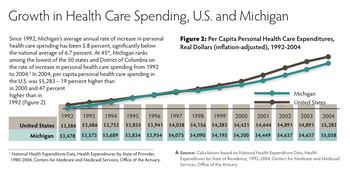
A look at the growth of health care spending in Michigan compared to the national average. Source | Center for Healthcare Research & Transformation.
Health care spending in Michigan has grown slower than the national average, according to a report released this week by the Ann Arbor-based Center for Healthcare Research & Transformation.
On average, Michigan ranks 36th in the nation for its personal health care spending per capita at $5,058 annually, compared to the national average of $5,283.
The center also highlighted the fact that although spending through private insurers accounts for less than 40 percent of health care spending in the U.S., it makes up 46 percent of spending in Michigan. Out-of-pocket health expenses for consumers were 14 percent in Michigan, lower than the national average of 18 percent.
The lower spending can largely be attributed to lower rates of Medicaid payments to Michigan physicians.
"What you can see in the data is overall, (lower spending) is a good thing," said Marianne Udow-Phillips, director of the center. Regarding Medicaid, though: "That’s an issue that could be hotly debated as whether that’s a good or a bad thing because doctors are not being reimbursed as much and many are won’t accept Medicaid, which raises an access issue," she said.
The lower spending can also be attributed to innovations among private insurers in the state, Udow-Phillips said.
For example, Blue Cross Blue Shield of Michigan has been offering incentives in its hospital contracts for initiatives that improve patient outcomes and decrease costs. Those include, most recently, a move to incentivize the creation of patient centered medical homes.
Udow-Phillips also referenced moves by all insurance policies throughout the state to agree on common guidelines of care for patients and incentives like health checklists that remind health providers to perform simple tasks like washing their hands.
The Center for Healthcare Research & Transportation is a jointly supported health research group funded by the University of Michigan and the Blue Cross Blue Shield of Michigan.
"We think it shows there are many strategies that have been tried in Michigan that have shown some success and we think other states can learn a lot from them," Udow-Phillips said.
The most successful strategies include collaboration, the use of supporting data and the involvement of physicians, she said.
Tina Reed covers health and the environment for AnnArbor.com. You can reach her at tinareed@annarbor.com, call her at 734-623-2535 or find her on Twitter @TreedinAA.