

Ann Arbor Board of Education candidates meet in final forum at Ann Arbor Open
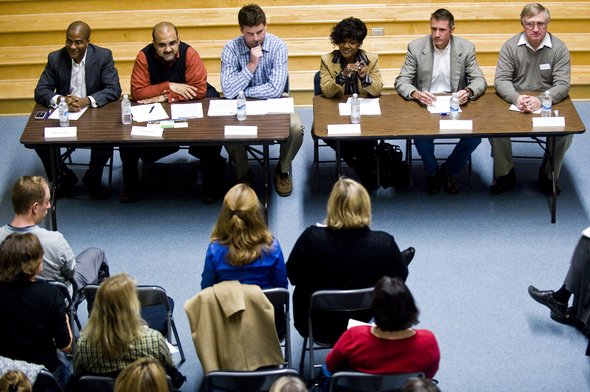
Ann Arbor school board candidates (from left) Albert Howard, Ahmar Iqbal, Patrick Leonard, Simone Lightfoot, Lawrence Murphy and Andy Thomas answer questions at a forum Thursday.
Joseph Tobianski | AnnArbor.com
The candidates addressed topics that ranged from their positions on a district millage for a technology bond to class size to their support for alternative schools, including Ann Arbor Open at Mack, where the forum was held. The Open School’s Coordinating Council organized the forum.
The election is Nov. 8.
Here is a roundup of what each candidate said during the 90-minute debate:
Albert Howard
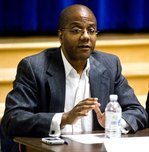
Albert Howard
Joseph Tobianski I AnnArbor.com
Howard said he was running as the parent of eight children enrolled in the district. “Nothing happens in the district without unity and love,'' he said. "I come to you as a father, a parent and a candidate who will listen to you.”
Howard said he favored smaller class sizes. “I would start with around 15. The school has to be a family,” he said.
He supports the technology bond that will appear before voters in early 2012. “Technology should be creative but we shouldn’t mix it with marketing. I want them to tap into the creative that’s within,” Howard said. “Technology should be state-of-the-art.”
Ahmar Iqbal
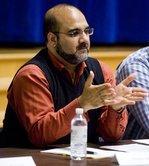
Ahmar Iqbal
Joseph Tobianski I AnnArbor.com
Iqbal said he did not support a countywide enhancement millage. Because of the way it would be allocated, Ann Arbor schools would only receive 65 percent of the enhancement millage it raised, with the rest distributed to other districts in the county.
And Iqbal said he did not favor the technology millage. “Before we embark on any capital expenditure, we need to look at how it will improve our children’s ability to learn. Before I can support it, I need to be shown how we would spend the $46 million,” he said.
Patrick Leonard

Patrick Leonard
Joseph Tobianski I AnnArbor.com
Leonard said he’d like to see class size at 22 for K-2nd grade, 25 for 3rd-5th grade and 30 at the secondary level. But he didn’t blame the school district for increasing class size. “They haven’t acted frivolously; they aren’t hiding the money.'' he said. "The state is responsible for 75 to 80 percent of our budget and the state has different priorities.” He said he supported an enhancement millage. Leonard said he also supports the technology millage. “Technology can improve student achievement,” he said.
Simone Lightfoot
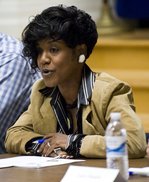
Simone Lightfoot
Joseph Tobianski I AnnArbor.com
Lightfoot said she would like to explore offering more lecture-style classes at the high schools with up to 80 students as a way to prepare students for college. This would allow the district to support smaller class sizes at the elementary and middle school level. She also said she would like to see internal staff do professional development rather than hiring outsiders as a way to save money. Lightfoot said she also supported the technology millage, but will need more details on how the money would be spent.
Lawrence Murphy

Lawrence Murphy
Joseph Tobianski I AnnArbor.com
Murphy said he supported expanding the open school concept in the district. “If it’s just a matter of some bus ride excursions; I think it’s money well spent,” he said. The Open School is a magnet program where most students are bused. “We need to customize education to prevent an exodus to charters,” he said. Murphy said he opposed the technology bond. “People look to technology as the panacea and discount the (importance of) person-to-person,” he said.
Andy Thomas

Andy Thomas
Joseph Tobianski I AnnArbor.com
Thomas said the ideal class size would be 22 for kindergarten through second grade, 25 to 28 for 3rd through 5th grade and 30 for middle and high schools. But the district’s budget is shrinking with many costs such as retirement locked in. The solution, he said, is to ask for a countywide enhancement millage to raise revenue.
Thomas supports the technology bond.
Comments
snapshot
Sat, Nov 5, 2011 : 9:40 p.m.
Murphy is the only one addressing the real problem.........changing the adimin/teacher ratio. Purchasing strategies and procedures should be addressed also. Murphy may not make an immediate difference but his election would send a message that it's time for the B. S. to end and the math lessons to begin.
A2anon
Sat, Nov 5, 2011 : 4:56 p.m.
More info here: <a href="http://annarborchronicle.com/2011/11/05/election-2011-final-aaps-candidate-forum/" rel='nofollow'>http://annarborchronicle.com/2011/11/05/election-2011-final-aaps-candidate-forum/</a>
Jack Panitch
Sat, Nov 5, 2011 : 6:52 a.m.
@A Voice of Reason: That's the whole analysis, huh? Irrespective of Mr. Thomas' actual record, you'll have us turn him out because the union supports him? The depth of that analysis leaves me kind of cold. Mr. Thomas used to be a regular contributor to these "conversations" on education issues, and anyone who has followed this stuff for long enough remembers he has command of the facts like few others, brings an independent-minded, sober view to the table and draws well-reasoned conclusions. His integrity speaks for itself. Mr. Thomas was involved in District issues for a long time before being appointed and then elected to serve as a trustee. He has built up more street credit for that service and the depth and breadth of his knowledge of the District and acumen for data analysis than any of the Johnny-come-lately, sound-bite posers. More than most folks I know, in fact. Lots of folks can spout nice ideas. Ask any one of them for the specifics of how they will make their plan work, and things start to get really interesting. Ask Mr. Thomas how he's going to accomplish his plan, and I guarantee you'll get specifics grounded in reality. That's partly because he's an incumbent, but mostly because of the dues he's paid and the experience he brings to the table. This is a critical time and a critical election. Knee-jerk reaction and change for the sake of change is not in our kids' best interests. It's not about status quo: it's about stability, vision and leadership in a time of huge change. There is no one I trust more or better to serve the interests of our children, not just mine, but all of them.
burlington
Sat, Nov 5, 2011 : 1:05 a.m.
Appreciated hearing all the candidates' viewpoints at the meeting. However, I think littering city property with campaign signs like Murphy did is inconsiderate. He has lost my support.
A Voice of Reason
Sat, Nov 5, 2011 : 4:11 a.m.
Andy Thomas's signs were far worse.
thecompound
Fri, Nov 4, 2011 : 7:19 p.m.
Anyone else notice how quickly AAPS stories get delegated to the second page and beyond? I guess a second story about a basketball recruit, the umpteenth story about Mott opening and a fluff story about Nickelback are more important....
A2default
Fri, Nov 4, 2011 : 6:28 p.m.
@A2 comments And you don't think the uninformed Murphy should be eliminated as well? It was completely galling to listen to him repeat several times that it is just a matter of busing kids to Open that will be money well spent. Nothing against Open or its parents. I contend that if you choose not to send your child to the local school, then it should not be at the cost of the AAPS to provide a bus from all across town to bring that child to Open who was lucky to win the lottery. There are currently TWO children being bused from one southeast school to Open everyday. There are no other children on the bus, yet for the majority of my neighborhood of 388 households, and who have traditionally had bus service, there are NO buses for the 88 kids that are there. Fine - we all know of the walking argument. Get 'em to walk. Is it safe? We are told TODAY that the City of Ann has put a moratorium on lighting the park that these kids are expected to walk through. AND, we are told today plowing is of secondary importance. What happened to informed planning and serving the majority? Iqbal shows the thinking that Murphy does not. He has the backbone to question the spending. Millage and giving more money for others to spend is not always the answer!
cette
Fri, Nov 4, 2011 : 5:58 p.m.
30 kids is still a lot of kids in a class for middle schoolers. I don't know if Ms. Lightfoote is talking about PEG with her consultant comments, or others types of consultants. Unfortunately, the only way out of a big drop in service is the staff taking a paycut, and a millage increase.. That's a very difficult sell to anyone. Ultimately, right now a county wide millage is the best solution, until the crowd in Lansing leaves.
ChrisW
Fri, Nov 4, 2011 : 5:09 p.m.
Sure wish there was video of the forum so we could watch it before the election.
Klayton
Fri, Nov 4, 2011 : 4:46 p.m.
Why aren't the candidates talking about renting out Community and the AA Open buildings (great locations...could rent and make decent money), then moving Community school into Skyline and AA Open format into something like Mitchell-Scarlet? Also, I think we should consider virtual schooling opportunities for students in the district...maybe create a district virtual school (use teachers already hired in district) that students from all over MI could attend (and pay to attend) and this could eliminate some busing and cost issues. Studies are showing (SRI 2009) that virtual/blended learning beats traditional face to face in standardized testing. I really want candidates who are thinking beyond our traditional structures.
say it plain
Fri, Nov 4, 2011 : 5:08 p.m.
Because there are *waiting lists* for Community and for AAOpen, so there is *obvious* demand for alternative education at the elementary-middeschool level, *and* at the high school level. The Mitchell-Scarlet program, which may prove to be a great system that we would want to expand, is *not* the "open" approach that AAO tries to use, so it would serve a different set of educational needs and desires. It seems pretty clear to many observers that potential AAPS 'customers' would leave the district for private, charter, or other alternative schools in other districts if these options didn't exist. That, imho of course, is why the candidates aren't talking about getting rid of those programs. To me, that means something other than a 'complete do not touch' approach though...that means being smart about what is good in those programs, about gauging what it is that makes some parents want these programs so much that if they do not get in they wait on waiting lists for years and often leave the AAPS if they are not 'lucky'. We should expect these candidates, imho, to actively discuss how they will meet the unmet desire for these alternative programs and try to expand to *all* programs what seems to be working about them for 'student outcomes' and parental satisfaction.
T
Fri, Nov 4, 2011 : 2:56 p.m.
I'm actually trying to be positive... But why do we continually try to invent the wheel, and throw what some think is unlimited money at it. -I'm 20-30 years out of the AAPS, but as a kid you didnt ask questions, the bus took you to the school in your district. No questions. You also respected your bus driver, riding was a priviledge not a right. -Recently had a teacher confrence. She made a comment about a different style of math being taught, and that she made it a point to the children but then moved on. Has anyone else noticed this while helping with homework. She also inferred that there was limited time for math during the week...are you kidding me. New AAPS math 500+503=1000 estimation is good. -Looking at the classrooms, the technology bond would be for teachers and administration only.
Grumpy
Fri, Nov 4, 2011 : 2:44 p.m.
I would like to know if any of these candidates are willing to push AAPS toward implementing a system similar to the city's new A2OpenBook program. Fully disclosing their finances to the taxpayers might benefit AAPS the next time they ask for a new millage. Utilizing OpenBook would provide taxpayers with answers to how AAPS is spending tax dollars, fees, and other revenue to provide a public school education in AA. It would disclose all AAPS budgets and actual amounts of expenditures in a transparent, simple, and easy to use format. This information could be pulled directly from the AAPS financial database. If there are two candidates that will actively pursue this idea, please let me know and they will definitely get my vote on Tuesday.
John Callewaert
Fri, Nov 4, 2011 : 2:29 p.m.
Iqbal has solid ideas for more meaningful interaction with the community including expanded advisory committees and more opportunities to have direct discussions with the administration and board. He also has plans for required competitive bidding for contracts and advocating state lawmakers to maintain school aid funding exclusively for K-12. Check out his website for more info: <a href="http://www.voteahmar.com" rel='nofollow'>www.voteahmar.com</a>
Basic Bob
Fri, Nov 4, 2011 : 2:18 p.m.
Spending more money does not solve problems. Excessive spending creates its own problems. Mr. Thomas's statement that Community High School is on the "do not touch" list is an acknowledgement of a sad political reality. Forget the outcomes, forget the cost. This is about the simple fact that the idle rich CHS supporters vote in every election and get their way. A school board candidate who publicly states that Pioneer, Huron, and Skyline provide a superior educational experience to CHS (which they do) effectively signs a death threat in the election. The same people who oppose spending hundreds of thousands on PEG because it is special treatment for poor minority students will advocate to spend millions to keep open a school that caters to an exclusive crowd. It's been a long time since CHS was truly an alternative school. Now its simply an alternative to Birmingham or Country Day. I will not vote for a candidate who pledges to uphold the status quo.
say it plain
Fri, Nov 4, 2011 : 3:58 p.m.
The rhetoric of CHS surely doesn't emphasize the alternativeness, I have to agree with @Basic on that... Once upon a time when there was a commitment to progressive education it probably did, but now --for whatever reason (and I can see the validity of various arguments as to why)--mostly it seems to exist as a 'small school' alternative, with lots of individual attention and great counseling. They even seem to spend lots of PR energy advertising their fantastic ACT scores and the lists of great colleges their graduates go to. That the kids there give up *nothing* of using the rest of the AAPS resources to boot (and so, can take AP this or that and do varsity sports and so on) makes it something other than truly an "alternative" school...it can and does for some people become a "home base" from which involved parents with motivated students can orchestrate something akin to a private school education while staying within the boundaries of the AAPS. If it were truly 'alternative' I would expect that choosing to go there would mean that something is sacrificed, something is chosen *instead* of what the rest of AAPS offers. This is true for AAOpen, where the middle school is small (of course, this counts as a perk to some people!) and doesn't have the resources of the larger middle schools in town, and where so far as I know, children aren't "asked to leave" if they cannot abide by some 'guidelines' special to its program, as is done at CHS, as I understand that program. That itself makes CHS more akin to a 'private' school than the other schools in the district are, doesn't it?
Barb
Fri, Nov 4, 2011 : 2:41 p.m.
"It's been a long time since CHS was truly an alternative school. Now its simply an alternative to Birmingham or Country Day." Wait, what? Can you explain?
thecompound
Fri, Nov 4, 2011 : 2:36 p.m.
I don't oppose the spending on PEG because it is special treatment for poor minority students, I oppose it because of the racism Glenn Singleton supports and think that the money could be used in more practical ways to help poor minority students. Several school districts across the US are in litigation with PEG and we are lucky AAPS is not being sued for their state law violation which can indirectly be attributed to PEG.
KeepingItReal
Fri, Nov 4, 2011 : 2:16 p.m.
If the comments of the candidates is any indication as to how they will govern, then I am impressed with Iqbal and Murphy. They seem to have the most logical approach to what it may take to help the district move forward. I received a mailer from each and must say that I was impressed with each. I originally supported Thomas when he was appointed to fill an interim slot but its obvious that he is pandering to a specific group...parents of kids enrolled in alternative education programs and I have not seem him mature much as a board member. I keep trying to get a handle on Lightfoot but she does not appear to have a well thought out platform. She seem to think that putting forth cute sounding phrases will impress. And Howard, well who knows. I think Leonard is a long shot but a good one.
A2default
Fri, Nov 4, 2011 : 6:46 p.m.
Murphy is a yes-man. There will be no change in any of the rorts that have been going on in AAPS right now. He is getting enough training from Thomas. His comments about simple busing for Open students were offensive - at the cost of the rest of the schools, Murphy? Iqbal is man enough, and fiscally aware, to challenge the usual patronizing position of the AAPS administration - Admin simply do what they want to do, and try to make you feel as if you had input. Loved how he rejected a millage without first demanding an explanation of how the first lot of money was spent. Do appreciate that when Iqbal doesn't know the answer, he simply says so. The others pander around trying to sound good and merely talk people into a tired stupor. There are enough of those people around without getting them voted into our children's school board. Lightfoot comes with political savvy. That may be needed as they say it's all Lansing's fault.
A Voice of Reason
Fri, Nov 4, 2011 : 1:35 p.m.
Andy Thomas & Patrick Leonard are being endorsed by the teacher's union president or the teacher's union which is a major conflict of interest. We do not need any more people protecting bad teachers and no accountability. We do not need any more yes men! Make a change!
thecompound
Sat, Nov 5, 2011 : 1:32 p.m.
Oops, I wish I could take my vote back on that last comment, I should have read the last sentence before voting. The district should be catering to ALL kids, not just the "elite", not just "achievement gap" kids, ALL kids.
A Voice of Reason
Fri, Nov 4, 2011 : 2:41 p.m.
Patrick Leonard said so when he came to our door and Andy Thomas is endorsed by Brit, head of the Teacher's Union. There is nothing against teachers, it is just called...electing your employer, and if we are going to make real changes in our district, the teacher's union voice (not the teachers) can not longer running the district-and sorry, they are different. We have too many problems for the status quo. We need to care about the kids for once and the achievement gap in this town in a district that is only meeting the needs of the elite, smart kids whose parents are teaching them at night anyway. TIME FOR A CHANGE!
Barb
Fri, Nov 4, 2011 : 2:30 p.m.
Do we know why they are being endorsed? Maybe it's because they are open to negotiation, just like both sides should be (I don't know - I'm asking). Since when is it a good idea to root against teachers, anyway?
SonnyDog09
Fri, Nov 4, 2011 : 2:04 p.m.
Thank you. This is information that I was looking for that the article was lacking.
Jim Mulchay
Fri, Nov 4, 2011 : 12:54 p.m.
I'm undecided so far - but (1) I believe smaller class sizes and concentration of resources on elementary learning is the best way to build a stronger student and - perhaps - close the achievement gap. (2) There is no single "best way" to educate - open schools, computer-based classes, lectures, etc. all have good and bad issues - but if you develop an ability to read, write and do elementary level math in elementary school you will have more success in middle/high school - reading (and comprehension) is probably the most critical element; (3) All the technology and software in the world cannot replace a dedicated elementary level teacher; (4) Within the scope of our 21st century society the schools need to do all they can to involve families in education; (5) Look to some of the area social networks - religious institutions, Kiwanis, Elks, American Legion/VFW/VVA, unions - for volunteer assistance for tutoring, reading, mentoring etc - don't wait for them to come to the schools, ask them for their assistance - the worst they can do is say "no";
gretta1
Fri, Nov 4, 2011 : 1:13 p.m.
You hit the nail on the head. Thank you.
thecompound
Fri, Nov 4, 2011 : 12:48 p.m.
I like Lightfoot's questioning of the waiting lists, but her giving the Dicken principal a complete pass and supporting the waste of PEG and Glenn Singleton, she will be off my list. And I agree with the comment that her idea of lectures doesn't really connect with her wanting to close the achievement gap.
Oli
Fri, Nov 4, 2011 : noon
Bonds.... Bonds ... Bonds and more bonds! What world are these people living into? Do they even look at how much tax we are paying in Ann Arbor? In other words, the tax savings measures that the State enacted trickle down to us as a tax increase. How in the world does that makes sense? What kind of other company or business applies the same principle: let's cut the production cost and at the same time increase the cost of the product? These people working in education needs to get their financial act together first before they shamelessly keep asking for more money.
Edward R Murrow's Ghost
Fri, Nov 4, 2011 : 11:42 a.m.
From the article above: "Lightfoot said she would like to explore offering more lecture-style classes at the high schools with up to 80 students as a way to prepare students for college." Yes, there are lectures at the U of M and at Harvard. There are also discussion sections at the U of M and at Harvard. And there are darn few instructors/classes at WCC where the instructor lectures. I'm betting far more AAPS grads go to WCC than go to any other college/university. So what, exactly, would jamming them in a lecture do aside from remove them from contact with a teacher? And that notwithstanding, I wonder if Ms. Lightfoot thinks that student achievement is enhanced in a lecture style course, whether at Harvard, WCC, or AA Pioneer? This is a woman groping for something that makes her standout, and she is gambling with our children's education as a means to do so. Good Night and Good Luck
Edward R Murrow's Ghost
Fri, Nov 4, 2011 : 6:48 p.m.
Note the phrase: "I'm betting . . ." But whether or not that is the case, do we really think 60-70 students with one teacher lecturing is the best environment for learning, whether Harvard, WCC, or AAPS? Note: At the military academies, which are consistently rated among the nation's best 4-year schools, there are ZERO large lectures courses. ALL courses are taught in small classroom settings with 12-17 students in a classroom. ALWAYS. GN&GL
Ed Kimball
Fri, Nov 4, 2011 : 12:58 p.m.
Do you have data to support your speculation that more AAPS students go to WCC than to traditional colleges with lecture classes?
Susan Montgomery
Fri, Nov 4, 2011 : 10:53 a.m.
These comments don't really give as much insight as to the candidates viewpoints as the Ann Arbor Chronicle's article on the first forum in October: <a href="http://annarborchronicle.com/2011/10/06/election-2011-aaps-board-candidate-forum/" rel='nofollow'>http://annarborchronicle.com/2011/10/06/election-2011-aaps-board-candidate-forum/</a>
gretta1
Fri, Nov 4, 2011 : 1:10 p.m.
Agreed. That was a much fuller analysis of the candidates. Also, each one has his or her own website. They are worth a visit.
A2comments
Fri, Nov 4, 2011 : 10:25 a.m.
Haven't followed the race, but this summary make it easy to cross people off the list: Howard gone due to crazy-low class sizes and support of tech bond. Leonard gone for bond support. Lightfoot gone for lecture comment. Thomas gone for supporting Community High School, a waste of money, and support of bonds. Two left.
say it plain
Fri, Nov 4, 2011 : 5:25 p.m.
@Barb, I think some of the anti-CHS sentiment comes from 1) It works *very well* for some of those who get in, because they essentially sacrifice *nothing* of their potential (it might be a hassle, but it's doable especially with highly involved parents!) use of the rest of the AAPS resources, and thus it seems, dare I say it, "unfair"?! That feeling can be irksome to people, I think we'd all have to admit... 2) Sometimes it might seem like CHS is 'supportive' not only of their students--which is very very true, I'm sure, and which would be nice to replicate for *all* AAPS students in way that doesn't happen for enough kids at the comprehensive high schools!--but also of attitudes like that expressed in the statement of @asympyote above. That's probably not good for anyone, imho.
A Voice of Reason
Fri, Nov 4, 2011 : 5:13 p.m.
Sorry Asympote-Michigan's MEAP scores are 48th in the nation (according to the NAPE) and Ann Arbor's achievement gap, which we have been spending millions of dollars trying to solve, is the same as Detroit. Clearly more money is not the answer without accountability for children learning. The average teacher in A2 makes $100,000 (including benefits). Teacher's should have to pass a test each spring in order to teach the following year. They are well paid. The education in this town only services the elite whose children's learning is not dependent on the quality of the teachers. For all the money this district has, our children should all have computers or iPad. Where is the money going? We are not the leaders in education here==maybe you should ask the hard question of ....why?
Barb
Fri, Nov 4, 2011 : 2:24 p.m.
I wish I understood why some folks want CHS gone - if you don't want your kid to go, don't. But why take something away that works for so many?
gretta1
Fri, Nov 4, 2011 : 1:09 p.m.
Agreed, although I came to my decision a few weeks ago and for not all the same reasons. What has never been clear to me is how Lightfoot can support narrowing the achievement gap and in the same breath negate the need for smaller class sizes. How does she think kids learn anyway? I think Leonard is a viable third choice but he seems unwilling to take the class size issue head on and seems perhaps a bit too cozy with the current administration.
Ed Kimball
Fri, Nov 4, 2011 : 12:57 p.m.
I disagree that CHS is a waste of money. Both my kids went there and got an excellent education. One transferred after her freshman year at Pioneer and found CHS a much more supportive environment.
thecompound
Fri, Nov 4, 2011 : 12:54 p.m.
It's ironic that someone with 8 kids would be worried about class size, lol.
A2anon
Fri, Nov 4, 2011 : 11:07 a.m.
DonBee - I am part of the Occupy movement in spirit. And I definitely support raising taxes for many people, including myself. This is not a referendum on CHS. CHS is not going anywhere.
DonBee
Fri, Nov 4, 2011 : 10:50 a.m.
asymptote - Not all people who are against taxes right now are republicans. Many are people who have watched the wages in their jobs slashed or have lost employment. If you take everyone who is hurting right now and lump them in the bitter republican camp, then Occupy must be a group of bitter republicans. Some people, given time for the economy to recover and a chance to get a job or move into a better job, will change their votes. Calling names never gets you anywhere in this world. Generalizing does not either.
asymptote
Fri, Nov 4, 2011 : 10:44 a.m.
Why would you not vote for somebody for supporting community high school? its clear that you are a bitter republican who doesnt want to cough up a little money to make people have a better education