

Ann Arbor City Council adopts set of 16 sustainability goals and calls for 'Green Streets' policy
The Ann Arbor City Council voted 10-0 Monday night with Mayor John Hieftje absent to adopt a set of 16 sustainability goals to guide future actions.
The goals are aimed at ensuring Ann Arbor maintains a high quality of life, while balancing economic development with the preservation and conservation of natural resources.
The council also voted 10-0 to direct city staff to work with the Environmental Commission in the development of a so-called "Green Streets" policy that takes into consideration the role impervious surfaces play in stormwater runoff pollution.
The resolution was sponsored by Council Members Sabra Briere, D-1st Ward, and Carsten Hohnke, D-5th Ward. (Read the resolution.)
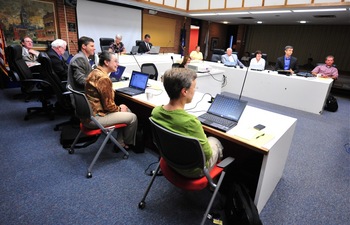
With the resolution approved Monday night, the Ann Arbor City Council is directing the Planning Commission to initiate a process to adopt 16 sustainability goals as part of the city's master plan.
Ryan J. Stanton | AnnArbor.com
The city received a grant from the Home Depot Foundation to develop a sustainability framework and sustainability action plan. The project began in January 2011.
Building off previous environmental goals and plans adopted by the city, the newly adopted set of goals will help guide and institutionalize sustainability planning within the city, said Planning Manager Wendy Rampson and Environmental Coordinator Matt Naud.
The city's Energy Commission, Park Advisory Commission, Housing and Human Services Advisory Board, Environmental Commission, Planning Commission and Housing Commission all passed unanimous resolutions in recent weeks recommending the City Council initiate the process to adopt the 16 goals as part of the city's master plan.
With the resolution approved Monday night, the City Council is directing the Planning Commission to initiate that process, as well as directing the city administrator to apply the 16 goals in continuing staff work on the sustainability action plan.
Here are the 16 goals:
CLIMATE AND ENERGY
Sustainable Energy — Improve access to and increase use of renewable energy by all members of our community.
Energy Conservation — Reduce energy consumption and eliminate net greenhouse gas emissions in our community.
High Performance Buildings — Increase efficiency in new and existing buildings within our community.
COMMUNITY
Engaged Community — Ensure our community is strongly connected through outreach, opportunities for engagement, and stewardship of community resources.
Diverse Housing — Provide high quality, safe, efficient, and affordable housing choices to meet the current and future needs of our community, particularly for homeless and low-income households.
Human Services — Provide services that meet basic human needs of impoverished and disenfranchised residents to maximize the health and well-being of the community.
Safe Community — Minimize risk to public health and property from manmade and natural hazards Active Living and Learning - Improve quality of life by providing diverse cultural, recreational, and educational opportunities for all members of our community.
Economic Vitality — Develop a prosperous, resilient local economy that provides opportunity by creating jobs, retaining and attracting talent, supporting a diversity of businesses across all sectors, and rewarding investment in our community.
LAND USE AND ACCESS
Transportation Options — Establish a physical and cultural environment that supports and encourages safe, comfortable and efficient ways for pedestrians, bicyclists, and transit users to travel throughout the city and region.
Sustainable Systems — Plan for and manage constructed and natural infrastructure systems to meet the current and future needs of our community.
Integrated Land Use — Encourage a compact pattern of diverse development that maintains our unique sense of place, preserves our natural systems, and strengthens our neighborhoods, corridors, and downtown.
RESOURCE MANAGEMENT
Clean Air and Water — Eliminate pollutants in our air and water systems Healthy Ecosystems - Conserve, protect, enhance, and restore our aquatic and terrestrial ecosystems.
Responsible Resource Use — Produce zero waste and optimize the use and reuse of resources in our community.
Local Food — Conserve, protect, enhance, and restore our local agriculture and aquaculture resources.
Ryan J. Stanton covers government and politics for AnnArbor.com. Reach him at ryanstanton@annarbor.com or 734-623-2529. You also can follow him on Twitter or subscribe to AnnArbor.com's email newsletters.
Comments
InsideTheHall
Sun, Jul 8, 2012 : 10:34 a.m.
Will rule 17 be a call for the return of dirt roads and the horse and buggy? Then rule 18 will be policy on manure removal and recycling. Then rule 19 will set policy for composting manure. This is folly, send in the clowns.
Stan Hyne
Fri, Jul 6, 2012 : 10:11 p.m.
Goals should be reasonable, achievable, controllable, and measurable. Saying we need rain every two weeks is a hope not a goal. Saying all florescent light bulbs that are used in city buildings, will be recycled instead of dumped into the land fill would be a goal.
Patriot Twin
Fri, Jul 6, 2012 : 9:13 p.m.
Does it concern anyone else that Ann Arbor's symbol is an ACORN???
Patriot Twin
Fri, Jul 6, 2012 : 9:08 p.m.
Unfortunately, this has NOTHING to do with the environment ~ everything to do with U.N. Agenda 21. http://www.youtube.com/watch?v=OzoN0IQsTAE
arborani
Thu, Jul 5, 2012 : 3:24 p.m.
Pish, I say to you, sirs and madams of the Council. Pish and a generous helping of tosh.
Frustrated in A2
Wed, Jul 4, 2012 : 11:25 p.m.
Blah blah and yackity smackity is what I got from that.
Mick52
Wed, Jul 4, 2012 : 7:56 p.m.
"Diverse Housing — Provide high quality, safe, efficient, and affordable housing choices to meet the current and future needs of our community, particularly for homeless and low-income households." Why is it that A2 never caters to the middle class? To live in Ann Arbor you have to be rich or poor.
Patriot Twin
Fri, Jul 6, 2012 : 9:09 p.m.
Welcome to socialism!
Paul Epstein
Wed, Jul 4, 2012 : 8:03 p.m.
Yeah right. Show me one area in which Ann Arbor actually caters to the poor.
JD
Wed, Jul 4, 2012 : 6:24 p.m.
"Sustainability" is a code word for increased taxes on energy use. This is the end goal for this whole sustainability initiative - to make energy very expensive so that we greedy Americans use much less, and the planet gets saved.
Steve Hendel
Wed, Jul 4, 2012 : 5 p.m.
All noble goals, for sure, but: what about setting priorities? How do you reconcile conflicts which WILL arise? Council likes to put itself on the side of "God, Mom and apple pie," but that's easy; the hard part is deciding how much apple pie you will trade for more quality time with Mom.
Jonathan Brier
Wed, Jul 4, 2012 : 2:07 p.m.
I am happy to see the City Council adopting these guidelines for making decisions that are looking at the longer term development of the city. This is a much appreciated public statement about the value that our environment plays into economic growth and community health and happiness. I look forward to how these are used to shape decisions in development and operation as well as improving quality of life.
annarboral
Wed, Jul 4, 2012 : 1:47 p.m.
Ann Arbor wastes a lot of time on words and symbolism instead of actions. The only green action I'm aware that should be implemented is traffic control. Ever wonder how much fuel would be saved or pollution eliminated if traffic moved smoothly so it didn't need to stop frequently? Ann Arbor traffic control is a disaster and could easily be improved but what is the city doing, nothing of course. Please provide action not words!
Michigan Man
Wed, Jul 4, 2012 : 12:45 p.m.
The green I like has "In God We Trust" written on it!
Ron Granger
Wed, Jul 4, 2012 : 12:58 p.m.
Everything isn't about money.
motorcycleminer
Wed, Jul 4, 2012 : 10:50 a.m.
This is OZ..with munchkins in charge ..what do you expect...
mixmaster
Wed, Jul 4, 2012 : 2:53 a.m.
You have to think beyond 2013 and further than the end of your nose.
RUKiddingMe
Tue, Jul 3, 2012 : 11:15 p.m.
Doubling (200%) bus trips for a gain of 14% riders is not sustainable or green. Driving buses with 4 people in them is not sustainable or green. Spending millions of dollars on bus expansion even given the above is not sustainable or green. Demolishing functional buildings to construct buildings in the same spot is not sustainable or green (especially when the new building meets no clear or provable demand. Like meeting rooms in the 2nd floor of a bus station). This applies to AATA and AADL. Paving roads and then tearing them up and patching them multiple times within 2 months is not sustainable or green. Funneling money to plublic art instead of applying it to issues critical to the continued operation of the city is not sustainable or green. Constructing massive new edifices like the Justice Center using the impossibility of use of the older building as justification, but then renovating the older building and continuing to use it anyway, is not sustainable or green. Spending millions of dollars to prepare a site for an unjustifiable new train station, and then not having it happen anyway after all the dirt is moved, exhaust expelled, etc. is not sustainable or green. If this vote and commitment is to mean anything, there should be less of what is listed above. Not the same amount. Not more. Less.
Patriot Twin
Fri, Jul 6, 2012 : 9:21 p.m.
Of course it doesn't make sense IF ppl buy into the "Green" agenda. That's because this isn't about the environment at all ~ this is about U.N. Agenda 21. http://www.youtube.com/watch?v=OzoN0IQsTAE
shepard145
Tue, Jul 3, 2012 : 11:04 p.m.
These people were elected to run the city of Ann Arbor? Buffoons of the first order signing on to the latest in extreme eco nonsense written by a bunch of unemployable eco dim wits. I want to see the objectives that cause AA to change the earth's weather! LOL And they voted 10-0, an indication that none of them have the knowledge or courage to object this farce! If you read the list, you can see the same liberal bs the City has been peddling for years, just recycled with a layer of eco blather. How about buying some of that $26 dollar a gallon bio diesel fuel (dear leader obama has decreed shall be used by the United States Navy) for AATA busses? Economic vitality - go ask California how their socialist eco economy is working out!! LOL
G. Orwell
Tue, Jul 3, 2012 : 10:56 p.m.
It all sounds great but if sustainability is based on the faux science of AGW, what is the end game? It cannot be good.
Steve Dowd
Wed, Jul 4, 2012 : 1:43 a.m.
notice how i didn't even feel the need to qualify as "faux"?
Steve Dowd
Wed, Jul 4, 2012 : 1:42 a.m.
as opposed to what, magic? the bible book? lol
Stephen Landes
Tue, Jul 3, 2012 : 10:50 p.m.
The list of 16 goals is interesting, troubling, and unlikely to achieve much. I find it troubling to include goals such as "eliminating net greenhouse gas emissions" or "Provide high quality, safe, efficient, and affordable housing". Really? City Council has no direct control over these actions and simply cannot achieve goals such as this. What is missing is a realistic component to these goals by providing guidance as to how they are to be achieved. For example, alter the housing goal to: Provide high quality, safe, efficient, and affordable housing by re-zoning all property in the city to emphasize a balance in development and altering property tax rates to attract the housing necessary to achieve the vision. Of course, such a statement is unlikely to garner support because it would tell people in Ann Arbor that something dramatic is going to be expected of us in order to accomplish this fluffy vision. The list of goals is supposed to be about sustainability, but sustainability is a three-legged stool that seeks to balance social, environmental, and economic needs. I see lots of social and environmental content, but precious little economic content. The Economic Vitality goal (one out of 16) seems week and not connected to the other 15. We cannot and should not eliminate all waste if it is not economically feasible to do so. We will never eliminate all pollutants because it is physically and economically not possible. It is all too easy to prepare a list of "wants" and publish that as a list of goals. It is something else again to develop goals based on a realistic assessment of how our community wants to live and what resources are available to the community. Somewhere in the bowels of City Hall resides a huge three ring binder of input from the community in the Ann Arbor 2000 process. I remember participating in that process. Go back and look at that volume and see what, if anything, was ever done with that expensive stu
Mick52
Wed, Jul 4, 2012 : 7:53 p.m.
In government, legislative policy making bodies pass laws/ordinances in general terms and give the departments the ability to craft how things are done. Note that many of the initiatives here fall under the scope of many existing city departments. Those folks are the ones that implement the council's ideas. A council/legislative body cannot deal with all the details. That is why at the federal level there are so many federal agencies staffed with employees. They have the power to write up the rules and regs. I do agree there is a lot of fluff here and nothing we have not heard before.
Goober
Wed, Jul 4, 2012 : 9:47 a.m.
I agree. Our mayor, most of city council and other city leaders have lacked being realistic for many years. They would rather spend time on issues that cannot be quantified or implemented and spend money on art rather than managing the issues the voters need like fire protection, road repairs, etc. They act just like the school board. Unbelievable!
Steve Dowd
Wed, Jul 4, 2012 : 1:35 a.m.
I agree. This strikes me as kinda feel-good but do-nothing. On many ways, it's counter to what's legally in place. To just name one thing- it would be easy to transition to a higher blend of biodiesel in the AATA fleet and municopal diesel vehicles. They currently use a 5% biodiesel blend, but they could use anywhere from 20% to 99.9% blend, and possibly even get it from recycled sources. Easier, more immediate, and cheaper than outfitting the current fleet/buying new buses with hybrid technology. This would substantially offset CO2 emissions, theoretically could offset them even greater in the community if the biodiesel came from locally derived, recycled sources. UofM already has been experimenting with this and runs it's buses on a 20% blend, has for a while. You can debate the specifics of all this, but my point is- in the list of 16 goals, what is already in place that's obviously hindering things? In the above example, the city's AATA has an exclusive contract with GE Wacker for all their fuel purchases. Would it be worth looking at what is in place that stands in the way of some of this rhetoric, and then look at what you really can do beside voting to approve some vague bulletin points , city council?
Stephen Landes
Tue, Jul 3, 2012 : 10:51 p.m.
"expensive study".
BernieP
Tue, Jul 3, 2012 : 9:48 p.m.
Psssst.... Boulder has pedestrian tunnels under roads with heavy traffic. ( See College Ave and the Boulder Turnpike for an example ).
MARK
Tue, Jul 3, 2012 : 9:44 p.m.
Place sustainable bio diverse Green Section 8 housing in the middle of Burns Park.
AAPS Student
Tue, Jul 3, 2012 : 9:39 p.m.
Oh yes because tearing down buildings and then rebuilding them is sooo good for the environment. (sarcastic). For example, if the AATA Transit Center gets torn down (does not help the environment). The city council has a long way to go if they think that the AATA bus transit center is "going green"
G. Orwell
Tue, Jul 3, 2012 : 10:52 p.m.
The whole encironmenal movement is a fraud. It should be obvious when the greenies are concerned with harmless CO2 over real environmental issues (GMO, nuclear, Gulf oil spill, etc.). Rediculous!!!
Ross
Tue, Jul 3, 2012 : 10:37 p.m.
Absolutely correct. The ability of people to ignore the environmental impact of new construction, when existing facilities are meeting our needs, is astounding to me.