

Ann Arbor City Council members debate legality of using street millage dollars for public art
The debate over public art continued Tuesday night with Ann Arbor City Council Member Stephen Kunselman, D-3rd Ward, calling the city's Percent For Art Program illegal.
Specifically, Kunselman raised concerns about the city's channeling of more than $500,000 in dedicated street millage dollars to the public art fund over the last four years.
"Until we get the opinion from the city attorney, as required by charter, and until there's some administrative rules put forth by the administration in terms of the functioning of this funding methodology, I will continue to say it's illegal," said Kunselman, one of four council members who sought to reduce funding for public art in the last round of city budget cuts.
City Attorney Stephen Postema said last week his office has reviewed the Percent For Art Program, and he's not aware of anything illegal about what the city is doing. He said he'll gladly issue a written opinion when the council as a whole directs him to do so.
Council Member Carsten Hohnke, D-5th Ward, offered a rebuttal to Kunselman's comments after Tuesday's meeting, arguing many cities across the country have similar programs.
"There's clearly a precedent for this type of program out there, and to say that funds are being transferred out of a millage is not an accurate interpretation," he said.
Under an ordinance approved by the City Council in 2007, 1 percent of the budget for all city capital projects — up to $250,000 per project — is set aside for public art.
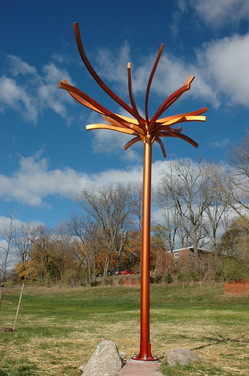
One of two metal tree sculptures installed in West Park using parks millage funds channeled through the public art program.
Courtesy of City of Ann Arbor
That includes $539,000 from the city's street millage, $40,000 from the parks millage, $907,000 from the sewer utility, $367,000 from the water utility, $60,000 from the stormwater utility, $38,000 from the solid waste fund and lesser amounts from the airport and energy funds.
The city's administration stresses that all public art projects must serve a purpose somehow related to the source funds. For instance, $750,000 in utility funds is paying for a sculpture being installed outside of city hall that will recycle stormwater.
But with the city's street millage up for renewal in November — along with a slight increase to fund sidewalk repairs — Kunselman said there's concern the city is taking money from dedicated millage accounts and transferring it to public art.
"The state law says under a millage you have to have a clear statement of purpose of the millage," Kunselman said, arguing art isn't in the street millage's stated purpose.
He read aloud a statement posted on the Tuscola County government website. He said Tuscola County has a number of special millages and county officials there have posted the message to give voters confidence that the millage dollars they approve are used as stated.
"The Board of Commissioners does not have the legal authority to remove funds from the special purpose millage accounts for any purpose other than what the voters in Tuscola County approved the funds to be spent on," Kunselman said, reading the statement. "Simply put, the Board of Commissioners can not reallocate funds from one account to another."
Kunselman argued the same applies to Ann Arbor.
"I've said it time and time again, transferring monies out of the street millage account to the art fund is illegal," he said, "whether you did it by ordinance or any other means."
Hohnke argued dedicating portions of capital dollars to art is similar to the council instructing city staff to use high-quality materials versus low-quality materials in construction projects.
"It's not transferring money out of that particular millage," he said. "It's simply saying this is how we're going to deploy these capital resources for this project. We're simply saying that having an artistic representation of a project is part of what we want out of that project. So it's not removing it from a millage and spending it on something entirely different."
Council Member Sabra Briere, D-1st Ward, said she hopes Kunselman will bring forward a resolution at a future meeting recommending an ordinance change that meets his goals. She said she plans to bring forward her own resolution spelling out how the council plans to account for and spend money from the street millage if it's renewed in November.
In a recent e-mail newsletter sent to residents, Briere shared a report on the street millage's revenue and expenditures going back to fiscal year 2007-08. (Download it here.)
The Public Art Commission, which oversees the public art program, also has submitted its annual report to the City Council. (Download it here.)
City officials said the city received 73 qualification statements from artists looking to take on a $150,000 art project in the lobby of the new Justice Center building.
Aaron Seagraves, the city's public art administrator, said 24 of the statements — about a third of them — came from Michigan artists. He said none of the artists have offered formal proposals at this point — only information about past work and statements of interest.
A panel is expected to select a group of about five finalists by Sept. 30, and the final proposals are due Dec. 1. A final artist could be selected by the Public Art Commission in January.
Despite the fact that $250,000 is shown earmarked for art in the Municipal Center project budget, Seagraves said only about $150,000 of that will be spent and the rest will go back into the pooled art fund after the project is finished.
City officials have told artists the lobby artwork should be a ceiling-mounted or suspended piece that will make an impression looking in from both Fifth Avenue and Huron Street during the day and at night, with either incorporated or reflected lighting. They also want the artwork to complement the building and surrounding site environment, and speak to the public purposes of the building: public safety, justice, equality and security.
Ryan J. Stanton covers government and politics for AnnArbor.com. Reach him at ryanstanton@annarbor.com or 734-623-2529. You also can follow him on Twitter or subscribe to AnnArbor.com's e-mail newsletters.
Comments
StrongFire
Fri, Sep 9, 2011 : 4:13 p.m.
I think the public art funding is being implemented too broadly. In my opinion, for public art to be funded it should have a nexus to the project being funded. Therefore, there should be no public art funding coming from the general, utility, solid waste, streets, and possibly, parks funds. The only time when it might be appropriate is for public building projects such as city hall, police, fire, and courts, provided that the funding comes from a building fund the location of the public art will be in relation to the project. To have utility user fees increase because a percentage of capital projects have gone to public art, in my opinion, is wrong. The street fund should absolutely not be raided for public art projects. Having public art in the city is a laudable goal, but the City of Ann Arbor is going about it all wrong.
Stuart Brown
Thu, Sep 8, 2011 : 1:59 a.m.
Voters should remember to vote down the Street's Fund millage 2 mill renewal this November which is disguised as a new 1/8 mill increase in taxes to pay for a new sidewalk program. Pat Lesko's letter above alludes to the $29 million dollar surplus in the Street's Fund (which is about four years worth of revenue collection) which has been sitting idle while the city's safety services have been allowed to wither on the vine. Why would the city let its roads crater while it is sitting on a surplus in its Street's Fund? Stephen Lange Ranzini at <a href="http://www.a2politico.com/?p=10130#comments" rel='nofollow'>http://www.a2politico.com/?p=10130#comments</a> had an informed opinion: the city was investing the fund balance in the bond market. This scheme worked well when investment grade corporate bonds were paying out more than the city was paying on its own debt of tax exempt municipal bonds, but not so well when corporate bonds pay less, which is what has happened. BTW, this change of events is coincidental with Roger Fraiser leaving the City Manager position. The question I have is this: what happened to the interest paid to the city on the various fund balances kept in the city's sundry buckets? Was this another avenue to divert funds from one bucket to another?
Mental Floss
Thu, Sep 8, 2011 : 1:59 a.m.
A designated fund is a designated fund. If Council really believes the citizens of Ann Arbor want to spend tax dollars on art in these very tough times, then propose a millage to pay for art and let us decide.
Halter
Wed, Sep 7, 2011 : 9:38 p.m.
I am waiting for a car to fall through those big potholes on the Stadium bridges that are, for all intents and purposes, now too dangerous to drive over and should be closed. Then I will take a photo, blow it up to 5 foot by 3 foot, frame it, and personally deliver it to City Hall...
nixon41
Wed, Sep 7, 2011 : 9:19 p.m.
What?????
fjord
Wed, Sep 7, 2011 : 9:04 p.m.
In times when tax dollars are plentiful and we have sufficient funds to fix our roads and bridges, fine, divert no more than one percent to public art. This is not one of those times. I'm generally in favor of public art, but not when it takes money from more important projects. Street millage funds should be used to pay for streets, end of story. If you want to fund public art, put a dedicated public art millage on the ballot. Good luck getting it passed during a recession...
MyOpinion
Wed, Sep 7, 2011 : 8:47 p.m.
All the vote these bums out talk is mostly hot air. The time for a competitive election was in August when the primary was held and 8% of the Ann Arbor electorate voted. Most of the council is running unopposed in November. In fact, Kunselman had one of the more vigorous challenges, with a candidate that the mayor and his cronies favored. Kunselman ended up winning. The point is, the chances to change the city council are few and far between. Run for office instead of commenting to AnnArbor.com Be informed Get out and vote
Goober
Wed, Sep 7, 2011 : 9:12 p.m.
So we truly are a one party town. I have no intent of joining a group of incumbents, being the sole voice of reason and logic. If the majority of Ann Arbor voters agree with what is happening in this town by re- electing the same people, then my voice of opposition needs to go silent. The majority deserves everything that this group is doing to the city. Can't fight city hall, eh?
B. Jean
Wed, Sep 7, 2011 : 7:59 p.m.
Kudos to Kunselman! Here is a guy who "gets it". City council's job is to spend our tax dollars on the things that are authorized by law. What a concept! Should the council fix roads and infrastructure, secure public safety or buy art? Yep, it's a puzzler all right. And for those on city council that can't quite figure out this puzzle, I pray the voters will figure out that we can elect someone that might actually listen to their consitiuents and put our priorities above their "personal agendas".
larry kramer
Wed, Sep 7, 2011 : 7:33 p.m.
I'd like to know which of these idiots originally voted for this money grab!
H.
Wed, Sep 7, 2011 : 5:28 p.m.
Seriously Ann Arbor? Are there not enought bleeding heart philanthropists to pay for this nonsense?
Goober
Wed, Sep 7, 2011 : 5:26 p.m.
I would love to see a full list of all recent city issues (for the past 3 years, I would think) showing the voting record for all city council members and the mayor. This record and summry would be a great help allowing the Ann Arbor voters the ability to decide who to retain and who to vote out of office. This makes even more sense, as I recall in one of the recent articles and comments that one city council person stated something to the extent of not remembering an issue or not remembering that it came up for vote. We should let the facts do the talking so that Ann Arbor voters can be fully informed.
buildergirl
Wed, Sep 7, 2011 : 6:30 p.m.
Sorry, it's at CTN Oct 5th at 7pm. Lets get some real answers!
buildergirl
Wed, Sep 7, 2011 : 6:09 p.m.
How about attending and submitting questions to the debates? There are opportunities available for the candidates but usually less than 20 people attend. Lets fill the library up! If we can find parking...
Patricia Lesko
Wed, Sep 7, 2011 : 5:10 p.m.
"In a recent e-mail newsletter sent to residents, Briere shared a report on the street millage's revenue and expenditures going back to fiscal year 2007-08. As a local accountant/lawyer who has spent many years analyzing the city's finances commented in response to a piece on A2Politico about the Street Repair Millage vote: <a href="http://www.a2politico.com/?p=10130" rel='nofollow'>http://www.a2politico.com/?p=10130</a> "Sabra Briere's newsletter included a link to a streets millage spending spreadsheet prepared by city CFO Tom Crawford. The spreadsheet shows a fund balance of 29,482,808 at 6/30/11. The spreadsheet shows projected FY2012 spending of 27,276,570. That amount is double the projected FY2012 spending provided to council member Briere in July by Homayoon Pirooz. "The spreadsheet shows the city will spend about 8.6 million on 2011 annual street resurfacing, but that amount is about double the amount council has actually authorized for the program. The other line item that appears to be padded is the annual street resurfacing program for 2012 and 2013. These are more than double past spending in this area. Even with these padded amounts, the streets millage fund is projected to have a fund balance of 11.4 million at the end of FY2012. "I can think of 3 explanations for these inconsistencies. 1. The city's CFO has no idea what is going on. 2. The padding is really the Stadium Bridge because there is no federal funding 3. A ploy to try to convince voters to approve the millage because the money will actually be used to fix the streets" It's crucial for readers of AnnArbor.com to remember that Christopher Taylor and Sabra Briere's "letters"—which this site simply repeats—are often riddled with inaccuracies.
blahblahblah
Wed, Sep 7, 2011 : 5:04 p.m.
This "art heist" of taxpayer money is only one of the many pet projects continuing to be fully funded and expanded upon at the expense of basic city services. Next up is building yet another parking structure (Fuller Station) as well as the AATA's $450 million expansion pipe dream. Not only are the roads in terrible shape, but our water and sewer rates have been rising over the years. No wonder! Over $1.25 million has been siphoned out of the sewer and water departments!!
annarborfan
Wed, Sep 7, 2011 : 4:20 p.m.
Just another city stealing from one fund to feed another unapproved fund. Sounds illegal to me, though the attorney will declare what is happening as legal. Looks like the city has spent most of the street mileage on art. Not very good art at that! I wondered where all this cheap art in my city was coming from!
JSA
Wed, Sep 7, 2011 : 3:46 p.m.
When I first saw the headline I was thinking this was going to be a humorous piece. Silly me, this is Ann Arbor's city coucil and mayor. Nothing is impossible. I doubt this is legal. I am willing to bet if the practice does not stop there will be multiple lawsuits filed. If this gets enough publicity, say good by to any new millages or millage renewals. This is another law passed by council to take power away from the voters and give it to a few obviously corrupt politicians. It should be done by ballot in a November election, if at all, not a special election at taxpayer expence to try to blow it though paying for a low turnout.
Goober
Wed, Sep 7, 2011 : 4:15 p.m.
Yes, another reason why all need to be replaced. The mayor should direct our city attorney for a written legal opinion that can then be confirmed by our legal community. My guess, it will be found to be illegal to divert specific millage funds to anything other than the specific fund purpose. Then, Ann Arbor leadership will have to find a way to restore the diverted funds. In this case, I would help vote for a law to stop the expenditures on art unless specifically asked for from the voters.
friend12
Wed, Sep 7, 2011 : 3:39 p.m.
Taking the money from a millage is illegal. Any first year law student can tell you that. If they want to use the money to make street repairs more artistic that is ok, but, using that money for anything but street repairs violates the terms of the millage. A really sleazy lawyer I am guessing will file a class action suit to recover that money for the tax payers.
Fredric
Wed, Sep 7, 2011 : 3:39 p.m.
Let see, less Police and Firefighters. The City is almost broke from all the articles in the papers. But, we have plenty of funds to build statutes in parks that we can not take care of and put into the new Public Center that someone " Forgot to add the cost of furniture in Original cost projections but we have money for ART!! . If we had the extra funds. then OK. But, now under the conditions we face today!
El Poquito
Wed, Sep 7, 2011 : 3:13 p.m.
Yesterday's news: bike lanes; bikers on sidewalks vs. streets. As a bike rider who uses both [with a high degree of awareness for my own and others safety], riding in Ann Arbor streets that are filled with potholes makes it a high-risk dodge to not be thrown into traffic. I appreciate art - especially public art. But if my kid needed something for their safety and well-being, that would be a higher priority than spending $ on a nice new piece of expensive art. Council has that same guiding responsibility, but instead what I hear are excuses for spending the family's hard earned money at the amusement park. Are we amused enough yet? And at what hidden costs?
Richard
Wed, Sep 7, 2011 : 2:51 p.m.
Does the Mayor or any city council member ever drive into downtown on Jackson/Huron or Miller ? Those streets are in horrible shape from the Stadium Rd/Maple Rd area into downtown. Patching and potholes that create very uneven pavement. Why aren't horrible roads like those two being repaired ?
foobar417
Wed, Sep 7, 2011 : 6:14 p.m.
Jackson/Huron is the responsibility of the state, not the city. The city can't do it. Miller is getting patched later this year (Chapin to 7th). 7th to Miller is planned for 2013, according to the city website. Dexter is planned for next spring. Stadium bridge is planned for the fall, again according to the city website.
Stephen Landes
Wed, Sep 7, 2011 : 2:43 p.m.
I have to add here that the only thing that metal tree in the park, shown in the photo accompanying this article, reminds me of are the dead ash trees I had to have cut down on my lot over the last several years. More REAL trees and less garbage metal trees, please.
Marilyn Wilkie
Wed, Sep 7, 2011 : 2:42 p.m.
Out of 45 comments so far there has not been a single one in favor of drawing off funds from necessary services to fund public art. This must be rescinded by a vote of the citizens of Ann Arbor. And, it is up to the officials to make sure that happens. Soon.
foobar417
Wed, Sep 7, 2011 : 6:10 p.m.
You realize of course that the frequent commenters on aa.com are hardly representative of the community as a whole. That said, putting percent for art up for a vote seems like a good idea to me.
Stephen Landes
Wed, Sep 7, 2011 : 2:37 p.m.
If (and this is a pretty big if) City Council and the Mayor believe they are expressing the will of the people by creating this public art fund then they can put this to the test very easily: use only funds directed for this purpose by citizens on their tax forms. They can put a check box on the tax form asking if you want $1 from your taxes put into the public art fund. This approach is similar to that used for presidential election funds on our Federal taxes. We also have the model on Sate tax forms for funding children's' programs and some environmental actions. The City could go a step farther and add several boxes to the form giving people a range of values from which to select, say up to $10. That approach will help Council and the Mayor zero in on what our citizens really want to see spent on this program. If citizens really value public art they will vote with their own money at tax time; if not then we have clear direction to dismantle this program. The selection of 1% is arbitrary and of dubious heritage. What makes 1% so magical? Is this a number dreamed up by the arts community as their "fair share"? I doubt there is anything substantive behind the selection of this figure.
Ryan J. Stanton
Wed, Sep 7, 2011 : 2:33 p.m.
Sorry to everyone taking the poll who would like to select multiple options. I tried setting it up that way but learned our polling tool doesn't allow for multiple selections. I hear we're working on adding that functionality for future polls.
Charlie Brown's Ghost
Wed, Sep 7, 2011 : 5:54 p.m.
In addition to the obvious -providing the choice "All of the above" - I find it troubling that you don't have control over your own software. Not a very effective way to run a Web-based business.
Stephen Landes
Wed, Sep 7, 2011 : 2:38 p.m.
Then just give us the option of "ALL", please. I refuse to vote in the current poll.
Hmm
Wed, Sep 7, 2011 : 2:32 p.m.
The roads themselves need fixing not art enhancements.
Stephen Landes
Wed, Sep 7, 2011 : 2:24 p.m.
Once again the poll created by A2.com fails to provide the real publicly desired alternative -- exempt ALL of the funds listed. This percent for art fiasco needs to com to an end. The only art project I can think of related to the street millage would be a pile of bent and broken wheels and suspension parts on an altar -- sacrificed to the City's inept street maintenance program.
Vince Caruso
Wed, Sep 7, 2011 : 2:12 p.m.
I find it hard to understand how we have ~$1M for stormwater art at the city hall but no funds to do a meaningful watershed study of the Allen's Creek watershed with 1,200 - 1,500 homes and businesses at risk with little information other than the 1968 flood data to guide planning. For example the West Park stormwater improvement design failure and flooding could have been avoided if meaningful data was available. A study could be done with 1/4 of the City Hall Stormwater Art project.
Goober
Wed, Sep 7, 2011 : 2:20 p.m.
Excellent point. Another example that all of our city council and city leaders need to be replaced. Not a single one of them is looking out for us.
jeff4179
Wed, Sep 7, 2011 : 2:06 p.m.
Can't really add much to all of the great comments about the City Council not being good caretakers of taxpayer money. But, I did have one original thought after reading the article....we in Ann Arbor have a Public Art Administrator? Is this a full-time job? How much does this person get paid? It's like a broken record, but unfortunately still relevant: what would Ann Arbor citizens choose if given the choice between having a Public Art Administrator or recalling a couple of laid off police officers or firefighters?
SonnyDog09
Wed, Sep 7, 2011 : 1:59 p.m.
Did council really meet on Monday night (Labor Day), or was the meeting on Tuesday night?
Tony Dearing
Wed, Sep 7, 2011 : 4:17 p.m.
Thanks for pointing that out. It's been corrected.
buildergirl
Wed, Sep 7, 2011 : 1:49 p.m.
Wait, after four years and 2.2 million dollars the legality of redirecting funds is coming up now?
Goober
Wed, Sep 7, 2011 : 4:09 p.m.
Sorry. We need to spread the word. I did not catch the macro changed my word as I typed it. In any case, replace all current city council personnel and the mayor.
Goober
Wed, Sep 7, 2011 : 3:55 p.m.
If this is true, the only experience we see is tax, spend and waste. I intend to vote in new people willing to partner with Ann Arbor citizens and residents to correctly manage our assets and provide visionary leadership. No incumbent has demonstrated this. We all need to speed this word to vote all incumbents out of office.
buildergirl
Wed, Sep 7, 2011 : 3:13 p.m.
The discontent of voters on every issue reported here is overwhelming yet the same people keep getting voted in. I don't get it. They want experience of the incumbent but the results are always the same. Maybe it's time to vote for the "other" side, or start voting in primaries! I was appalled when the voting volunteer told me they were almost to 100 in the last primary. If you want change you have to act on it!
Goober
Wed, Sep 7, 2011 : 1:59 p.m.
Either this is an after thought or done on purpose to snooker the tax payers even with legal concerns. I believe it was done on purpose with prior legal concerns, but now put on the table due to citizens raising the issue. My belief is based on the track record of our city leaders and council personnel.
Mr Blue
Wed, Sep 7, 2011 : 1:44 p.m.
If the city is serious about art and building a vibrant, growing local art scene not based around the UM and it's many museums, use some of the percent for art to turn 415 W Washington into a public performance and gallery space. Plant seeds to grow and nurture a local arts scene instead of spending more big bucks on elitist art of dubious necessity. Those metal "trees" in West Park are ugly. Who's silly idea was that? They're self conscious and not in context with the natural features or the history of Ann Arbor of the Allen Creek. Kind of like the "art" bike racks. For all the creativity in this town, the people in charge have made some incredibly un-creative decisions, like yet another fountain in front of yet another public building.
Bertha Venation
Wed, Sep 7, 2011 : 1:28 p.m.
Kunselman is right. Boy, this really fries my oysters, and one reason I want to vote out city council AND the mayor!
Goober
Wed, Sep 7, 2011 : 4:59 p.m.
I would propose checking Anglin's voting record too. We should let the facts do the talking as to whether he keeps his job or should be replaced like the rest including the mayor.
Bertha Venation
Wed, Sep 7, 2011 : 4:40 p.m.
@ Goober. I don't know a lot about Kunselman, and guess maybe I shouldn't believe everything I read. @Peregrine, My mistake. I should have been more specific. I should have said everyone except Kunselman (and Anglin). My apologies
Goober
Wed, Sep 7, 2011 : 4:36 p.m.
I did a quick search and see that Kunselman is not new, but did take a short hiatus from council before returning. I would love to see his full voting record on issues to help us decide if he should retain his job as a lone voice of sanity amongst the city council & leadership track record of mismanagement, tax, spend and waste.
Goober
Wed, Sep 7, 2011 : 4:21 p.m.
Is Kunselman new to city council? We need to check his voting record to see if he has voted in favor of spending diverted funds on art.
Fredric
Wed, Sep 7, 2011 : 3:41 p.m.
Hey, are these oysters on the half shell or just deep fried with hot sauce. I agree with you though. ( I do like FRied Oysters and Fried Clams though!!)
Peregrine
Wed, Sep 7, 2011 : 3:22 p.m.
That's really precious! You believe Kunselman is right, so you want to vote him out.
Goober
Wed, Sep 7, 2011 : 1:54 p.m.
I agree that we need to clean the slate and vote out all current city council members and the mayor. Please help spread the word.
ypsiarborchica
Wed, Sep 7, 2011 : 1:21 p.m.
I think public art is important, but not when we can't even fix our roads and bridges. Why aren't our council members fighting this hard over how to find funding to fix the bridge on Stadium?
Linda Peck
Wed, Sep 7, 2011 : 1:07 p.m.
At this time of necessary budget cuts, there is no money for public art in my opinion. Let's solve our pressing problems first and if we are rich after that, go for it, but please get some people who have a sense of what public art really is.
Carole
Wed, Sep 7, 2011 : 1:04 p.m.
Let me see here -- they can take funds from various "buckets" of water, which were to be used specifically streets, parks, sewer, etc. and transfer them to an "art fund" without citizens approval. However, they can not take any funds out of the buckets and transfer them to help provide adequate fire and police services and repair one of our greatest disgusting features in Ann Arbor -- The Stadium Bridge. Are they waiting for a major accident to occur before taking action.. I agree with Local and Goober -- and, it is disturbing that several on the council don't get it. Millage approved for parks - use it for parks, likewise right down the list. As for the art in West Park -- I surely would rather have seen the parks department plant trees that would provide shade and oxygen to the area --
aataxpayer
Wed, Sep 7, 2011 : 12:59 p.m.
How can people vote to renew this millage if we can't trust the city to spend the money according to the will of the people? If you want 1% for art then put that idea up for a vote.
Greg
Wed, Sep 7, 2011 : 12:38 p.m.
Fund art from dollars voters approve for art. Stop trying to sneak art (your opinion of art) into funding the voters have approved.
A2G
Wed, Sep 7, 2011 : 12:37 p.m.
Public art is a nice to have when there is money but is in no way an essential or vital service. When we are cutting resources for public safety and can't even maintain our parks let alone just mow the grass so they are useable, then spending money on more non-essential things is irresponsible.
MikeyP
Wed, Sep 7, 2011 : 12:34 p.m.
Here's an idea for a promising local artist, should even fit in one of the round-abouts or in the median on S. State St. near I-94: A sculpture of a large bucket marked Street Millage fund with council members poking a hole into it so it drains into another large bucket named "Art Fund" while there are a group of cops and firefighters holding up their meager Public Safety bucket with the council members/mayor sneering at them as they deplete from one bucket into another bucket but not the cops/firefighter bucket. It can fill up with rain water, environmentally friendly! I can't draw a stick figure let alone sculpt this but put it up for a vote and I think you'd find this particular art piece to be highly popular around here and a great project for a talented local artist.
Marilyn Wilkie
Wed, Sep 7, 2011 : 12:33 p.m.
The Mayor and city counsel members who adopted and continue to push for this have no concern for the wishes of the citizens, this is clear. In these times, when artwork is valued over taking care of necessary repairs to the extent of syphoning off funds, it is evident that city government has no clue about governing a city. Perhaps their lives are so comfortable that they are unable to see basic needs of those under them.
Doug
Wed, Sep 7, 2011 : 6:18 p.m.
I agree with you, but the liberals of Ann Arbor will continue to vote these people into office!
say it plain
Wed, Sep 7, 2011 : 12:21 p.m.
Clearly the City Attorney is a political hack, 'answering' Kunselman's question that way, and playing this game about saying he'd be glad to 'research the legality' of the Mayor's desired art allocations if (and only if, is the subtext) the "whole" council asks him too! Hey, this town has a goodly number of skilled lawyers... Are there any who'd have the stomach (because it wouldn't help anybody's political aspirations lol) to 'research' a class-action lawsuit on behalf of drivers in this town?! What is the "legality" of having money sitting in road repair funds *at all* and yet failing to repair heavily travelled obscenely pot-holed streets like Miller, Dexter, etc...? Perhaps a suit would be the only way to get Mr. Postema to look in to that?!
Jaime
Wed, Sep 7, 2011 : 12:18 p.m.
You have a button for "none" but not one for "all". Public art is nice but not necessary and when funds are tight you should not be allocating them for "wants" over "needs".
Brad
Wed, Sep 7, 2011 : 12:03 p.m.
So if the sidewalk repair addition to the street millage were to pass, would the repairs count as "capital projects" where there would be a 1% "siphon-aside" to the art bucket?
foobar417
Wed, Sep 7, 2011 : 6:12 p.m.
I believe the answer was no, but there was an article on this previously.
golfer
Wed, Sep 7, 2011 : 11:54 a.m.
just drive down some of our streets. you want to take money away from them. i would add to them not take away. you want art go to new york.
Ignatz
Wed, Sep 7, 2011 : 11:54 a.m.
First of all, I agree with several of the posts that an additional choice should be in the poll; that of all. Secondly, it looks like the voters and taxpayers have been hoodwinked by those in power. Art is nice, if and when you can afford it, but the city's infrastructure is not nearly up to par. All money voted for any funding should be spent on that particular project.
lbechard
Wed, Sep 7, 2011 : 11:53 a.m.
Expenditures for public art is fine in times of prosperty and budget surpluss. If there is money to spend, fix the roads.
Ryan
Wed, Sep 7, 2011 : 11:52 a.m.
That's an interesting picture of a metal tree installed in West Park. Perhaps the Ann Arbor city council is unaware that trees grow naturally out of the ground and that metal trees bear no fruit? I assumed they would know this seeing as Ann Arbor is known as "tree town". Paying for metal trees seems completely ridiculous when you think about it, seeing as they are useless for shade, provide no home for animals, and require more maintenance than a regular tree. I wonder how much that genius idea cost Ann Arbor taxpayers? I also wonder how many real trees could have been planted for the cost of this piece of "art"?
JHW426
Wed, Sep 7, 2011 : 11:37 a.m.
I came up with a great idea. How about using a different colored cold patch to fill in the street potholes every year. That way, over time, streets like Dexter, east of Maple would take on a very colorful mosaic and after a few years from the many, many patches it could be a form of public art and we'd save money by not maintaining the roads properly.
Vivienne Armentrout
Wed, Sep 7, 2011 : 8:37 p.m.
A great idea, perhaps to combine with the Newshawks' talking potholes (5 min in) <a href="http://www.youtube.com/watch?v=2QN9jIyij6U&feature=related" rel='nofollow'>http://www.youtube.com/watch?v=2QN9jIyij6U&feature=related</a>
63Townie
Wed, Sep 7, 2011 : 2:12 p.m.
It would be Ann Arbor's interpretation of "The Heidelberg Project". Love it.
snoper
Wed, Sep 7, 2011 : 11:34 a.m.
Ok, let's assume it is legal. At best, it is still one of the most arrogant over-reaches you'll ever witness by a City government. Taking $500,000 from a fund that voters SPECIFICALLY DEDICATED for street repair is madness. Have you driven on our streets? Let's put public art up for a vote. Are there no reasonable Democrats in this town who believe in running a City government?
JHW426
Wed, Sep 7, 2011 : 11:20 a.m.
I vote for all of the above. Where is that option? When the streets are no longer in need of repair, why don't we revisit the public art issue. Or better yet, let's try to pass a separate millage strictly for public art and see how well that works. Keep voting for the same council, more of the same to come.
Goober
Wed, Sep 7, 2011 : 11:41 a.m.
I intend to vote for all new representatives. No incumbent will get my vote. We need a clean slate of all new city council representatives and city leaders (the mayor, etc) so we can change this experience of tax, spend and waste. Please spread the word.
Cash
Wed, Sep 7, 2011 : 11:19 a.m.
Of course the answer is to have art and NOT spend taxpayer money to get it. This area abounds with wonderful artists who would welcome an opportunity to display their art anywhere and often have to drive hundreds of miles to get that opportunity...in Chicago, western Mich etc. Displaying local artist's work would serve the purpose of helping the local economy (offering the art for sale) and not using taxpayer funds to do so. I don't think there would be any objection to displaying artworks around Ann Arbor. Just remember, council members: ONLY LOCAL ARTISTS should be considered. No taxpayer funds should be spent.
average joe
Wed, Sep 7, 2011 : 11:17 a.m.
"Under an ordinance approved by the City Council in 2007, 1 percent of the budget for all city capital projects — up to $250,000 per project — is set aside for public art." "...$750,000 in utility funds is paying for a sculpture being installed outside of city hall that will recycle stormwater." Isn't the Council 'overbudget' on this one project?
Peregrine
Wed, Sep 7, 2011 : 3:21 p.m.
You're misreading the statements. Either 1% or $250,000, whichever is smaller, from city capital projects gets SET ASIDE for art. That does not put a limit on what can be SPENT for any given project. Did you and 17 (as of now) up-voters really misunderstand this? Or did seeing an accusation of the city being "overbudget" spur knee-jerk up-votes?
1bit
Wed, Sep 7, 2011 : 11:15 a.m.
The "buckets" we keep hearing about are growing leakier and leakier when it suits the purpose of the mayor and some council members.
local
Wed, Sep 7, 2011 : 10:57 a.m.
This is a no-brainer, this money should not be going towards art at all. This idea that Ann Arbor needs art to compliment other features is getting old. If the picture in this article represents art, that in itself is very concerning. What is going to happen is someone is going to cut it down and take it to the scrap yard for money. If Ann Arbor and its mayor want money for art, ask for it at the next election in its own little tax package. If voters okay it, awesome. It voters turn it down, that should be a clear message to the mayor to cut it out. Clearly they have spent enough tax payer money on the fountain and other projects around the city, yet sidewalks need fixing and stadium road bridge is still a mess. Both those projects seem much more important then art around the city.
Bill
Wed, Sep 7, 2011 : 10:50 a.m.
@Ryan--The poll should allow for selecting multiple as well as all funds. It will reflect the views of the people more accurately for the mayor and council to ignore.
Goober
Wed, Sep 7, 2011 : 10:49 a.m.
The Hohnke comment about using lower quality materials is not the same and is not logical. This issue can be solved rather easily. Stop diverting money to art from specific funds. Determine the desired amount of money for art and allow the Ann Arbor citizens the ability to vote for this in the form of a tax or millage. Then if approved, use the money for local artists to demonstrate the talent that we have in this area and in Michigan. I have no faith that our mayor or city leaders will come to an easy solution such as this. Their track record speaks for itself - tax, spend and waste; divert money from needed fund categories for their own personal desires.
Stephen Landes
Wed, Sep 7, 2011 : 2:29 p.m.
As we're dealing with City Council what makes you think their statements should be logical? Self-serving, yes, but logical?
say it plain
Wed, Sep 7, 2011 : 12:33 p.m.
Yes, indeed, Hoenke's comment is not only illogical but terribly ironic, since a valid complaint about the work the city *does* spend as the millage requires has been the lack of quality materials/workmanship! We should be spending any "percent-for-art" salaries instead on extra resources for assuring that the road repairs get done properly so that we don't have to spend extra making up for it! His statement is a poster-child for why the fund diversion *should* be illegal, even if Postema can't find any specifically worded 'ban' on such siphoning.
The Black Stallion3
Wed, Sep 7, 2011 : 12:15 p.m.
Very well said.......Thank You
A2comments
Wed, Sep 7, 2011 : 10:30 a.m.
"City officials have told artists the lobby artwork should be a ceiling-mounted or suspended piece that will make an impression looking in from both Fifth Avenue and Huron Street during the day and at night, with either incorporated or reflected lighting. They also want the artwork to complement the building and surrounding site environment, and speak to the public purposes of the building: public safety, justice, equality and security." Suspend a jail cell from the ceiling, rotating, illuminated by the sparkling water from the fountain ...
Alan Goldsmith
Wed, Sep 7, 2011 : 10:27 a.m.
"They also want the artwork to complement the building and surrounding site environment, and speak to the public purposes of the building: public safety, justice, equality and security." Something, the Mayor and his supporters on Council, have obviously shown with cutting police and fire staff, making decisions behind closed doors and spending millions on an illegal art tax. It would be nice to have a City Attorney who isn't making his plans for a political office on the city payroll too
Vivienne Armentrout
Wed, Sep 7, 2011 : 10:23 a.m.
Your poll is constructed so that one may vote for only one fund, but several of them are appropriate to exempt.
Charlie Brown's Ghost
Wed, Sep 7, 2011 : 12:13 p.m.
I was looking for "all of the above."
Craig Lounsbury
Wed, Sep 7, 2011 : 12:09 p.m.
well said. We should have the option to pick as many as we want.