

Ann Arbor City Council members express hesitation about vehicle idling ordinance
Ann Arbor City Council members expressed hesitations Tuesday night about implementing an ordinance banning the unnecessary idling of automobiles in the city.
But it's still under consideration.
Council members agreed reducing idling could improve the community's health, but some believe simple education might be enough to change behavior.
"I think the education is fine," said Council Member Jane Lumm, an Independent who represents the 2nd Ward. "Enforcement is an entirely different matter."
Council members heard from Matt Naud, the city's environmental coordinator, and two members of the city's Environmental Commission during a special work session.

Matt Naud

John German

John Koupal
The ordinance, which is being recommended by the Environmental Commission, is intended to reduce unnecessary idling from internal combustion engines of all types.
"So that's heavy-duty vehicles, trucks, light-duty vehicles, regular passenger vehicles, and also small engines, lawnmowers, things like that," Naud said. "Generators at a construction site — it's another area that we've seen a number of complaints."
Naud said there are many problematic examples in Ann Arbor ranging from delivery trucks idling in front of businesses to parents idling in front of schools waiting for their children.
"Many communities have developed idling ordinances as a tool that they have — to deal with unnecessary idling in their communities," Naud said. "The state of Michigan actually has a bill before them right now regulating idling. It's unclear where that's going to go."
Naud said the city's Environmental Commission is lucky to have two members — John German and John Koupal — who are experts in air quality issues. They both testified before council.
German, a former Chrysler powertrain engineer, worked at the U.S. Environmental Protection Agency and spent 13 years writing regulations for vehicles and conducting research.
He also spent 11 years at Honda where he was a liaison between the automaker's research and development professionals in Japan and operations in the U.S. For the past few years, he has worked for the International Council on Clean Transportation.
"Idling is something that's coming up recently as an issue," German said. "It's never really been an issue before.
"Part of that," German continued, "is because of the huge benefits that society has from mobility and the high value people put on it — to the extent that we've been willing to put up with the safety impacts, congestion, air pollution and all of that."
German stressed the ordinance isn't aimed at curbing idling by vehicles that are in traffic or stopped at red lights. It's when they're parked and don't need to be running.
It used to be the case that vehicles were not all that easy to restart, German said, and so a certain amount of idling was better than shutting off the engine and restarting.
It also used to be the case that starting a car and then immediately driving off in cold weather could damage the engine, he said.
Engines today are very different, German said, noting the computer controls and sensors allow them to restart almost instantly and with no additional fuel.
"So even if you can shut the engine off for just 10 or 15 seconds, you will actually save fuel," he said, surprising some council members with that statement.
"So there's a lot of legacy reasons why people think that they need to idle, but none of them are really valid anymore," he said.
And then there are the emission impacts from the idling. For gasoline vehicles, German said, one of them is benzene, which evaporates into the air and causes cancer.
Naud described some of the worst idling scenarios.
"The worst emissions for a regular passenger car is if it's under 50 degrees, and that first start and idle — exactly what you want to do in the winter time," he said. "You know, you walk out, start your car, leave it for 15 minutes. It's the worst emissions you can get."
Koupal, an air quality expert who has worked at the EPA for two decades and worked for Nissan, also addressed council members.
"I'm here not representing the EPA tonight, but representing the breathers of our community, and also the parents of breathers," he said.
Koupal said he has spent his career working on vehicle regulations and technology, including estimating emission impacts on health and air quality.
"Fundamentally, this is a health issue," he said. "There are a lot of benefits from reducing idling, and again, we're talking unnecessary idling."
Trucks are part of the problem, Koupal said, but the larger problem is normal passenger vehicles, which he called a "major contributor of the air toxics that we're seeing."
He said elevated levels of benzene are being found in the air at schools across the country because of parents idling while waiting to pick up their children.
"As part of Denver's anti-idling program, they put together an estimate that said one minute of exposure to vehicle exhaust gives you the same carbon monoxide exposure as smoking three packs of cigarettes," Koupal said.
The Washtenaw Area Transportation Study estimates there are 440,000 passenger vehicle trips per day in Ann Arbor, on top of 22,000 heavy truck trips and nearly 2,000 bus trips.
Assuming 10 percent of the passenger vehicles are idling 10 minutes per trip, Koupal said that's 15,255 grams of carbon monoxide per day being emitted into the air, along with 889 grams of volatile organic compounds. He said that's far worse than heavy trucks and buses.
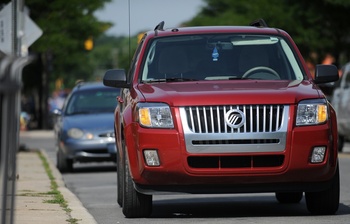
Cars sit parked outside the U.S. Post Office on East Liberty Street in Ann Arbor. Cars are often left idling outside the building.
Angela Cesere | AnnArbor.com
"So this has been in the works for nearly a decade," Council Member Sabra Briere, D-1st Ward, said at Tuesday's meeting.
Briere asked Naud how much outreach there has been to Ann Arbor Public Schools about the issue. Naud said originally there were a lot of talks, and the schools were supportive, but it's been a number of years since he's talked with any school officials about it.
Briere said one of her concerns has to do with the city's ability to change people's behavior, and the most effective way to do that.
"This ordinance is based on enforcing that change," she said. "But, of course, I think we need to do more on the education up front, rather than as part of passing the ordinance."
Council Member Marcia Higgins, D-4th Ward, said it's seems unclear how the city would enforce an idling ordinance. She asked whether it would be complaint-driven, meaning residents would have to complain about neighbors idling in their driveways.
She also wondered what the city would do at drive-throughs.
Higgins said educating school students about the dangers of idling might go a long way in terms of encouraging adults to get on board.
"When kids started recycling in school, now you have all those little people in your home chastising you if you're not throwing something in the correct container," she said.
"So I'd also like to see if we could partner with the schools to help them help educate their parents," she said. "Because we all know that if you have that little person sitting in the back seat going 'you should shut the car off,' you're going to want to do that."
Naud said it's always been assumed that public education was going to be a significant component of any effort to reduce idling in the city.
He said there's quite a bit of unnecessary idling by trucks in loading zones in the downtown and the city anticipates needing to buy a number of anti-idling signs for those locations.
Lumm and Briere asked Naud to bring back more information on the budgetary impact of implementing an idling ordinance, including what it would take to enforce it.
Council Member Margie Teall, D-4th Ward, agreed education is a great way to get people to reduce idling, but she believes an ordinance is needed, too.
"An ordinance is a great tool to kind of give a backbone to the concept itself," she said. "And education, while it's a great way to bring people up to speed about the effects of idling, I think sometimes you need to have just the threat in the back of one's mind that we value this."
Council Members Carsten Hohnke, D-5th Ward; Mike Anglin, D-5th Ward; and Stephen Kunselman, D-3rd Ward, were absent.
Ryan J. Stanton covers government and politics for AnnArbor.com. Reach him at ryanstanton@annarbor.com or 734-623-2529. You also can follow him on Twitter or subscribe to AnnArbor.com's email newsletters.
Comments
res-a-dent
Sun, Jan 22, 2012 : 1:27 a.m.
This proposed ordinance is insane. Isn't it already ileagle to drive your car without adaquate visibility? Most Ann arbor residents don't have the luxury of parking in a garage. On many winter days it is absuletly necessary to run your car with defrost on for a short period of time to clear the windshield. This is common sense. A law is not a " tool" to be inforced only when the council wants to. Anyone who sees laws as their "tools" (margie) has no business making them. This entire council needs to drop this senseless pet issue and work on solving real problems. Its nice to see that neither of my ward 5 reps could make it to this meeting.
Mike
Fri, Jan 20, 2012 : 3:54 a.m.
I have it on good source that if the Environmental committee gets this passed, they are going to be going after public gas passers next.
Kristi
Thu, Jan 19, 2012 : 9:19 p.m.
Enforcing an idling ordinance in residents driveways may not be practical or have much effect on air quality, but enforcing it in school parking lots and along city streets would. It seems many commenters have not parked among a train of idling cars at our local schools - I have for the past 10 years. Every single time I have picked up my kids there are cars idling away around my parked car and despite the weather, I have never gotten hypothermia or heat stroke. I've also been downtown and around campus and held my breath as I walked through the exhaust of idling cars and trucks waiting at the curb. Like the UM grounds truck that was repairing black top on State Street yesterday - did they really need their truck idling while they shoveled and smoothed the black top for several minutes?
Fat Bill
Thu, Jan 19, 2012 : 4:15 a.m.
This proposed ordinance is about as obnoxious as Dave Holden's pledge of allegience deal. Look, watch us do something! Please Council, find something more important to work on. There are so many reasons why this ordinance is silly. Vocational trucks have to run to power the accessories. When its 10 outside, I'll be unlikely to shut my car off waiting for a kid, same when its 90. Maybe I will leave the car in drive, in which case I'll be standing, not idling...maybe move an inch every so often...
snapshot
Thu, Jan 19, 2012 : 3:30 a.m.
If council passes this ridiculous ordinance cops better be parked at schools giving out tickets to local taxpayers rather than alleys giving tickets to companies trying to deliver goods to local businesses.
mr54
Thu, Jan 19, 2012 : 1:40 a.m.
This is just as stupid as the law of parking on residential streets for more than 2 hours.
Arno B
Thu, Jan 19, 2012 : 1:39 a.m.
How sad that the deep thinkers inCity Hall are wasting time and taxpayer dollars on such trivia! But I guess that's what they are good at! I noted that nothing was said about the AATA busses at the downtown terminal. They idle in the summer to keep the interiors cool and in winter to keep them warm. I wonder why these moral crusaders aren't advocating reducing skin cancer too. After all we have had the sidewalk police; apparently the idling police will soon be upon us. I have proposed setting up skin cancer prevention police. Such a force could be kept busy - especially around Art Fair time. Just have them go around giving tickets to people wearing shorts, short sleeves and un-approved headgear. The environtalists could readily put up similar arguments about how bad raw sunshine is for our un-enlightened townspeople.
RTFM
Wed, Jan 18, 2012 : 10:12 p.m.
I think it is the Ann Arbor City Council that is doing the idling here.
obviouscomment
Wed, Jan 18, 2012 : 9:18 p.m.
It doesn't make sense for a seatbelt ticket to be $60 and an idling ticket to be $100. Personally I think there should be no ticket or law for idling but if there's going to be please make it reasonable.
cornelius McDougenschniefferburgenstein jr. 3 esq.
Wed, Jan 18, 2012 : 10:25 p.m.
thank the lord you dont drive a commercial vehicle.tyrant tax=$500.00
Jim
Wed, Jan 18, 2012 : 8:54 p.m.
This is a classic example of "feel good" (versus "real good") legislation. A vehicle burns about .3 to .6 gallons of gas PER HOUR idling. This produces about 6 to 12 pounds of CO2 PER HOUR in emissions. (The other stuff, CO, etc. is negligible with current catalytic converters, etc.) This equates to 0.005 to 0.01 gallons of gas (or 2 to 4 cents worth) per minute. Based on Koupal's estimate, this would mean saving 800,000 gallons of gasoline per year. That sounds like a lot, but 440,000 cars burn about 352,000,000 gallons per year, so it's a savings of less than .25 percent (0.00227). This simply isn't worth the time and effort of legislation. I'm disappointed that these board members can't put these issues in their proper (minimal) perspective.
Bablat
Wed, Jan 18, 2012 : 8:46 p.m.
How about controlling passing gas first? Let's start with the City Council.
HeimerBoodle
Wed, Jan 18, 2012 : 8:09 p.m.
"The worst emissions for a regular passenger car is if it's under 50 degrees, and that first start and idle — exactly what you want to do in the winter time...You know, you walk out, start your car, leave it for 15 minutes. It's the worst emissions you can get." Indeed Mr. Naud, people make tradeoffs every minute of every day between what may be the perfectly "right" thing to do and what provides them with some level of comfort above the most basic survival requirements. We live in homes that are warmer than necessary, take hot showers...hell, we TAKE showers, we eat more than we "need" to, etc., etc. It's easy to play the "what do you really need?" game, but it's also absurd. Singling out warming up a car as something we should sacrifice for the greater good is incredibly simplistic. And it seems especially insulting given that city vehicles will be exempt from this legislation!
javajolt1
Wed, Jan 18, 2012 : 7:42 p.m.
I just read the article again because I didn't believe it the first time. A titanic joke. What's next.... No mowing on weekdays? The amount of smoke those 3/4 empty AATA buses belch in the name of 'green transportation' far eclipses the handful of idling cars. Message to this City Council: How about doing some real live work!
ArthGuinness
Wed, Jan 18, 2012 : 7:31 p.m.
"an estimate that said one minute of exposure to vehicle exhaust gives you the same carbon monoxide exposure as smoking three packs of cigarettes" Interesting, though I don't think carbon monoxide is the most dangerous thing in cigarettes, is it?
Swordsman
Wed, Jan 18, 2012 : 7:01 p.m.
The sillliness part of this proposal is that you can idle 5 mins every hour is you are in the car...but never if you aren't in it. Honestly, what difference does it matter if you're in the car or not? In other words, it's ok if I sit in my freezing car with my toddler when it warms up in my driveway...but not ok if I idle it for the exact same amount of time while stay inside. Nuts! They should really look into no-idling zones (like in front of a school), rather than an unenforceable blanket ordinance. That way the fumes stay away from where they can do the most damage.
Dog Guy
Wed, Jan 18, 2012 : 6:54 p.m.
The proposed ordinance would actually increase Ann Arbor's already egregious smug level.
MIKE
Wed, Jan 18, 2012 : 6:53 p.m.
"I think the education is fine," said Council Member Jane Lumm, an Independent who represents the 2nd Ward. "Enforcement is an entirely different matter." Jane, thanks so much for bringing some common sense to the AACC.
djacks24
Wed, Jan 18, 2012 : 6:44 p.m.
I honestly wouldn't doubt if their agenda wasn't green at all. Their true agenda could be decreasing our fuel consumption to help China meet their increased fuel demands. After this, and some of the other things they've done/proposed, nothing would surprise me.
Hmm
Wed, Jan 18, 2012 : 6:36 p.m.
One thing they can do if they are serious about this idling "problem" is get rid of every single "no turn on red" sign in town. There are too many intersections where people have to sit at the light and wait for it to change to green simply because a sign is sitting there saying you can't make a right turn on the red. I can understand if three is visibility issues but many of these signs are placed at intersections where anyone in any kind of vehicle can see far enough away to judge whether it is safe to turn or not. If we get rid of these ridiculous no turn or red signs we can do a whole lot to combat the idling situation
deletedcomment
Wed, Jan 18, 2012 : 6:20 p.m.
Have no fear everyone, I have the answer to our troubles; Before your 5mins are up turn off the car for 30 seconds and then restart it. That move will gain you another 5mins before you must repeat and rinse. I love sarcasm...
Candy
Wed, Jan 18, 2012 : 6:09 p.m.
I'd personally welcome this ordinance in Ypsi, where someone at my apartment complex once let his vehicle idle for an hour and ten minutes! And I've seen/heard many other vehicles idling for more than a few minutes. Seems to be a pastime in Ypsi. I never encountered this many idlers when I lived in other places.
obviouscomment
Wed, Jan 18, 2012 : 9:20 p.m.
It's not your car why do you care? The only thing that bugs me about my neighbors leaving their car idling is if the radio is blasting that whole time that I can hear it clearly in my apartment with windows closed.
mun
Wed, Jan 18, 2012 : 6:06 p.m.
"Trucks are part of the problem, Koupal said, but the larger problem is normal passenger vehicles, which he called a "major contributor of the air toxics that we're seeing." Then don't fine commercial vehicles. As other posters have noted, diesel trucks take more energy to start than if they are idling.
friend12
Wed, Jan 18, 2012 : 5:43 p.m.
Lets see: 1) Anyone picking a patient up at the hospital and has to leave the car to assist the patient is in violation. 2) Every school bus in the city is in violation every time they are picking students up at school. 3) Everyone that starts and lets a car warm up to defrost the windows must now drive with limited visibility or get an idling ticket. 4) All police cars sitting watching for speeders should be ticketed. They are idling. 5) Ambulances that are idling at a location need to turn off creating a cold/hot environment for their next patient. 6) You get that train that blocking the tracks for more than 5 minutes and you are going to ticket everyone waiting. 7) Construction equipment in the middle of winter can't go through a proper warm up before use that is required for safe operations. 8) All armored cars making a pickup should be ticketed. 9) Anyone stuck in a long drive through line should be ticketed. 10) if 100+ in the summera and you are waiting for a kid to get out ofscool. You have a baby in the car. Instead of running the air conditioning you have to shut the car off or get a ticket. The ordance is promoting child abuse. I can keep going. This is a stupid ordance that should never be passed. It is just screaming to be abused by PD looking earn money like Romulas does now by the airport. At a minumun there needs to exceptions during extreme weather conditions (hot or cold).
grye
Wed, Jan 18, 2012 : 8:05 p.m.
You forgot all the gas powered generators that would be running when ever there is a power outage.
friend12
Wed, Jan 18, 2012 : 5:46 p.m.
Sorry I was in a hurry and messed up the words near the end.
CobraII
Wed, Jan 18, 2012 : 5:34 p.m.
Stop the AATA buses from idling too!
cornelius McDougenschniefferburgenstein jr. 3 esq.
Wed, Jan 18, 2012 : 6:08 p.m.
they are commercial vehicles($500)
mr54
Wed, Jan 18, 2012 : 5:33 p.m.
Welcome to the Peoples Republic of Ann Arbor, a city unto it's own. The next next thing you'll hear is that the city will require all residents to drive Prius automobiles, but they will have a choice of colors. Glad i don't live in AA!!!
Steve Hendel
Wed, Jan 18, 2012 : 5:27 p.m.
Koupal, an air quality expert who has worked at the EPA for two decades and worked for Nissan, also addressed council members. "I'm here not representing the EPA tonight, but representing the breathers of our community, and also the parents of breathers," he said. Mr Koupal, you represent no one except yourself; otherwise, please tell us when and how the "breathers" appointed you as their spokesperson.
TreeTown
Wed, Jan 18, 2012 : 5:18 p.m.
What's next? Max allowed temperature setting for your home in winter and lowest allowed for summer?
SMC
Wed, Jan 18, 2012 : 5:07 p.m.
Idle hands may be the devil's workshop, but an idle city council discussing idling vehicles is clearly even worse.
Sandman
Wed, Jan 18, 2012 : 5:04 p.m.
Who voted for their council representative, so they could try and create a local ordinance against idling vehicles? Come on now...I know you're out there, speak up. Someone told council to do this; there is no way our educated council members would have come up with this piece of dribble without a resident backing them up. One more thing to consider, you should have painted the old worn-off cross-walks, so I know where I'm suppose to be yielding to pedestrians instead of wasting money on bicycle stickers on the road.
rinmem10
Wed, Jan 18, 2012 : 4:56 p.m.
Ok. Assuming I support the ordinance, in principle, who will enforce it? AAPD has been whittled away to the extent that they can not respond to "minor" crimes. Think, people, think.
Joe_Citizen
Wed, Jan 18, 2012 : 4:43 p.m.
Wow, not many happy citizens here! The counsel is wasting precious time and money here, WHY?. If the counsel lives in A2 they must be as annoyed about the traffic signals as the rest of the city. This is a total waist of gas, and make harmful gases into the air. A car burns a lot more gas stopping and going than an idle car.
javajolt1
Wed, Jan 18, 2012 : 4:37 p.m.
So I would assume City Council members and staff would read the responses on these articles to gauge community interest or lack thereof on various issues....at least they should unless they are too arrogant and already know what is best for all of us (which is certainly a possibility). Sooooo... it looks like we have an actual real live case where the 99% is against the 1%. The roads in this city are deteriorating, the unsophisticated negotiating of union contracts has resulted in debt as far as the eye can see and a reduction of city services and we're buying $million art from Germany. City Council needs to stop these silly initiatives that are poorly conceived, not well thought out and start serving its constituents.
Ron Granger
Wed, Jan 18, 2012 : 4:35 p.m.
PLEASE do this. And allow city employees to write the tickets. I can't count the number of times when I'm sitting outdoors, on a bench, in a park, or wherever, and someone pulls up close in their car and just leaves it running as they text message. They are completely oblivious to the toxic vehicle exhaust, the noise, and the heat rolling off the vehicle.. It isn't about the weather - it does not seem to matter. You'd think people would be a bit more considerate and that common sense would guide them, but many aren't and it doesn't.
Ron Granger
Wed, Jan 18, 2012 : 10:26 p.m.
"Also did you just say people need to be "more considerate" because it inconvenienced you? Just a little narcissistic wouldn't you say?" Pollution isn't inconvenient, it is poison. Would it be narcissistic to ask you not to fart next to me?
deletedcomment
Wed, Jan 18, 2012 : 6:16 p.m.
You forgot its illegal to drive and text message so they are required to pull over in order to finish that sentence. Also did you just say people need to be "more considerate" because it inconvenienced you? Just a little narcissistic wouldn't you say? I hear Canada is a nice place and lots of land with no one around for miles. You might want to look into that.
Dan
Wed, Jan 18, 2012 : 4:24 p.m.
Did anyone actually read the article? With modern car engines, there is no good reason to idle anymore! Let's pass this law and improve our health and environment!
djacks24
Wed, Jan 18, 2012 : 7:59 p.m.
"Did anyone actually read the article? With modern car engines, there is no good reason to idle anymore!" Show me an article from ANYBODY besides an environmentalist group and I'll take it into consideration. Go ahead and search, and their is not one article that is not linked to an environmentalist group. Not popular science, motor trend, even the automobile makers themselves or any other non-environmentalist publication that supports these claims.
SMC
Wed, Jan 18, 2012 : 5:03 p.m.
Actually, there are good reasons: when it's freezing cold or 100 degrees out, idling the engine makes the climate control work. First thing in the morning in February, warming the car up allows the windshield defroster to work, so you aren't trying to drive completely blind. Commercial delivery trucks use large diesel engines, which require more energy to start than to leave idling.
easy123
Wed, Jan 18, 2012 : 4:55 p.m.
Big Brother at work here!
Hunterjim
Wed, Jan 18, 2012 : 4:10 p.m.
How about reducing the citys budget by elimination Matt Naud, the city's environmental coordinator, and the city's Environmental Commission. To me just a bunch of hot air adding to "Global warming".
Major
Wed, Jan 18, 2012 : 4:05 p.m.
Idling, what people do when driving in Ann Arbor at the...badly timed street lights, light signaled crosswalks, rush hour(s), trying to navigate all the closed roads, dealing with "game day traffic", bunching up at two into one lane reductions, waiting for the confused at round abouts, waiting for bicycles to get out of your right of way, stuck behind busses...etc., etc. Idling is obviously a VERY small problem compared to the reality of the situation. I drove from Arborland, to Westgate the other day, I spent 14 minutes "idling" 6 driving......most of the wait in the form of badly timed lights (10 years ago this was a 7 minute drive). Start and stop driving is by far more gas guzzling than idling....even though I know better, I will still say it...get real city council.
G. Orwell
Wed, Jan 18, 2012 : 3:49 p.m.
"The ordinance would make a $100 ticket the minimum punishment for a driver who leaves a vehicle running while unoccupied for any amount of time or running for five minutes while occupied. For commercial vehicles, that minimum fine increases to $500." These are extremist nuts that believe they know what is best for us. Same people that lectured to us that CO2 is somehow an evil gas. How does a naturally occurring, life giving (plants breath it to survive and grow) CO2 become evil. Mass propaganda. It's like saying O2 is evil. If you allow these eco-fascists to influence and control our government, we will descend into tyranny. I am all for good science but not when it is twisted for the purpose of their sick agendas. Why don't they tackle real environmental issues like GMOs, BPA in plastics, fluoride (toxic waste) in our water, mercury in vaccines, chemtrails (Google it), aspartame (neurotoxin) in our foods, and cancer causing benzene in gasoline (take it out!). Research out yesterday links fluoride to heart disease. Just one of many illnesses caused by fluoride. They don't tackle real environmental issues because they are fake environmentalists.
easy123
Wed, Jan 18, 2012 : 5:39 p.m.
"Take a lung full of CO2 and try and tell us that it is not harmful" Boy, we surely have a lot of Phds in town. So is\was Oxygen. in fact evolution of animals allowed for the use of oxygen. Humans pass gas as well, it may or may not be toxic. Maybe we should limit any food ingestion that creates this mess. Most cities are poluting, maybe we should ban those as well. We can really take this to the ninth degree!
G. Orwell
Wed, Jan 18, 2012 : 5:12 p.m.
@Ron, CO2 makes up only .038% of our atmosphere and man contributes only 1/3 or .013% of that. I seriously doubt we are causing the destruction of the earth. Tell me, what will happen to me if I take a lung full of CO2? In nature that would never happen even if humans double CO2 emissions. Historical records show that CO2 levels were far higher than they are today and there is NO evidence CO2 causes global warming. Where is the evidence other than in the propaganda riddled MSMs?
Ron Granger
Wed, Jan 18, 2012 : 4:41 p.m.
"Same people that lectured to us that CO2 is somehow an evil gas. How does a naturally occurring, life giving (plants breath it to survive and grow) CO2 become evil. Mass propaganda. It's like saying O2 is evil." Take a lung full of CO2 and try and tell us that it is not harmful. Cyanide occurs naturally in apple seeds. That it is "natural" does not make it okay to consume, even in tiny amounts. Telling people not to eat apple seeds because they will kill you is not "mass propaganda". It's a fact.
a2roots
Wed, Jan 18, 2012 : 3:47 p.m.
This is absolutely embarrassing. These clowns waste their time on this while there buckets of important issues which have relevance to the residents of Ann Arbor that are ignored. What the hell is wrong here!!!!!
mun
Wed, Jan 18, 2012 : 3:44 p.m.
I'll support this ordinance if the city of Ann Arbor will buy every resident a 2012 Nissan Leaf or Chevy Volt.
djacks24
Wed, Jan 18, 2012 : 3:38 p.m.
Just another step in city counsels agenda of making Ann Arbor an car free, anti-business, artsy place to live. Infrastructure is crumbling, crime is on the rise, businesses closing left and right, but the priorities are idling cars and art first and foremost.
bunnyabbot
Wed, Jan 18, 2012 : 3:34 p.m.
so are generators on the list? (they idle and burn fuel) we have one for when the power goes out. YOu know, during storms when we don't want the sump pump to fail so we don't get raw sewage in the basement, the sump pump the city installed because the infrastructure of the city cannot keep up with the demand on it. YOu know because the city's infrastructure is failing and should be dealt with before a stupid idling ordinance.
fjord
Wed, Jan 18, 2012 : 3:31 p.m.
When they invent a car that instantly defrosts its own windows and heats up the cabin to a halfway comfortable temperature, I'll stop idling my car on these frigid winter mornings. Until then, y'all are going to have to deal with a little extra exhaust in the air. (In fact, I've been thinking about getting a remote starter installed ... so, sorry everyone.) I'm as much of a tree-hugging liberal as anyone else in Ann Arbor, but there are limits to how far we can push people in the name of environmental stewardship.
YpsiVeteran
Wed, Jan 18, 2012 : 3:28 p.m.
Wait! Here's an idea. The City of Ann Arbor can write each resident a check for $35,000. We'll all take our checks and go purchasea new GM (eAssist models) or Mercedes or BMW (I think) cars with automatic stop and go. They automatically shut down the gas engine at lights and in other idle situations, but continue to run the climate control with their electric motors until the accelerator is pressed again, when the gas engine automatically starts back up. Perfect. Problem solved.
YpsiVeteran
Wed, Jan 18, 2012 : 3:13 p.m.
Hilarious! What an ambitious agenda this council has laid out for itself. First, ban "unnecessary" idling. Then, go after GM, Chrysler, Ford, BMW, Mercedes-Benz, Infiniti, Audi and all the others and haul them into court for selling remote starters on their cars, in defiance of the idling edict. Then, ban the sale or possession of any car that is equipped with remote start. Next, pass a law requiring an automatic shut-off on all new cars and trucks operated in the city limits. Any car or truck not in "drive" that doesn't shut off after 3 minutes will be impounded. The opportunity for this council to really make a name for itself is breathtaking. Bravo!
Sam
Wed, Jan 18, 2012 : 2:52 p.m.
Council needs to learn to refrain from passing ordnances just because they can! The emphasis seems to be on punishing citizens rather than correcting problems. They mucked up the pedestrian walkway ordnances as well as a dozen other costly, ill-considered pieces of legislation. Wake up.
Mike
Wed, Jan 18, 2012 : 2:52 p.m.
If I were in the AAPD I would stake out the McDonalds during lunch hour and generate some much needed revenue................
racerx
Wed, Jan 18, 2012 : 2:46 p.m.
Vote these people out. If there is a possibility that action might take place on the state level, why is the council even considering this? Now the council is forcing me to alter my lifestyle just because some croonies of the mayor (environmental commission's staff) would like to implement this. So, if I leave my lawnmower on while changing the bag, I could be fined $100 if it takes six minutes to change that bag.? Or, if I leave my car running while warming up in the winter, or if I'm picking up my child from school in sub-zero weather, and, having to put said child in that cold car. And who is going to enforce this? The police department that has me calling in to report a minor crime like property damage? This is such a joke Ann Arbor! The city doesn't have enough police officers who can come out and take a physical report, and now you're going to want them to fine people who leave their car idling? What other evidence is there that this is a health related issue in the community? Is it actually happening within the community? Or is this just a theory by what some environmentalist says? One of which, who works for the city and seemingly is using any tactic to justify his position. I for one am really sick of how this council and mayor are using their pet projects and forcing me to change when there is no proof that idling cars are an issue in the community. What's next, tailpipe emission's? Oh no! Did I give them another suggestion?!?
f4phantomII
Thu, Jan 19, 2012 : 2:57 p.m.
"What other evidence is there that this is a health related issue in the community?" You nailed it. Let's just ban the internal combustion engine. We can go back to horses and the city environmental coordinator can shovel real horse manure instead of this stuff.
motorcycleminer
Wed, Jan 18, 2012 : 2:44 p.m.
The only thing that needs an idling ordinance in this town is the tongues of the inmates that are running the asylum...these clowns are totally out of touch and control.....OZ gets dumber by the day ..6 square miles of lunacy surrounded by reality...
yourdad
Wed, Jan 18, 2012 : 3:59 p.m.
maybe free parking for mopeds and motorcycles could help with the amount of emissions... many cities make allowances for 2 wheelers. Illinois just passed legislation that allows motorcycles and scooters to proceed through a red light after a full rotation. This helps to shorten their stops and idling time while otherwise waiting for a passenger vehicle to trigger a light.
Stephen Landes
Wed, Jan 18, 2012 : 2:43 p.m.
I am a "breather" and the parent of "breathers". The arrogant Mr. Koupal does NOT speak for me no matter what he says to Council. This is what happens when self-righteous people on commissions seek to drive their own agenda rather than that of the voters in our city.
Stan Hyne
Wed, Jan 18, 2012 : 2:39 p.m.
The answer to idling vehicles is obvious. Don't park, drive around. That should be fun to watch as parents pick up their children after school.
ArthGuinness
Wed, Jan 18, 2012 : 7:35 p.m.
Or, here's an ingenious solution: let the bus take the kids home. I know, I know, incredible, why didn't anyone think of this before?
ViSHa
Wed, Jan 18, 2012 : 4:22 p.m.
Kind of like airport pickups, lol.
Unknown
Wed, Jan 18, 2012 : 2:23 p.m.
I respect the concern for the environment and we do all that we can as a family to make changes but this is one change that will not happen if it becomes a law. Small children in car seats are not supposed to wear winter coats while buckled in a car seat so you have to warm up that car before they get in. This is a case of my kids' health and safety coming before the environmental concerns. No way a newborn baby is going to be put in a freezing cold car in the bitter winter months or a car that hasn't been cooled off in 90 degree weather. Common sense with this one.
cinnabar7071
Wed, Jan 18, 2012 : 3:21 p.m.
Oh so you think your baby is more important then the environment? You know this is A2 right?
Jojo B
Wed, Jan 18, 2012 : 2:12 p.m.
Yes, agreeing with most of the other commenters here, the council members appear to be INSANE! There is widespread frustration about the timing of many streetlights in town. Hire somebody who has a brain to improve traffic flow and you will not only lessen idling, but you will have happier commuters who visit Ann Arbor with less road rage. If you want an example of strange light behavior, drive down Main St. to Briarwood Mall at 6am on a Saturday. If you get caught at the light at Main and Eisenhower, you will be sitting at red for 5 minutes with not another car to be found for miles. This would be the perfect spot for police to ticket drivers. People should really turn their cars off at these absurdly-timed lights. :)
Usual Suspect
Wed, Jan 18, 2012 : 2:08 p.m.
"Generators at a construction site " I have some shocking news for you: idling is what generators do. They don't have wheels. They don't move around. They don't drop kids off at school. They don't deliver pizzas. Is the city offering to supply power - free of charge - to any construction site so generators won't be needed, or do are they going to require that construction crews use hand saws, brace-and-bit drills, and drive every roofing nail by hand?
deletedcomment
Wed, Jan 18, 2012 : 2:08 p.m.
If this is passed I vow to camp out in front of each counsel members home with a stop watch and time everyone of them to the second. If they so much as dare go past the 5min mark I will be calling the fuzz to deal with these obnoxious polluters. Now back to reality, the roads in A2 are crap. Maybe some of that surplus cash could be used to fix a few of them?
yourdad
Wed, Jan 18, 2012 : 3:52 p.m.
I am certain that they will all be driving truely electric cars to set the appropriate example for the minions. The city should move all of it's fleet to electric/hybrid vehicles! Lead by example first! Then and only then can they ask the followers to actually follow their lead!
cinnabar7071
Wed, Jan 18, 2012 : 3:17 p.m.
These laws are for the common folk, how dare you question the city counsel?
grye
Wed, Jan 18, 2012 : 2:04 p.m.
Eating less and exercising more would improve the health within our community. Shutting off idling cars will not make that level of an impact.
Linda Peck
Wed, Jan 18, 2012 : 2:02 p.m.
Please get out and vote in your local elections! These kinds of discussions revolve around finding the right people for city government.
pbehjatnia
Wed, Jan 18, 2012 : 1:59 p.m.
I lived in Germany many (LOOONG) years. In Germany, as in most of Northern Europe, it's verboten (along with 6 million other things) to idle your car - e.g. as trains pass or long light or traffic jams. And it's a good thing as the pollution is horrendous from all of the cars. However, I am not convinced that the idling arguments transfer to Ann Arbor, at this time. We have emergent issues that our city leaders must deal with. Our streets are a mess, public safety and public opinion of safety are in the can, businesses cannot sustain themselves, in part, due to the ridiculous amount of very often aggressive panhandling esp. in the Liberty and Main corridors. We have stabbings, rapes, assaults, shootings all on a regular basis now and we are not a big city. We have a prosecutor who prosecutes on a pick and choose basis. Yes, we have emergent issues affecting the state of our city right here, right now. Idling vehicles is not one of them. Jane Lumm, education is the best answer right now. This is a luxury ordinance we cannot afford - right now.
yourdad
Wed, Jan 18, 2012 : 3:49 p.m.
AMEN!
Frank Lee
Wed, Jan 18, 2012 : 1:59 p.m.
Typical Ann Arbor over regulation. Is council really that bored? It won't be long before you can be ticketed for leaving the lights on in an unoccupied room.
Craig Lounsbury
Wed, Jan 18, 2012 : 1:57 p.m.
As I stated in the other story about this,... "its a solution in search of a problem. " There is no giant idling cars problem and passing a law is Government infringing for no reason.
A2James
Wed, Jan 18, 2012 : 1:56 p.m.
John German says that cars can be shut off for 10-15 seconds and that would save fuel compared to letting it run for 10-15 seconds? Not true. I don't care if you have a 2012 subcompact or a 1990 truck, that is simply not true. Would there be an exemption for older cars/trucks? Also, congratulations to Marcia Higgins for actually showing up to a City Council meeting, she's the most idle part of A2 City government (pardon the pun!).
djacks24
Wed, Jan 18, 2012 : 2:37 p.m.
That's what kills me. Two EPA lunatics who have never so much as changed their own oil, but know today's cars don't need to idle to warm up.
Steve
Wed, Jan 18, 2012 : 1:49 p.m.
Just fix the potholes. Will ya?
golfer
Wed, Jan 18, 2012 : 1:28 p.m.
Ok first of all I am not against this IF it makes sense. If it is with in reason. I think we have enough signs up now. With the crosswalk etc. we will be known for the sign city vs. the tree city. Example two different enforcements one for the winter and one for the summer. Need to look at cabs, bus, limo ambulances and police cars (hiding). This will be one heck of a thing to control and being fair at the same time. I will say this I hope it works but people from out of the city will get nailed. Maybe we could use some of the art commission money to hire someone to look into this. ONLY from a city that has experience place. need to have feedback from people whom have some actual knowledge from this law.
jcj
Wed, Jan 18, 2012 : 4:45 p.m.
Mort Fair enough.
golfer
Wed, Jan 18, 2012 : 4:07 p.m.
not really! but i want to see what comes out of the city council meeting. i am sure it will be nothing that makes sense. i cannot see how they can control it. but i want to see what. then tell them they are in outer space. i really think it is crazy.
jcj
Wed, Jan 18, 2012 : 1:45 p.m.
Mort You said "Ok first of all I am not against this IF it makes sense. If it is with in reason." I ask you how much of what you know makes sense? Can you think of ANY scenario that makes sense?
Wolf's Bane
Wed, Jan 18, 2012 : 1:24 p.m.
"For gasoline vehicles, German said, one of them is benzene, which evaporates into the air and causes cancer." Really? No, please tell me that the entire automotive industry hasn't been aware of this for nearly a century? Second hand smoke was (is) more of an issue then idling cars will ever be and which can't be helped given Ann Arbor's traffic snarled streets!!!
Diane
Wed, Jan 18, 2012 : 1:20 p.m.
Back to the laying off the cops, UNTIL they need one. ONLY then will they change their tune. A-e's
Stan Hyne
Wed, Jan 18, 2012 : 2:35 p.m.
The problem is they may hire more police with the restriction they will have to issue enough tickets each day to pay double their wages.
jcj
Wed, Jan 18, 2012 : 1:17 p.m.
Matt Naud,John German,John Koupal are more interested in pushing their agenda than displaying any common sense. A simple rule concerning new ordinances should be: If you CAN'T enforce it FORGET it! Does anyone think that if they call the police to complain about a neighbors car idling that the police would come? And if they did the alleged ordinance breaker would be gone to work LONG before they got there. This is nothing more than a grandstand move by these guys to get recognition in their field!
hermhawk
Wed, Jan 18, 2012 : 1:12 p.m.
Please find some real legislation to pass and put this frivolous piece of garbage in mothballs. This is a subject lawmakers at any level should put on the back burner. Fix the budget, fix the roads, fix the problems of parking downtown; those are bigger issues than car idling.
gofigure
Wed, Jan 18, 2012 : 1:11 p.m.
"Ann Arbor City Council members express hesitation about vehicle idling ordinance" Duh!
Jimmy McNulty
Wed, Jan 18, 2012 : 1:06 p.m.
I guess the city should begin by examining the vehicles of the parking enforcement folks. They sit and idle with no one present.
cornelius McDougenschniefferburgenstein jr. 3 esq.
Wed, Jan 18, 2012 : 12:50 p.m.
what would save more fuel is removing the evil no turn on red,right turn only signs.has anyone priced a starter latley?vote tyrants out.
Sparty
Wed, Jan 18, 2012 : 12:41 p.m.
We get who we allow to be voted into these positions. Vote for change or we will continue to see more of this ridiculous nonsense while important city business goes undone. The 4th Ward is a particular embarrassment, how could we elect these normally invisible women who are deaf to their constituents over people who actually campaigned for the position?
Goober
Wed, Jan 18, 2012 : 12:38 p.m.
Based on their track record, I have confidence that the mayor and city council will do the wrong thing. They continue to chase all of the wrong issues. Almost seems that they are on a path to only address personal beliefs, personal issues and personal desires. Absolutely no visionary leadership taking Ann Arbor in the right direction. But, the majority of Ann Arbor voters love this group.
yourdad
Wed, Jan 18, 2012 : 3:43 p.m.
sadly you're correct, but keep in mind that that actual majority doesn't even vote. They just express their "holier than thou" opinions on some silly news blog.
JHW426
Wed, Jan 18, 2012 : 12:28 p.m.
I think this ordinance is a waste breathe just to discuss. Of course that's what politicians are best at. Besides, with the new EPA fuel economy standards coming for 2025 and requiring something like 55 MPG, we will all be driving hybrids or electrics by then.
Diagenes
Wed, Jan 18, 2012 : 12:28 p.m.
"So this has been in the works for nearly a decade," Council Member Sabra Briere, D-1st Ward, said at Tuesday's meeting. It took less time for Pres. Kennedy to decide to go to the moon and achieve it. Decide this is a foolish intrusion into the personal lives of peole and stop talking about it.
Aaron Wolf
Fri, Jan 20, 2012 : 2:20 p.m.
This is not an intrusion in personal lives. This is about public behavior. Are you saying that any regulation about citizen behavior (speed limits? noise violations? trash dumping? public nudity? etc) are "personal" issues that shouldn't be intruded upon?!?
Basic Bob
Wed, Jan 18, 2012 : 12:27 p.m.
I would feel better if they reprinted the 1973 orange "Save Energy" stickers for the light switches. We had them in every room at school. Anyone else remember these?
Usual Suspect
Wed, Jan 18, 2012 : 2:15 p.m.
Yes. And how the heck did you remember it was 1973?
cinnabar7071
Wed, Jan 18, 2012 : 12:22 p.m.
They should just go ahead with their plans, the people of A2 aren't smart enough to know whats good for them. They have to be controlled for their own good.
dconkey
Wed, Jan 18, 2012 : 12:17 p.m.
This is really a moot point. Within the next thirty years we will all be riding AATA buses and trains.
saintketih
Wed, Jan 18, 2012 : 12:16 p.m.
We live in a state where the temperatures in a car range from extremely high in the summer to well below freezing in the winter. Yet some half-wits who don't really represent us want to give us a ticket if we're waiting and running air-conditioning or heating? And who would enforce this? The bike cops? Oh, that's right. They got rid of that healthy form of policing preferring cops in cars. Going back to the advent of automobiles, if politicians hadn't represented car companies and built our cities around their use, this would be a non-issue. Once again, this highlights the problems caused by putting corporate interests above public interests.
RUKiddingMe
Wed, Jan 18, 2012 : 11:46 a.m.
With cars being so different NOW, I'm assuming one of the exceptions they'll have is for people who are idling a car built before a certain year? Come on council, FIX THE ROADS AND TIME THE LIGHTS you bunch of self serving lunatics!! Lay off the weird fuzzy pet projects and stop wasting time and money on things that are not critical to the operation of the city!!
Carole
Wed, Jan 18, 2012 : 11:30 a.m.
I really do believe that there are much more important topics to address by the council and the mayor. With the price of gas these days, I don't believe that there is a huge number of individuals who let their car idle wasting precious gas.
Alan Goldsmith
Wed, Jan 18, 2012 : 11:27 a.m.
"Council Member Marcia Higgins, D-4th Ward, said it's seems unclear how the city would enforce an idling ordinance. She asked whether it would be complaint-driven, meaning residents would have to complain about neighbors idling in their driveways. She also wondered what the city would do at drive-throughs." Finally, Ms. Higgins is a voice of reason. Kudos! "Council Member Margie Teall, D-4th Ward, agreed education is a great way to get people to reduce idling, but she believes an ordinance is needed, too." Sure Margie, let's hire some more cops to write tickets. Lol. Oh right, YOU were for gutting the fire and police departments while pushing for the City Center Water Fountain. Clueless once again. Kudos to you too for your The Onion style of representing the 4th Ward.
Barb
Wed, Jan 18, 2012 : 1:36 p.m.
Should have been "unenforceable"... Man, I wish we could edit our posts.
Barb
Wed, Jan 18, 2012 : 1:25 p.m.
Yeah, education is the key, it's true. Not another enforceable ordinance.