

Ann Arbor city departments asked to trim budgets to address $2.4 million shortfall
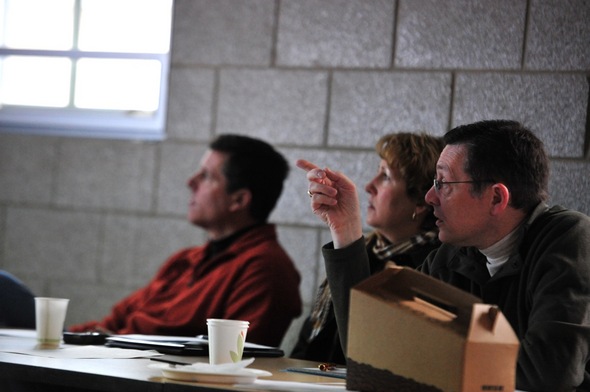
Ann Arbor City Council Member Stephen Rapundalo, right, and other city officials met for six hours today for a city budget retreat. The city has an estimated $2.4 million shortfall to address for fiscal year 2011-12, officials said.
Ryan J. Stanton | AnnArbor.com
The tough work begins now, City Administrator Roger Fraser told Ann Arbor City Council members during an all-day city budget retreat today.
Top city officials met in the Wheeler Service Center at 4251 Stone School Road for six hours to talk about the city's looming financial challenges.
The city's administration revealed a new forecast showing a $2.4 million shortfall in the general fund for fiscal year 2011-12, which starts July 1.
Budget challenges of a similar magnitude are projected for 2012-13, according to Tom Crawford, the city's chief financial officer.
City officials will be tasked with developing a two-year budget plan over the course of the next several months, and it won't be easy.
"After all the cuts we've done leading up to now, I don't see how we can get another $2.5 million out without having some impact to services," Crawford said. "This is the start of the conversation on what the impacts might be. We don't see revenue coming back soon, so we need to have some bigger discussions on what services are going to be provided and how."
The city predicts property tax collections and state revenue sharing will remain mostly flat over the next two years, while interest rates on city investments stay near zero percent. The challenge is that costs, such as employee healthcare and retiree benefits, continue to rise.
As the city looks at its budget strategy, Fraser said, city officials need to align that with the city's labor strategy and push for increased concessions from city unions.
Each city department will be asked to trim 2.5 percent to 4 percent from their budgets for next year, Fraser said. Departments largely staffed by employee groups that haven't agreed to changes in their healthcare will be asked to make deeper cuts than others, he said.
Data presented today show active employee healthcare costs have risen substantially since June 2003, when they checked in at $5,173 per employee. As of June 2010, that had risen to $11,441 — 17 percent above the national average, which is $9,740.
The numbers are even higher for certain city unions that contribute little to the cost of their healthcare, city officials said. Individual AFSCME employees cost the city $12,310 a year, while police officers cost $13,121, and firefighters $12,871.
Settlements of new labor contracts with the police officers, firefighters and AFSCME unions are on the horizon and could result in the departure of a significant number of experienced employees, absent the kind of concessions the city is after, Fraser said.
"We cannot continue to pare down the number of employees and still provide the services we're providing," he said, hoping cuts to personnel numbers can be avoided.
Mayor John Hieftje said he doesn't have any confidence that the police and firefighters unions will make the concessions the city is asking, though. Unfortunately, that means "we're going to continue to have fewer and fewer employees," he said.

City Administrator Roger Fraser addresses Ann Arbor City Council members during today's retreat.
Ryan J. Stanton | AnnArbor.com
"I don't know how you get away from that."
Council Members Margie Teall, D-4th Ward, and Stephen Rapundalo, D-2nd Ward, wondered whether city employees are fully aware of the consequences of not making sacrifices.
"What I perceive there to be is either really a lack of understanding and appreciation or an unwillingness to understand the impacts," Rapundalo said.
At this time last year, Fraser announced a similarly grim budget forecast for the current year, which required closing a gap of more than $5 million — although $2 million of that was filled in with a continuation of parking revenue transfers from the Downtown Development Authority.
The city's predictions for the coming year now assume upfront that the DDA transfers to the general fund will continue. Without that money — to compare the budget picture more accurately to last year — the city would be talking about a $4.4 million deficit right now.
Last year's budget process was one of the most painful in recent memory. City leaders spent months anguishing over proposed cuts, and police and fire became a major target. In the end, actual cuts were much less severe than originally feared.
Fraser called this past year the most difficult of his entire career. But he said "the good news is we may be at the bottom of the barrel in terms of this sloping line."
As of June 2010, the city's pension system was 90 percent funded, according to new data released today. The retiree healthcare trust was only 30 percent funded.
Council members received a four-page sheet showing a summary of city services and areas of the budget where significant sums of money are dedicated.
With police services at $23.1 million and fire services at $13.8 million, public safety continues to account for about half the general fund. Other major areas of the budget include solid waste, parks and recreation, utilities, information technology and courts.
City officials spent time brainstorming ways to cut costs in various service areas, ranging from street sweeping to mowing city parks. Two specific ideas floated were the privatization of solid waste collection and switching the fire department to a new paid on-call system.
Council Member Stephen Kunselman, D-3rd Ward, questioned why the city has made cutbacks to services like Christmas tree pickup and fall leaf pickup, while adding funding for public art. He suggested the city further privatize information technology.
At one point, council members also talked about charging schools for the cost of providing crossing guards and getting more aggressive about recovering costs from the University of Michigan for expenses incurred during university-related events.
"We incur about $100,000 worth of expenses a year associated with providing traffic control and solid waste services for university game days," said Sue McCormick, the city's public services area administrator. "I don't believe that the city has billed for that in a number of years, because the university has made it pretty clear historically that they won't pay."
McCormick said the city has continued an ongoing dialogue with the university on the issue as the city's budget has gotten tighter.
"This is an expense that is impacting our ability to provide other services, but the university has been reticent," she said. "Certainly we would like to recover those costs. Those dollars could be used to support other services for our residents."
Ryan J. Stanton covers government and politics for AnnArbor.com. Reach him at ryanstanton@annarbor.com or 734-623-2529.
Comments
GerryD
Mon, Dec 6, 2010 : 1:16 p.m.
Time to seriously press for PILOT payments -- (Payment In Lieu Of Taxes). This is done by a number of universities where the U posess a large %age of the host cities taxable property (Harvard, for one, pays PILOT). Yes, A2 would not be the city it is without UofM, but the university really doesn't need to shoulder some of the burden given the great swathes of previously taxable property are no longer generating any tax revenue for the city. They payments are usually just a fraction of what the property would generate, but it's still significant money and could help the city a LOT as well as restore some much-needed goodwill between town and gown. You can read more about the wide-spread use of PILOT in Massachusetts (as an example) here: http://www.dotnews.com/2010/report-agreements-nonprofits-are-potential-govt-revenue-source Also, in the more minor category, why not cut back recycling collection to every other week. Those new recycling carts are huge and I have rarely seen one yet more than half full. Not sure if that could directly translate back into city savings though, given existing contracts, but...
Snarf Oscar Boondoggle
Mon, Dec 6, 2010 : 3:31 a.m.
AFTER... flly paid police dept ADN fire department is funded, everyting else is optional. wake up.
sbbuilder
Sun, Dec 5, 2010 : 1:37 p.m.
Unless I'm missing something, the whole raison d'etre of a city government is to provide services. They do not exist to produce a product (unless you count water). The majority of the expense comes from the pay/benefits of the employees who deliver those services. That begs the question; why not cut the pay of those workers? We are presented with the only option of fewer workers providing fewer services. Somewhat Concerned: I can't see where your analogy holds up. If you are suggesting that we cut back on services in our family, which ones do you propose? Cut back on trash pick-up? Can't do that. How about not calling the Police/Fire depts? Having never called them, it would be hard to cut back there. What other 'services' are available to our family? If you look at the 'real world' as you suggest, you will find that GM, Ford, Chrysler all have significantly cut hourly pay. They had to start there. They couldn't ask their customers to drive a car off the lot with only three wheels. Only one wiper instead of two. They'd be out of business for good. Yet we are asked to swallow the idea that reduced services is the answer. No to that. When the private sector has cut pay, and dramatically, the public sector must follow suit.
bunnyabbot
Sun, Dec 5, 2010 : 11:24 a.m.
the major could start by cutting his assistant from the payroll, if you want to cut someone from the emergency responders he could stand to lose someone who isn't emergency from his office.
Kai Petainen
Sun, Dec 5, 2010 : 10:12 a.m.
I have a hard time understanding how a city with a rich population and low unemployment (compared to other Michigan cities).... can have all these financial problems? Are people living beyond their means? Cut the AAFD? They work hard, and folks might not realize all the helpful stuff that they do.
Nephilim
Sun, Dec 5, 2010 : 9:42 a.m.
Why do people keep saying their rising taxes? Haven't property taxes actually been decreasing due to property values declining? I would have to assume the only reason your taxes increase is because you citizens continue to approve milleage requests for silly crap like public art and oh let's not forget your green belt initiative. You all spent millions of dollars for other peoples property development rights that you get nothing out of. Now THATS funny!!!! I think it's so hilarious how you all have also bought into how "great" the police and fire employees have it. We refuse to work with the city and won't take concessions. Yea, the city eroded all that negotiating trust when the fire department tried to trust them and took a pay cut to save bodies, only to have the city say ha ha we fooled you. Now we will just keep them for a couple more months and laid them off anyhow. So how come you all don't go after Fraser and Tom Crawfords "Cadillac" wage packages? They have given NOTHING up. Fraser even took a substantial pay increase at the height of recession. The city pays for his BMW convertible. All your council people took massive pay increases to a job that they wanted which is supposed to be more status and giving back to the community oriented than compensation oriented. Let usvalso not forget you people shot down so many development ideas by developers years ago because oh let's see, there was the save the skyline coalition, no manhattanism coalition ameba laundry list of other complainers as to why progression is a bad idea. None of you could care less about menial civil servant wages back when most of you were raping, not reaping the rewards of whatever private entity you worked for making bloated wages and bonuses. How many ofbthe over bloated UAW workers are on here complaining? What? Because you all overpriced yourselves right out of the market. That's the biggest and saddest example of unions there ever was. Now since all you private employed people lost your hind ends and your second homes and your boats, it's crying time towards everyone that lived with what they had. Now us civil servants look like we are the fat hogs to everyone else. They never complained about all you when you were at your top and you turned your noses up at them. Funny how the table turns and who the big whiners are as usual.
Brad
Sun, Dec 5, 2010 : 9:27 a.m.
We the city would/wouldn't be without the U is a discussion that's been going on forever here and in every other college town, and isn't any closer to an answer than it ever was. And it isn't any more germane, either. Who cares?
DagnyJ
Sun, Dec 5, 2010 : 9:20 a.m.
We would be East Jackson without the university. And we'd be looking to locate a prison here to provide jobs. How about cutting the parking garages, bike lanes, and golf course operations?
stunhsif
Sun, Dec 5, 2010 : 8:44 a.m.
Mayor John Hieftje said he doesn't have any confidence that the police and firefighters unions will make the concessions the city is asking, though. Unfortunately, that means "we're going to continue to have fewer and fewer employees," he said. That is very distressing. Union brethren would rather throw their newest and lowest paid co-workers under the bus ( or firetruck in this case) and have them get fired rather than take reasonable cuts to their Cadillac pensions/healthplans. Forcing the city to reduce staff numbers shows a complete lack of concern for the public in regards to the police,firefighters and other city employees. But would you expect anything less, it has always been that way. If they don't give a hoot for their co-workers livelehoods they certainly don't care about those they are supposed to be working for.
xmo
Sun, Dec 5, 2010 : 8:37 a.m.
Do we really need ALL of the services the city provides? Hell NO!, We need Fire, Police, some admin, permit and inspectors but the rest of the city services can be cut. Take a look at the 1960 budget City Council Members and see what services we had then and use that as a base for the new city government.
Brad
Sun, Dec 5, 2010 : 8:16 a.m.
Let's see... $800K of that could come from not installing the piece of "art" at the new city/courts building. That's 1/3 of the shortfall right there. Two more no-brainers and problem solved. Now if we only had a council that could handle such things.
Somewhat Concerned
Sun, Dec 5, 2010 : 8:10 a.m.
We might have to cut services? That is how it is done in families, businesses and other cities in the real world. Soak the university? Good idea, other than the fact that Ann Arbor would look like Flint but for the university. Cities are offering tax abatements to attract businesses that employ one-tenth the people the university employs, and at much lower wages, with far fewer benefits. The university is the reason unemployment in Ann Arbor is not at Michigan levels. More taxes on local businesses? Good idea, other than the fact that Ann Arbor would like Benton Harbor. There would be no downtown, and we would have the same tired mall stores that Saginaw has. More taxes on property owners and people who work in Ann Arbor? Good idea, at least for the suburbs that will happily expand to greet the people and employers moving out of the city. Cut back on services? Live within our means? That seems like the lesser of the evils. We do it in my family. How about yours?
Tree Logger
Sun, Dec 5, 2010 : 4:17 a.m.
I am grateful to the city council for spending a gajillion dollars on some stupid building with fat chairs for their pompous behinds.
margie
Sun, Dec 5, 2010 : 1:38 a.m.
Wow, 2.4 million to cut, Paid-on call fire dept. as a proposal, and throw in another 100K incurred on university game day and somehow the union salaries & AAPS are the problems and UM is the almighty savior of Ann Arbor! Look at the white elephant in the room and get out of the glass house and see what's the real causes are. First, loss of property taxes collected due to the massive land grab by tax exempted UM in the guise of educational superiority; 2) multiple use of unpaid services by UM from the Fire Dept.; That upcoming wonderful Big Chill is going to utilize the services of the city Fire Dept. because of their insane use of fireworks near homes (they plan to ask for blanket use of fireworks by their puppet Board of Regents which will further strain the budget) 3) the multiple use of the police dept. by UM. That same wonderful Big Chill will continue to eat up their budget and lastly the public officials who run the city of Ann Arbor and the Board that approve these useless new construction/property sales by UM and others that drain the city budget. Some of these officials work for UM, which should be considered a conflict of interest. The UM should be billed for all the tax revenue lost and all events/services that requires the use of any city services. In addition, don't keep voting for these public officials who can't say no to UM or any expensive public bldg, parking projects. Don't forget outrageous art projects we don't need or want. These are the same folks who would rather pay for a needless expensive art project than keep a public pool open, annual leaf pick-up or even a firefighter in a dept. they want to cut. If only we lived in an alternate universe where these crazy knee-jerked ideas & villification of unions and the public schools are rare and people actually had rational ideas/actions to support their city, workers and public schools instead of being blindly led by the nose by rich Universities & groups that only have their self-interest as a priority. Their PR about how good these things are for us and our constant focus on sports keep rational people from thinking rationally about what's good for the public good or even themselves.....just like that Tea Party Group.
johnnya2
Sun, Dec 5, 2010 : 12:17 a.m.
@Craig Lounsbury Name businesses that would still be in A2 without the University and those that would not. The whole tax roll things is a moot point. It is a STATE law. It isn't going to change. The U buys property that is available. If Pfizer or any other former "private" entity was so hot for all this land, what would property taxes on that commercial property ACTUALLY be? Without the U Ann Arbor is NOTHING. The sooner the whiners realize that, the sooner issues can be solved. If the city wants to stop working during football games, go ahead. I wonder how that is gonna work out for ya. The U buying vacant properties actually props up the value of other properties that nobody really wanted in the first place (does anybody remember Pfizer). Tell us oh smart and great one, who was gonna pay for that property? Or were you waiting for another Michigan Inn.
AlphaAlpha
Sat, Dec 4, 2010 : 10:52 p.m.
Mayor John Hieftje said he doesn't have any confidence that [employees] will make the concessions the city is asking, though. Unfortunately, that means "we're going to continue to have fewer and fewer employees," he said..."I don't know how you get away from that." (Normally, one would first ask whether that quote is accurate, but Mr. Stanton is pretty reliable.) "I don't know how you get away from that." That is one of the most astounding quotes ever. He 'doesn't know'. Well, sir, you need to get the confidence that you can make a difference; you need to get the confidence to convince your workers that we are in an unusual situation, and that we need everyone to help, from the top down, and if we don't get enough cooperation, you need to get the confidence to put the city into bankruptcy, something which is likely to be much easier to do in a couple months than it is now. With all due respect, if you still don't know, you should resign.
lester88
Sat, Dec 4, 2010 : 10:12 p.m.
"Mayor John Hieftje said he doesn't have any confidence that the police and firefighters unions will make the concessions the city is asking" Great insight from the Mayor. Maybe it's because one week you are bragging about spending "insignificant" amounts of GF $$ on this or that then the next week saying we don't have any for essentials. And blaming the employees no less. Darn workers, making health care costs go up by having babies and getting sick. After burning the FF's and watching the spending habits of this city, why would the other unions believe any city official about the budget? "What I perceive there to be is either really a lack of understanding and appreciation or an unwillingness to understand the impacts," Rapundalo said. What kind of double talk is this? How about, they must know that we want to take from them so we can give it to others. Typical statist redistributive policy. Eliminate the 2 Mill in Human Svc funding and cut some of those eco friendly but expensive initiatives that only AA and a couple other cities like San Fran find it necessary to fund.
glacialerratic
Sat, Dec 4, 2010 : 7:02 p.m.
Rather, the city would be East Dexter without the University.
sbbuilder
Sat, Dec 4, 2010 : 6:48 p.m.
"After all the cuts we've done leading up to now, I don't see how we can get another $2.5 million out without having some impact to services," Crawford said. "The challenge is that costs, such as employee healthcare and retiree benefits, continue to rise." We continue to see a decline in the number of City employees, but not a decline in their compensation. Why, oh why, oh why do public employees not have declines in their pay? Why? Why? The option presented to us is a decrease is services. I think this is very much the wrong way to tackle the problem of a shortfall. City residents will be asked to do with less services for the same, or even greater cost. Because of healthcare. Because of retirement. THE UNION BENEFITS AND PAY MUST GO, AND GO NOW, BEFORE THEY BANKRUPT US. Sorry for the all caps part, but I truly don't think this message is getting through to the decision makers.
AAresident
Sat, Dec 4, 2010 : 6:43 p.m.
It's good to keep in mind the $50 million spent for the Police Courts building, the $50 million spent on the Library Lot underground parking, the approximately $500,000 spent on the Fuller Parking for the U of M, the agreement to issue a $10 million general obligation bond for the 1st and Washington Parking.
Foote
Sat, Dec 4, 2010 : 6:15 p.m.
Looking around for others to "bill" is not going to work, especially thinking of the idea of billing Ann Arbor Schools. What strikes me as a bit odd is the other idea of going back to the employees for a solution. The heart of the matter lies in not only the services provided, but within the quality of service level. In this regard, the city is falling short in my experience. Billing problems and snafus are greeted with a yawn, a "not my job" attitude, calls and e-mails are not returned, service levels are inconsistent. Even city employees I know are unable to get a response from other departments in a reasonable amount of time. In private industry people stay on the job until the job is completed each day. I expect that of all middle and upper management at the city level. Sure there are some damn hard workers there putting in the hours, but mostly the culture is "get it off my desk". This is the sign of a sick organization. I would suggest quality surveys directed at residents whenever a contact is made for a service request. There are patterns that will emerge, and these will help you learn where money is being wasted.
Craig Lounsbury
Sat, Dec 4, 2010 : 5:54 p.m.
johnnya2@ "How does this sound, tell me what the city budget would look like without the University of Michigan." An interesting question. All that property we collectively own in the name of the University would be taxable. The city would be smaller to the extent that employees who work at the University actually live in town. I guess we'd be "West Royal Oak". But its a pointless question to ponder because the University (that we the people collectively own) isn't going to "take its ball and go home" rather than pay for their own mess.
Dominick Lanza
Sat, Dec 4, 2010 : 5:46 p.m.
Well first all the revenue from football and other things like resturants etc doesnt come near to making up for what the U doesnt pay for all of their tax free status properties. Remember they buy buildings now and rent space out to private enterprise making it harder for taxpaying landlords to make a buck. All the drunks downtown after games drain police, fire and medical service from taxpayers how about that. If all the U property was picked up and taken away and only half replaced with tax payers we would be well ahead. Now on to the fire department Roger Fraser favorite whipping boys. Let Mr Fraser and the Mayor remember that the Firefighters were the ONLY union to give back real money in the form of a 3% wage cut the Police didnt nor did any other employees but gee the fire department is now threatened with being replaced by paid on call? Pittsfield just went to a paid fire department do you think they did that because they wanted the expense NO. There is not the demographics in Washtenaw County to support a large active Fire Department with paid on call. Even if Ann Arbor stopped running medical calls and just did fires and other fire department typical calls they run 4 to 5 time more than anyone else in the county. Why do we never look at police? Why are there still two police officers in one car? Go to single man cars throw all the uniformed people that ride a desk out in the street and replace them with civilians for the admin jobs they do. This is black mail the fireifghters have stood strong in negotiations and the City is taking the backdoor to threaten them with extinction. Wake up people if you have a fire in your house do you want to wait 5 or 10 minutes for people to race through the streets from their homes to get to the fire truck then leave to get to your house. Do not sit by and let this happen.
johnnya2
Sat, Dec 4, 2010 : 5:28 p.m.
So there is 100k the U does not give to the city for waste pick up. How much money does the AAPS get for parking? How much does the city get in increase revenue because those houses near the stadium have a higher value due to the ability to sell spaces for parking? How many businesses get an increase in business due to the 111k people who come to the stadium each and every game seven or eight times a year? How much money do landlords get from students in rent? How about the nars, restaurants, retail establishments? How does this sound, tell me what the city budget would look like without the University of Michigan.
Jay Thomas
Sat, Dec 4, 2010 : 4:56 p.m.
We incur about $100,000 worth of expenses a year associated with providing traffic control and solid waste services for university game days," said Sue McCormick, the city's public services area administrator. "I don't believe that the city has billed for that in a number of years, because the university has made it pretty clear historically that they won't pay." So let the trash pile up...