

Next step for Ann Arbor's pedestrian crosswalks on Plymouth Road: Strobe lights?
One word: Strobes.
Ann Arbor officials have identified a $65,000 solution to the crosswalk problems along Plymouth Road and it involves installing new pedestrian-activated LED lights called Rectangular Rapid Flashing Beacons — or RRFBs — at four locations.
The strobing RRFBs, complementing existing crosswalk signs, are designed to grab attention and get motorists to stop safely for pedestrians.
And, hopefully, they'll help put an end to a recent string of rear-end accidents that have happened — largely along Plymouth Road — as a result of motorists not stopping in time after vehicles in front of them hit the brakes for pedestrians at crosswalks.
"This is actually a stutter flash beacon. It kind of looks like what you might see on the top of a police vehicle nowadays," Patrick Cawley, a city traffic engineer, told members of the Ann Arbor City Council during a special work session Monday night.
"Because of the irregular flash pattern, and the intensity of it, it seems to grab people's attention and they react to it," he said.
Here's a video showing how they work:
Cawley was joined by Eli Cooper, the city's transportation program manger, in making a series of recommendations to council for improving safety at crosswalks.
The four crosswalks expected to get RRFBs are along Plymouth near Beal Avenue, Bishop Avenue, Traverwood Drive and Georgetown Boulevard.
If approved by council, installation could start in February and be finished by the end of March, officials said. Funding is available in the major streets fund balance.
Much controversy has surrounded the city's new pedestrian safety ordinance, which requires motorists to stop not only for pedestrians within crosswalks, but also those approaching. There have been numerous rear-end accidents at crosswalks since enforcement of the ordinance began in September.
The highlights of Monday's report were the recommendation of installing RRFBs at four locations along Plymouth Road and staff-proposed modifications to the ordinance.
Council members already gave initial approval to tweaks to the ordinance last month, but they were waiting to make a final decision until after Monday's report on crosswalk options.
It's been stated by Ann Arbor officials in recent months that the city's ordinance requiring motorists to stop for pedestrians approaching crosswalks — which is the case when there aren't signals in place — merely goes one step further than existing state law.
But that's not true.
Cooper clarified Monday night what AnnArbor.com confirmed with the city's attorneys last month — that there actually isn't a state law in Michigan that requires motorists to stop for pedestrians within crosswalks when there aren't traffic signals in place.
Eli Cooper
If a local municipality desires to adopt the crosswalk ordinance in the UTC, it may do so, but it's not required and it isn't state law.
The optional UTC ordinance, which differs from Ann Arbor's ordinance, states that when traffic control signals are not in place drivers must yield to pedestrians within crosswalks, but only when the pedestrian is on the half of the roadway on which the vehicle is traveling, or when the pedestrian is approaching so closely from the opposite half of the roadway as to be in danger.
The City Council originally adopted that UTC language in early 2010 but later decided to craft its own pedestrian safety ordinance, which was approved in July 2010.
The version awaiting approval, as revised by council last month, would drop the word "approaching" and instead state that drivers must stop for pedestrians "stopped at the curb or ramp leading to a crosswalk." It also states that drivers must stop for pedestrians within crosswalks without regard to which portion of the roadway the pedestrian is using.
In proposing an alternate revision, Cooper suggested Monday night the council may want to instead say "curb line" to be more clear. The staff-proposed revision states that drivers must stop for pedestrians who are within a crosswalk or "stopped at the curb, curb line or ramp leading to a crosswalk."
The staff's version also recommends going with the part of the UTC that calls for stopping when the pedestrian is on the half of the roadway on which the vehicle is traveling or when the pedestrian is approaching so closely from the opposite half of the roadway as to be in danger.
Whatever wording is approved, Cooper said it's important that the city continue to educate the community about the ordinance and properly enforce it.
Over the last three years, he said, the city has spent about $50,000 educating the public about pedestrian safety, including brochures, posters and advertisements on buses.
Cooper noted it's been a safety concern that other vehicles have been whizzing by in adjacent lanes when motorists have stopped for pedestrians at crosswalks. Under a UTC rule that was adopted by the council earlier this year, that's already a civil infraction, he said.
In addition to RRFBs, the $65,000 proposal coming back to council for approval calls for augmenting crosswalk pavement markings to include "advance stop bars." City officials say that will help best locate the place to stop and not impede the ability of the pedestrian to see or be seen by traffic in the other lane.
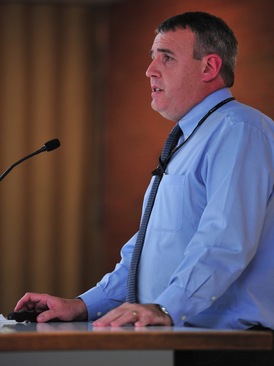
Patrick Cawley, a city traffic engineer, gives a report to the Ann Arbor City Council Monday night.
Ryan J. Stanton | AnnArbor.com
Solar panels can be used to power the RRFB devices, he said, which lowers the ongoing operations and maintenance costs.
Cawley told council members RRFBs can achieve yield rates of 80 percent or higher. He said HAWK signals are known to achieve yield rates above 90 percent. But where an RRFB costs about $15,000, he said, a HAWK signal costs about $75,000.
"It's a lower-cost installation but it's going to provide yielding rates that are near what you can get with a HAWK," Cawley said.
City officials said the installation of the HAWK signal at Huron and Third streets last year cost more than $100,000 only due to the complexity of the installation.
Mayor John Hieftje and Council Member Carsten Hohnke, the original sponsors of the pedestrian safety ordinance last year, both said they like the RRFB solution.
"I'm going to suggest that they look beyond just four, given the cost and the safety feature that they provide," Hieftje said. "We can take a look at a few other places around town."
Hohnke agreed.
"Wherever they do make sense, I think we should seriously consider allocating those resources to do that because I think the value is significant," he said.
Hohnke said though there may have been several recent rear-end accidents at crosswalks, there's been no historical data presented yet to prove there'e been any increase.
Cawley didn't have historical data for rear-end accidents at crosswalks, but he did report there were 5,534 rear-end crashes in the city from 2006 to 2010.
Most of those caused only property damage, Cawley said. He said there were 225 accidents involving pedestrians from 2006 to 2010, and almost all of those involved injuries.
Considering those facts, he said, the city may be increasing rear-end crashes at some crosswalk locations, but they're probably only "property-damage-only crashes."
Council members also heard from an Ann Arbor Transportation Authority official who said the transit agency is evaluating the locations of bus stops near crosswalks.
Meanwhile, city officials are asking the state to consider installation of a HAWK signal at a crosswalk on Washtenaw Avenue near Tappan Middle School.
The four-lane road there is a business loop for I-94, a state corridor where nearly 20,000 vehicles travel each day, city officials said.
Cawley said there is no crash history at the crosswalk, nor is there a lot of pedestrian activity, so he's not optimistic it'll qualify for a HAWK signal.
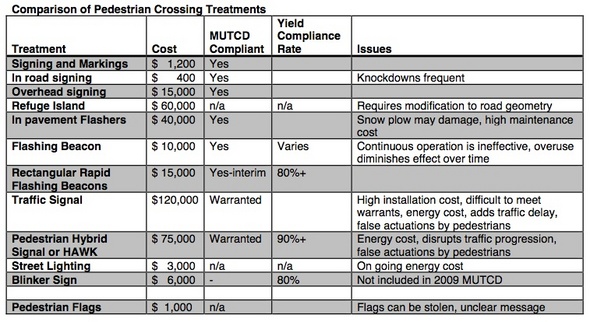
This comparison chart was included in the materials handed out Monday night.
Ryan J. Stanton covers government and politics for AnnArbor.com. Reach him at ryanstanton@annarbor.com or 734-623-2529. You also can follow him on Twitter or subscribe to AnnArbor.com's e-mail newsletters.
Comments
EcoRonE
Fri, Dec 16, 2011 : 3:15 a.m.
To follow up on the chart, the "Blinker sign" attains an 80% compliance rate but it's not in the MUTCD, presumably the Michigan Uniform Traffic Code D? Why wasn't this option mentioned since it's half the cost of the RRFB even. From the tone of the comments, it sounds like most respondents do not walk around AA much and do not try to cross the major arteries. I live between Washtenaw and Packard. If you think you can wait for traffic to clear to cross Washtenaw in front of the Mary Lou Murray rec center, then you actually haven't tried. Similarly for crossing Packard at Buhr park. And don't say use the lighted crossing at Eisenhower and Packard - it just proves you've never tried it. I often get the impression that drivers are annoyed by my crossing and disrupting they're drive. I'm annoyed that they're disrupting my walk. But when they step on the gas or swerve to 'beat me' to the open lane it's scary. Cars making right or left turns off these streets always assume they have the right of way over a pedestrian on the crossing a sidestreet. I for one am all in favor of the Eli Cooper's championing pedestrian rights and safety in this city. I believe that most actual residents are respectful of the pedestrian ordinances. However, I believe that among the thousands of commuters into the city each day, there are many who do not respect our attempts to be pedestrian friendly and increase pedestrian safety.
Holy Cow
Thu, Dec 15, 2011 : 4:47 p.m.
I think that strobe lights are a very bad idea. They are very distorting/disorienting which is not what you want when people are driving or trying to walk across a road.
Edward R Murrow's Ghost
Thu, Dec 15, 2011 : 3:43 a.m.
Maybe I'm missing something: is there not a traffic light one block away at Traverwood? If so, why all of this nonsense? Good Night and Good Luck
shepard145
Thu, Dec 15, 2011 : 1:48 a.m.
This is frustrated, petulant political correctness on steroids after dropping acid: It goes back to 1985 when the Islamic Center was constructed in a location centered between two traffic signals - Willowtree and Bishop Avenue. This brilliant location is about 800 feet from either crosswalk, equal to walking on State Street from Huron to a bit past Liberty, something hundreds of people manage every day. One dark night in 2003 some kids decided to cross the 5 lane highway rather then walk to the traffic signal. Tragically, they were struck and killed. Ever since then, Ann Arbor City Council has acted like frustrated children trying to invent one of their wonderful "out of the box" "solutions" to offer that location special treatment from the burden of walking 800 feet. So in 2011, their incompetence has lead them to now promise children that they should go ahead and cross, ignoring the cars, semi trucks or buses driving at 40mph in Plymouth Road because Council will stop them with their magic ordinance power! ...and don't worry, if your child believes this deadly nonsense and is smashed to a pulp in traffic as a result, Ann Arbor City Council will MAKE SURE the traumatized driver gets a ticket 'cause they violated an ordinance!! How about if we make those on Council who vote for this travesty personally liable for the funeral expenses of their victims?
BobbyJohn
Wed, Dec 14, 2011 : 10:38 p.m.
Currently the crosswalks on Plymouth are often at bus stops so people are stopped and standing at the crosswalk but they are only waiting for a bus. Please A2 traffic control, clear this up.
lefty48197
Wed, Dec 14, 2011 : 10:15 p.m.
Why do they keep worrying about this crosswalk? A crosswalk across Washtenaw at Arborland has been needed for decades. This is just another example of Ann Arbor ignoring the old East Ann Arbor neighborhoods. It's time to seceed from the city and get something accomplished in this area.
Left is Right
Wed, Dec 14, 2011 : 3:58 p.m.
With something as important as pedestrian safety, I assume that a "failure modes and effects analysis" (FMEA) was done to show that the ordinance actually improves pedestrian safety. Where are the results of that analysis? A yield compliance rate of 80%? Good, means that as a pedestrian I have less than a 20% chance of being pancaked? Sounds safe to me!
Brad
Wed, Dec 14, 2011 : 2:20 p.m.
Council/mayor/WBWC - you goofed with the current and extremely poorly considered pedestrian law. As currently written it is dangerous to pedestrians and motorists alike. It's time to admit your failure and move on with something that might actually work. And this time let's have a little more input from traffic engineering PROFESSIONALS and a little less from the "walking coalition".
Simon Green
Wed, Dec 14, 2011 : 1:32 p.m.
Let's review the chart handed out at the meeting (provided at the end of the original article). I see their list of options falling into two categories: 1) ones that do not adequately achieve the objective of the ordinance (getting drivers to yield to pedestrians) 2) ones that achieve some threshold for accetable compliance rate... (presumably 80%) Ironic that two of the options with the higher yield compliance rate (80% or higher) list the following as a potential drawback: "adds traffic delay" or "disrupts traffic progression" isn't ANY "effective strategy" going to do that? (traffic stopping = delay) Well, there is one other option, but it is inconceivable to the brilliant minds who inhabit our city government - COMMON SENSE on behalf of the pedestrians. And don't tell me distracted drivers are the "problem" because as a pedestrian, if you assume they are all distracted it wouldn't be an issue. It's worked for decades.
Simon Green
Wed, Dec 14, 2011 : 1:19 p.m.
Just add a DJ and a bar and you'll have the Plymouth Road Dance Club.
golfer
Wed, Dec 14, 2011 : 11:42 a.m.
you know it really does not make a difference how long a street is like ply and stadium. a street is a street. so how do you pick where you will put them. got to do a full job vs a half you know what one.
Somargie
Wed, Dec 14, 2011 : 6:32 a.m.
Who are the folks promoting the crosswalk drama in the face of such a disaster? Haven't the public showed their dislike & disgust for something that isn't even required by law? Here's a simple solution...Get rid of these ridiculous crosswalks, pedestrians need to cross the street at intersections only. Stop wasting our money on art works and unnecessary lights and bring back the services that we lost...Fall leaf collection and holiday tree collection would be a good start for example.
Steve
Wed, Dec 14, 2011 : 5:47 a.m.
Nothing brings out those neighborly feelings quite like crosswalk articles. Tomorrow I will go for a drive along Plymouth until I find a pedestrian to stop for. After that I'll park and go for a walk where I cross the road as many times as possible. Look for me!
shepard145
Wed, Dec 14, 2011 : 3:57 a.m.
No it will not be better. The consequences of Council's incompetence are vastly one sided. They are telling pedestrians to cross 40mph 4 lane highways when ever they wish to and cars will magically stop "'cause they passed an ordinance that says so" and they wasted more of the City's money on strobes. Except when alert drivers fail to figure out what the junior traffic engineering council cooked up this week and drive as they would on any other road in Michigan, the pedestrian continues into the road in front of them, gets hit by a 2 ton car, the driver gets a ticket and the pedestrian and maybe a few children get a ride to the morgue. Does that sound smart to anyone but the nitwits on Council voting for this garbage? VEHICLES HAVE THE RIGHT OF WAY IN EVERY OTHER CITY IN THE COUNTRY FOR A REASON. YOU ARE NOT SMARTER THEN ANYONE.
John Q
Fri, Dec 16, 2011 : 7:06 p.m.
Vehicles don't have the right-of-way when pedestrians are in the crosswalk. Basic driver's ed. lesson. Learn it.
Stuart Brown
Wed, Dec 14, 2011 : 3:43 a.m.
Jerome Blue said, "It never ceases to amaze me when people talk about rear-end collisions. Rear-end collisions are ALWAYS the fault of a driver who was either tail-gating or not paying attention to the brake lights of the car in front of it, not pedestrians or the pedestrian safety law. ALWAYS the fault of a driver." The none too subtle insinuation here is that it is alright for public officials to increase the number of rear-ends by implementing broken, dysfunctional laws like the latest gem from our genius Council Majority as long as some hapless driver can be blamed for the inevitable chaos and mayhem that results. I'm not trying to pick on Jerome Blue since I believe the Council Majority thinks the same way and I want to make it clear this thinking is just plain wrong. Whose fault it is when something bad happens should not be used to decide what is good public policy or bad public policy. If policy makers know a large percentage of the driving public is going to have trouble, for whatever reason, of maintaining an appropriate separation from any vehicles ahead; they should not be passing rules that increase the need to maintain distance. To do otherwise is just asking for trouble. No! The criteria for good policy should be its probability of improving safety when the cops are not around. The reason we are getting stupid blinking lights is because the genius Council Majority is really cheap when it comes to the people who live here. The best solution is to put in regular traffic control lights at pedestrian crossings on major traffic arteries; but this costs money the Council Majority would rather give away to their developer friends. The public should demand better from its elected representatives.
1bit
Wed, Dec 14, 2011 : 3:38 a.m.
Most of the comments posted show frustration at the problem from both sides, but inherently agree with each other. Drivers want to stop and pedestrians want to cross. Both want to do so safely. The flashing strobes will help and having read this article, I now know what they mean. A red pedestrian-activated signal is better. No system is perfect. If pedestrian safety is the goal, then I don't believe "skimping" on safety is ever a good idea. Simply choose what is the safest means to achieve safety and then implement it. If we don't have the money now, then budget it and save money to pay for it. In the meantime, I would say that I try very hard on Plymouth Rd. to stop at the crosswalks for those wanting to cross. If you are a pedestrian and are wearing dark clothes, I can't see you at night and might not stop. If you are on the other side of the road, I definitely won't see you. If you are at a bus stop near a crosswalk, I don't know which you are waiting for. If I do stop for you, don't expect the car behind me or the ones next to me to stop.
baker437
Wed, Dec 14, 2011 : 3:32 a.m.
What about adding some music so the pedestrians can dance in the streets! Seriously the cheapest solution get rid of this local law!!! What a joke.
KINGofSKA
Wed, Dec 14, 2011 : 2:58 a.m.
Was that the same car in the at every stop? Why not just get rid of the law, just tell them to stop instead of threatening them, and save the money so I won't have to pay it in taxes.
demistify
Wed, Dec 14, 2011 : 2:06 a.m.
Once the strobe lights are in place, will the crosswalks be used for disco dancing?
Blue Eyes
Wed, Dec 14, 2011 : 2 a.m.
Ante up the $ for the HAWK signal. Strobe-type lights have been proven to bring on seizures!
Jon
Wed, Dec 14, 2011 : 1:14 a.m.
How about we use this money to full staff our fire companies and get more patrol cars on the street
Diana
Wed, Dec 14, 2011 : 12:58 a.m.
Why not the standard light with red,yellow,green? Most people will know what to do without another education campaign.
Fat Bill
Wed, Dec 14, 2011 : 12:52 a.m.
How about pedestrian-operated tire spikes.... stop or ELSE! ...
muddyh2o_djk
Wed, Dec 14, 2011 : midnight
Did you know that strobe lights can induce seizures in people with photosensitive epilepsy. Is it really logical to use strobes at crossings? Why can't we use a red light to stop traffic? Believe me when I say I am for safe pedestrian crossings. As someone that has been hit and almost killed by a speeding while using the pedestrian crosswalk at Huron Street and Fourth Ave. I have gotten to the point that I can barely stand to drive through Ann Arbor because so many pedestrians jaywalk. Lets create a safe environment for both driver and pedestrians by ticketing illegal use of the roads even when they are pedestrians. Yes of course I know the car can be a deadly weapon when misused but we breed reckless pedestrians in Ann Arbor.
Ann English
Tue, Dec 13, 2011 : 11:58 p.m.
Last week or the week before, I noticed that snow was partially covering up some traffic signal lights. What is there to keep these RRFB lights from being obscured by snow? They're mounted 6 feet or more above the sidewalk, where many pedestrians can't reach them to brush the snow off. Before I thought of this possibility, I thought about how snow on the streets often covers up lane lines, so why not crosswalk markings, too? White like the snow on top of them. If these strobe lights can melt the snow that falls on them, then winter is the best time of year to see how they work, when it's darkest and the streets are whitest.
grimmk
Tue, Dec 13, 2011 : 11:43 p.m.
This sounds like a great idea! Now everyone who has undiagnosed seizures will find out! What a great help this will be! /sarcasm. DO. NOT. WANT.
Julius
Tue, Dec 13, 2011 : 10:53 p.m.
Pedestrians just need to understand that they're personal safety is up to them. Laws and police only address it after the fact. You can't count on anyone or anything else, but you can be in control of yourself. I'm not in favor of anything else that hinders the driving experience. It's hard enough to drive through town as it is. Perhaps pedestrian education programs. Perhaps foot bridges.
grimmk
Tue, Dec 13, 2011 : 11:48 p.m.
I hate how everyone is blaming drivers and taking away any and all responsibility from the pedestrians. Know that a car will not stop just because you walk out in front of it. Know that a person driving cannot see you in the dark - wear light and reflective clothing. Don't walk out in between cars. I could go on and on. I think more roads should have a wider bike path if a sidewalk is not present. Driving used to be more fun for me. Now I am constantly checking out other drivers and more hyper aware of what is going on around me. I've been in so many close calls and seen so many crazy stunts that now driving is a chore. I need more eyes.
Carolyn
Tue, Dec 13, 2011 : 10:50 p.m.
I would be more comfortable with this idea if the flashing lights (which are pedestrian activated, I'm assuming) were overhead instead of on the side of the street. Definitely moving in the right direction, though.
Frustrated in A2
Tue, Dec 13, 2011 : 9:43 p.m.
People from out of town still won't know how to react to these signals and those of us in town who know to stop will still get rear ended. Sounds like the city is good with us crashing cars up as long as the pedestrians don't get hurt. This seems like one of those "if it's not broke, why fix it" things. Was there a spike in car/pedestrian crashes that made city council introduce this new ordinance in the first place or were they just trying to appease someone as usual???
John Q
Wed, Dec 14, 2011 : 1:34 a.m.
Spike in accidents? Pedestrian deaths actually. But who cares about a few bodies as long as you can drive however you want.
leaguebus
Tue, Dec 13, 2011 : 7:59 p.m.
I still cant believe that anyone could be against this ordinance because it will increase the number of rear end accidents. Surely you jest. A rear end accident is caused by someone not paying attention to what they are doing. Plain and simple. I cross at Third and Huron daily and never step into the street after the walk signal says for me to go until all four lanes have stopped. Someone, not paying attention, runs that light about every other day. Sorry, its not the laws that kill, its the drivers.
Billy Bob Schwartz
Tue, Dec 13, 2011 : 10:49 p.m.
The bottom line is, ******I am not the person tailgating; I am the person getting slammed from behind because I stopped!********** Why can't you folks get this? Why should I have to get hit and spend hours waiting for a cop and getting towed and getting the car repaired and getting someone to come and get me because my car doesn't work and seeing the doctor for my whiplash and missing work, etc. etc. etc., just because you have a system in which the people behind me don't know the law and slam into me? That is stupid. Period. You also have to consider this: we have a huge university in A2 that has around 40,000 students, plus many, many other personnel, most of whom are from out of town, many from another country, and many who don't know how to drive well, besides being unaware of some of the more arcane twists of A2 driving ordinances. In addition, many, many people from around the country and around the world come here to visit the U. and attend conferences, etc., and they show up driving a rented car and don't know that a double flashing strobe means someone is entering traffic as a pedestrian and the must stop. This also would include parents, grandparents, siblings, cousins, friends from back home, and many others who come to visit those students, faculty members, and others, and maybe take them out to dinner or whatever. Do you really think all of these people should know about this very unusual ordinance and be prepared not to crash into my rear end when I slam on my brakes to stop for the strobe? Pullllllleeeeeeease!
Woman in Ypsilanti
Tue, Dec 13, 2011 : 10:28 p.m.
The thing is that pedestrians are not terribly visible even in the best of circumstances. It is common for drivers to slam on their brakes in order to stop in time after seeing the pedestrian. And unfortunately, it is common for people to not leave enough room and/or not pay attention when they drive. The reality is that the when you have a situation where some cars are stopping suddenly, the increase the potential for rear end accidents. So it is perfectly fair to say that a law which demands people to stop suddenly is causing rear end accidents in the sense that those accidents would not occur in the absence of the law.
PLGreen
Tue, Dec 13, 2011 : 9:53 p.m.
Good for you, you use common sence.
DonBee
Tue, Dec 13, 2011 : 8:43 p.m.
Leaguebus - For people who do not live in Ann Arbor/Michigan, how do you inform them of all the ordinances and special signs and lights? The UofM draws dozens of people a day down the Plymouth Road Corridor for meetings. They may visit one or two times total. I can understand enforcing state and federal laws. I have a hard time holding someone at fault for not understanding that someone 10 feet from a cross walk requires stopping or that a flashing strobe on the edge of the road requires them to stop. If you want safety, standard laws and signals.
Kathy Griswold
Tue, Dec 13, 2011 : 7:12 p.m.
Please remember that the city traffic engineers, credentialed as professional engineer in the State of Michigan, did not have the lead on this ordinance. They are now reacting to a pedestrian rights ordinance. If the goal is pedestrian safety, then City Council must educate the public and enforce the Michigan UTC rather than continue to wordsmith the "approaching" concept. Ann Arbor has failed to adopt, on a consistent basis, many of the safety measures that are standard in other communities: adequate lighting and sight-distance, no parking with 20 feet of a crosswalk, and pedestrian-activated engineering solutions in the initial crosswalk design on wide, busy roads. And if it is not safer than 80%, don't build it! Want to be heard by Council? Send an email and speak at, or at least attend, the next Council meeting on December 19.
DonBee
Tue, Dec 13, 2011 : 6:53 p.m.
Let's just get it over with... Cars are not allowed in Ann Arbor. Oh, but wait, we need the parking revenue to fill the budget hole. What, what, what am I going to do? Help me Mr Mayor.
InsideTheHall
Tue, Dec 13, 2011 : 6:45 p.m.
Send in the clowns. This is folly. The building is on fire and the "leaders" of Ann Arbor are looking for marshmallows.
Ricebrnr
Tue, Dec 13, 2011 : 6:41 p.m.
OK stupid question...how much to put in a pedestrian bridge at those select locations? No weird regulations, no signage required...
Ricebrnr
Wed, Dec 14, 2011 : 12:04 a.m.
wait but wasn't the idea to save pedestrian lives?
grimmk
Tue, Dec 13, 2011 : 11:54 p.m.
Only multiple millions of dollars where a strobe light is several thousand....
Ricebrnr
Tue, Dec 13, 2011 : 11:46 p.m.
Doesn't have to be steps, can be long ramps instead
Frustrated in A2
Tue, Dec 13, 2011 : 9:48 p.m.
I remember the big one at Plymouth/Barton years ago. If you have a bike or more importantly a wheelchair you won't get up those steps. I like you're thinking though, it would be nice if nobody had to stop at all.
Kara Marie
Tue, Dec 13, 2011 : 6:05 p.m.
Sounds distracting for drivers. No thanks.
Kara Marie
Tue, Dec 13, 2011 : 10:58 p.m.
I mean like, looking at the lights rather than the road. Also.. what about people that have seizures?
Daniel Soebbing
Tue, Dec 13, 2011 : 6:27 p.m.
What do you mean distracting? The point of the light is to draw your attention to the fact that there is a pedestrian in the crosswalk that you are about to run over! If the lights don't distract you from driving to the point that you see that you need to stop they aren't doing their job.
NorthsideHobbit
Tue, Dec 13, 2011 : 6:04 p.m.
I am increasingly anxious when driving in Ann Arbor after dark. A few weeks ago I was driving on a dark, rainy night and nearly hit a pedestrian who I didn't see and who was obviously taking full advantage of the pedestrian law. The visibility was extremely low, the cross-walk was not well lit and even though I've replayed the scene many times in my head, I don't remember seeing that man. What happened to "look both ways"??? Have council members driven around town and taken note of the number of bus stops that are AT crosswalks? They aren't NEAR crosswalks they are AT crosswalks. I find myself driving Plymouth, Pontiac Trail and other streets trying to guess the intentions of pedestrians. Are they waiting for a bus? Are they waiting to cross? If I stop will the car behind me stop? Trying to process this information quickly is making me more distracted than if I was talking on a cell phone. PLEASE let common sense prevail and repeal this ordinance!!!
Fat Bill
Wed, Dec 14, 2011 : 12:56 a.m.
I agree that bus stops that are located at crosswalks must be moved, I have many times come to an abrupt halt for nothing.
grimmk
Tue, Dec 13, 2011 : 11:57 p.m.
It does come up on your fast! I was driving over the Broadway bridge at night and there were some pedestrians trying to cross that crazy interchange. I didn't see them until I was up on them so I kept on going. There isn't a light there. The old way of looking both ways should be the tried and true way.
JHW426
Tue, Dec 13, 2011 : 5:50 p.m.
I haven't been through there recently so I just noticed they added a pedestrian crosswalk on Huron between State and the Power Center when I drove by. It was dark and I didn't see a pedestrian dressed in dark clothes in the crosswalk on the opposite side of the road. Did we really need to add more of these potential problem spots when it is only about 250' in either direction to an existing stop light? I don't think the new crossing even has a streetlight nearby so seeing somebody in dark clothing that is just expecting they will be seen is a little disturbing. I don't think walking 250' to an existing intersection is unreseaonble rather than add another crossing.
Frustrated in A2
Tue, Dec 13, 2011 : 9:52 p.m.
That E Huron/N. Ingalls crossing is not a good one. We had a bad crash about a year or two ago with some folks trying to cross there on a rainy day were hit. The lighting there is pretty bad.
kathryn
Tue, Dec 13, 2011 : 6:50 p.m.
No, we don't need more crosswalks downtown, but there are few places, like Plymouth Road, Washtenaw, Stadium, Huron Parkway, etc. where the intersections are few and far between. I don't think it's reasonable to ask a person to walk more than 1/2 mile out of the way in order to be able to get across a street.
Daniel Soebbing
Tue, Dec 13, 2011 : 6:04 p.m.
I didn't realize there was a crossing there. Seems like a poor location.
eJohn
Tue, Dec 13, 2011 : 5:45 p.m.
Yeah, it's a great idea to put confusing flashing strobe lights along busy roads. Good plan! And for those epileptics, like me, that can have a seizure when surprised by flashing lights?? Even better!! It'll be way safer for both pedestrians AND traffic when suddenly no one is driving my moving car because I'm busy having a seizure inside of it. WHEN will Ann Arbor stop trying to legislate respect between its citizens?? It will NEVER work! If you want traffic to stop so pedestrians can cross, put in a traffic signal and stop traffic so pedestrians can cross! Quit playing these stupid games and trying to force solutions that don't make any sense!
Daniel Soebbing
Tue, Dec 13, 2011 : 5:32 p.m.
As many problems as we have with pedestrians getting hit by cars in this city, I really value the fact that the laws in this country protect pedestrians, and that pedestrians are presumed to have the right of way. I have traveled in some big cities in South America where there are virtually no police, and where drivers won't even slow down or swerve to go around pedestrians, let alone stop to let them pass, even if they are crossing at a place where cars have to stop for stop signs. Trying to cross a street was a real adventure. I don't think any of these survival of the fittest, anti-pedestrian advocates would hold that point of view if they actually spent some time in a place where the status quo actually reflected what they are arguing for.
Woman in Ypsilanti
Tue, Dec 13, 2011 : 5:17 p.m.
These sorts of crosswalks solve what I consider to be the biggest problem with Ann Arbor's pedestrian ordinance. That is that pedestrians are not especially visible even in the best of circumstances so it isn't always possible to stop safely after one spots one waiting on the side of the road. This is especially true at night. These kinds of signaled crosswalks really make it easier for everyone. But I still don't like the ordinance. If Ann Arbor really wanted to improve the pedestrian experience, they would enforce the already existing laws. I am often nearly run over by cars while using signaled cross walks downtown. This morning I had to walk around (in traffic) a car stopped over the crosswalk and then had to dodge cars turning right on red at another intersection,as in I actually literally had to jump out of a car's way or I would have been hit. I was crossing with a walk signal and the driver wanted to turn right on red so she just went through the crosswalk so she could get a better look at traffic. I would rather see these kinds of infractions enforced. Another negative to the new ordinance, since there isn't as far as I know extra money for enforcement, is that it means less enforcement of times when drivers are in the wrong at the regular signaled crosswalks.
Daniel Soebbing
Tue, Dec 13, 2011 : 5:35 p.m.
I agree totally. Biggest problem is drivers who don't pay attention or who willfully ignore the laws that are there to protect pedestrians. Bust the existing law breakers and everything would be better. That being said, the crossings that are going to be protected by these strobes are places that people are going to cross regardless of what the law says. Many of the people that use these crossings are elderly or children. There needs to be some signaling to protect these people.
Beth Wilson
Tue, Dec 13, 2011 : 5:10 p.m.
I have a perfect solution! Let's take this outlandish City decision and fix an outlandish County decision. Take all this potentially wasted money on crosswalks and give it to the Humane Society. We will be saving the lives of people and animals!
T
Tue, Dec 13, 2011 : 4:46 p.m.
When in doubt, spend more money for more signs. Next time you drive through Ann Arbor notice how many signs are on each street, its a cluttered mess. Driving in town is unsafe because of the amount of signs, painted bike lanes and misc. crap. Roads are built for vehicles, by vehicle tax for the purpose of vehicles. When bikes start paying road tax I may care, but until then vehicles should have the right of way.
T
Tue, Dec 13, 2011 : 11:04 p.m.
Trucks on the road, the same road built by trucks. Try to find something at your house, your work or a store that hasnt been on a truck. Now find something delivered on a bike...keep looking I'm sure it there.
Billy Bob Schwartz
Tue, Dec 13, 2011 : 10:19 p.m.
I doubt that bicycles inflict the same level of damage to the roads as motor vehicles (and especially semis) inflict. Let them borrow a little bit of the road. Every bicycle on the road is one less car to have to deal with. Enjoy it.
John Q
Tue, Dec 13, 2011 : 6:47 p.m.
Your vehicle tax and gas taxes don't even come close to paying the cost for roads. That's one reason that Ann Arbor has to levy a millage for roads. As for who has the right-of-way, by state law, bikes have a right to be on the road. How much of a road hog do you have to be?
T
Tue, Dec 13, 2011 : 5:51 p.m.
After I park my car I use the sidewalk, I cross at an intersection. Crossing the street is something you learned as a kid, and should be passed down to your kids. Laws, signs or lights, I would never trust 180 vs. 3000 pounds. A few extra seconds by drivers and pedestrians would save alot of grief.
Daniel Soebbing
Tue, Dec 13, 2011 : 5:40 p.m.
I pay taxes to drive my car, but I ride a bike too. I like bike lanes. I also like to be able to walk across a street to get from where I parked my car to my destination. Not only that but vehicle licensing fees aren't necessarily used to build roadways, nor are gas taxes. These taxes and fees are dumped into a general fund, just like every other tax that we pay. Even if there are bicyclists who don't happen to own cars, and/or pay taxes to operate cars, they probably pay other taxes that will in some way contribute to road construction.
Peter Baker
Tue, Dec 13, 2011 : 4:54 p.m.
What about when vehicular tax payers get out of their cars, are they somehow less than worthy?
Peter Eckstein
Tue, Dec 13, 2011 : 4:31 p.m.
I erred in my comment above in thinking that the RRFBs were not pedestrian activated and in referring to the "issues" with "Flashing Beacon" rather than RRFBs. Of course, there are no "issues" listed for City Hall's preferred position, the RRFBs. Even if they are pedestrian activated, the signal to motorists seems much more ambiguous than for a HAWK, and they "disrupt traffic progression" just as much as a HAWK--except when motorists fail to respond to them. So they are better only when they are less effective.
UncleMao
Tue, Dec 13, 2011 : 4:19 p.m.
New bumper sticker: "I don't break for people in X-Walks" I solved this problem months ago. Catapults. Just lob pedestrians over the busy streets.
cornelius McDougenschniefferburgenstein jr. 3 esq.
Tue, Dec 13, 2011 : 4:09 p.m.
the only change needed is for pedestrians be required to extend arm and point then drivers are required to stop.otherwise drivers risk POINTS,loss of license,fines etc.for thier lack of clarvoyense.but the tyrants get rich! GO BIG BROTHER GO.
Peter Eckstein
Tue, Dec 13, 2011 : 4:07 p.m.
The solution with the highest compliance rate is the HAWK. The very biased list of "issues" says that a HAWK signal "disrupts traffic progression," but isn't that exactly what it is supposed to do? Their great advantage is that they ONLY disrupt traffic when someone is trying to cross, and they become highly visible when a pedestrian signals, so they do not have the disadvantage of the flashing beacons that "overuse diminishes effect over time." We don't need them for every pedestrian crossing, and they do cost $75,000 each, but that means that 6 of them could be bought for $450,000. That is probably less than the 1% for public art that has already been diverted from the streets and road millage. So there are two possibilities. One would be to redivert the 1% taken and being taken from that millage and use it to install some HAWKs at critical crossings. The other would be to have artists, preferably local ones, compete with proposals to decorate the HAWK signals so that they could be considered "public art." That way Council would not have to back down from its adamant refusal to cut any dollars from the program.
1bit
Wed, Dec 14, 2011 : 3:25 a.m.
I'm not sure if the last part of your post was sarcasm or in jest, but I believe that getting local artists involved in creating an "artistic" HAWK would be a great idea. It would allow emptying of some unused bucket money and hopefully solve this problem.
DadooS
Tue, Dec 13, 2011 : 4:02 p.m.
Two words: Repeal (and if not) Recall.
Jim Walker
Tue, Dec 13, 2011 : 3:58 p.m.
Ann Arbor did adopt the Uniform Traffic Code (UTC) in 2010, so it IS part of our city code. The pedestrian ordinance is not optional, it is part of the UTC, thus it is already part of the city code. James C. Walker, National Motorists Association, <a href="http://www.motorists.org," rel='nofollow'>www.motorists.org,</a> Ann Arbor, MI
Woman in Ypsilanti
Tue, Dec 13, 2011 : 5:19 p.m.
The ordinance in the UTC is reasonable. And if it is already the law, how about we just stick with it?
bunnyabbot
Tue, Dec 13, 2011 : 3:55 p.m.
I watched the video and all the examples were in daylight, I know they must look bright in the dark, but how bright? I wonder how many people will be distracted/confused by a strobe light? wonder if they will cause anyone a seizure. I am not totally against them, just wonder if they are rushing to a solution without thinking it all the way through.
Orangecrush2000
Tue, Dec 13, 2011 : 3:48 p.m.
What is wrong with a pedestrian bridge?
Ryan J. Stanton
Tue, Dec 13, 2011 : 6:28 p.m.
The mayor's rationale: "They are also expensive but engineers tell us they are seldom used, people still cross the road under them and they cannot be used by those who are less able."
Dave
Tue, Dec 13, 2011 : 3:58 p.m.
Expensive, difficult to install & maintain, and aren't suitable for every location. (Some would say they're unattractive, too.)
Dave
Tue, Dec 13, 2011 : 3:47 p.m.
The strobes are a step in the right direction, but I'm not convinced they're good enough. By the way City Council... it's *OKAY* to spend a little extra money on Traffic & Road Safety if it means we get the right system for the job. I promise: we won't get angry.
PLGreen
Tue, Dec 13, 2011 : 3:44 p.m.
If a light system is going to be put in place it appears as though the HAWK system is preferred by the citizens. In the past City Council has never had a problem spenidng boat loads of money on "pet projects", it seems like this is one of their "pet projects". If City Council really believes in the law, then spend the money and do it right. The "glob of art" in front of City Hall has lights on it. So why can't they call the HAWK system art and pay for it out of the "Art Fund". One final comment. If drivers are to be held accountble, so should pedestrians. When will there be an ordinance that tickets pedestrians for ALL FORMS OF JAY WALING. It only seems fair.
John Q
Tue, Dec 13, 2011 : 6:45 p.m.
Drivers aren't being held accountable.
jcj
Tue, Dec 13, 2011 : 3:38 p.m.
lets also paint the cross walk area neon orange with chartreuse polka dots!
Daniel Soebbing
Tue, Dec 13, 2011 : 5:21 p.m.
Not a bad idea
Tesla
Tue, Dec 13, 2011 : 3:27 p.m.
Just a reminder of the total conflict of interest in that the board person who started all this also sits on the city board who ran with it, and the fact that they won't let this failed, weird deal go tells me theres more to this story. Now they are going to toss another 65 grand at the problem? Why? Who benefits from this (other than pedestrians) Start following the money, and the favoritism, and conflicts of interest and you'll see why they won't take their teeth off this issue.
Daniel Soebbing
Tue, Dec 13, 2011 : 5:46 p.m.
Seeing as there were people being run over and killed, I don't think 65 grand is a lot to spend on this problem. Sounds like you are grasping at straws. Are you just going to toss around innuendo, or can you actually connect the dots to make a plausible conspiracy theory? Sounds like you have been spending too much time listening to Glen Beck's shows that you are ready to be convinced that everything that government does is part of a conspiracy.
Tesla
Tue, Dec 13, 2011 : 3:28 p.m.
Should say Board person who started this is also president of the ann arbor walking and biking club.
Stan Hyne
Tue, Dec 13, 2011 : 3:25 p.m.
Maybe we could get pedestrians to put down their cell phones long enough to LOOK before they step off the curb into the street.
Billy Bob Schwartz
Tue, Dec 13, 2011 : 10:01 p.m.
Peter Baker...Yes, they are. That's my answer. Drivers are terrible with that. Pedestrians are terrible with it, too. Very often and A2 you see someone walking along talking on the phone with a far-off look on their face, and you know they are not present. Then they turn and step directly into traffic. If you don't hit an Ann Arbor pedestrian who is talking on a phone, you are not really trying. Why don't we stop this silly driver vs. pedestrian nonsense and address the real problem. There need to be safe places for pedestrians to cross the streets without getting hit, and without causing drivers to have to make sudden stops that cause them to be hit by tailgating drivers behind them. Think about it. Let's have a solution that prevents both of these problems. There are a couple of good solutions. They are not in play in Ann Arbor right now.
Peter Baker
Tue, Dec 13, 2011 : 3:51 p.m.
You're kidding right? Who on their phone is the bigger problem, drivers or pedestrians?
Frank Lee
Tue, Dec 13, 2011 : 3:17 p.m.
Roads move vehicular traffic. Sidewalks move foot traffic. The two intersect at intersections where there are signals for both to stop or go. If foot traffic cares to intersect with vehicular traffic at any other point, they exercise their own judgment. Changing this system that has been in place forever is against common logic, impleads the flow of traffic, and dangerous. Locals cannot adopt the ignorance of this ordinance and visitors to the city won't know it exists until it's too late. Why this debate continues to go on is beyond me. They are all laughing at you Ann Arbor City Council. There doesn't need to be so many ordinances and not implementing any is absolutely free $! You'll consider an ordinance meant to curb idling vehicles and emissions while passing a pedestrian ordinance that (along with all of the above) increases emissions with stop and go driving? Put the pen down and join the rest of us in reality. Ignorance may be bliss but we vote and pay your salary.
Daniel Soebbing
Tue, Dec 13, 2011 : 9:26 p.m.
Yes Frank, now you are getting it! That's why we have a system of signals that alternately allow pedestrians and cars to take turns using the roadway! That way cars don't totally stop foot traffic and foot traffic doesn't totally shut down roads. I'm glad we see eye to eye on this.
John Q
Tue, Dec 13, 2011 : 6:42 p.m.
Typical self-centered driver viewpoint.
Frank Lee
Tue, Dec 13, 2011 : 6:37 p.m.
Nobody is saying that pedestrians can't cross the road. In areas where there is high foot traffic volume it could take a long time for motorists to find a break in foot traffic suitably large enough for them to travel efficiently. I have heard of driveways, it's amazing pedestrians can cross them without getting hit. We should install signals for them.
Daniel Soebbing
Tue, Dec 13, 2011 : 6:24 p.m.
Nobody is advocating for pedestrians to walk in the road. Just for them to be able to cross it. In areas where there is high traffic volume it could take a long time for pedestrians to find a break in traffic suitably large for them cross safely if they don't have a signal stopping traffic for their safety. I don't particularly like the law as written, either. But I do like the idea of signals that can stop traffic to allow for pedestrians to cross. I've also traveled in Nevada and Oregon, where the state law was that cars had to stop whenever there was a pedestrian in the crosswalk. Didn't cause me any difficulty. Vehicles cross sidewalks all the time. Ever heard of a driveway?
Frank Lee
Tue, Dec 13, 2011 : 6:18 p.m.
So pedestrians have been elevated to a higher priority than what the road was built for? Is vehicular traffic allowed to operate on sidewalks? Yes, cross walks have been around for decades but very few require traffic to stop by law. I am not against crosswalks, I'm against the pedestrian ordinance.
Daniel Soebbing
Tue, Dec 13, 2011 : 5:21 p.m.
Disagree. Pedestrians have to cross roadways at locations other than places where roadways intersect for a variety of reasons. Crosswalks are places where pedestrians can cross roadways other than at places where roadways intersect. Crosswalks have been around for decades. Obviously some sort of signaling is needed to protect pedestrians because they are being run over on a regular basis when crossing at cross walks. Pedestrians are also being run over when crossing at intersections in Ann Arbor. Clearly the motorists are causing a problem here, not the pedestrians.
Janet Neary
Tue, Dec 13, 2011 : 3:02 p.m.
If I understand this correctly, both RRFBs and Hawks are designed to be activated by pedestrians and to cause traffic to stop for them. However, in the table above, which was handed out by the experts, the Hawk signal issues are listed as "energy costs, disrupts traffic progression, false actuations by pedestrians"; but there are NO issues listed for RRFBs. Why weren't "Disrupts traffic progression, false actuations by pedestrians" also listed for RRFBs? It appears that someone is trying to manipulate things to encourage RRFBs over Hawks. I believe Hawks would be much safer and worth the added expense. However, I suspect that the state would not approve stopping traffic for pedestrians so often on state trunk lines, so instead we are doing something that pretends we are not stopping traffic for pedestrians on the one hand and requiring traffic to stop via the ordinance. If we believe traffic should stop at every non-signaled crosswalk whenever any pedestrian wants it to stop (which I don't agree with), then we should go all the way and make it safe to do so.
Ron Granger
Tue, Dec 13, 2011 : 2:59 p.m.
Drivers who think they can't stop for pedestrians are driving too fast. It is a pedestrian-centric city, not a race track. If you want to drive fast, stick to I-94, M-14, or US-23. Or Dearborn. Dearborn is nice for cars.
Billy Bob Schwartz
Tue, Dec 13, 2011 : 9:47 p.m.
I don't think most of the posters here are concerned about driving on a race track. I think they are concerned about a counter-intuitive and totally unconventional system that only (some )local drivers will know about, fewer will obey, and anyone else will ram into them when they stop for a pedestrian. If the situation is so desperate (and perhaps it is), then why not break down and install the standard crossing lights. This other "system" sounds more like a way to divert the damage from pedestrians to vehicles? Why even bother if you won't do it right?
Daniel Soebbing
Tue, Dec 13, 2011 : 5:14 p.m.
Agree!!!!!!
A2WS1
Tue, Dec 13, 2011 : 2:54 p.m.
Questions on the table provided in the article; 1. Why is the "Yield Compliance Rate" column not complete. If we're to use this element as a comparison, we'll need this information. 2. Why is there an empty row near the bottom?? Error, or was something removed?
G. Orwell
Tue, Dec 13, 2011 : 2:53 p.m.
This is so idiotic there has to be a broader agenda. What a waste of money when there are so many needs. Ann Arbor needs to change its name from "Tree City" to "Sign City."
G. Orwell
Wed, Dec 14, 2011 : 3:43 a.m.
So, giving pedestians the right of way when a 5,000 pound automobile hits them is making it safe? Do you want to be the test subject? It was not broken so don't fix it by making it more dangerous.
Daniel Soebbing
Tue, Dec 13, 2011 : 5:48 p.m.
Yeah, a broader agenda like SAVING LIVES! Is protecting people from being run over a waste of money? I think not.
Peter
Tue, Dec 13, 2011 : 2:50 p.m.
80% yields eh? I guess that's good - except the other 20% will get splattered across the road.
Tanzor
Tue, Dec 13, 2011 : 2:49 p.m.
The strobing RRFBs, complementing existing crosswalk signs, are designed to grab attention and get motorists to stop safely for pedestrians. Designed to grab the attention of the motorist. Let me see, I'm driving along at 40 mph and instantaneously I've got a flashing strobe light "like you see on police vehicles". This is not a good idea; many drivers will be confused even startled by this.
Jaime
Tue, Dec 13, 2011 : 2:38 p.m.
So, what is a life worth? How many more rear end accidents are we going top have before thjey realize that the only solution is to put in a pedestrian activated red light. Anything else will be confusing.
grye
Tue, Dec 13, 2011 : 3:42 p.m.
How long will a red light last and if the pedestrian is finished but the light isn't, does the driver need to wait for a green light?
Forever27
Tue, Dec 13, 2011 : 3:18 p.m.
or a pedestrian bridge
A2WS1
Tue, Dec 13, 2011 : 2:35 p.m.
True leadership is admitting your errors and correcting them. I see here an attempt to correct, but no ownership of the error. I drive Plymouth twice a day - it is clear to me that the accidents that I have seen at the crosswalks are directly attributable to this poorly thought out ordinance.
Billy Bob Schwartz
Tue, Dec 13, 2011 : 9:41 p.m.
I think this fits into the woulda/coulda/shoulda category. Let's be real here. People these days drive like there's a bonus for stupidity. They pay no attention to those around them. They forget even that they are driving a car. They follow one car length behind on the open expressways. So you are saying, "Tough. That's the driver's fault." Well, not this driver. I pay attention. I make driving a full-time activity. And yet, even at a stop sign, if you stop, someone is likely just to plow into you. In the middle of a drive out or in on Plymouth Road? Oofda! The less likely the stopping place, the greater the chance of getting slammed into. Stopping on a wide-open road like Plymouth in spots where stopping would be very unusual radically increases your chances that one of these bozos will nail you in the rear. Do you really want safety? Traffic lights. Do you really want to save the bucks? Silly strobes and rear-end collisions.
John Q
Tue, Dec 13, 2011 : 6:40 p.m.
Who do you blame for the accidents and deaths that occurred before the ordinance was passed?
Daniel Soebbing
Tue, Dec 13, 2011 : 6:31 p.m.
Peter Baker is right. Cars should always follow at a distance that will allow them to come to a stop before hitting the car in front of them even if the car in front of them makes a sudden and unexpected stop. That is what they teach in driving school. If a car fails to stop and rear ends the car in front of them there are only two possible causes. One is that the driver was following too closely. Two is that the driver wasn't paying close enough attention to what was happening in front of them.
Peter Baker
Tue, Dec 13, 2011 : 3:50 p.m.
All rear-ending traffics are directly attributable the the driver in back going to fast and being too close.
golfer
Tue, Dec 13, 2011 : 2:33 p.m.
can not wait for football game days. maybe they can send a note with each ticket saying. star wars has hit ann arbor.
DagnyJ
Tue, Dec 13, 2011 : 2:28 p.m.
I often cross Plymouth road up near Georgetown and no one stops. I feel like Frogger. Even though I don't like to see the city spend money, I would like to be able to cross the street without taking my life in my hands.
kathryn
Tue, Dec 13, 2011 : 6:35 p.m.
I agree that it's hard to cross Plymouth. The traffic doesn't clear during rush hour and it's a long way to the next light.
leezee
Tue, Dec 13, 2011 : 5:10 p.m.
Traffic clear. Go to median. Traffic clear on other side. Complete crossing.
Forever27
Tue, Dec 13, 2011 : 3:18 p.m.
then look both ways before you cross the street. Or, walk up to a light.
Guinea Pig in a Tophat
Tue, Dec 13, 2011 : 2:19 p.m.
"The version awaiting approval, as revised by council last month, would drop the word 'approaching' and instead state that drivers must stop for pedestrians 'stopped at the curb or ramp leading to a crosswalk.' " What about the bus stops that are right across from the crosswalks? There's some on Liberty. With that language, it would be illegal to not stop for the person that is waiting for the bus in those locations.
AnnArBo
Tue, Dec 13, 2011 : 2:16 p.m.
Lets just require all pedestrians to wear a strobe light helmet.
Forever27
Tue, Dec 13, 2011 : 2:10 p.m.
Strobe lights? hahaha, our city officials really are on drugs.
EyeHeartA2
Tue, Dec 13, 2011 : 1:52 p.m.
$65000 for a bunch of flashing lights we don't need. PLUS $650 (1% for art, you know), for the next monument to Hizzonor Major Lieftje. When do they take away our "smartest city" trophy?
A2James
Tue, Dec 13, 2011 : 1:50 p.m.
Ridiculous. Whenever I am in a pedestrian situation, I look both ways, give right of way to traffic, and only cross when the road is clear enough to do so. And guess what? I don't need a fancy strobe light, HAWK system, or even a painted crosswalk to do this. I simply use common sense. Unfortunately, "common sense ain't so common anymore"
1bit
Wed, Dec 14, 2011 : 3:16 a.m.
@A2James - apparently common sense costs between $15,000 - $65,000 in Ann Arbor. @keri - I'm truly sorry you were hit. I am not sure that any law would have protected you from the driver who hit you.
keri
Tue, Dec 13, 2011 : 3:19 p.m.
Surprisingly, I do that too. Yet I was still hit by a car, while I was in a crosswalk, because the driver who hit me wasn't paying attention and had swerved around the car who HAD stopped for me to cross. In this case - common sense is simply not enough. There need to be additional pedestrian protections in the laws.
doglover
Tue, Dec 13, 2011 : 3 p.m.
If common sense were so common, more people would have it!
BornNRaised
Tue, Dec 13, 2011 : 1:49 p.m.
Just make Ann Arbor the next Mackinac Island. When you hit the city limit there will be an officer with an M4 waiting for you to park your car and pickup your horse or bike. If you don't comply... well then... I mean, if Ann Arbor is moving to be the great sovereign area big john wants it to be, why not? *** OR **** Look left, look right, look left, cross when safe. Wow, how did we all survive decades upon decades with this simple low cost rule? Didn't even need a law for it. Just simple common sense. WAIT! Maybe that's the problem... I just figured it out...
BornNRaised
Tue, Dec 13, 2011 : 6:45 p.m.
Good point. How in the world are people expected to cross the street while talking on cell phones, texting, and listening to MP3 players? I mean, with the recent invention of this crazy thing called the automobile, crossing the street is a brand new skill we expect people to know how to to. You're right, we should have government step in and help those that don't posses common sense. That's a much better solution.
kathryn
Tue, Dec 13, 2011 : 6:32 p.m.
Nice idea if there is a safe time to cross. When was the last time you tried to cross Plymouth Road during rush hour? There would be breaks in traffic if we'd give up "right turn on red." Are you willing to do that?
Urban Sombrero
Tue, Dec 13, 2011 : 1:42 p.m.
One word: Strobes. Four words: Ann Arbor. Laughing stock. Eleven words: We need to vote this city council OUT. The mayor, too.
pbehjatnia
Tue, Dec 13, 2011 : 1:41 p.m.
If at first you don't succeed - just do more of the same. Gotta love us in the Deuce! We are all soooo educated that we have zero in the way of common sense.
Forever27
Tue, Dec 13, 2011 : 2:11 p.m.
not all of us. Some of us residents are just as upset about this ridiculousness as the "out-of-towners"
sbbuilder
Tue, Dec 13, 2011 : 1:41 p.m.
So much for 'traffic calming'. First, they want you to practically fall asleep with their new calming techniques. Now, they want to jazz you up with strobe lights. Schizoid. Maybe we'll see disco balls in the near future?
jj
Tue, Dec 13, 2011 : 8:20 p.m.
...and a little KC and the Sunshine Band blaring from loudspeakers while waiting for the red light to change.
Wolf's Bane
Tue, Dec 13, 2011 : 5:06 p.m.
Spandex to follow.
Urban Sombrero
Tue, Dec 13, 2011 : 1:43 p.m.
Don't forget to bring your glow-sticks!
thinker
Tue, Dec 13, 2011 : 1:39 p.m.
No visitor to Ann Arbor (read football traffic) is going to know what a strobe is, or even see it to stop for it. Haven't you heard of "whiplash injuries" or "closed head injuries" in rear-end accidents?
Kathy Griswold
Tue, Dec 13, 2011 : 1:35 p.m.
Pat Cawley is an excellent professional engineer. He did not discuss the crosswalk ordinance amendment, only engineering alternatives for improving pedestrian safety at crosswalks. Eli Cooper gave a professional presentation. However, he is not a professional engineer. A professional engineer has not supported the ordinance language, which gives a pedestrian the right-of-way before he enters the crosswalk. Only one other city has similar language, Boulder Colorado. Unlike Ann Arbor, Boulder is a platinum-level bike friendly city with over two decades of pedestrian/cyclist safety improvements. Ann Arbor, on the other hand, passed an ordinance similar to Boulder over one year ago and is just now considering needed safety improvements. SeeKids.org has a benchmark analysis and more information on pedestrian safety issues in Ann Arbor.
thinker
Tue, Dec 13, 2011 : 1:34 p.m.
One word: epileptic seizures. For 3% of the epileptic population, strobe lights can and do provoke a seizure. Even as a passenger, not a driver. Probably even in controlled epileptics who are allowed to drive. Also, is this not another terrible distraction that motorists will have to cope with? Why does all traffic have to stop for one pedestrian? Why can't this pedestrian wait until traffic is clear? Shall we have strobe lights that stop traffic when one car wishes to pull out of a place of business, a gas station?
63Townie
Tue, Dec 13, 2011 : 1:24 p.m.
After all the whoop-ti-do about enforcing the state law, we find out there is no state law. Another embarrassment for our elected government.
Wolf's Bane
Tue, Dec 13, 2011 : 1:21 p.m.
Installing these so-called strobing RRFBs will not complement existing crosswalk signs at all and only upset and irritate already annoyed drivers. I don't think we want an upswing in traffic related assaults and the excessive light pollution is not worth it either. The only real logic choice for Plymouth road is to build a pedestrian walkway over the road or an underground walkway.
Wolf's Bane
Wed, Dec 14, 2011 : 1:26 p.m.
Look, kiddies. In Europe, that's the way they handle it and it works. It is already hellish driving in and around Ann Arbor. All I'm saying, let's not endanger pedestrians any more!?
jj
Tue, Dec 13, 2011 : 8:18 p.m.
Hey Kathryn, maybe the city can hang some art from the overpasses. That way, it can come out of the "art fund"!
John Q
Tue, Dec 13, 2011 : 6:38 p.m.
Yes, let's not annoy drivers lest they engage in some acts of road rage. If people can't drive down the road without engaging in random acts of violence, they need their keys and license taken away.
MjC
Tue, Dec 13, 2011 : 6:31 p.m.
Pedestrians along Plymouth Road won't necessarily take the time to use a crosswalk bridge, most rarely use the current crosswalks!
kathryn
Tue, Dec 13, 2011 : 6:30 p.m.
And where do you think A2 is going to get the money for those?
mrshicks2000
Tue, Dec 13, 2011 : 1:21 p.m.
How much would it be to construct the "over the road" cross walks? Could it be much more than all of those items listed in the spreadsheet in this article?
Daniel Soebbing
Tue, Dec 13, 2011 : 5:08 p.m.
Yes, it would cost a lot more than it would cost to construct any of the solutions that were looked at.
leezee
Tue, Dec 13, 2011 : 1:14 p.m.
I recommend bringing the number of crosswalks on that stretch down to two. It's ridiculous to expect drivers to potentially stop 4 times in a half mile. Does there really need to be a crosswalk 12 feet from an actual traffic light?
Barb
Tue, Dec 13, 2011 : 6:49 p.m.
Uh, I actually do drive Plymouth Road - I just don't have a hissy fit each time I need to stop or yield to someone else. Again, I get why some of these places are more dangerous than others. But I'm not talking about that. I'm asking why 4 is too many, as mentioned in the comment above.
MjC
Tue, Dec 13, 2011 : 6:30 p.m.
Barb - You clearly don't drive Plymouth Road. There are many, many pedestrians who cross that road! There is one particular cross walk on Plymouth Road that is particularly dangerous because it comes at the bottom of a small incline coming both directions - drivers don't necessarily see this cross walk right away - especially anyone new to Ann Arbor (plenty of people take Plymouth to the hospital).
Barb
Tue, Dec 13, 2011 : 2:25 p.m.
"It's ridiculous to expect drivers to potentially stop 4 times in a half mile. " First, why is that ridiculous? Second, the likelihood that a motorist will encounter a ped. in each one of those crosswalks in one trip is slim to none. Thirdly, I'm not loving this new law (mainly because of the way it's worded) but I do not get why inconveniencing motorists is such an anathema. I mean, really? This is what stresses you out?
tim
Tue, Dec 13, 2011 : 1:12 p.m.
Just ban cars in Ann Arbor and be done with it already.
jj
Tue, Dec 13, 2011 : 8:05 p.m.
and in the same vein, let's ban bicycles and pedestrians...
SonnyDog09
Tue, Dec 13, 2011 : 1:11 p.m.
This is just another incremental step in hizzoner's cunning plan to put a stop sign at every crosswalk.
treetowncartel
Tue, Dec 13, 2011 : 1:09 p.m.
Does this mean my kids have to go back to Safetytown this summer? I think they were taught by that Ann Arbor operation to wait to cross the road until it was safe to cross, e.g. traffic had cleared.
Not For You To Know!
Tue, Dec 13, 2011 : 1:04 p.m.
Waste of tax money anyone?!?
Daniel Soebbing
Tue, Dec 13, 2011 : 5:06 p.m.
Sounds like a good a prudent use of tax money to me.
justcurious
Tue, Dec 13, 2011 : 1:03 p.m.
"He said there were 225 accidents involving pedestrians from 2006 to 2010, and almost all of those involved injuries." I wonder if they make note of how many of these accidents were caused by people running in front of moving vehicles and jay-walking. The video of the flashing signals doesn't convince me that they are bight enough to work well. Also, their locations at the sides of the road seems wrong. They should be suspended over the lanes of traffic in my opinion and be true strobes. The video does not look like they are strobes.
John Q
Tue, Dec 13, 2011 : 6:36 p.m.
The police reports will note who was at fault. Quit wondering and start reviewing the reports.
Kurtis S
Tue, Dec 13, 2011 : 1 p.m.
I hope people remember these names when re election comes around.
John Q
Tue, Dec 13, 2011 : 6:35 p.m.
Most of the cranks on AA.com don't live in Ann Arbor.
MjC
Tue, Dec 13, 2011 : 6:27 p.m.
Rapundalo is finally out from the northeast side. Now for the Mayor...
Daniel Soebbing
Tue, Dec 13, 2011 : 5:58 p.m.
Yep, I sure will remember to vote for them again! Glad to know that my government is defending the rights and lives of pedestrians. I'd hate to see what would happen if the mob mentality of the majority of the commenters on this article was to hold sway in this community!
Barb
Tue, Dec 13, 2011 : 2:21 p.m.
Don't hold your breath.
Unknown
Tue, Dec 13, 2011 : 12:38 p.m.
Seriously? I can't believe this might be their solution when the problem is not visibility of the signs! The PROBLEM is the ridiculous law. This entire topic has become a joke, a sad joke that is going to hurt a lot of people (winter is arriving)! It doesn't take a rocket scientist to realize the law, the signs and expectation of motorists to stop in an unsafe manner in unsafe locations will NOT work. What ever happened to good ol' crosswalks with signals that go with the flow of traffic? Everyone is safe with a system that has been around for ages and in spots that require more, put in a HAWK system- the price of a couple of those will be cheaper than putting useless flashing lights on top of all the useless signs!
Ron Granger
Tue, Dec 13, 2011 : 2:57 p.m.
The sky is not falling. Not anymore than it already does when the driver in front of you stops to make a sudden left turn, an animal enters the road, someone pulls out in front of you, or hundreds of other common events we must deal with when driving. The joke are the drivers who can't slow down enough to control their vehicle in city traffic.
Major
Tue, Dec 13, 2011 : 12:37 p.m.
I have the cheapest solution of all.....pedestrians must cross at intersections, no jaywalking!!!
Major
Tue, Dec 13, 2011 : 7:32 p.m.
Read my comment more carefully, I said Intersections, you know, where most people cross with traffic lights already in place. WALK to the intersection, you're walking already, why not go the extra distance, which in AA they are not far apart.
grye
Tue, Dec 13, 2011 : 3:41 p.m.
Using a marked crosswalk is not jaywalking. Often the distances between intersections is a half mile or more. Putting in crosswalks at intervals is a convenience for the pedestrians. Hopefully this shouldn't be an issue. Otherwise the city could put in center barriers on all roads to preclude left hand turns except at intersections. That would go over real well with drivers.
Ed Kimball
Tue, Dec 13, 2011 : 1:24 p.m.
Read the article more carefully. We're talking about places where there ARE marked crosswalks, but drivers are ignoring pedestrians in or at them because there are not traffic signals. That said, I think a way for pedestrians to activate a flashing red light, which already means "stop", would be better than a new kind of indicator that drivers must learn, even if it is more costly. The table after the article said that "false actuations" are a problem with pedestrian activated red lights. Why would they not also be a problem with RRFBs? Similarly, why is the message of RRFBs any less "unclear" than that of pedestrian flags?
Jean Schiller
Tue, Dec 13, 2011 : 12:37 p.m.
Please, please tell me that the flicker rate of these RRFBs is not the rate that can trigger seizures in people with photosensitive epilepsy. I hope someone has looked into it. Otherwise, we could have injuries of both the pedestrian, the driver and any surrounding vehicle when I person with epilepsy has a seizure.
justcurious
Tue, Dec 13, 2011 : 1:06 p.m.
What do those people do when they approach a police or fire vehicle with their lights running? I would assume they look away.
Jean Schiller
Tue, Dec 13, 2011 : 12:39 p.m.
sorry for the typos.
John Spelling
Tue, Dec 13, 2011 : 12:30 p.m.
"I'm going to suggest that they look beyond just four, given the cost and the safety feature that they provide," Hieftje said. "We can take a look at a few other places around town." A few other places around town? How about ALL major road crosswalks around town? If Hieftje and Company are going to stick with this ill-conceived ordinance, protect all pedestrians (and motorists), especially during dusk/evening hours and in the winter when crosswalks aren't obvious at all. Here are other locations that need strobes - - All Stadium Blvd crosswalks - All Main St crosswalks (especially the one near the north end of the football stadium) - West side of the Broadway bridge - All Miller Rd crosswalks - All Packard Rd crosswalks And AATA is evaluating crosswalks near bus stops? Shouldn't this have been done prior to adopting the ordinance? More proof the citizens of Ann Arbor have been failed by current city leaders and staff.
Woman in Ypsilanti
Tue, Dec 13, 2011 : 5 p.m.
I agree! Signaled cross walks are the way to go. They can be paid for out of the street budget.
golfer
Tue, Dec 13, 2011 : 2:27 p.m.
hey got all the money problems solved. us the art fund 1.5 mil in savings. they will have an extra 300,000 next year. oops oh sorry we need art vs lights. priority council members.
Not For You To Know!
Tue, Dec 13, 2011 : 1:05 p.m.
Will you be funding this?
snapshot
Tue, Dec 13, 2011 : 12:29 p.m.
Almost 5 pedestrians a week getting hit by vehicles and about 4 vehicle rear end collisions each day within Ann Arbor city limits over a 4 year period? This town has a problem but it's not with laws, it's with distracted drivers. Police need to concentrate on giving tickets for texting when behind the wheel and city council needs to ban cell phone use by drivers when behind the wheel. Mandatory drivers tests every year after age 70 wouldn't hurt either.
Billy Bob Schwartz
Tue, Dec 13, 2011 : 8:57 p.m.
Mandatory walking tests for those under 70 might help, too. You know: don't drink and walk; don't text or talk on the phone while walking; stop and look both ways before crossing; be aware of your surroundings; etc. It takes two to mangle, you might say. Overly entitled drivers and overly entitled pedestrians make a rough combination. Add to that that this is a pretty cosmopolitan city and people don't know where they are and what to do, and you have disaster. Why is it too expensive to put up a few lights? Wish we know the amount of vehicle damage and medical costs per year so we could see the true cost of having regular signal lights vs not having them. Meanwhile, pleaase, everybody Wake Up!!
MjC
Tue, Dec 13, 2011 : 6:23 p.m.
It's not all about distracted drivers. We have a lot of distracted pedestrians (crossing at night wearing dark clothes, not looking both ways, talking on cell phones, etc. etc.). The problem with Plymouth Road is that one of the crosswalks happens to come up at the bottom of a small incline from both ways of traffic. By the time a car actually sees the pedestrian it's a very quick stop you have to make. Someone not familiar to the area wouldn't necessarily know this. I think this law has made Plymouth Road MORE DANGEROUS than ever for cars and people alike.
justcurious
Tue, Dec 13, 2011 : 1:10 p.m.
Where di you get that figure? 225 in four years would be just over one per week. Are you saying that none of them were caused by the pedestrians? I agree we have a distracted driver problem, but we also have a stupid pedestrian problem.
Halter
Tue, Dec 13, 2011 : 12:21 p.m.
Oh sheesh...just put in a plain old stoplight that pedestrians activate for crossing like the rest of America.
jj
Tue, Dec 13, 2011 : 8:02 p.m.
That would make too much sense. Remember, this is Ann Arbor, where the city spends millions on public art while a serial sex offender preys on the city's women!
Daniel Soebbing
Tue, Dec 13, 2011 : 5:04 p.m.
That would be very, very expensive.
golfer
Tue, Dec 13, 2011 : 12:20 p.m.
if it is not the state law leave it alone. i am sorry but people for years have know to cross at a traffic light. why all of a sudden are we doing this? how many accidents have we had in the past before we started messing around with crosswalks? how many rear ends have we had since we started messing around with crosswalks. yes you will say people have to get used too it. i think you could use a few on some of the busy roads. not a bunch of them. before you know it we will have more crosswalks than trees? before we were known as the "tree city" now it will be the "crosswalk city" their must be a reason the state does not have this law in place?
golfer
Tue, Dec 13, 2011 : 10:52 p.m.
Daniel Soebbing you got some good points. what i worry about is the 1/2 mile like you said. how many of these lights do we need to put up. i think people will not walk any distance to a crosswalk. they will still jaywalk. you can only do so much. cars will have to stop if you put a bunch up. that means more chance for rear ends. cell phones will cause a lot of them. i really think this is a issue that you be damned if you do and damned if you do not. if you do not try to cross on a curve you can see what is comming down the street. just like we always have. you just have to wait or go to a different location.
Daniel Soebbing
Tue, Dec 13, 2011 : 5:03 p.m.
There are no traffic lights for about a half mile in either direction where the crosswalk on Plymouth is located. Same with the crosswalks on Stadium. People are going to cross at these locations. Either people will be jaywalking or they will have some kind of signage and signaling to protect them. Pedestrians were being run over on Plymouth, that is why this whole issue started. The HAWK light had to be installed on Huron because seniors were having to order taxis to drive them across the street to get to the YMCA so that they didn't have to walk a mile out of their way to the nearest traffic light to cross. The city is trying to find the lowest cost solution that will save lives and protect peoples' property. If that makes us the "crosswalk city" then so be it. Frank Lee, nice sentiment. Let the law of the jungle reign. The rich can drive their cars right over the poor that have to walk. The young and fast can trample the old and weak. Why do we even have police?
Frank Lee
Tue, Dec 13, 2011 : 4:31 p.m.
I agree with Mort and my comment on this article echoes much of the same. @ 5c0++ H4d13y - laws and ordinances should not be put in place to protect people from their own stupidity. Government has no business interfering with survival of the fittest. It's bad enough we have to implement warnings such as those found on the side of McDonald coffee cups.
5c0++ H4d13y
Tue, Dec 13, 2011 : 2:33 p.m.
Haven't you been reading about the pedestrian deaths in Washtenaw?
Ricebrnr
Tue, Dec 13, 2011 : 12:17 p.m.
Iand the saga continues.. No AA awficials can?t possibly be wrong. It's everybody else. So fix it by throwing money at it until evryone i convinced they were right. So after all the law suits are done (the city attorney admitted the city's liability after all) and include the cots of these strobes...couldn't they have just put in the damn crosswalks and signal?
Mike D.
Tue, Dec 13, 2011 : 12:10 p.m.
I am not in favor of nonstandard traffic signals with unclear meaning on a 40-mph road. Blinking yellow means "proceed with caution." It doesn't mean "stop." If the goal is to get people to stop, why not just put a pedestrian-triggered red light at the crosswalk and be done with it?
Billy Bob Schwartz
Tue, Dec 13, 2011 : 5:43 p.m.
These strobes will cause many (like me) to look at the lights instead of looking for pedestrians. Lots of distracted and distractable individuals in Washtenaw County, eh?
Woman in Ypsilanti
Tue, Dec 13, 2011 : 4:44 p.m.
@gyre That is impossible since pedestrians cross streets at very different paces.
grye
Tue, Dec 13, 2011 : 3 p.m.
Then make the stobes red. Blinking red means stop, then proceed with caution. However the blinking should be on only long enough for the pedestrian to get part way across the street. You wouldn't want the light to blink for another 30 seconds requiring vehicles to stop when there is no longer a pedestrian.
Mike D.
Tue, Dec 13, 2011 : 1:39 p.m.
Incorrect. Steady yellow means prepare to stop. Blinking yellow means proceed with caution.
Jerome Blue
Tue, Dec 13, 2011 : 1:19 p.m.
No. On a three color stoplight, yellow means prepare to stop, if you can safely, If you can't, proceed with caution.
Ryan J. Stanton
Tue, Dec 13, 2011 : 12:05 p.m.
Cooper said a survey by the national Complete Streets Coalition found 23 of the 50 largest cities have crosswalk regulations in place with fines ranging from $50 to $242 for not stopping or yielding for pedestrians. The fine in Ann Arbor is $100 plus $30 in court costs. "So we're not alone," Cooper said.
EyeHeartA2
Tue, Dec 13, 2011 : 1:46 p.m.
Do these other cities require mind reading? or just once the pedestrian is actually in the cross walk?
justcurious
Tue, Dec 13, 2011 : 1:18 p.m.
So who are these "Complete Streets" people? <a href="http://www.completestreets.org/who-we-are/" rel='nofollow'>http://www.completestreets.org/who-we-are/</a> "Our History On December 3, 2003, Barbara McCann, then working for America Bikes, wrote a memo to the America Bikes board suggesting the term "complete streets" as a replacement for the clunky term "routine accommodation" - the term then in use to express the idea of including bicycles in everyday transportation planning."
Bob Heinold
Tue, Dec 13, 2011 : 12:03 p.m.
As both a pedestrian and driver, I think the installation of strobes is a good idea. However, I also think that cyclists and pedestrians should be required legally to wear safety clothing at night.Too many pedestrians and cyclists are dressed in black or dark clothing. After all, they have responsibilities as part of the transportation system, too. -Bob Heinold
1bit
Wed, Dec 14, 2011 : 3:05 a.m.
Bob - you are exactly right. It is impossible to see many of the pedestrians at the crosswalks at night because of their dark clothing. And you've also got the problem of bus stops right at crosswalks too. Then trying to judge whether someone on the other side of the road in dark clothing, at a bus stop, is intending to use the crosswalk.
Daniel Soebbing
Tue, Dec 13, 2011 : 5:55 p.m.
I don't see how you can require pedestrians to wear bright clothing. But bicycles are ALREADY required to have a rear facing reflector and a front facing light if they want to operate on the roads after dark. I was actually pulled over by a police officer when I was riding my bicycle without a light at night several years ago. Now my commuter bicycles have full lighting systems. The majority of cyclists that I see at night have good lights. But there are still a few students who I come across here and there that don't. Again, we don't need a new law. We just need to enforce the existing laws.
Billy Bob Schwartz
Tue, Dec 13, 2011 : 5:39 p.m.
Lol!! Not being dressed right in Ann Arbor, Michigan? Wow! What an incredible thought! lol
jcj
Tue, Dec 13, 2011 : 3:35 p.m.
"I'm not sure that would pass constitutional muster." How does helmet law? Seat belt law? Head lights?
5c0++ H4d13y
Tue, Dec 13, 2011 : 2:31 p.m.
I'm not sure that would pass constitutional muster.
slave2work
Tue, Dec 13, 2011 : 1:48 p.m.
yesssss!!. finally someone else is saying what i have since this all started.. where does the pedestrian responsibility come into this. They need to be getting tickets for dark clothes failure to be visible,, failing to wait for cars to stop.. and crossing where ever the hell they want
Jerome Blue
Tue, Dec 13, 2011 : 1:17 p.m.
It makes sense, but can they enforce that? {I'm sorry, I'll have to cite you for not being dressed right…"
A2comments
Tue, Dec 13, 2011 : 11:49 a.m.
"Cawley didn't have data for rear-end accidents at crosswalks, but he did report there were 5,534 rear-end crashes in the city from 2006 to 2010. Most of those caused only property damage, Cawley said. He said there were 225 accidents involving pedestrians from 2006 to 2010, and almost all of those involved injuries. Considering those facts, he said, the city may be increasing rear-end crashes at some crosswalk locations, but they're probably only "property-damage-only crashes."" His conclusion is so poorly made that he should be fired. If most of 5,534 crashes caused property damage, SOME of them caused injuries. Maybe 10%? That's 553 accidents causing injuries, MAYBE to multiple drivers, So MAYBE 1,000 injuries? Versus MAYBE 225.... Really poorly thought out conclusion Cawley made... I'm aghast that they just found a solution that costs ONE FIFTH of a HAWK signal. They just figured this out? REALLY? And they are still proposing HAWK for another intersection because they can get someone else to pay for it? And they just figured out that there is no state law.... Citizens of Ann Arbor, you are served by incompetent officials... You can't make this stuff up.
Jeff Gaynor
Tue, Dec 13, 2011 : 7:23 p.m.
It was never the city that said there was a state law. It was some of the people making comments here. KJMClark kept making corrections. It DID take a2.com along time to check the facts.
Carole
Tue, Dec 13, 2011 : 11:36 a.m.
Why not install a light similar to the one on Huron Street and Chapin. It is marvelous. When a pedestrian wishes to cross the street, they push a button, after a moment or two, the light turns red, and the pedestrian sign indicates to them it is time to walk. Don't know how much it costs, but it surely seems to be working even from those who would be turning right off Chapin because you can see the pedestrian signal. I just truly believe the city wish to spend money, and lots of it, for whatever reason -- no really forethought at all.
Billy Bob Schwartz
Tue, Dec 13, 2011 : 5:37 p.m.
LIghts cost more, but do you subtract the "only" property damage from that? Nokomis, FL has a push button traffic light for a bicycle crossing. Why not do it right? Save my whiplash for another event.
Usual Suspect
Tue, Dec 13, 2011 : 1:29 p.m.
We can't afford HAWKs and art at the dame time, sorry. Priorities, you know.
golfer
Tue, Dec 13, 2011 : 12:21 p.m.
jeff u r right big diff and we could get more the the dollar!
Jeff Gaynor
Tue, Dec 13, 2011 : 11:50 a.m.
From the article: "But where an RRFB costs about $15,000, he said, a HAWK signal costs about $75,000." The cost is 5 times higher than strobes, so maybe your last statement is not well thought out.
a2grateful
Tue, Dec 13, 2011 : 11:20 a.m.
1) Signals are a far better solution than the stupid, dangerous, and ineffective "law." 2) Hopefully, the strobes are such that they will not trigger seizures for those with photosensitive epilepsy. 3) About that ivory-tower concept of ordinance enforcement: Few police equals minimal, to no, ordinance enforcement. Don't believe it? Just watch any intersection, any day, and count the number of people that run red lights.
Jerome Blue
Tue, Dec 13, 2011 : 1:15 p.m.
As an epileptic, I hope not too.
kms
Tue, Dec 13, 2011 : 12:16 p.m.
triggering seizures...that was my first thought after reading this..
Les Gov
Tue, Dec 13, 2011 : 11:19 a.m.
Oh good grief, Charlie Brown
Alan Goldsmith
Tue, Dec 13, 2011 : 11:16 a.m.
"Considering those facts, he said, the city may be increasing rear-end crashes at some crosswalk locations, but they're probably only "property-damage-only crashes."" ONLY property damage only crashes. ONLY?
Carolyn
Tue, Dec 13, 2011 : 10:56 p.m.
I am still waiting for the completion on the repairs to my car. I just recently was informed that it may be mid February before I can expect to get it back. Luckily I am in a position where I have a loaner car but for others this would be disasterous. City officials seem to be a bit callous when it comes to the hardships of others.
5c0++ H4d13y
Tue, Dec 13, 2011 : 2:25 p.m.
Better than a dead pedestrian.
Jerome Blue
Tue, Dec 13, 2011 : 1:14 p.m.
It never ceases to amaze me when people talk about rear-end collisions. Rear-end collisions are ALWAYS the fault of a driver who was either tail-gating or not paying attention to the brake lights of the car in front of it, not pedestrians or the pedestrian safety law. ALWAYS the fault of a driver.
Alan Goldsmith
Tue, Dec 13, 2011 : 11:13 a.m.
"It's been stated by Ann Arbor officials in recent months that the city's ordinance requiring motorists to stop for pedestrians approaching crosswalks — which is the case when there aren't signals in place — merely goes one step further than existing state law. But that's not true." So can we have bullet point quotes specifically who the "Ann Arbor officials' were who passed along the misinformation? I know, there were probably so many outright falsehoods, distortions and out and out lies, it would take several reporter a couple of weeks to compile a complete list. Never mind.
Alan Goldsmith
Tue, Dec 13, 2011 : 11:09 a.m.
"One word: Strobes." Four words: Ann Arbor. Laughing stock.