

Ann Arbor DDA considering whether to hire consultant to assist in downtown planning process
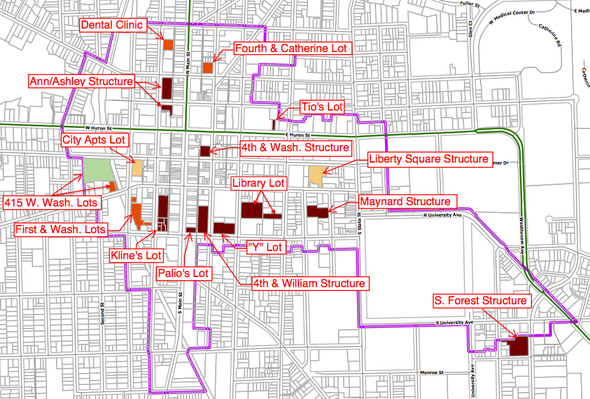
The Ann Arbor City Council was presented this map in April showing parcels owned by the city downtown. The DDA is charged with coming up with a plan to develop five of them.
The overarching question that remains after today's two-hour discussion is whether the DDA should tap the expertise of paid consultants.
Doug Kelbaugh and Kit Krankel McCullough, both architecture and urban planning professors from the University of Michigan, are offering to assist in shepherding a public planning process and developing conceptual plans for a fee of $25,000 plus expenses.
The two made a formal pitch today, noting their schedules require the DDA hire them by September. They said they would complete their work and submit a final report by January.
No decisions were made today.
The City Council recently directed the DDA to facilitate a master planning and implementation process for future development of five city properties in the area of the so-called Library Lot — the site along South Fifth Avenue where a new underground parking structure is being built and where a hotel and conference center proposal was rejected by council this year.
DDA officials will be considering uses and eventually issuing requests for proposals for the Library Lot and three other surface parking lots: the Y Lot, the Palio Lot and the Kline's Lot.
Susan Pollay
Amber Miller, the DDA's planning and research specialist, presented an 11-page report today to the DDA's Partnerships and Economic Development Committee, laying out a framework for how to move forward with what's tentatively being called the A2P5 Planning Process (download the report).
Miller received praise after giving her report. She suggested the planning process could start with looking at what's already been articulated through previous planning efforts — such as allowable height and uses in the downtown zoning districts, appropriate density and design, and broader community goals.
Following that, Miller suggested the DDA could ask what's missing in the downtown and what's needed to meet goals like attracting jobs and increasing connectivity between different business districts. She suggested the DDA could look to other communities for best practices.
Miller also suggested the DDA could host a public speaker series with discussions on smart development, community space and economic, social and environmental viability. She also discussed the option of a steering committee to help guide the process.
Additionally, Miller said there could be a technical component to the process including input from DDA staff and board members, the City Council, the Planning Commission and city planning staff. And that could be complemented by community outreach.
Kelbaugh and McCullough said they envision a two-stage process, the first of which involves coming up with a "road show" presentation that DDA staff can give at a variety of public meetings with development options for the five properties. The second phase involves coming up with a final conceptual plan with recommended uses for the sites.
Local real estate developer Peter Allen also proposed back in June that the DDA hire him as a consultant to assist in the planning process, but he's no longer being considered. Pollay said Allen's proposal focused on the Library Lot and the DDA is looking for a broader approach.
Pollay asked committee members today if they're interested in formally seeking proposals from other consultants, not just those who have approached the DDA on their own.
DDA board member Joan Lowenstein said she's against that idea. She said she likes that Kelbaugh and McCullough don't have a vested interest in the matter.
Other committee members expressed hesitations about rushing the planning process to fit the schedules of Kelbaugh and McCullough.
In addition to DDA officials, today's meeting was attended by three City Council members — Sabra Briere, Tony Derezinski and Sandi Smith — as well as Planning Commissioner Kirk Westphal and Jesse Bernstein, chairman of the Ann Arbor Transportation Authority.
Bernstein talked about the AATA's ongoing initiative to expand public transit services countywide, which included an extensive, 30-year planning process resulting in a new transit master plan. He offered some advice to the DDA based on that experience.
"The key thing to start with is that common knowledge base. As long as everybody is on a different planet, we're not going anywhere," he said. "And in that common knowledge base, there's one piece that's got to be developed very fully: It is revenue. It is not only whether a project is economically viable, but what is the city going to get."
Briere chimed in, stressing that the benefit from a project needs to be evaluated not just by its contribution to the tax base, but also the overall benefit to the community.
"Yes, but what we often miss is the hard revenue," Bernstein responded. "Because we're again saying what our opinions are, but we need to say, 'If we do this, rather than this, what's the impact on the city revenue?' So that's my thought of how to do this."
After conducting focus group meetings, Miller said the DDA could synthesize the feedback into a plan that stops short of dictating specific uses for the city-owned sites. Miller and Pollay both stressed the goal is not to over-regulate or second-guess the marketplace.
"The marketplace will decide kind of the uses, and that will change over time," Pollay said. "Our job in trying to articulate what the RFP criteria will look like is more broad brush — it's more 'these are our goals and these are the things you need to deliver on.' But it's not to specifically say 'and it must be a hotel,' because hotels may not be viable, and it doesn't make sense to write that kind of granular detail into an RFP."
Miller and Pollay also stressed the importance of making sure whatever is built along William Street will increase connectivity and enhance the pedestrian experience.
One of the things that might come out of the planning process, Pollay said, is that the DDA would ask everybody who develops along William Street to have at least some kind of door, if not their primary door, facing toward the sidewalk so there aren't blank walls. She said even what happens with the Fourth and William parking structure should have windows.
Smith, co-chair of the committee, said "there's not a lot happening" in the area of downtown that the DDA is studying and she agrees William Street lacks character right now.
"You walk up and down William — it's a very odd collection of things," she said. "You don't know whether you're going to residential or the backs of all these kinds of buildings."
DDA board member Newcombe Clark said some in the community are going to say DDA means "don't do anything." But he said the status quo is not going to work here.
"Be it a building or a park, or whatever we end up doing with them, we're here to try to do something with them," he said of the five properties.
Ryan J. Stanton covers government and politics for AnnArbor.com. Reach him at ryanstanton@annarbor.com or 734-623-2529. You also can follow him on Twitter or subscribe to AnnArbor.com's e-mail newsletters.
Comments
A2Esq
Fri, Aug 26, 2011 : 1:58 a.m.
Let's hope its not the same consultant that botched up the recycling program. More millages; no accountability.
Ron Granger
Thu, Aug 25, 2011 : 2:27 p.m.
How much are we paying the DDA staff? Is that information public? Is it reasonable that they lack the vision and expertise in the core area that they were hired to manage? Maybe I misunderstand their primary function.
Ron Granger
Thu, Aug 25, 2011 : 2:23 p.m.
I have no doubt that professors hired to do "work" would assign that work to their TAs.
Ron Granger
Thu, Aug 25, 2011 : 2:23 p.m.
Is it not obvious that it would be a brazen conflict of interest for the city to hire University of Michigan employees to plan the city's future? If the DDA lacks the expertise and must hire consultants, then they should come from a less conflicted source.
donderop
Thu, Aug 25, 2011 : 11:31 a.m.
Definition of a consultant: Someone who borrows your watch to tell you what time it is.
snapshot
Thu, Aug 25, 2011 : 3:46 a.m.
More "good ole boy" back scratching with public dollars to get nothing accomplished but a selective redistribution of taxpayer funds.
PLGreen
Thu, Aug 25, 2011 : 2:28 a.m.
Hire a consultant, that way no one on the DDA has to be accountable. That is how it is done in Ann Arbor.
bruno_uno
Thu, Aug 25, 2011 : 2:13 a.m.
DDA board member Joan Lowenstein said she's against that idea of inviting other consultants? She said she likes that Kelbaugh and McCullough don't have a vested interest in the matter? Sounds like Lowenstein has a vested interest in University of Michigan, Id be willing to bet she has connections to the school.
dan
Thu, Aug 25, 2011 : 2:04 a.m.
Witout compensation I can offer an explanation to the current state of development and why we are on the edge of a new era. Restaurants are the more successful commercial use of downtown space. They use the evening hours to generate their most signifigant revenue. They work because parking is free after six. Take away their prime income production potential - they will melt away. This fall DDA cuts them off and moves us into the new and unknown era. A consultant who understands the value of some accessible free parking for any type of competitive commercial success, that person has stepped onto the reality path and would be a valuable hire.
mczacharias
Thu, Aug 25, 2011 : 1:27 a.m.
Please, please....if you do waste our money on a consultant, don't flush it directly down the toilet by hiring a pair of academics. Find someone who actually partakes in reality.
Mary Beth Copp
Wed, Aug 24, 2011 : 11:32 p.m.
How about a detailed sidebar chronicling the history of public-private developments downtown to put this in perspective? a2grateful has it exactly right.
outdoor6709
Wed, Aug 24, 2011 : 11:17 p.m.
I think the consulting company Friend of Politician LLC is available. They could look at this issue tonight and issue a report in 18 months for only a large retainer.
Edward R Murrow's Ghost
Wed, Aug 24, 2011 : 10:42 p.m.
You have to be kidding me. They don't know what they want to do, yet for years they have had millions of taxpayer dollars at their disposal so that they can play in their sandbox? Time to disband the unelected and unaccountable DDA. Good Night and Good Luck
a2grateful
Wed, Aug 24, 2011 : 10:21 p.m.
"Local real estate developer Peter Allen also proposed back in June that the DDA hire him as a consultant . . ." Peter Allen is a respected local real estate expert. Yes, he is a consultant. Sure, he is a professor. Most importantly in this case, he is a licensed broker. Have him list the properties for sale as a broker. Let him explain possibilities of allowable use and structure to potential investor/purchasers. Brokers do this in the normal course of business. They have to know what they are selling. Existing city zoning and/or master plan already defines the rights of use. So, pay Mr. Allen a commission when he closes a sale, actually producing tangible value for the city. Otherwise, there is little reason to hire a consultant in this scenario. Pay him, or anyone else, NOTHING as a consultant. Our history with paid consultants is pretty dismal. Paid consultants seem to be like sharks. They become involved in a feeding frenzy when there's blood in the water: also known as folly projects of City a2/DDA. And, City a2/DDA is bleeding cash. The fatal mistake for a2 City Government is that it believes tax-collected money is free to use at whim, without accountability and responsibility. Their silliness and arrogance seem to grow daily. Meanwhile, financial capability decreases daily. It's not a great scenario for Ann Arbor's future. Wake up a2 City Government!
seekplsntpeninsula
Wed, Aug 24, 2011 : 9:22 p.m.
In terms of Planning Process, the DDA has said that they are going to amend their process and listen to find out what the people want first, rather than other ways that haven't worked out so well. I suggest that the citizens would like to see what Kelbaugh and McCollough have done in the past in terms of their documented public planning process and their development of conceptual plans for a fee of $25,000 plus expenses or thereabouts. Have them collect it, put it on the internet, and let people comment. A lot will have been learned from that process alone. It certainly is not unusual to make decisions about how to proceed based on previous work. This should be no different.
MyOpinion
Thu, Aug 25, 2011 : 1:42 a.m.
A $25,000 consultation/report by these folks is a piece of cake. It is something they can pass off to a grad student. If they do it themselves, it is over a pitcher of beer and is no more than a weekend of work. It might be 20 pages long, but 10 of those pages are boiler plate text used for other purposes.
Carole
Wed, Aug 24, 2011 : 8:49 p.m.
Sell the properties, close down DDA and we will have another bucket of money for something -- hopefully for some of the items the citizens have been asking for like public safety.
jcj
Wed, Aug 24, 2011 : 8:16 p.m.
How many times have "consultants" screwed things up in this town? How do these supposed intelligent members of city government keep passing the decision making process on to someone else?
Hot Sam
Wed, Aug 24, 2011 : 8:02 p.m.
Must agree with A2grateful here...
lynel
Wed, Aug 24, 2011 : 7:58 p.m.
Why have public input and consultants the DDA is going to do what the Mayor wants anyway.
a2grateful
Wed, Aug 24, 2011 : 7:43 p.m.
1) City a2 has a zoning ordinance 2) City a2 has a master plan 3) City a2 has a planning department 4) City a2 has staff planners 5) City a2/DDA has no money to develop these parcels 6) City a2/DDA has no expertise to develop these parcels The community is NOT saying don't do anything. The community IS saying that we don't want to pay for further City a2/DDA folly projects. End the follies. Sell the parcels, or hold them until they are marketable. Then, let private developers take all the risks. Focus on marketing vacant parcels. Focus on selling. Close the deals. Then, collect the taxes. Provide and maintain basic city services. Protect citizens and their property. Maintain infrastructure. Protect park investments. Maintain parks. Pay retirees. Exercise civic and fiduciary responsibilities to regain public trust. Focus on these things, City a2/DDA!
mojo
Mon, Sep 5, 2011 : 3:02 p.m.
Don't forget all the architects and developers who actually build buildings and develop property for a living. AA has it's share of talent. Sell the parcels.
racerx
Wed, Aug 24, 2011 : 10:24 p.m.
This message should be mandatory reading for all on council, the mayor, the DDA and each department head in the city!
Carole
Wed, Aug 24, 2011 : 8:47 p.m.
Right on!
nixon41
Wed, Aug 24, 2011 : 7:42 p.m.
Why consult with anyone? Just put in another restaurant like all of downtown with no parking available. Ann Arbor used to be VERY nice in the 60's & 70's.
MyOpinion
Wed, Aug 24, 2011 : 7:42 p.m.
The DDA just needs to read the comments section of AnnArbor.com. There are no end to suggestions of what the DDA should be doing; what the parking rates should be, etc. Frankly, the DDA is more nimble/focused than the city council is, but it has a lot of power for an unelected entity. When you elect the mayor, you also are electing the DDA.
bunnyabbot
Wed, Aug 24, 2011 : 7:37 p.m.
I'm confident that wether there is or isn't a consultant the DDA, which is an unaccountable tenticle of the city council will still muck things up.
treetowncartel
Wed, Aug 24, 2011 : 7:29 p.m.
I think they should hire a consultant, to see if they should hire a consultant. What is up with the use of consultants these days?
Richard Dawn
Wed, Aug 24, 2011 : 6:56 p.m.
Save everyone's money. The best advice is to simply have the city offer the properties for sale. Get the city out of the land development business. They still have ample opportunities to shape any private sector investments through their zoning and site plan regulations.
bunnyabbot
Wed, Aug 24, 2011 : 7:42 p.m.
I have to agree with this, if the city didn't own the old Y lot than AATA could have used the space better to expand, maybe (or at least would have had that option). As it is AATA pretty much has taken over 4th Ave. You have a row of buses on either side of the street, which wouldn't be the problem, but you always have people cutting in between buses to cross willy nilly in a dangerous game of frogger.
Vivienne Armentrout
Wed, Aug 24, 2011 : 6:55 p.m.
Thanks for this good summary of the meeting. I attended and the report seems to me an accurate reflection of what was said. One further detail is that the committee discussed establishing an additional committee - a Steering Committee - which, as CM Smith said, would be more "nimble" and would interview resource people like business owners. I asked after the meeting and was assured that those meetings would be open to the public. Also, the next Partnerships/Economic Development/Communication committee meeting is September 14 and I thought that committee members were hoping to firm up their process at that time.
treetowncartel
Wed, Aug 24, 2011 : 7:30 p.m.
Actually, ad hoc committees to the OMA.