

Ann Arbor considers how to 'activate' Main Street corridor south of William Street
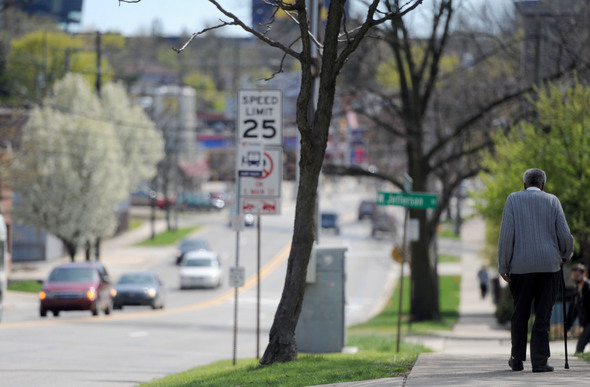
The Ann Arbor Downtown Development Authority is working to extend the pedestrian corridor from William to Madison on South Main.
Angela J. Cesere | AnnArbor.com
Not too far south of William Street, Ann Arbor's Main Street changes from an active pedestrian corridor to somewhat of dead zone in what is still technically part of downtown.
But there are talks of changing that.
The developer of the 618 South Main apartment project between Madison and Mosley proposed several weeks ago that the DDA channel some of the captured tax revenues from the project back into the development.
DDA officials have kicked around the idea and they're now thinking there might be a way to make something work, though maybe not exactly what the developer has in mind.
"If you go from Ashley Mews down to this project, if you come on down the hill, it's still kind of industrial and not very pedestrian friendly," said Ann Arbor City Council Member Sandi Smith, also a member of the DDA's governing board. "If we were to use this as an anchor site and do street improvements up there, then I think we could really activate that corridor."
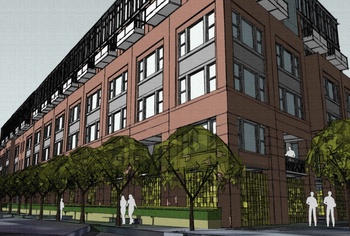
A look at the 618 South Main proposal
Project developer Dan Ketelaar of Ann Arbor-based Urban Group Development Co. threw out a $2.3 million figure in February when talking about a potential TIF reimbursement. Smith said on Wednesday it's more likely to be closer to $1.2 million.
"There were misconceptions on the developer's part on what the TIF would actually be," she said. "We've sent them back to get some clarification and correct numbers. We also took an opportunity to take a look at the history of partnership grants that we've done in the past and the specific reasoning behind each time that we have given money."
Smith said each time the DDA has agreed to help finance a project in the past it was because it was an extraordinary project for some reason at its time. And that's the question now — whether 618 South Main is an extraordinary project and whether it offers enough pubic benefit to tip the scale and justify the DDA channeling tax dollars toward it.
"We still need some more information," Smith said. "It's potentially a very important project for the location in the South Main corridor. I think it has an ability to extend Main Street on down by kind of finishing that block off or that stretch off. But without having an organized plan to do that, I don't know that we're ready to say that's a tipping point for us to go forward."
Smith said the current plan being looked at would have about $250,000 a year in tax revenues from the project captured by the DDA and channeled back to the development. She said that would cap out at about $1.2 million, though the numbers are still being refined.
She said it's a community reinvestment program not unlike a brownfield plan. She said the developer will have to apply to the state for funding.
"But it does require a local contribution," she said. "Given the situation that there are very little taxes being paid on the property right now, there's no other source of new tax dollars except for what the DDA has, so it's got to happen with the DDA's dollars and not city dollars."
The developer would have to get the project up and running and start paying taxes before any taxes captured by the DDA get channeled back to the project.
Smith said the developer would like to apply those dollars directly to the eight-story apartment project, but DDA officials prefer a different approach.
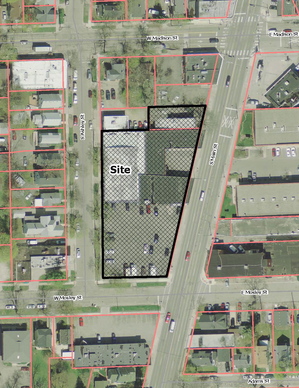
The location of the 618 South Main project
-Urban Group Development Co.
In her report to the DDA's governing board on Wednesday, Smith didn't say specifically what the money could fund, but she spoke generally of activating the Main Street corridor in some way, and that could mean streetscape improvements.
"The developer is right when he says this is an anchor project that will allow us to kind of infill the rest and really change that neck of the woods," she said. "I think it would be dramatic. We just have to find out how we can participate."
DDA board member Joan Lowenstein gave a separate update on the DDA's Connecting William Street project, a master planning effort that has the DDA evaluating new uses for five city-owned properties, including the Library Lot, Y Lot and Palio Lot, among other sites.
Lowenstein relayed the results of a recent community survey for the initiative, saying the DDA expected 1,000 responses but received double that amount.
"We heard some clear messages through the survey — a strong desire for a more vibrant sidewalk experience in the William Street area with attention to building quality and design, economic development, housing and open plaza space," she said.
Lowenstein said the DDA is partnering with Concentrate to host a speakers series to explore with the community the different ways to accomplish some of those goals.
The first event was held on March 29 at Conor O'Neill's with the Michigan Municipal League's Dan Gilmartin speaking. Gilmartin co-wrote a book called "The Economics of Place," which Lowenstein said contains "a lot of ideas that we want to try to accomplish."
The second event in the speakers series — focusing on activating sidewalks and open space — is scheduled for 5:30 p.m. April 19 at Conor O'Neill's.
Lowenstein said a Philadelphia-based land-use consultant has visited Ann Arbor and is helping the DDA with its planning process.
"We're going to get some of his market analysis, we're going to have focus group meetings and also utilize the survey results," she said. "Our next step is to create scenarios that we will then be able to show to people, because you can't really get ideas about what people want until you start showing them something a little bit more concrete. And so we're going to create these development scenarios that we'll then also explore with the community."
Ryan J. Stanton covers government and politics for AnnArbor.com. Reach him at ryanstanton@annarbor.com or 734-623-2529. You also can follow him on Twitter or subscribe to AnnArbor.com's email newsletters.
Comments
firstfolio
Fri, Apr 6, 2012 : 4:40 a.m.
So DDA just wants to see people walking between Williams and Madison?...weird..
DagnyJ
Fri, Apr 6, 2012 : 2:05 a.m.
How about a supermarket to encourage people to live and work downtown, where they could walk to shops that sell goods they need to live?
say it plain
Fri, Apr 6, 2012 : 4:24 p.m.
Now *that* would be useful, but it doesn't help with the "extension of Main Street" plan, which is mostly about entertainment and high-end retail 'venues'. SMain Market has at various times been somewhat supermarket-y, and even now there is some food, right, just more specialty stuff than staples (but is By the Pound still there?).. And there used to be a sort of small market where the Happy's Pizza is now, that was useful for area residents (that didn't quite feel like a 'convenience store' a la the Seven-Eleven) Ages ago there was a produce market at S.Main Market...something like that again would be nice. And I can't help but feel that a well-stocked reasonably priced purveyor of pantry/fridge/breadbox items could do well for people who want to walk/bike to a grocery store instead of drive the albeit short distance to the Busch's down the road there. Especially once that giant new apartment building goes in...
mtlaurel
Fri, Apr 6, 2012 : 1:33 a.m.
before ya know it there'll be parking meters at the SMain market. ....surely it'll be impossible to park and get a little ice cream or milk at the Dairy. Predictable....hey, it ain't broken .....but just stay tuned.
Daisy1
Thu, Apr 5, 2012 : 8:58 p.m.
It's a good place to put some "Public Art"...like a broken down police car and fire truck!!
Goofus
Thu, Apr 5, 2012 : 8:36 p.m.
That area was active about 5-6 years ago until the city shutdown the live music at Leopolds with noise complaints and killed the venue and the area.
say it plain
Thu, Apr 5, 2012 : 5:11 p.m.
well, isn't "the thing" about that stretch of S. Main Street that it actually contains 'industrial' type businesses? Are they going to try kicking these folks out as part of the 'activation'?! I've always found this an interesting aspect of town. Aside from the collision repair shop (is that still there?! the fumes from that place were never very appealing!), I thought it was 'real' and nice for the feel of an actual town that there was a great auto-repair shop in Japanese Auto, a car wash, a window/door shop, that sort of thing. S. Main Market has been variously vibrant depending on the tenants, and remember when there was live music right around there ;-) !? So, now everything has to be "upscale", because the REALTORS make out better when it is. Sandi Smith is a REALTOR, the mayor is one too, and the DDA isn't even accountable to people, wow. I like parks and such, but already the Washtenaw Dairy aspect of this part of town will go away because of the new huge apartment building...are we also going to 'cleanse' all the other non-upscale aspects of that part of Ann Arbor away?! And thusly keep the rents so high that something like the old Leopold's or an independent *anything* that isn't pricey-pricey catering to the tenants of the big expensive condos nearby couldn't exist? *Activate*, that's an interesting euphemism!
talker
Fri, Apr 6, 2012 : 12:17 a.m.
Could some want those blocks "gentrified" because they own property there?
justcurious
Thu, Apr 5, 2012 : 8:12 p.m.
You just "Said it Plain"...something that most of Ann Arbor has forgotten how to do evidently. Self glorification is the rule of the day. Snobbery at it's finest.
BobbyJohn
Thu, Apr 5, 2012 : 4:34 p.m.
The block long 5+ story behemoth being built without setbacks is the definition of pedestrian unfriendly. And on top of that, the building will totally block afternoon sun and increase wind velocity. These mega buildings are destroying Ann Arbor's character as they impinge more into our residential neighborhood.
Tom Joad
Thu, Apr 5, 2012 : 4:14 p.m.
Worth the walk: San Fu--Chinese food at Main and Madison. Hands down the best deal in town.
YpsiLivin
Thu, Apr 5, 2012 : 3:57 p.m.
"We heard some clear messages through the survey — a strong desire for a more vibrant sidewalk experience in the William Street area..." What EXACTLY is involved in a "more vibrant sidewalk experience?"
YpsiLivin
Thu, Apr 5, 2012 : 10:25 p.m.
Foobar, According to the article, Main Street (not William Street) doesn't give good sidewalk in the 600 block. When you take that observation and combine it with the results of the survey, which show that 70% of the respondents are looking for "opportunities for spontaneous social interaction," I'm left trying to picture the kind of "spontaneous social interaction" that delivers a "vibrant sidewalk experience." I've seen a lot of "spontaneous social interactions" on sidewalks, some of which might even have been "vibrant," but I'm still wondering what the DDA is going for here.
foobar417
Thu, Apr 5, 2012 : 4:55 p.m.
Which do you prefer: A) Strolling with your significant other down Main Street from William to Washington B) Strolling with your significant other down William Street from Main Street to Fifth Avenue. Almost everyone would answer "A". Why, since they are both equally wide sidewalks? Answer: Main Street has a more vibrant sidewalk experience. It's a combination of aesthetics (light poles, flower beds, crosswalk treatments, etc.) and desirability (interesting shops, people hanging out, etc.). They're trying to figure out how to keep William Street from being such a pedestrian wasteland. Doing so usually drives increased economic activity and the overall desirability of the city.
bunnyabbot
Thu, Apr 5, 2012 : 4:55 p.m.
colored cemet squars and blocks that light up Michael Jackson Billie Jean style
Jon Wax
Thu, Apr 5, 2012 : 3:46 p.m.
Maybe I'm way off here but: The riverfront is "where it's at"! Look at main street from m14 into town. It's wasted riverfront space that should be FULL of shops, food and clubs plus whatever else fits. If we turned the riverfront into something functional instead of letting cruddy companies like Lotus hog up all the space while poluting the area with it's noise and garbage, then folks from other towns would probably come here more often and spend more money which to me is never a bad thing. I would love nothing more then to open a small cafe on a houseboat permanently moored along the main street side of the river, using locally grown produce and meets. I can imagine how incredible it would be in the summer and how cozy it would be in the winter. There should be plenty of room for parking and it seems like most of the buildings in the area could take their business and move it elsewhere with little effort. Except for lotus. They just need to go back to Europe and pollute their own country. A2 is not "small and quaint" anymore. Those notions ended in the 80s. Peace
Wolf's Bane
Thu, Apr 5, 2012 : 6:36 p.m.
You know, that is a great idea. i have often thought how cool it would be to remove the dam and then develop the area along the river including pedestrian land bridges and full scale shops.
blahblahblah
Thu, Apr 5, 2012 : 5:40 p.m.
All great ideas, but time for a reality check: The DDA and city council answer to the downtown merchants and landlords who like the status quo just the way it is. Therefore, the rezoning process necessary for retail on N. Main is nothing but a pipe dream at this point.
foobar417
Thu, Apr 5, 2012 : 4:52 p.m.
Actually, I suspect you could a lot even with the tracks there. Imagine replacing all those buildings on north Main with a set of restaurants and cafes at street level. At the back side, the restaurants would be one floor above the tracks. I could even envision terraces that extend out over the tracks giving you an unimpeded view of Argo Pond. Then you could hide parking underneath those restaurants at the level of the tracks between the road and the tracks.
spm
Thu, Apr 5, 2012 : 4:30 p.m.
I absolutely agree. That whole area is wasted opportunity. Bandemere park is right there and if there were more coffee shops, resturants, quaint shops and green grocers lining that road it would bring more people in to use that area for a total recreation experience. I love your idea of a houseboat cafe!
MRunner73
Thu, Apr 5, 2012 : 4:25 p.m.
There's one problem with that; the railroad tracks. Not much can be done because of that. That is why that small stretch of Main from William to Madison is being contemplated, there are railroad tracks 1 block to the south and it is difficult to develop around that.
blahblahblah
Thu, Apr 5, 2012 : 4:18 p.m.
I can think of worse examples than Lotus on this stretch of N. Main to pick on, however I do agree about the lost opportunity here. Instead of a houseboat, consider opening a railcar diner along with outdoor seating. I am ready to quit my day job too if you need a bartender?
lumdum15
Thu, Apr 5, 2012 : 3:26 p.m.
Outdoor community recreation draw shoppers to participate and watch a' la ice skating rink in Houston's Galleria. An inline skate rink, shuffleboard, hopscotch, jump rope, bocci ball, marbles, hand ball, four square. You get the point. Look at the HighLine in NY for instance.
ranger007
Thu, Apr 5, 2012 : 3:23 p.m.
Put in a parking garage for all the people lining up down main st together in and get a place to park.
Veracity
Thu, Apr 5, 2012 : 2:54 p.m.
Unfortunately, the City Council and the DDA must contend with budgets struggling to avoid deficit spending. TIF payments will be important in offsetting future increased servicing costs for bonds that the city has issued, especially the recent $50 million bond issue that is paying for the underground parking structure which is being completed next to the downtown library. I am not even certain if Sandi Smith is aware of the schedule of payments due for servicing the bonds.
bunnyabbot
Thu, Apr 5, 2012 : 2:22 p.m.
the picture shows several people walking on the sidewalks, including a man with a cane, so apparently they are user friendly. Thousands of people walk this stretch on game days, apparently for years it has been just fine. So that leaves me thinking that the developer just wants it to be "prettier" for thier building. Well I say sure, if they want a prettier looking area they can pay for it out of thier landscaping budget. Disband the DDA or make them elected, term limited and held accountable to the people.
bunnyabbot
Thu, Apr 5, 2012 : 4:53 p.m.
actually Peter as someone who has spent a lot of time in Canton I can tell you that the sidewalks are user friendly as people who walk or bike can easily get from point A to point B, and they do. You don't need multi story buildings with cafes to be user friendly (and honestly who the heck would want patio seating along Ford Rd anyway?) Additionally due to Ann Arbors budget "priorities" Ann Arbor unlike Canton doesn't even have garbage recepticals in all of their parks or on school properties, this leads to more litter and no place to throw out your scooped up dog poop. They also have several large parks (like Heritage Park) that are clean, user friendly, well taken care of and used for multiple events that are family friendly. They also have several "bike" events where they encourage families to use the sidewalks to bike. "street level enviornment that people want to be in" the DDA should focus on graffiti and user friendly parking and ADVERTISING for the downtown business core. Not redoing something that is working just fine for the block in question.
Peter Baker
Thu, Apr 5, 2012 : 4:26 p.m.
The sidewalks in Canton work fine too, and nobody uses them, because poor planning has led to a place that is not pedestrian friendly. Friendly means more than just being ABLE to walk, it means trying to develop a street-level environment that people want to be in.
JRW
Thu, Apr 5, 2012 : 2:22 p.m.
"If you go from Ashley Mews down to this project, if you come on down the hill, it's still kind of industrial and not very pedestrian friendly," said Ann Arbor City Council Member Sandi Smith, also a member of the DDA's governing board. "If we were to use this as an anchor site and do street improvements up there, then I think we could really activate that corridor." Too vague. What exactly are they planning to do to "activate" that corridor? There are a few small businesses in the area, including auto repair and auto collision services. These are not places where people walk to. They drive their cars to those locations for service. Several other large buildings are in the area, one is DTE offices, one is rented to small businesses (floral, etc), one is real estate. What are they planning to do, tear everything down and add cute little boutiques thinking people will stroll around and "activate" the corridor? Several businesses have failed in the commercial space in Ashley Mews due to lack of pedestrian traffic. I don't know what the latest iteration is for commercial space in Ashley Mews, but what were they thinking? There is little pedestrian traffic in that area and that's fine. The city needs areas like this to support these existing small businesses and not every area adjacent to downtown needs to be lined with boutiques and restaurants! Enough already! That corridor is semi- industrial and offices. Leave it alone. It's fine. Ashley Mews was overly ambitious (did those penthouses sell yet?), overpriced (one bedroom condo for $360,000?) and misplaced. The other monster apartment project (618 S Main) will also be overbuilt for the area, and only add more car traffic to the area. This latest one is a monolithic architectural beast totally out of character with the residential neighborhood on Madison. There are MANY other areas of the city that need "activating" (Miller-Maple, for example).
say it plain
Thu, Apr 5, 2012 : 5:34 p.m.
Exactly... I think they must be hoping that if they can just use this bull excuse of tax-funneling to the developer of the monster apartment project to 'support' the un-needed 'street level improvements', and pay some consultants money to help them sketch out the large-scale changes to that part of town needed to get people to see it off in the distance from the downtown proper, THEN they can finally live their dream of making downtown bigger! THEN they will have done what these Mews and other projects failed to do--"extend" the bubble of endlessly higher rents and commissions that downtown Ann Arbor in the 'right' corridor (like S. Main--very very very reliable!) represents! It's like RE alchemy they're after....ready, set, *ACTIVATE* :-) Imagine if they could work it so that Main Street level rents/prices extends *all the way to the Stadium*!? They could sell parking spaces on a football-seasonal basis in the new underground garage and have patrons spend their way all along Main til they get their fannies into their seats, woohoo!
Wolf's Bane
Thu, Apr 5, 2012 : 2:10 p.m.
City officials have always been aesthetics challenged and that will never change. We have a myriad of city approved examples including buildings, streets, signage, and bridges that fall short regarding aesthetics and barely meet minimum standards for most of us. I also echo the concerns regarding this being another exercise conducting a "full funding" exercise by the DDA as well as the city. Short of declaring the stretch of Main street between Williams and Stadium a pedestrian zone, nothing else will really "enhance" that area and I don't need an outside consultancy to tell me that. And, I might add, it isn't feasible.
blahblahblah
Thu, Apr 5, 2012 : 1:29 p.m.
Hopefully, the developer was not banking on receiving all of the initial $2.3 million TIF number to make this work. I would hate to see one of the only "non-student oriented" developments fail, especially at this location. In terms of "activating" dead zones, PLEASE focus on North Main FIRST, say from the Greek church all the way north to the highway. Perhaps this area extends outside of the DDA's jurisdiction but the city has totally ignored this important extension of downtown and gateway into the city.
Pete
Sat, Oct 13, 2012 : 1:28 p.m.
Far North Main St. is in sort of a tough position. It is squeezed between the hills and the river so it can't ever have any lateral expansion. Also, the bit on the river side has been industrial for a long time. I bet there would have to be a major ($$$) clean-up before anything could be developed there. Closer in to downtown, you might have a case, although the current use (marginal businesses and residential) might make it difficult.
MRunner73
Thu, Apr 5, 2012 : 2:14 p.m.
Agreed. You have a much better idea/proposal. This makes much more sense. Thx @blah(3)
SMC
Thu, Apr 5, 2012 : 2:11 p.m.
I use those as landmarks when giving directions: "Get off the freeway. Avoid the potholes. Go past the dilapidated houses and industrial buildings. When you pass the house on the right with the collection of old pickup trucks that are in various stages of disassembly, slow down. When you see the house with a giant hole in the roof, turn left...."
lugemachine
Thu, Apr 5, 2012 : 1:53 p.m.
Wish I could vote this comment up X10. North Main is horrible. As you exit M-14, you see sidewalks in disrepair, unattractive industrial buildings, overgrown scrub/trees... then a railroad trestle, an abandoned gas station, a decidedly unattractive party store, then a whole row of abandoned/burned out/boarded up homes. Welcome to Ann Arbor!
JRMjr
Thu, Apr 5, 2012 : 1:23 p.m.
They need to consider what happens to the historic and residential district a few blocks off of Main St and what that added traffic would do. Also, I think first focus on transit center/Palio lot area. Once you master that dead space then work on focusing on that bigger chunk... nothing will come from trying to bite off more than you can chew and then it all turning into under-leased space with no anchor tenant, local flavor.
MRunner73
Thu, Apr 5, 2012 : 1:22 p.m.
Sounds like much to do about nothing. That corridor is an overflow for parking. There are a few small local business owners which is very good. The information given in this article seems vague. I was looking for bottom line and didn't see it. The city needs to spend it's monies not narrowing a Jackson Road corridor for a bike lane or contemplate what to do with a very small strectch of Main Street but rehiring more police and fire department people.
foobar417
Thu, Apr 5, 2012 : 4:42 p.m.
City money is not being spent on the Jackson Road corridor. That's an MDOT project with MDOT funds to repave a badly worn piece of pavement. The "debate" such as it is where to put the paint to improve safety for drivers, pedestrians, and cyclists.
SMC
Thu, Apr 5, 2012 : 2:12 p.m.
Yes.
Halter
Thu, Apr 5, 2012 : 1:02 p.m.
Seriously, I am glad they are looking at this....those several blocks south of Downtown look bad, have little of general interest, and need some sprucing up....in fact, the entire stretch from the Stadium to downtown could use some TLC and paint....BUT, and this is a big but, the businesses there were things that historically have been pushed OUT of Downtown A2 which most people consider ending at WIlliams....there's a gas station and a pizza place; a few shops, and a car wash -- who is going to "walk" down there to enjoy a stroll to the gas station or car wash? REALLY??? Even with a zoning change, the stretch is going to be basically service-oriented. Now, I am all for new sidewalks, fresh paint, new lights, and while we are at it, let's throw in some nice median strips with cobblestones -- but it makes zero sense to do that. I would much rather see them spending their time, energy, and effort to try to figure out what they are going to do with that awful "washtenaw corridor" that is a bigger eyesore; a huge traffic control problem; and will increasingly become so with futher development. Talk about an area that looks awful.
say it plain
Thu, Apr 5, 2012 : 5:23 p.m.
Exactly...*that* region you refer to is definitely a 'problem', as opposed to a place where they'd like to see what Paula Gardner referred to recently as that part of the downtown area where "they"--namely this little cabal of city officials and developers--previously tried to 'extend' the high-rent zone but didn't quite fully succeed. So far at least they can't actually *close* businesses they'd rather see replaced by coffeeshops and MI cherry souvenir joints, can they?! And this, while there are *real* problem areas in town they could attend to! Like the corridor you mention, and the north main area which contains some *serious* eyesores that aren't even actually businesses bringing something of value to the community like the ones they find "kind of industrial" in that S. Main area! This is great great evidence that the DDA's prominent and unaccountable role in AA should END.
Kafkaland
Thu, Apr 5, 2012 : 1 p.m.
Craig, when you say "Anything else is aesthetics that should be outside the realm of city officials", I have to vehemently disagree. I think it is an important function of city government to keep Ann Arbor livable, and aesthetics, and the character of the community, is very much part of that.
Kafkaland
Thu, Apr 5, 2012 : 3:38 p.m.
Well, if you don't like the decisions these commissions make, how about making yourself knowledgable in these matters, like art, historic conservation, urban development, etc., engage with the community, and if you do the hard work chances are that you will be invited to become a member of one of these bodies, and can help them make decisions more to your liking. It's very easy to sit ehre and kvetch about art or development projects that you don't like; it's much harder to contribute productively to making our community better.
Veracity
Thu, Apr 5, 2012 : 2:50 p.m.
Would you say that the Dreiseitl "art" project in front of the municipal building is attractive and enhances the appearance of Ann Arbor? Unfortunately, a small group of individuals appointed to the art commission decides what art will be placed and at what sites in Ann Arbor.
Brad
Thu, Apr 5, 2012 : 2:11 p.m.
Great. So while we're defining "pedestrian friendly" can we also get a definition of "livable"? A lot of fluffy terminology.
Craig Lounsbury
Thu, Apr 5, 2012 : 1:10 p.m.
The problem as i see it is the notion that any time the "city" has a better idea of what should be on a particular plot that it implements its plan and that plot changes to meet some vision held by 6 people, or whatever it takes to win a vote in city council.
Vivienne Armentrout
Thu, Apr 5, 2012 : 12:56 p.m.
Sandi Smith: "so it's got to happen with the DDA's dollars and not city dollars." I know what she means, but that is the problem, isn't it?
Peter Baker
Thu, Apr 5, 2012 : 12:48 p.m.
There is a lot a city can do to cultivate areas of use. Zoning blocks as mixed-use with first-floor businesses and living space above, along with city-owned common areas like parks and plazas are absolutely in the purview of the city, and should be pushed for in all areas around downtown.
Craig Lounsbury
Thu, Apr 5, 2012 : 1 p.m.
a financially strapped city that slashes public safety to balance a budget and can not maintain its existing parks adequately has no business pushing for more.
Small Business Owner
Thu, Apr 5, 2012 : 12:45 p.m.
Wow. Lots of small-time, short-term thinking in these comments so far. If you want Ann Arbor to stay small, quaint, and 'charming', with a small tax-base, then by all means let's never consider progress of any sort.
thecompound
Thu, Apr 5, 2012 : 2:28 p.m.
Also lots of interesting voting on these comments....almost as if someone sent out a memo, lol
Craig Lounsbury
Thu, Apr 5, 2012 : 2:21 p.m.
alternatively, welcome to Ann Arbor.com where everybody can express an opinion and express their opinion on other peoples opinions. Seems pretty fair to me.
tegel
Thu, Apr 5, 2012 : 2 p.m.
Welcome to the AA.com forums where the vocal minority think they are the majority and enjoy wielding virtual pitchforks at every opportunity.
Craig Lounsbury
Thu, Apr 5, 2012 : 12:56 p.m.
Its Government sponsored, Government subsidized and Government orchestrated "progress" that concerns many of us.
B2Pilot
Thu, Apr 5, 2012 : 12:39 p.m.
reduce the road from 5 lanes to 2 and put a nice sculpture in the middle that will spruce it up. Also why are 'public' meetings being held in a bar? just sayin
B2Pilot
Fri, Apr 6, 2012 : 1:06 a.m.
okay so why was my reply rewritten and by who?? I was in a rush and had some grammatical errors but why was my post changed?? it is not what i posted ? Is Jane Lowenstein now demanding that ANTi's comments be censured??
B2Pilot
Thu, Apr 5, 2012 : 4:53 p.m.
Is DDA not part of city government ?? Their calling the shots with our money?? They are appointed by the Mayor? They are driving this covnersation to change the area are you okay with that? They just screwed up 5th avenue with 'their' undergournd parking garage with the hopes of building a hotel on top of it The first event was held on March 29 at Conor O'Neill's with the Michigan Municipal League's Dan Gilmartin speaking. Gilmartin co-wrote a book called "The Economics of Place," which Lowenstein said contains "a lot of ideas that we want to try to accomplish." The second event in the speakers series — focusing on activating sidewalks and open space — is scheduled for 5:30 p.m. April 19 at Conor O'Neill's.
thecompound
Thu, Apr 5, 2012 : 2:23 p.m.
As long as it is their own money being locally spent and not some slush fund...
SMC
Thu, Apr 5, 2012 : 2:15 p.m.
Conor O'Neil: "Hey guys, I'm willing to host the speaker series at my place. I won't charge for the space, and anyone who wants dinner and a beer afterwards can have one there." Other members: "Oh, no can do, Mr O'Neil. You place is bar. That's beneath us."
Barb
Thu, Apr 5, 2012 : 12:59 p.m.
Yeah, why are folks spending money at local establishments? Insanity!!
Rod Johnson
Thu, Apr 5, 2012 : 12:49 p.m.
Why should they not be held in a bar? It's not a meeting, it's a speaker's series. If Conor O'Neill's has a space, why not?
Carole
Thu, Apr 5, 2012 : 12:32 p.m.
To my way of thinking, there is nothing terribly wrong with the area that they are discussing. It is just another way to spend dollars.
f4phantomII
Thu, Apr 5, 2012 : 7:16 p.m.
And make things more congested.
Craig Lounsbury
Thu, Apr 5, 2012 : 11:35 a.m.
""If you go from Ashley Mews down to this project, if you come on down the hill, it's still kind of industrial and not very pedestrian friendly," said Ann Arbor City Council Member Sandi Smith," Huh? you mean there isn't a sidewalk? When did the city remove the sidewalk? Because all "pedestrian friendly" should mean is a well kept sidewalk. Anything else is aesthetics that should be outside the realm of city officials .
Brad
Thu, Apr 5, 2012 : 11:49 a.m.
Craig, maybe they're planning to equip that stretch with Sherpas to carry the pedestrians so that they don't get too tired going up and down the hill. Or possibly a tram. We are a "pedestrian centric" town I've heard (repeatedly).
justcurious
Thu, Apr 5, 2012 : 11:45 a.m.
Absolutely correct Craig. She needs to define her version of "pedestrian friendly". More likely she is looking for "shiny new", or "upscale", or "urban polished" or, "artisinal" or some sort of high-falootin' surroundings that common businesses don't fit into. Maybe just fill it with lofts and artwork and chain stores and bike paths? These folks came to Ann Arbor for their "schooling" and then decided to hang around and change it to match where they came from. All character is being obliterated step by step.