

Ann Arbor DDA officials want proceeds from sale of city properties to go toward affordable housing
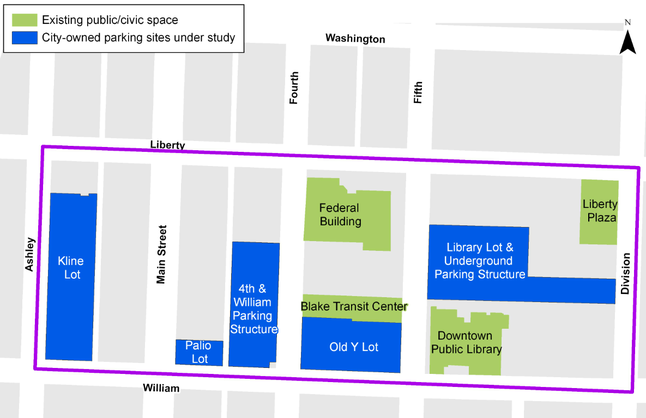
Map courtesy of DDA
But what will happen with the millions of dollars the city potentially could get if it sells any of those properties to a developer with a winning proposal?
DDA Chairwoman Leah Gunn has an idea she's planning to bring forward in the form of a resolution next week: Send the net proceeds directly to the city's housing trust fund.
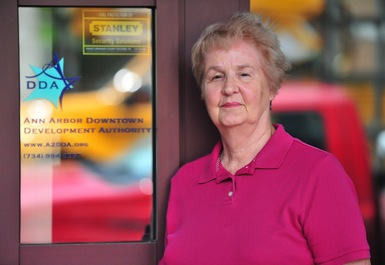
Ann Arbor DDA Chairwoman Leah Gunn
Ryan J. Stanton | AnnArbor.com
Gunn said she's planning to have a resolution on the DDA's agenda when it meets next Wednesday at noon. The resolution would encourage the Ann Arbor City Council to support the idea. Gunn said she's hoping for a resolution to go before council for consideration on Sept. 17.
At the request of the City Council, the DDA is leading a planning process for the future redevelopment of five city-owned sites downtown:
- The Library Lot atop the new underground parking garage off Fifth Avenue;
- The old Y Lot where the YMCA and 100 affordable housing units once stood at the corner of Fifth and William;
- The ground floor of the Fourth and William parking garage;
- The Palio Lot at the corner of Main and William;
- The Kline Lot at Ashley and William.
Because William Street is the link between the five properties, the project is known as the Connecting William Street initiative.
As part of the planning process, the DDA has been inviting groups of downtown residents, employees and business owners to share their thoughts on the future of the five properties. The next meeting takes place from noon to 1:30 p.m. Sept. 10 at the downtown library.
DDA board member Bob Guenzel, chairman of the Washtenaw Housing Alliance board, said he's been in talks with City Council Member Sandi Smith, who also serves on the DDA, about the possibility of using the property sale proceeds to re-energize the city's housing trust fund.
"She's still fleshing out the specifics," Guenzel said. "But the idea is that we had 100 (affordable housing) units downtown, they've disappeared and there is a very strong advocacy for housing, especially for those individuals who are most at need."
Guenzel said the five lots need to be developed, but considering their location in the center of downtown, adding new affordable housing units there might not be the best idea.
"We'd be further ahead looking near downtown, looking at the existing structures even of the Housing Commission," he said. "But to do that you need some revenue — not only for bricks and mortar, but maybe ultimately for supportive housing.
Gunn agreed.
"One of the problems with building affordable housing in the downtown is that this is the most expensive land in the city," she said.
The city owns 360 affordable housing units at 18 sites overseen by the Housing Commission. City officials said earlier this year the Housing Commission is now operating in the black after staff cutbacks, but the units it oversees are suffering continued deterioration due to a lack of money, with an estimated $14.5 million-plus in deferred capital needs.
The city purchased the old YMCA building at Fifth and William in 2003 in hopes of ensuring the housing units inside would be preserved after the YMCA moved into its new facility on Washington. Had the city not purchased the building, city officials feared the YMCA could have sold it to someone else and the city would have permanently lost 100 units of affordable housing.
But the city found the building had been poorly maintained — the boiler was deteriorating and eventually died, the plumbing was poor, and the building lacked proper accessibility for the disabled.
Because of the deteriorating conditions, the city paid to relocate remaining tenants to other housing units in 2008 and then tore down the building.
The original goal was to sell the property to a developer who would demolish the building, but that deal fell apart in 2007. The developer sued the city in federal court but lost.
The site has remained a surface parking lot ever since.
Guenzel said the prospect of transferring sale proceeds to the housing trust fund presents a real opportunity to add new affordable housing units in the city.
"I just think it's a tremendous opportunity for this community and I think City Council shares that value about housing," he said.
Ryan J. Stanton covers government and politics for AnnArbor.com. Reach him at ryanstanton@annarbor.com or 734-623-2529. You also can follow him on Twitter or subscribe to AnnArbor.com's email newsletters.
Comments
pbehjatnia
Sat, Sep 8, 2012 : 2:35 p.m.
Yet another attempt to build Near North. Sweet. Build it in your own backyard, Ms. Gunn. Really. Do it. Oh, you aren't that liberal are you? Just liberal enough to give a little but not the real deal? Typical. Cheap. Self-serving liberal.
Steve Hendel
Wed, Sep 5, 2012 : 8:35 p.m.
This is in great part a repackaging of a previous story, with a few added twists; much of it has been lifted verbatim from that story. One of those twists invites comment: " But the city found the building had been poorly maintained — the boiler was deteriorating and eventually died, the plumbing was poor, and the building lacked proper accessibility for the disabled." Well. Surely a proper inspection would have revealed these deficiencies, so two possibilities occur: 1. There was no such inspection, or 2. There was an inspection, and it was not paid any heed. Neither alternative reflects well on the City.
Steve Hendel
Sat, Sep 1, 2012 : 11:54 a.m.
"I think it is a very good idea because it will help to provide not only affordable housing but supportive services, which we desperately need," she said. "My feeling about this is that this would re-energize the housing trust fund and it wouldn't cost anybody anything." Nonsense! It would cost the City the revenue it would have otherwise received. Just because you find a quarter on the sidewalk doesn't mean you go spend it without examining your priorities . "Affordable housing" as it relates especially to the downtown area, is an oxymoron. The only way it works in the downtown area is if: (a) the City subsidizes it heavily and/or the owners/ tenants of the 'market rate' units make up the difference in the price THEY pay.
Can'tspellChelseawithoutDDA
Fri, Aug 31, 2012 : 10:31 p.m.
This is another example of non-elected DDA members making bad and decisions with taxpayer monies. The Chelsea DDA has a history of spending monies on projects that the city council should be responsible. ($1 Million dollars of DDA money for the police station, the Longworth building purchase ) Gov. Snyder and the legislature should attempt to abolish DDA's and force city councils to be accountable for the taxpayer dollars
demistify
Fri, Aug 31, 2012 : 8:37 p.m.
Let's see now: The official myth is that the City Council makes policy for the city. It has delegated authority and sources of funding to the DDA which, as its name implies, is tasked to develop downtown. It is within the province of the DDA to propose to the City Council what to do with undeveloped (or underdeveloped) city property within the downtown, though the ultimate decision is for the Council to make. The DDA has no business planning development outside the downtown area. The City Council may decide to sell downtown city property and use the proceeds for projects outside of downtown, if it so wishes. The DDA has no legitimate say in the matter.
1bit
Sat, Sep 1, 2012 : 11:03 a.m.
A point of clarification here, which I believe you are also making: although it is within the scope of the DDA to suggest uses for downtown property and development it is not within their boundary to suggest the usage of funds from sales of property. The city council and mayor have ceded too much to the DDA and I consider the latter as not so much a shadow government, but a ruling cabal. The idea of the DDA may be good in some ways, but it has become so entrenched with money that they now believe it belongs to them. They have no accountability and thus grow in arrogance and entitlement.
Linda Peck
Fri, Aug 31, 2012 : 7:52 p.m.
It is odd that Leah Gunn believes the profit from the sale of properties would "not cost anybody anything." I don't agree with this. This money could be spent on other worthy causes such as police and fire personnel, fixing roads and parks, relieving some unfairly overtaxed property owners.
Townspeak
Fri, Aug 31, 2012 : 7:47 p.m.
I am all about affordable housing. I just don't believe the most valuable property in town should be dedicated to it. I don't, in theory, mind some of the funds on sale of public land going to affordable housing. I disagree that we need more police or firemen and think that some of the latter should go "on call." What did i hear that we had a staff of 85+ full time fire employees? that seems high to me for the amount of actual fires a city this size regularly combats.
Mick52
Fri, Aug 31, 2012 : 6:53 p.m.
For me the question is the definition of "affordable." Does this mean more housing for poor folks, or for all levels of income, those people who cannot afford to live in Ann Arbor but make good incomes? Historically it has been only for people of very low income and those making in the $30k to $70k range are out of luck. And Ann Arbor continues to be a city of rich folks and poor folks. With as GoNavy points out lots of people living in the surrounding cities. Ann Arbor already has 17 locations with 67 buildings and 355 low income rental units with 1 to 5 bedrooms: http://www.a2gov.org/SERVICES/OTHERSERVICES/HOUSING/Pages/Low-IncomePublicHousing.aspx It looks fairly large already and this does not include the homeless shelter. And the waiting lists are closed. How many more should the city support? I have always had a question of whether or not the costs associated with this program are covered by the low rents and maybe grants so that it is self supporting which makes if more palatable financially. Or does it require support from the general fund, money that could be used on police, fire, streets, utilities? Good hearted? Yup. But is it fair to people who work, make a decent living, would like to live in A2 but feel they can't afford it? Looks like favoritism to a portion of the population. I would recommend that before it is expanded the costs and how it is paid for is examined carefully to ensure their is no financial burden to the city.
PoliSci
Fri, Aug 31, 2012 : 6:22 p.m.
Use parking revenues for housing. The DDA should have no more input into what happens to these properties than the average citizen.
Veracity
Fri, Aug 31, 2012 : 5:31 p.m.
All the city properties being considered for sale and development are already in use productively so re-characterizing the land is not urgent. Furthermore, before considering adding any new affordable housing the city needs to invest $14 million into repairing the 370 buildings being managed by the Housing Commission so that tenants do not have to continue living in substandard and possible dangerous conditions.
Gerry
Fri, Aug 31, 2012 : 5:14 p.m.
There's plenty of affordable housing in the area- it's just not in Ann Arbor. Improvements to buses and transit would be a better use of the money.
Karen
Fri, Aug 31, 2012 : 4:50 p.m.
How about what We want? You know "We - the taxpayers paying for this" How the heck did the DDD get started in the first place and why are their wishes being catered to? The taxpayers should decide where the money should go. How about re-instituting leaf pickup, Christmas tree pickup, and other city services that have been cut? How about taking care of the people who pay taxes first? In this age of electronic communication, it seems pathetic that the DDD (and the City Council) haven't set up a webinar - those of us who work for a living usually can't just b*gger off for 1.5 hours at noon. How about it? You could get AA news to help - they seem to have some IT support.
Macabre Sunset
Fri, Aug 31, 2012 : 4:19 p.m.
"...is now operating in the black after staff cutbacks, but the units it oversees are suffering continued deterioration due to a lack of money, with an estimated $14.5 million-plus in deferred capital needs." While this is technically operating in the black, it is, obviously, not a successful program from a financial standpoint. You get what you pay for. In this case, a terrific recipe for urban blight. Good job, DDA. Ann Arbor somehow survives despite you.
Vivienne Armentrout
Fri, Aug 31, 2012 : 3:19 p.m.
The Affordable Housing Trust Fund was originally established by council to make donations from developers in lieu of providing affordable housing in PUD projects. This was to satisfy public benefit requirements. Most current developments do not require PUDs because council has liberalized development standards in the desirable downtown area. The trust fund was administered by the Ann Arbor Community Development department and used along with block grant funds to subsidize housing aimed at low-income individuals. That department was subsumed by the Urban County, which is a countywide community development department. Leah Gunn has been the chair of the Urban County executive committee for many years. I think she yielded her seat recently. But what this means is essentially that proceeds from sale of Ann Arbor properties will go to a regional group to dispense to favored projects. Many of these projects have been awarded to Avalon Housing. Here is a link which provides background. http://annarborchronicle.com/2011/02/27/urban-county-gets-grim-funding-update/ Avalon has also been the recipient of considerable support from the DDA, especially for its Near North project. The DDA made an early donation of $500,000 to jumpstart this project. Part of the justification is that it would alleviate the need for affordable housing downtown (though Near North is far from the DDA, downtown, district boundary). As has been reported here and elsewhere, Near North has been in financial trouble and the city is now stepping in to demolish the buildings on its site. This move by the DDA appears to me to be motivated partly by the need to provide funds for Near North's completion.
1bit
Sat, Sep 1, 2012 : 5:35 p.m.
Thanks!
Vivienne Armentrout
Sat, Sep 1, 2012 : 12:16 p.m.
I'm sure Avalon will continue to build and manage affordable housing, since that is their mission. What will be done with that specific site should be of considerable interest to the community as well as to the immediate neighborhood. I'd also like to know how creatively the PUD can be used for a different configuration.
1bit
Sat, Sep 1, 2012 : 10:54 a.m.
Vivienne, I get the impression that Avalon wants to move forward, maybe just not with "affordable" housing. What is your take on it?
Vivienne Armentrout
Sat, Sep 1, 2012 : 1:11 a.m.
Today's announcement that "Near North won't work" http://tinyurl.com/8kfkrt2 does not necessarily negate my supposition, but it is certainly of interest.
say it plain
Fri, Aug 31, 2012 : 6:27 p.m.
Ah, so it's more of a move to distribute the monies among the little friends-and-associates cabal then! Cool how the appointees, unelected, to the DDA, can send out these 'principled' memos on how they think money should be allotted, and the elected officials can stay farther from the messiness of such obvious conflicts of interest and webs of you-grease-my-palm-I'll-grease-yours.
An Arborigine
Fri, Aug 31, 2012 : 2:46 p.m.
Ann Arbor Citizens want after-hours parking charges to go toward affordable parking!
jwsina2
Fri, Aug 31, 2012 : 2:42 p.m.
"Affordable Housing" -- how much is that in downtown Ann Arbor? Are these homes to sell to the buying public? Or is to be offered for low-income housing? There is a difference. In a development agreement, the city adds a per unit cost. That cost is on the bottom line of every buyer's purchase price. With the cost of the city taxes (vs. twp.) and the per unit charge for affordable housing, the cost of the home is already priced out of the "affordable housing" price point. Prior development agreements with the city show a negotiated number of "affordable housing" homes that were necessary to meet that criteria (less than 5 in most cases). The developer is looking at marketability for profit when the project is completed, it isn't to create "affordable housing" in the City of Ann Arbor. Many A2 residents would like to live downtown after selling their existing family home. They are still working and many work downtown. They are still trying to fund their children's educations and their own retirements, contributing to many local charities and shopping downtown. Why can't we cater to these people? They benefit the downtown by paying taxes, purchasing goods and services from the downtown businesses. And....they aren't the rich -- they're just the population that we have in A2 that would like to enjoy living downtown. These folks need 3 bedrooms (or 2 w/a study), storage space, 2 reasonable sized bathrooms and an open kitchen and living room, maybe 1,600 sf, 1 parking space and a real grocery store. These are $400-$450K buyers at the VERY most. No more. And that sounds like a lot of money...it is. But that's the cost of downtown living in Ann Arbor with a new home, city services, well built with decent not over-the-top finishes. Realistic "Affordable Housing" in Ann Arbor is an existing home, under $225,000, which is not "affordable housing" in the sense that the DDA is referring to. Good luck with d
jwsina2
Fri, Aug 31, 2012 : 2:44 p.m.
...developing a product that fits that description.
Stephen Landes
Fri, Aug 31, 2012 : 2:04 p.m.
Per Leah Gunn, "My feeling about this is that this would re-energize the housing trust fund and it wouldn't cost anybody anything." This sounds like the usual Democrat nonsense; somehow it doesn't cost anything because there is no line item in a budget for it. Wrong! Whatever funds are derived from the sale of these properties is part of our City assets. We have contractual obligations to meet such as paying off the bonds on the underground garage and funding a pension system. I'm sure we have other outstanding bonds or loans that need to be paid. What we desperately need are some adults in government who can establish priorities and then stick to them. What we have are undisciplined child-like functionaries who let the latest bit of money burn a hole through OUR pockets.
Tony Livingston
Fri, Aug 31, 2012 : 1:59 p.m.
It is unclear what the trust fund would do. Will it help people pay for housing that already exists? Or are they proposing to build more that would be owned by the city. It is inappropriate to use our money to compete with private landlords. There is already a lot of affordable housing as the market is way down. Subsidizing new housing with government money forces existing landlords who are already providing affordable housing out of business. It actually will make things worse as more houses will be abandoned and foreclosed. I would support the use of the money for vouchers.
xmo
Fri, Aug 31, 2012 : 1:59 p.m.
We could just save the money and let it accumulate for a while. (For a future crisis) Of course, we have "Progressives" in power so this money must be spent on something where it will do the least good! By the way, Why is the city in the "AFFORDABLE HOUSING" business anyways?
Veracity
Fri, Aug 31, 2012 : 5:51 p.m.
Accumulate in what way? Zero interest in a bank account! Ingenious! Where is the pressure to sell any of the properties which are all revenue producing enterprises at this time? When the properties are sold the money should first be applied to the $14 million of repair work needed by the 370 buildings being managed by the Ann Arbor Public Housing Commission at 18 locations. Realistically, the only way to resolve the substandard living conditions is by selling the structures for whatever will be offered by McKinley or First Martin or any other experienced property management companies.
anti-thug
Fri, Aug 31, 2012 : 4:48 p.m.
Ann Arbor in the "AFFORDABLE HOUSING" business because only you afford a masion .
Buckybeaver
Fri, Aug 31, 2012 : 1:57 p.m.
The city recently passed an law that all businesses must be inspected by the fire dept once a year. This by it's self isn't a bad thing, but they are charging those business' for doing the inspection. This used to be included in our taxes, but the city keeps finding ways to spend our money on worthless projects that the citizens don't want. Use that revenue to pay for the services that we used to get like trash pick up and other things, instead of continually coming to the well.
a2roots
Fri, Aug 31, 2012 : 1:21 p.m.
How about doing some investigative reporting regarding the Y building. The city has been dumping money onto that tract of land for far more years than you report.
bunnyabbot
Fri, Aug 31, 2012 : 1 p.m.
Gunn said this would cost anybody anything. How was the Y building paid for? or was it even PAID for? wasn't it just mortgaged? b/c that is not PAID for. Do these people really think that we the people can't follow the money trail to see where it started? Not cost anybody anything? Is that fairyland logic from Nod where money grows on trees? Wow, just wow.
a2grateful
Fri, Aug 31, 2012 : 12:57 p.m.
It is actually wonderful that DDA members exhibit such benevolence. Hopefully, they will lead by example. I look forward to the article where DDA members place proceeds from sale of their PERSONAL assets into a nonprofit housing trust. This includes: Personal home(s) Vacation home(s) Investment real estate Stocks Bonds Savings accounts Checking accounts Pensions Annuities Cars Boats Airplanes Collectibles, such as vintage train sets Etc Benevolence is only profound when personal sacrifice is involved. So let's go DDA. . . Show us your sacrifice, leading by example. Giving away other peoples' money is not as benevolent as you might believe. . .
RjR
Fri, Aug 31, 2012 : 12:56 p.m.
The money should be used towards any of the outstanding loans that the DDA has. End of story pay your bills first.
bunnyabbot
Fri, Aug 31, 2012 : 1:06 p.m.
well that would make too much sense
bunnyabbot
Fri, Aug 31, 2012 : 12:49 p.m.
While affordable housing is a warm and fuzzy idea any monies made from the sale of these properties belongs to the tax payers. The money should be used to pay down any exsisting debt on parking lots or structures, which could offset any future plans to raise parking rates. (are these properties even PAID for outright by the city, I doubt) The money should not be used to incur more debt or to fill another "bucket". Disband the DDA, unelected cronies with too close ties to the mayor and city council.
bruceae
Fri, Aug 31, 2012 : 12:49 p.m.
Why don't we sell her house and use the money for low income housing. The really sad thing here is that people like her don't see a problem with taking property that was paid for by MY tax dollars and everyone else that pays taxes in Ann Arbor and just give the money to someone else.
Scott
Fri, Aug 31, 2012 : 12:20 p.m.
Actually the idea stinks. I just hate the far right who run the federal government with every fiber of my being. The money should be used in the general fund to keep down property taxes on the middle class who get screwed by the people at the bottom and much more so by the welfare for the rich at the top.
Jay Thomas
Fri, Aug 31, 2012 : 10:50 p.m.
If the far right make up government bureaucrats then why does the democrat always get most of those votes?
Stephen Landes
Fri, Aug 31, 2012 : 2:08 p.m.
Scott -- did you get your directions mixed? The Right doesn't run the Federal government -- yet. If they did you would be getting what you advocate.
B2Pilot
Fri, Aug 31, 2012 : 1:29 p.m.
Gee you sound like a conservative to me - pay down debt, cut taxes, cut out corprate welfare. couldn't agree more
Scott
Fri, Aug 31, 2012 : 12:18 p.m.
This is communism. The money should be divided up and given to the richest 1% in the city. The surgeons, the health care bureaucrats, investment bankers, trust fund babies. These poor guys pay 15% in taxes and have to shuttle money to overseas accounts to hide it from the government.
bunnyabbot
Fri, Aug 31, 2012 : 12:55 p.m.
if you read the article the only trust fund I see mentioned is a housing trust fund, paid for by tax payers.
Jim Osborn
Fri, Aug 31, 2012 : 12:01 p.m.
The city, via its unelected DDA, wants to rais our parking rates so it can then bring in low income housing. Ann Arbor has plenty of low income housing next door, just east of US 23. We do not need more. One thing that I'm 100% certain of, it will not be next ot any mayor, council members, or DDA member's homes. Oh, no.
Jeffersonian
Fri, Aug 31, 2012 : 11:50 a.m.
I still can't understand this tendency toward social engineering in our town. Subsidized housing cannot be fair with limited resources. A few gain a windfall while the majority are left out- it amounts to window dressing for bureaucrats who want to demonstrate their well meaning but misguided compassion. Ultimately housing is distributed by arbitrary means of qualification which sometimes even forces people to underachieve in order to qualify or worse is a gift to slackers (I experienced this as an acquaintance I knew boasted about how he could bilk the system, until he was arrested for illicit activity- no joke) . The only thing approaching fair would be a weighted lottery where all applicants would have an equal chance based on their income- not unlike some sports draft lotteries. Even then the stink wafts for all to smell.
Mick52
Fri, Aug 31, 2012 : 6:36 p.m.
It is also called the "social agenda" of the elected officials. In this case the social agenda of unelected officials appointed by elected officials who appoint people with the same agenda. Social Agendaists are people who believe a city should cater to the social needs they see fit, like housing the homeless, the poor, installing "green" technology and buying a million dollar art piece designed by a world renowned artist. It is a focus often on non-essential services (see above) that are considered more important than essential services (police, fire, streets, utilities) in the minds of the elected officials. It's fine if the majority of voters agree with it. One problem of it is that once you build it, you have to maintain it no matter how costly it gets or creates an unintended circumstances like the panhandlers that a lot of folks complain about.
Brad
Fri, Aug 31, 2012 : 11:43 a.m.
"it wouldn't cost anybody anything."" Say what? It would cost the taxpayers however much money was involved. The property belongs to the TAXPAYERS, and so the TAXPAYERS should reap the proceeds. Very simple. Don't you love how the mayor/council offloads their unpopular positions to the unelected DDA? They they can claim (however laughable that claim might be) some distance and act like they have nothing to do with it. It would be a great plan were it not so thoroughly transparent. And they have the perfect people in the DDA (well, because they appointed them) who can take these positions with a straight face while looking down their noses at us poor, misguided citizens.
walker101
Fri, Aug 31, 2012 : 11:34 a.m.
If the city has housing in dire need of repairs and upgrades, how about using the funds they receive for making repairs to those housing units before you start spending money for another project. Such a novel idea.
Veracity
Fri, Aug 31, 2012 : 5:39 p.m.
You are correct. The Schumaker and Company report on the poor operations of the Housing Commission identified $14 million of repairs needed by the 370 buildings being managed by the Ann Arbor Public Housing Commission at 18 locations within the city. As much as a million dollars of immediate improvements are required to assure safety to residents. The Housing Commission has not adequately collected deserved HUD funds nor identified other sources of revenue. In view of its failing mission, the Housing Commission should be disbanded and housing units sold to McKinley or First Martin or other capable property management and development companies. Even if no profit is realized at least the albatross of substandard living conditions will be removed to the advantage of tenants and the city in general.
a2roots
Fri, Aug 31, 2012 : 1:18 p.m.
The units are in disrepair due to poor management and tenants that are destructive. Millions have been poured into the units over the years. They were built like crap and are virtually impossible to keep up with. At some point it needs to stop and other alternatives sought.
a2grateful
Fri, Aug 31, 2012 : 11:17 a.m.
1) Sell the properties to the private sector, placing them on the tax roles. Affordable housing issues can be considered in development agreements. 2) Use tax money to fund adequate police and fire services. 3) Start petition for voter initiative to abolish DDA. 4, Abolish DDA, restoring DDA tax stream to public schools, library and voter-influenced city budgets.
Mick52
Fri, Aug 31, 2012 : 6:27 p.m.
DDA taxes, TIF funds are based on increases in assessment values of property in the downtown and are supposed to only be used for downtown improvements. So they can't be given to other units of govt.
a2grateful
Fri, Aug 31, 2012 : 12:45 p.m.
Oops. . . from point 1: tax rolls, not tax roles
thorj97
Fri, Aug 31, 2012 : 11:09 a.m.
When is the membership of this group up for election? Oh that's right, never.
Brad
Fri, Aug 31, 2012 : 5:41 p.m.
They are up indirectly every time the mayor runs.
1bit
Fri, Aug 31, 2012 : 10:53 a.m.
I have a growing disdain (actually the word is contempt) for these unelected folks on the DDA telling the city how to spend its money. There are many worthwhile things that could be done with the money and police and firefighters are the first them come to mind. I particularly am skeptical over anything Ms. Gunn has to say as she blatantly and reprehensibly asserted the right of the DDA to steal money from people unaware of parking hours in A2. It is well past time for the DDA to go.
Brad
Fri, Aug 31, 2012 : 12:22 p.m.
Give them a break (not). They're just the mayor's puppets.
jcj
Fri, Aug 31, 2012 : 11:31 a.m.
It can't be said better! It is bad enough having dictators in office that we elect. But to have this group of renegades presume to tell us what to do is repulsive!
GoNavy
Fri, Aug 31, 2012 : 10:48 a.m.
Why are some of the city's leaders insistent upon turning this town into New Haven? Ann Arbor had plenty of affordable housing - much of it in Ypsilanti, and some of it ringing the city. Those areas are served by bus lines directly into the city. If the goal is to complete a role reversal, whereby the wealth leaves downtown and poverty (i.e. the need for "affordability") replaces it, then we can kiss a vibrant downtown city scene goodbye...to be replaced by what we see in Liberty Plaza every day and every night.
Jay Thomas
Fri, Aug 31, 2012 : 10:47 p.m.
That is exactly right. It is impossible to notice the trend of the well to do relocating outside the city limits... all the while encouraged by the Mayor and his policies.
antikvetch
Fri, Aug 31, 2012 : 5:33 p.m.
Because buzzwords and cliched phrases get you re-elected in areas where people vote solely by political party.
say it plain
Fri, Aug 31, 2012 : 4:14 p.m.
What part of *using the proceeds from sale of city properties* for affordable housing *outside* the city center don't you understand?! Indeed, the proposals and rhetoric of the DDA here are exactly the opposite of your 'feared' scenario, so, sleep easy. Gunn and Huenzel are clearly saying that there is a problem with locating the affordable (not necessarily to be read 'poverty' but thanks for showing us some true colors lol!) housing in the downtown...namely, that this is the most expensive land in the city. They are trying, it seems to me,to please the people who want to see affordable housing added not to *ypsi*, which isn't actually in ann arbor just to say, but perhaps gasp! to ann arbor itself, by claiming if they use the money they get from developers for the pricey downtown lots to pad the affordable housing fund, they may even have dough to create gasp again *supported* housing, which means housing for people who probably are currently living in poverty, or who have special needs/issues. I guess reading comprehension might be served well with the development of many new programs in an updated downtown library lol?!
Craig Lounsbury
Fri, Aug 31, 2012 : 3:07 p.m.
" Ann Arbor had plenty of affordable housing - much of it in Ypsilanti" huh?