

Ann Arbor DDA outlines new process for handling development of city-owned properties downtown
The Ann Arbor Downtown Development Authority today rolled out details of a draft plan under which the DDA would assume an oversight role in the development of city-owned surface lots in the downtown.
The plan outlines a new process for issuing requests for proposals — or RFPs — for city-owned properties where the city would like to see development happen. And that plan involves a transfer of duties from the city to the DDA.
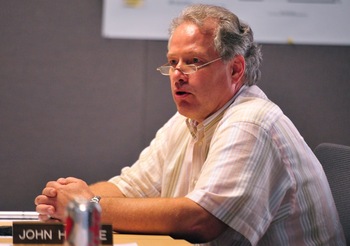
DDA board member Roger Hewitt said today talks are happening between city and DDA representatives about having the DDA assume an oversight role in the development of city-owned properties downtown.
Ryan J. Stanton | AnnArbor.com
"It proposes doing master planning for those lots and hiring expert consultants to help us through that master planning," DDA board member Roger Hewitt said today during an update to the board.
Talks of having the DDA assume oversight of the city's RFP processes are taking center stage in discussions happening between the city and the DDA. The two sides are working together on crafting a so-called mutually beneficial agreement that outlines each entity's roles in managing the downtown.
DDA Executive Director Susan Pollay has drafted a new process under which the DDA would be the engine for implementing development of city-owned properties downtown. The plan, available here, was distributed today.
"What the recommendation is intending to do is a couple things," Pollay said. "Instead of writing an RFP and throwing it out and seeing what the development community says, instead take some time to understand our downtown — what's there, what assets we could add to this, talk to our community in advance of writing an RFP, and ask them, 'What are you not seeing? What are you seeing in other communities? Tell us what you think.' And also, let's bring in some expertise. There's an enormous amount of information that we just don't have about real estate."
Under the current process for developing city-owned properties downtown, the Ann Arbor City Council first votes to distribute an RFP. A member of city staff drafts the RFP, which is placed on the city’s website and distributed to developers who express an interest in the property.
After responses come in, the city sets up an advisory committee approved by the City Council, and then interviews are held with developers.
"Sometimes this is the last step," reads the DDA draft document distributed today, referencing a city-owned lot at 415 W. Washington St. where an RFP process started in 2007 stalled, and no development happened.
The draft document shows four other instances where the city sought to develop properties through its own RFP processes. Only one of them has resulted in a development: the Ashley Mews condominium project at Main and Packard, which was finished in 2001.

Susan Pollay
The 2005 RFP for the city-owned lot at Fifth and William resulted in a legal battle with the developer, and nothing was ever built. The 2006 RFP for First and Washington resulted in the selection of developer Village Green, but the project has not yet started.
The 2007 RFP for 415 W. Washington netted three responses, but after interviews, no further action occurred. City officials now are taking another approach and trying to figure out a new plan for the site.
The RFP issued last year for the Library Lot — atop a new underground parking structure being built on South Fifth Avenue — remains an ongoing process. With the help of a consultant, a city advisory committee is evaluating two hotel and conference center proposals that remain in the running.
Under the plan outlined by Pollay today, all downtown development sites would be inventoried by the DDA, including public and private property. With the help of consultants, sites would be prioritized for development.
The new RFP process would go something like this:
- DDA develops a first draft of an RFP for a site.
- DDA approves any incentives (parking, affordable housing, pedestrian improvements, etc.) to be written into the RFP.
- DDA consultant edits/revises the RFP, oversees the distribution.
- Advisory committee selected by DDA with strategic strengths (e.g. project financing experience).
- RFP responses are reviewed.
- Interviews.
- Advisory committee frames recommendation.
- DDA approves recommendation - forwards recommendation to City Council.
- City Council approves recommendation or gives direction.
- DDA consultant assists with DDA - managed negotiations.
- DDA approves agreement - forwards to City Council.
- Site plan developed.
"The game plan is - on all of the lots - to come up with a series of recommendations that we give to council based on all the input we've received," Pollay said, "and let council then help us flesh out the highest, best use for all of them."
Pollay said she thinks the city has a lot of great goals for downtown development, but the current piecemeal approach has the city "trying to put everything on each site."
"We know there's an interest in open space, we know there's an interest in affordable housing, we know there's an interest in expanding the tax base and economic development," she said. "To try to wedge it into each site doesn't make sense, but if we can look at it wholistically, that allows us to be more strategic, and these things can be provided for in the downtown."
City Council Member Christopher Taylor, one of the leaders of the City Council's Mutually Beneficial Committee, said having the DDA become the implementation engine for development of city-owned properties downtown is a real possibility.
"Absolutely this is something that we're talking about," Taylor said. "The DDA's proposal on how this will work precisely has not been given to the committee, so we very much look forward to seeing it. The city stands to gain a great deal by a comprehensive approach to the use of city assets downtown."
Pollay said there are probably about a half-dozen "substantive lots," both public and private, where the DDA could assist in making development happen.
Ryan J. Stanton covers government and politics for AnnArbor.com. Reach him at ryanstanton@annarbor.com or 734-623-2529.
Comments
Steve Hendel
Thu, Sep 2, 2010 : 1:30 p.m.
It sounds like the Council will have no say over the process(of developing City-owned property downtown)until it is almost a fait accompli; that is, until the basic decisions over what and who have already been made by the DDA. Council will be pretty much reduced to a 'thumbs up or thumbs down' decision, although they CAN give their reasons for that decision and advice as to future direction. Is this what we want? Yes, the development of any property downtown (City-owned or otherwise) can be a byzantine process, but do we really want to cede substantive control over the process to non-elected boards and officials? Is it not the Council's responsibility to make decisions, and not just punt them to outside (appointed) entities? After all, the issues which have made downtown development so contentious will not go away because the DDA takes over the process. Preservation vs. growth, so-called 'affordable' housing vs. market-rate prices, aesthetic considerations, etc. will still be on the table no matter who runs the process. Could it not be an alternative for Council to REFORM the current process without pushing these (and other) basic issues off the table and into the offices and conference rooms of high-priced consultants? Or, could it be that Council is so addicted to dipping into the DDA cash cookie jar for all sorts of peripheral projects that it is willing to implement (or even consider) such a move?
Joe
Thu, Sep 2, 2010 : 10:03 a.m.
Is the current process broken? yes Is the solution to put the power in the hands of the unelected DDA? Absolutely not. We need government that is more responsive to the needs of citizens, not to the needs of developers.
5c0++ H4d13y
Wed, Sep 1, 2010 : 5:31 p.m.
Here's my new process. 1) Does city have clear need for land? 2) If no, sell land and collect taxes. There's no step three!
Lynn Lumbard
Wed, Sep 1, 2010 : 3:37 p.m.
Katie, are you referring to the hotel/conference center?
katie
Wed, Sep 1, 2010 : 3:26 p.m.
Question: Will this process give the public more or less control over development? I don't mean requests for public input, either. That is often less than meaningless and easily rigged for particular outcomes.