

Ann Arbor mayoral candidates talk budget, economy, other issues in third public debate
Ann Arbor Mayor John Hieftje and challenger Patricia Lesko went head-to-head in their third debate Monday night, mostly sticking to the issues this time and talking about the city's budget, jobs and the local economy.
"Despite everything that has happened to the economy, despite the loss of Pfizer, our city remains a leader on many fronts and we continue to move forward," Hieftje said. "The brightness of our city is undimmed in this long depression."
Lesko replied with a witty comeback.
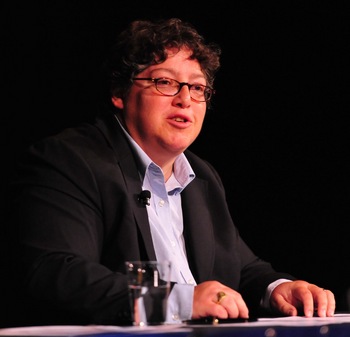
Ann Arbor resident Patricia Lesko, a candidate for mayor, criticized city spending on Monday during the League of Women Voters debate.
Ryan J. Stanton | AnnArbor.com
"In terms of the brightness of our city, it is being dimmed, literally," she said with a laugh. "Our street lights are being shut off to save money."
As part of budget cuts being implemented by the city's administration, about 1,200 streetlights — or a total of one in six lights around the city — are being turned off to save an estimated $120,000 in energy costs.
Lesko and Hieftje, both Democrats, will face off in the Aug. 3 Democratic primary. The winner likely faces two independent challengers in November, including Steve Bean, head of the city's Environmental Commission, and William Bostic Jr., a recent University of Michigan graduate.
Lesko argued throughout the debate that the city doesn't have a revenue shortage problem, but rather has an overspending problem.
"We have a city government that has been allowed to overspend and run up debt for years," she said. "Instead of reining in spending, taxpayers are asked to pay more and accept fewer services. We're being nickeled and dimed to death with fees and fee increases. I'm committed to putting services center stage, and I have the political will to say no to nonessentials and rein in overspending."
The debate, which lasted only 30 minutes, was hosted by the League of Women Voters of the Ann Arbor Area. It was aired live from inside CTN's television studios and taped for rebroadcast.
Hieftje once again hammered on the fact that cities across Michigan are suffering from falling property tax revenues and deep cuts in state funding.
"Highly regarded cities like Grand Rapids, Troy and Royal Oak have recently been forced to close facilities, raise taxes or make deep cuts in staffing," he said. "In Grand Rapids, they opened only three of their six swimming pools this year. But in Ann Arbor, the millage is lower now than it was 10 years ago, the swimming pools and the senior center are open. This is despite the fact that on July 1, the city lost nearly 5 percent of its property tax revenues from the former Pfizer."
Hieftje said the city continues to move forward, though. He said Ann Arbor is on the road to "ever greater efficiency" that started nearly 10 years ago when city officials began working on restructuring city government.
"There was a time when we had close to 20 people heading up departments in the city," he said. "That's been cut down to five areas, what we call 'bubble heads,' because it's a bubble chart. Those types of changes have streamlined city government ... and I think it served us very well."
Hieftje estimated the reorganization done this past decade is now saving the city $15 million a year. "And that continues every single year," he said. "Actually, our CFO puts it quite a bit higher than that, but I'm being very conservative with these numbers here."
Lesko said a lot of cutting still needs to be done in the city's budget because there's still a lot of what she considers "nonessential spending."
"We've made some decisions in our city government to fund, for example, a new underground parking garage," she said. "We have allocated money to the IT, fleet and solid waste departments for, in essence, nonessential spending. We need to go through our budget with a fine-tooth comb and identify areas where we are funding nonessentials."
Lesko said Hieftje's argument that the city hasn't raised taxes in the last decade is "almost a red herring because fees for water, sewer and solid waste have been raised dramatically."
"It's not accurate to say we've lowered the millage without saying we raised your fees," she said. "The raise in fees was how the overspending in city government has been supported."

Mayor John Hieftje defended his record Monday night against accusations that the city has not prioritized its budget appropriately.
Ryan J. Stanton | AnnArbor.com
Hieftje said the city's water and sewer rates have gone up, but at lesser rates than surrounding cities and other peer communities in the state.
"At the same time, we're preparing to build a huge new addition — a replacement, actually — at our sewage treatment plant," he said. "Something that is well over $100 million. And yet our rates have been going up less than 4 percent, for the most part, while peer communities are going up sometimes in double digits."
Lesko offered a critique of the business climate in Ann Arbor. She said she has spent a lot of time talking to individual business owners up and down Main Street and throughout Ann Arbor and doesn't like what she's heard.
"The word on the street is that our city government is unhelpful, if downright arrogant, that our city government is cumbersome to deal with, that our city government is nonresponsive, and our city government, in essence, makes it difficult for folks to do business in Ann Arbor," she said. "No city can afford to have that kind of a reputation amongst its business folk."
Lesko also criticized the city's investment in Ann Arbor SPARK, the area's public-private economic development corporation.
"Our city has experienced a net loss of jobs," Lesko said. "The Detroit Free Press did an expose, in fact, on SPARK and the reporter told us that, in the state of Michigan, only about 900 jobs, real actual jobs, have been created. We need to look at other kinds of economic development engines. We need to bifurcate that process. SPARK underscores startups. We need to support existing small and medium-size businesses that we already have."
SPARK recently reported it had seven project successes in Ann Arbor in 2009 that resulted in 265 new job commitments and the retention of 450 jobs the city faced losing. Overall, SPARK assisted 61 innovation startups in Ann Arbor last year using tax capture funds from the Local Development Financing Authority.
SPARK also reported working on six pre-seed investments that translated to 27 jobs and $1.5 million of investment. SPARK also reportedly assisted six companies in Ann Arbor with micro-loans that led to 15 jobs and $204,000 of investment.
According to U.S. Department of Labor statistics, jobs in the Ann Arbor metropolitan statistical area have dropped from 178,794 to 164,720 from May 2000 to May 2010 — a nearly 8 percent decline.
While jobs are being lost at a quicker rate than they're being replaced, Hieftje argued SPARK has been successful at attracting jobs to Ann Arbor. He said the city continues to have the lowest unemployment rate in Michigan.
"When I'm in Lansing and talking to other mayors, one of the things I hear from them is 'we wish we had a SPARK,'" he said. "Because SPARK is renowned around the state for an organization that is bringing new business to our city, that is bringing thousands of jobs to our city."
At another point in the debate, Lesko went on the attack against tax abatements, which Hieftje defended by saying the city doesn't give out many of them.
"Tax abatements are a bit like junk food," Lesko said. "We gave Google some tax incentives when they said that they would create 1,000 jobs. We gave them parking spaces. That money came from our general fund."
Lesko said Google ended up creating "nowhere near 1,000 jobs, but we gave them the parking spaces." Instead of tax abatements, she said, the city would be better off to have sound infrastructure, provide excellent services and attract businesses organically.
Hieftje argued Ann Arbor has been "judicious and stingy" about handing out tax abatements.
"Sometimes, however, an incentive is necessary," he said. "Certainly Google didn't grow to 1,000 jobs, but not very many companies have been growing jobs in this economy in this past decade."
Nonetheless, Hieftje said, the presence of Google in Ann Arbor has made a big difference and has helped attract other startup companies like Barracuda Networks that are "hiring a person every week right now."
Lesko, who runs a home-based publishing company, said she would bring two decades of real world experience in management and finance to the city as mayor. She said she would get city government refocused on the basics: responsible spending, services, infrastructure, and neighborhoods.
"We talk about wanting people to move here," Lesko said. "We have to provide them with superior services and excellent infrastructure, superior schools. Those are some challenges that face us as a community. The incumbent has made some claims with respect to lost revenue. We've lost, he said, almost 5 percent of our revenue. That leaves us with 95 percent left. We're not facing any great revenue shortage. We've lost state revenue sharing, about $500,000 a year since 2006. Loss of revenue is not a problem in Ann Arbor. Fiscal management and prudent management is the challenge."
Responding to a question about the role of the mayor, Hieftje said there's more to it than being a voice on council and hiring and firing the city administrator.
"It certainly is being the leader of the council, being the ceremonial head of the city in all sorts of ways," he said, "meeting with people who come in from out of town, meeting with business leaders and other governmental leaders, and there's certainly a role to play in Lansing as well."
Hieftje and Lesko shared similar views on historic districts. Both agree they should be evaluated on a case-by-case basis. Lesko added the city also needs to make sure it continues to grow and see investment.
"Development is inevitable," she said. "We need it. We need the investment. It's how we go about it that needs to change. We need to have much more transparency, open and honest discussions."
Lesko said one of her goals as mayor would be to reopen the city's capital improvement plan and dedicate funding to fix roads, water mains and other infrastructure that is crumbling right now. She called the city's record on maintaining its infrastructure "abysmal," citing reports that say Ann Arbor had the third worst roads in the state and referencing the Stadium bridges.
"Is it foolish to fix the bridge our fire trucks can't go over but must go around to reach our homes and families?" she said. "It's easier to talk about Royal Oak, Troy, and Grand Rapids than to explain to voters why a bridge that carries 20,000 vehicles daily wasn't fixed in 2005."
Hieftje said the city was behind on maintaining its infrastructure when he came into office a decade ago. He said water and sewer infrastructure, particularly, were being neglected and that has changed.
He noted the city, under his watch, also has undertaken projects to build a new maintenance center to replace aging facilities at 415 W. Washington and on North Main Street. He said he's also proud to be completing the new police-courts building next to city hall and to fix the Stadium bridges next spring.
"Our city may be in the best financial condition of any of the major cities in our state," he concluded toward the end of the debate.
Lesko used her closing comments to reiterate why she's running. She called this year's mayoral race a referendum on the direction of city government.
"It's time to stop talking about Troy and Grand Rapids," she said. "Why were our roads and our Stadium bridge allowed to crumble? How do we keep the same thing from happening in the future? That's the more important question. In our city, do we save a buck by slashing public safety? Do we want reactive or proactive government?
"Let's ask why our city government charges itself $4,000 per acre per year to mow our parks," Lesko added, concluding that, as the next mayor of Ann Arbor, "I'll refocus city government on the basics."
Ryan J. Stanton covers government and politics for AnnArbor.com. Reach him at ryanstanton@annarbor.com or 734-623-2529.
Comments
Chrysta Cherrie
Mon, Jul 19, 2010 : 4:07 p.m.
A comment containing a personal attack has been removed.
AlphaAlpha
Thu, Jul 15, 2010 : 8 p.m.
Hello Tom Teague - "but I don't know that citing those two numbers gets us to the right spot." You can now be sure; the numbers do get us to the right spot. The tired old supposition that city workers have unusual or particularly specialized training or experience is simply not valid. Occupation for occupation, a privately employed worker in nearly any job has about the same specialized training, experience, etc, as a city employee. Whether the job is clerk, cop, administrator, street sweeper, tree trimmer, city garage mechanic, etc., there are comparable and adequate private sector equivalents earning much less than city workers earn. Overpayment of city workers is a growing fiscal disaster for the city. A couple good links are here: http://www.annarbor.com/news/ann-arbor-mayoral-candidates-talk-budget-economy-other-issues-in-third-public-debate/#comments and http://www.annarbor.com/news/controlling-employee-costs-may-be-ann-arbors-biggest-challenge/ Please investigate. Let us know what you find. An enlightened consumer is a politician's...
AlphaAlpha
Thu, Jul 15, 2010 : 7:44 p.m.
Peg dash fab - Um, no mistakes made. Well, not here, anyway. Earnings = total compensation = salary + benefits. So, again, no mistakes. Just basic accounting practice. You can check yourself;FASB (Financial Accounting Standards Board) is a good place to start. Good luck.
Stephen Lange Ranzini
Thu, Jul 15, 2010 : 3:44 p.m.
I am very disappointed that neither candidate in these debates is addressing the fact that the city of Ann Arbors pension fund and retirement health care fund (Veba Trust) combined deficit as of June 30, 2009 had increased to $190 million, an increase in the deficit of $75 million in the 12 months to June 30, 2009. To put $190 million in context, the proposed city income tax would raise $9 million per year and would be insufficient to close the $190 million deficit. All of the city's (very high) property taxes raised a total of $70 million in 2009. Details on the deficits and links to the source documents are available at: http://www.annarbor.com/news/ann-arbor-deputy-police-chiefs-union-first-bargaining-unit-to-meet-citys-requests-for-concessions/index.php#comment-116840 The giant hole in the city's pension and healthcare retirement funds can be plugged only by increasing taxes (which is a very bad option in the current environment and would likely cause further problems and more job losses in the area) or by reducing benefits, reducing other spending or substantially increasing the annual contribution of cash from the city's coffers from some other source. I dont think the problem can be solved if we stay on the same policy path that were on and if changes of some type arent made, the city faces financial ruin.
Lokalisierung
Thu, Jul 15, 2010 : 1:56 p.m.
"@Merkava Yes Ann Arbor is a great place to live. However, it was nicer before the current mayor and council. I too have lived other places. St. Louis was my favorite...." Here we go agian. Was there more to ee and do in St. Louis? How can you even compare the two cities? ST L is 3 times the size and has Pro Sports teams. Give me a break.
Tom Teague
Thu, Jul 15, 2010 : 1:42 p.m.
@Alpha Alpha - I'm not against having the discussion about wages, but I don't know that citing those two numbers gets us to the right spot. Are those figures normalized to reflect the kinds of jobs that city employees perform? If not, then you may be comparing salaries for city jobs that require specialized training and education against a private salary base that includes lots of lower wage skill sets that the city doesn't use. It's not a useful comparison if that's the case. For us to determine whether city employees are really overpaid, their salaries have to be compared to those for similar positions that require equivalent training or education. Could you post the actual links to those figures so we can all go see what goes into those?
peg dash fab
Thu, Jul 15, 2010 : 10 a.m.
AlphaAlpha writes The average city worker earns over $103,000 per year. Pat Murphy asks for sources and Ryan Stanton provides a link to his February 2010 story, which states The average Ann Arbor city employee earns a base salary of $65,198 and receives $32,993 in benefits. Evidently, AlphaAlpha added the two numbers together. Hey (giving AlphaAlpha the benefit of the doubt), mistakes happen! But does AlphaAlpha correct his false claim in his rejoinder? Of course not! That is not The Lesko Way: Spread lies, move on, don't look back!
stephanie
Wed, Jul 14, 2010 : 10:01 p.m.
@Merkava Yes Ann Arbor is a great place to live. However, it was nicer before the current mayor and council. I too have lived other places. St. Louis was my favorite. It had everything plus what Ann Arbor has and the taxes were a third of what they are here and were infinitely better. This mayor and council think that they can charge us whatever they want because Ann Arbor is a great place to live. There are other great places to live that are able to better manage their money and provide services at the same time.
Barb
Wed, Jul 14, 2010 : 2:44 p.m.
@ShadowManager, Right you are! Instead of rubber stamping Hieftje back into office like we always do, some scrutiny is finally being given to what's going on on City Council. Lesko doesn't have a prayer but don't dismiss all her points out right (because she has some good ones) and after the election, continue to knock on City Council's door and demand changes. We deserve better.
ShadowManager
Wed, Jul 14, 2010 : 2:31 p.m.
I know that the A2dotcom establishment...along with her neighbors and just about everyone else in A2 going by recent articles... can't stand her, but having Lesko in this race has made for one of the more thoughtprovoking and interesting mayoral races in YEARS!
Speechless
Wed, Jul 14, 2010 : 12:27 p.m.
Lesko will not win the primary, and would bring far too much personal baggage to city council, anyway. Although if she is elected, as some have noted in earlier discussions, the entertainment value could be priceless. The mayor and the city council majority have been getting by fairly easily in recent elections, winning the large majority of challenges in the Democratic primaries and the fall elections. Heiftje and his allies, however, have gained great benefit from the considerable dysfunction among their opponents. While Lesko displays this quite prominently, she's but part of a tradition over the last five years or so. As a group, the opponents have their own problems. One can only hope that Hieftje and others see the long-term writing on the wall. They will need to clean up their act in various ways during the next few years or else leave themselves wide open to defeat by the eventual arrival of competent competition at the ballot box. If they choose to move forward with new public-private "partnerships" or dump cash into more downtown projects, while simultaneously voting to reduce community programs and services, a time will come when city council pays a heavy political price.
Mick52
Wed, Jul 14, 2010 : 11:49 a.m.
A 30 minute debate? Talk fast I guess. So, how's your quality of life? I like Stephanie's post, but Merkava (good stance there, I like to see the thumb away from that slide) makes an excellent point. Look at other cities and you see far more empty store fronts that in A2. So the mayor is correct on that. Ms. Lesko is starting to sound appropriate, speaking about non essentials, but once again is way off base and too late. Its not new projects you focus on re: non essentials, its the ongoing services spending that is beneficial in examining where the $ are going. This waiting until infrastructure is collapsing is typical, and the current admin has to take the responsibility on that. I think term limits might be appropriate here. That would have generated better candidates. With a better choice than Ms. Lesko, the mayor should be booted just on the million dollar fountain mistake. As it is, he deserves re-election since A2 is in much better shape than most cities.
Lokalisierung
Wed, Jul 14, 2010 : 11:24 a.m.
"I hope that when people vote they think about how many traffic tickets they have received because the speed limits have been lowered so low you can't drive that slow. " Where have they been lowered? Which areas, streets, or wards of the city? I've seen them raised, but not lowered, help me out here. "By removing Hiefjte from office, this election will have significantly broader implications in that Lesko will surely remove Roger Frasier." So the Mayor has the power to remove the City Administrator?
a2roots
Wed, Jul 14, 2010 : 9:59 a.m.
Support for Lesko regardless of how justified is nonsense. She would be an outright disaster and cause so much damage that recovery would take years. Wake up Ann Arbor. The FD and PD unions support her because most live outside the city and only care about their paychecks.
Peregrine
Wed, Jul 14, 2010 : 9:29 a.m.
@speerhawk: So as one raptor to another, would you be willing to support marriage for our gay citizens in order to reduce the need for domestic partner benefits?
calmic
Wed, Jul 14, 2010 : 9:27 a.m.
This is much more than a battle between the incumbent Hieftje and the challenger Lesko. By removing Hiefjte from office, this election will have significantly broader implications in that Lesko will surely remove Roger Frasier -- who has in fact been calling many of the shots. The fact that Lesko may be rough around the edges is exactly the trait we need right now to shake up the entire Hieftje-Fraiser regime that has led to our city's systemic mediocrity.
speerhawk
Wed, Jul 14, 2010 : 8:37 a.m.
The city could start by eliminating Domestic partner benefits I know of quite a few Hetrosexual couples who are enjoying these benefits without having to be married.
deb
Wed, Jul 14, 2010 : 7:58 a.m.
"Hieftje said the city was behind on maintaining its infrastructure when he came into office a decade ago. He said water and sewer infrastructure, particularly, were being neglected and that has changed." And it is still behind. Mayor Hieftje how long do you need to catch up? Another decade in office? Your proud your going to fix a bridge 6 years late (actually longer) and that you overspent and contracted out jobs for the city building (I'm talking about the waterfall.) Ill probably write in my father on the ballot.
speerhawk
Wed, Jul 14, 2010 : 7:25 a.m.
Why dont they start by eliminating domestic partner benefits. There are plenty of hetrosexualy couples (unmarried) who enjoy the benefit package the city offers its employees. How much money would that save I wonder.
Awakened
Wed, Jul 14, 2010 : 7:01 a.m.
For comparison the US Census bureau indicates that the 2007 median household income in Washtenaw County was $80,799 without benefits.
AlphaAlpha
Wed, Jul 14, 2010 : 5:20 a.m.
"I wish you would cite sources for your seemingly factual statements. In this instance, we need to know what categories of city workers are included, too." Agreed; excessive city worker wages has been discussed here for awhile; many threads include the references with links which you so rightly request; the numbers come primarily from the US BLS for wage statistics, and studies of the A2 budget by A2.com and others. Btw, the numbers generally include, and represent, all 766 city workers. http://www.annarbor.com/news/controlling-employee-costs-may-be-ann-arbors-biggest-challenge/index.php is a good place to begin; it is link-rich. Good luck.
Ryan J. Stanton
Wed, Jul 14, 2010 : 5 a.m.
The $103,000 figure some commenters are citing here includes both pay and benefits and is a figure taken from a story I wrote back in February which took a hard look at employee costs. http://www.annarbor.com/news/controlling-employee-costs-may-be-ann-arbors-biggest-challenge/
onlytruth
Wed, Jul 14, 2010 : 1:06 a.m.
@AlphaAlpha, Are you related to Lesko by any chance? 103,000. a year huh? Where do you get your information from? I have worked for the City for a long time and last year I made 52,500. As a matter of fact the only City employee that I know that has made that much is a long time manager or a Administrator. You are giving false informtion and you know it. Why would you lie? I have a crazy idea for you. Tell the truth once and a while. Wow, what a concept! Stop with the lies! Stop listening to Lesko! I can't wait until she loses this election and makes up some BS excuse why. By the way, Ryan Stanton did a great job on this article.
onlytruth
Wed, Jul 14, 2010 : 1:04 a.m.
@AlphaAlpha, Are you related to Lesko by any chance? 103,000. a year huh? Where do you get your information from? I have worked for the City for a long time and last year I made 52,500. As a matter of fact the only City employee that I know that has made that much is a long time manager or a Administrator. You are giving false informtion and you know it. Why would you lie? I have a crazy idea for you. Tell the truth once and a while. Wow, what a concept! Stop with the lies! Stop listening to Lesko! I can't wait until she loses this election and makes up some BS excuse why. By the way, Ryan Stanton did a great job on this article.
Pat Murphy
Tue, Jul 13, 2010 : 11:02 p.m.
"The average city worker earns over $103,000 per year." AlphaAlpha ad others (especially Candidate Lesko), I wish you would cite sources for your seemingly factual statements. In this instance, we need to know what categories of city workers are included, too.
Merkava
Tue, Jul 13, 2010 : 10:01 p.m.
by the way, when I listed other places i have lived, I did so in order to illustrate that other places, both close to home and far away are vastly more dangerous than our near idyllic little city. If your biggest complaints are the speed limits, no turn on red signs and your neighbors not trimming around their fence, well I'd say you have things pretty well. Other peoples' biggest worries are being robbed, raped or how they will feed their families. Try to get a little perspective, Ann Arbor is a good place to live. You are lucky.
Merkava
Tue, Jul 13, 2010 : 9:50 p.m.
Stephanie - you say the city government hassles you about "the stupidest stuff" and yet here you are complaining endlessly about trivialities. What important issues would you like the government to address, your neighbor's rotting fence? You imply that Ann Arbor is not a great place to live. where else have you lived that gives you the experience to make such a judgement? I've lived in places as close as Kalamazoo, Michigan and as far away as Cape Town, South Africa. Low crime, clean streets, free trash pickup (including streamlined recycling), beautiful parks...yeah Ann Arbor sure is a terrible place to live. I think I'll move to Detroit where the city government won't "harass [me] to death about the stupidest stuff."
stephanie
Tue, Jul 13, 2010 : 9:29 p.m.
I hope that when people vote they think about how many traffic tickets they have received because the speed limits have been lowered so low you can't drive that slow. Look at all the no turn on red signs in Ann Arbor. Probably more than anywhere else in the state because it's a fund raiser for the city. There is one on Broadway and Pontiac Trail that I sit at for 2 minutes without a car going by on the cross street but if you make a right on red you are sure to get a ticket. Think about how many times you have been ticketed for not perfectly shoveling your sidewalk. The whole philosophy of this mayor and council has been to say they didn't raise our taxes while charging us for absolutely everything they can get out of us and then making it look good by calling it Community Standards. For our increased fees we have lost the animal control officer, we have a community standards dept that does nothing to maintain any kind of standard except what they can use to ticket us to raise money. They won't ticket my neighbors for letting their fence rot, or the other neighbors for not trimming the grass along their fence. We have tons of parking now, a new court building that no one wanted, and the court building is going to have a million dollar art sculpture by some guy from Germany instead of an artist from Michigan. I think he should be voted out on that basis alone. He is interested in looking good to other communities, not doing what is best for the residents of Michigan or Ann Arbor. The mayor has done nothing to help improve the day to day lives of the citizens of Ann Arbor except to harass us to death for the stupidest stuff. The roads are only getting done now because there is an election coming up. I laugh whenever I see these articles about Ann Arbor being one of the best places to live. Do they even talk to the people who live here? Hiefte needs to go! I don't care who wins. I would even vote for Palin at this point.
AlphaAlpha
Tue, Jul 13, 2010 : 9:03 p.m.
"Let's ask why our city government charges itself $4,000 per acre per year to mow our parks," The city's most important fiscal issue: city workers are overpaid. The average city worker earns over $103,000 per year. That's about 180% of the average US worker's earnings. Paying competitive wages would save the city $37 million per year. How about it, candidates?
treetowncartel
Tue, Jul 13, 2010 : 8:29 p.m.
I love the fact I moved out of Ann Arbor proper 8 years ago. Good riddance.
DonBee
Tue, Jul 13, 2010 : 8:05 p.m.
I love the fact that the Sierra Club endorses the idea of raiding the sewer and water fund that is set aside to build a better sewage treatment plant and use it to pay for police and fire. I love the fact that the Sierra Club does not seem to care about how much waste is dumped into the Huron River without that plant. I love the fact that Ms. Lesko says that she is upset about moving restricted funds between accounts and that is the core of some of her issues with groups she belonged to and disagreed with. Now wants to do the same thing in Ann Arbor and their restricted funds. I love the fact that she destroyed the PTO at Northside, and drove everyone who was working on projects for the PTO out of the PTO. Now she wants to do the same thing for city government. I love the fact that people can support Ms. Lesko.
peg dash fab
Tue, Jul 13, 2010 : 7:35 p.m.
Like earlier commenters, I howled when I read that Patricia Lesko will bring "two decades of real world experience in management and finance to the city" thanks to her home-based publishing company it seems to me that 20 years of competent management and finance would have gotten her business out of her basement! Long on insults, short on facts, always happy to twist the truth: Patricia Lesko is our very own Sarah Palin! What a disgrace.
Lokalisierung
Tue, Jul 13, 2010 : 7:28 p.m.
"Mr. Mayor, the millages may be lower, but my property taxes keep going up with every assessment." Hey look at the bright side, the value of your home has probably plmmeted so it's makig up for it.
onlytruth
Tue, Jul 13, 2010 : 7:13 p.m.
Straight up, if Lesko somehow wins this election, the City of Ann Arbor is doomed! She can't even get along with her own neighbors for Gods sake. If anyone didn't read the article from Sunday, I suggest that you do. Doing a home business for twenty years does not even come close to qualify you to be a Mayor of any town. I think that it is funny that she never mentions why she isn't on any more boards around the City. She gets kicked off, plain and simple. I can't trust someone that thinks the problems are eveyone but her. How can you trust someone that gets caught in a different lie almost every week. I don't remember our present Mayor being caught in a lie or even being accused. Plain and simple, if you want this City to go down hill, lose basic services, and possibly the State having to step in one day, than vote for Lesko. If she wins, I am out of this town!
Autumn Craft
Tue, Jul 13, 2010 : 7:01 p.m.
Hey, Lesko has a lot of experience besides just running her home business. Look on her campaign website. She founded a society. The Ann Arbor Society of Editors and Publishers. It says so right there on her website. (I tried to find an URL to post here so you could go look it up for yourself, but Google couldn't find anything for me. Perhaps she hasn't gotten to that web site thing yet. I called directory assistance to find a phone number for the Society, but it appears she hasn't gotten around to that yet, either. Then I checked with my favorite local editors and publishers, and none of them had heard of it. I guess she's too busy running for Mayor to invite anyone to join her society. But she founded it, it says so right there on her website. Shouldn't that count for something?
63Townie
Tue, Jul 13, 2010 : 6:34 p.m.
"...being the ceremonial head of the city in all sorts of ways," Cermonial head indeed. Fraser runs the city. Heiftje is merely a rubber stamp on Fraser's initiatives. Mr. Mayor, the millages may be lower, but my property taxes keep going up with every assessment. I almost lost the front end of my car in a pot hole on Chapin a few days ago. I do everything I can to avoid the bridge on Stadium for fear I'll be the hapless soul who falls through, and I'll be damned if I'm going to pay to recycle styrofoam. Thank god I live across the street from a fire hydrant, I think I'll buy my own hose in case my house catches on fire. I agree with Lesko's message, but I can't support the messenger. Looks like "M.O.T.S." for years to come until a serious challenger comes along.
Veracity
Tue, Jul 13, 2010 : 6:33 p.m.
Alan Goldsmith, Yohan: I am sure Mr. Stanton appreciates your plaudits. As for me, I see no difference in Mr. Stanton's writing style; only the content is different. Reporting a debate is not like reporting a visit to a local neighborhood to stump for the election. Blaming the Mayor for the delay in repairing of the Stadium Bridge is unjustified. The city needs federal dollars in order to afford fixing the bridge. In that regard the city is competing with hundreds of other infrastructure projects throughout the state. Available federal dollars will only fund 5% of requests. In an effort to improve Ann Arbor's chance for funding, city officials and Representative Dingell had federal transportation officials visit Ann Arbor to personally view the bridges. By the way, if Ms. Lesko believes that the city is making no effort at infrastructure repair then she should observe the repair work going on now along Plymouth Road and Georgetown Boulevard on the northeast side of the town. Ms. Lesko seems to believe that managing her small publishing business is all the experience and financial background she needs to manage the millions of dollars in the city budget. Of course, Mayor Hieftje doesn't manage the budget directly which is the job of the city administrator, Roger Fraser, and Mr. Fraser's staff. The city council votes on the budget and directs Mr. Fraser to make changes when feasible. If Ms. Lesko becomes mayor she will learn that she will have to get along with city council members and the city administrator if the city is to operate efficiently and effectively. And if it is her intention to change the city administrator I am curious about her selection of a replacement. Ms. Lesko's inexperience with city government will require her to be humble and open-minded while learning on the job, should she be elected Mayor. Otherwise the citizens of Ann Arbor should prepare for a tempestuous term in office (IMHO).
Kafkaland
Tue, Jul 13, 2010 : 6:01 p.m.
Leaso said "she would bring two decades of real world experience in management and finance to the city" - from running her small home buisness, or messing up every board she ever served on? We need more expertise like this...
yohan
Tue, Jul 13, 2010 : 5:09 p.m.
I agree, finally a balanced article on the mayor's race. Looks like Stanton has been listening to the people. This is more than I can say for our local government officials. Hey Ryan, wanna run for mayor?