

Ann Arbor mayoral candidates talk environment, city parks in first public debate
Discussion of environmental issues and city parks took center stage Monday night in the first public debate between Ann Arbor Mayor John Hieftje and challenger Steve Bean.
Hieftje, a Democrat who has been in office a decade, faces Bean, an independent candidate, in the Nov. 2 general election. Bean is chairman of the city's Environmental Commission and has been involved in environmental issues in Ann Arbor since the 1980s.
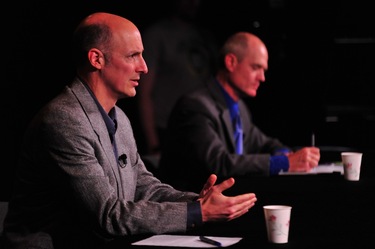
Steve Bean, left, takes on Mayor John Hieftje in a debate Monday night hosted by the League of Women Voters of the Ann Arbor Area.
Ryan J. Stanton | AnnArbor.com
"I know some folks aren't familiar with me," Bean said. "I've lived in Ann Arbor for 28 years, came to the university to study physics and also study ecology and environmental policy at U of M, and decided to stay — and very early on, while still a student, became involved in city issues around recycling, and since then served more than 20 years on city commissions."
In addition to his work on the Environmental Commission since 2000, Bean served on the city's Energy Commission from 1992 to 2000. He is a board member for Think Local First of Washtenaw County and has volunteered his time for several groups, including Food Gatherers, the Huron River Watershed Council and the city's Natural Area Preservation program.
A database consultant for Berg & Associations Inc., Bean previously worked for Recycle Ann Arbor, the Ecology Center, Michigan SANE/FREEZE and Resource Recycling Systems Inc.
Bean said in his closing statement Monday night that addressing climate change and responding to rising oil prices are challenges that lie ahead for Ann Arbor.
"We need to transition away from fossil fuels, we need to be creative and innovative, and we need to work together to do that," he said.
Hieftje used a fair amount of his time to talk about his own record as an environmentalist, calling himself a champion for renewable energy and parks.
"I think you'd be hard-pressed to find a mayor who's done more for parks," he said. "I've certainly won a lot of awards for my work with parks and in working to provide open spaces."
Bean disagreed with Hieftje over an ongoing initiative to build a parking structure next to the University of Michigan Hospital in Fuller Park.
"There are questions about whether it's appropriate," Bean said, referencing the fact that the city's charter requires any sale of public parkland to be approved by voters. "If we have an agreement with the community that a vote would be made to use parkland in the long-term ... let's put that to a vote and get the community to buy in before we go forward."
Hieftje defended his position in favor of the Fuller Road parking structure, which is seen as the first phase of a long-term goal to build a full-scale transit center with a new train station.
"I think we need to be clear when we talk about Fuller Park," Hieftje said. "While the place where there is currently a paved parking lot at the base of the hospital is technically parkland, it has been a parking lot since 1993.
"The key point here is that is possibly the very best place in the state of Michigan for a transit station," he said, adding that thousands of people per day visit the site because of the hospital.
But Bean questioned whether the project is appropriate at all.
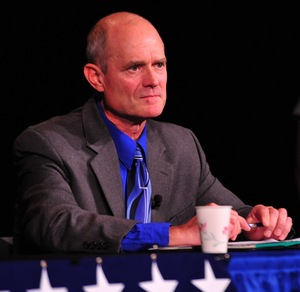
Hieftje said Monday night that Ann Arbor is doing relatively well compared to other cities in Michigan, a message he has often repeated this year.
Ryan J. Stanton | AnnArbor.com
"The concept there is to develop a transit station, and a parking structure does not bring us in the direction of alternative transportation," he said.
Despite disagreeing on Fuller Park, Hieftje and Bean, who actually carpooled together on Monday, remained cordial throughout the debate and agreed on most issues.
Monday's debate was hosted by the League of Women Voters of the Ann Arbor Area. It was aired live on CTN and also was taped for later rebroadcast.
Touching on environmental issues in his closing statement, Hieftje made note of the fact that Ann Arbor is a "Solar City USA."
"This year, we hit 20 percent renewable energy for municipal government," he said of the city's energy consumption. "Hopefully we can sustain that next year. A lot of that work has been done because we were able to reduce the amount of energy through conservation that we use."
Hieftje mentioned he has been endorsed by leading environmentalists, including Mike Garfield, director of the Ecology Center in Ann Arbor, and groups like Clean Water Action and the Michigan League of Conservation Voters.
Hieftje addressed the fact that the city recently issued a request for proposals that could lead to privatization of part of the city-owned Huron Hills Golf Course, a move being opposed by some residents. The deadline for submitting proposals is Oct. 29.
"Huron Hills Golf Course is a beautiful piece of property," Hieftje said. "The city's been struggling now for a couple years to see if we can make it pay for itself, so to speak — to see if we can make it so that golf is not taking away from the general fund budget."
Hieftje said it "would be a great thing" if Huron Hills could remain a golf course, and the RFP is a way to "get some new ideas." If it ever comes to a point where it can no longer work as a golf course, he said, it would remain a park of some kind.
Bean agreed that, if viable, it would be preferable to keep Huron Hills a golf course. But he asked: If bringing in a private operator for Huron Hills makes economic sense, why isn't the city also considering it for the Leslie Park Golf Course?
On issues of development, Hieftje and Bean agreed Heritage Row is preferable to City Place, a near-downtown apartment project that proposes demolishing seven century-old homes along South Fifth Avenue.
"The proposal for a historic district there failed," Hieftje said. "And now that that's failed, the owner could pull a permit and demolish those houses next week if he chose to do that. Those are his houses. I would prefer to see the Heritage proposal there, rather than City Place."
But Bean expressed concerns that Heritage Row is a Planned Unit Development that would deviate from the city's existing zoning code.
"I would say let's have a community discussion about the near-downtown neighborhoods and decide how we really want to do that," he said.
Bean said he's in favor of a corridor improvement authority to help redevelop Washtenaw Avenue from Ann Arbor to Ypsilanti. Hieftje agreed Washtenaw Avenue needs to be redeveloped, but said he still has questions about using tax-increment financing.
On the topic of the city budget, Hieftje declined to speculate where the city might make future cuts, but he said the city continues to look for efficiencies throughout the organization.
"We're going to need to see what staff can come up with, continue to push them to become more efficient, and we'll get through the next budget year, I'm sure," he said.
Bean said he agreed with Hieftje and didn't want to "choose winners and losers" in terms of which areas might see cuts.
"What I would prioritize is ways that we can transition away from fossil fuels," he said. "And that would be those services that involve moving a lot of trucks around. For example, how can we reduce that? Can we put more police on bicycles?"
Hieftje said improving quality of life is Ann Arbor's economic calling card.
"Our city continues to win many awards, most recently named 'fourth most livable' by Forbes magazine," he said. "And, you know, does that really make me think we're the fourth most livable? Or are we really the third best city to walk in in the United States? I don't know, but it's certainly better than not winning the award."
Ryan J. Stanton covers government and politics for AnnArbor.com. Reach him at ryanstanton@annarbor.com or 734-623-2529.
Comments
bugjuice
Thu, Sep 30, 2010 : 8:44 a.m.
Is public transportation the highest best use of a river valley?
LiberalNIMBY
Wed, Sep 29, 2010 : 9:44 p.m.
1. "We cant get the train station to come to fruition unless we show that we are serious about the location and the idea" Can you (or anyone) substantiate this idea? Do we really need this eyesore to demonstrate to the Feds that our shrinking state really needs more train service? "And look, we're willing to erect a Brutalist Bloc to prove it!" 2. Lumping "getting off fossil fuels" with "envirobabble" is a mistake. The former item will be necessitated by a little thing called "peak oil," which is an undisputed geological and economic event. (Try Googling it.) Whether we prepare for it now, or let it happen to us, is up to individuals and their representatives. I prefer the candidate who is willing to look further than the next budget cycle. 3. I credit Hieftje with the Greenbelt initiative, but he's predictably skittish in the face of NIMBYs when it comes to the density side of the coin. He votes for density only when he knows he's not the deciding vote. But, I guess that's what full-time politicians do: once in, they try to keep their job at all costs, sometimes to the detriment of those they serve.
bugjuice
Wed, Sep 29, 2010 : 5:40 p.m.
Nemo's vision may seem like science fiction, but that's what we all thought when we first read Arthur C Clarke and other writers visions of the future only to find out that much of it came true. His suggestion makes perfect sense to me 100-200 years down the road, err I-94. Use the land that's already dying for intense use like inevitable mass transit serving millions of people and save the land with the most potential benefit to humankind. Further separate the industrial infrastructure from the natural and peaceful world. Unless we figure out how to teleport...
Stephen Landes
Wed, Sep 29, 2010 : 4:16 p.m.
@A. Green NO! "Repurposing" park land is not permitted just because the use is somehow for the benefit of the public. Park land is park land and that is it's only appropriate use. If your definition of what is appropriate prevails then there is no limit to what the city administration may choose to do with park land including building some sort of "public" facility on it. That is not what I voted for and I'm willing to bet that is not what the majority of citizens of Ann Arbor voted for either.
denise1inaa
Wed, Sep 29, 2010 : 3:54 p.m.
Two very good candidates, what is a voter to do? The liberal in me likes the vision of the train station... I have travelled via train for years... ughhh it needs an update especially since it will serve the issue of mass transit. The conservative in me says we just do not have the funds. I respect the outcome of the vote.
demistify
Tue, Sep 28, 2010 : 8:35 p.m.
@nemo: I am amazed at your ability to predict how Ann Arbor will function 100 or 200 years from now. To appreciate the magnitude of the feat, dial back by a comparable amount. A hundred years ago, the automobile was just being invented, and Ann Arbor was much smaller than today's anti-development folk can dream of. Two hundred years ago, it was virgin forest. I enjoy reading science fiction, but I do not confuse it with planning,
nemo
Tue, Sep 28, 2010 : 7:48 p.m.
To all those who say that the Fuller plan is the "Perfect" place for a transportation hub, I say BUNK. Better to relocate all of that far from the river and put it alongside I-94; buses, cars, trains and all. Having the local transportation infrastructure follow the river is 19th century thinking. That's where the mills were, goods flowed along the river; not anymore, we should do everything possible to cleanup, restore and protect the river, and move industry to higher, more arid ground where wastes can be isolated. Even though the source of power for the vehicles will change in the future, the lubricants and other fluids will stay the same and leak too. Lets all think here 100, 200, or more years into the future, and what we can do today to make things better then.
CynicA2
Tue, Sep 28, 2010 : 3:36 p.m.
Is either one of these so-called candidates from the United States of America?! Do they live on planet earth? This enviro-lib gibberish will be the least of the problems faced by the next Chairman and Politburo of the Peoples Republic of Ann Arbor! I'm sure this town will get exactly the government it deserves - clueless losers.
Kai Petainen
Tue, Sep 28, 2010 : 1:32 p.m.
Steve.... thanks for taking the time to listen to my thoughts and the thoughts from others. It's certainly appreciated.
GB
Tue, Sep 28, 2010 : 12:57 p.m.
I will vote for Steve Bean.... The minute I read two of his statements; we need "community discussion" and the other "voters should decide" I was sold on Mr. Bean. What a departure from the current council group. Good luck Mr Bean.
Steve Bean
Tue, Sep 28, 2010 : 12:26 p.m.
Jenna, ha! (regarding my reply to your comment) "more"=substantive, "far more"=ego. Watching it is a constant process, and it still sneaks up on me at times.
Steve Borgsdorf
Tue, Sep 28, 2010 : 11:58 a.m.
I love that they carpooled to the debate! Truly, only in Ann Arbor...
Steve Bean
Tue, Sep 28, 2010 : 11:37 a.m.
I appreciate the thoughtful comments. I'll jump in while there's a reasonable number to respond to briefly. MJC, long shots are best accomplished when we're not distracted. Voters considering odds are distracted from their own power. truthspeak, John has done a great job. My candidacy isn't about that. I'm offering an alternative for voters, one with some different perspectives on issues we face, including some that we haven't given much consideration. How I appear to have a personal or professional agenda in this that's any different than John's (i.e., a paid position working for the community) is beyond me. One of the dynamics of a debate (the first, as the headline notes, and one composed of one-minute responses, lasting a total of thirty minutes) between a long-time incumbent and a candidate who hasn't held elected office is that the former can seem to be mostly talking about his/her record, while the latter can be seen as mostly saying something along the lines of, "we don't need change", as you put it (or, under different circumstances, "we need more change".) If you look for a viewpoint from me beyond environmental issues you'll find it. Kai, I read the previous coverage of the spill and largely agree with Rod J's thinking on possible responses. I'm not sure what value alerting the (broader) public would have, though signs at access points along the river might be helpful to people who allow their dogs to go in the water, for example. On the more proactive side, several years back I suggested to the Huron River Watershed Council and the Ecology Center that coordinating a network of volunteer residents to monitor storm drains on a regular basis might help prevent some of the worst of such cases of pollution. At the least, having a large number of people better informed of who to call when they come across a possible problem might help to lessen the impact on the river. My proposal was more detailed than that, contact me if you're interested in learning more. Last I heard from the HRWC, they were still interested in the concept but hadn't taken it on. Jenna, erecting straw men is playing politics. I won't compete with that. You're right about one thing, I am a nice guy. Some time between now and November you might learn that I grasp far more than you imagine. Tim, it is a good site for a transit station for the reasons you cite. I think that it's worth fully exploring alternatives to building a large parking structure there. If that's been done, I'd like to know the details. I also think that concerns about use of parkland are valid. Dismissing them wouldn't be helpful and would only further erode the public trust in our local government. There are ways to address those concerns. A public vote is one, and there are likely others. Sonny, we didn't get a question about the bridges. I suspect that we'll receive federal funds and that it will get done. If we don't, rather than immediately move to using local funds alone to replace them, I would advocate for a serious consideration of that as a signal that our country may no longer be able to maintain such infrastructure. That's a complex issue with broader implications that I won't go into further here. demistify, (assuming that you're not being totally facetious) I posed a question, as the quote reflects. I do that regularly. Interpreting questions as proposals won't be helpful. Residents who'd like to contact me directly can do so at stevebeanforannarbor@gmail.com.
Huron74
Tue, Sep 28, 2010 : 11:26 a.m.
This sad match up is what passes for democracy in Ann Arbor now? Our city should adopt a non-partisan system of municipal elections so more people are able to participate. Otherwise you end up mayoral choices like this.
Ryan J. Stanton
Tue, Sep 28, 2010 : 11:19 a.m.
No, Argo Dam was not discussed. We'll get into that issue in a future story. While we're talking environmental issues, I suppose this is a good place to mention this event tonight: http://www.aadl.org/events/list?id=9316
Tim Darton
Tue, Sep 28, 2010 : 11:14 a.m.
Actually Bugjuice, the mayor has been very successful in moving his initiatives along. The city increased the bike lane system by 600% in 5 years and if I remember right 10 more miles are going in this year. A2 is in the top 20 for rankings for cycling now, third in the 100,000 to 200,000 pop. range. The city achieved 20% renewable energy, I don't think anymore than a handful of cities have done this. A2 is leading the whole country in LED lighting. They won the Solar City award from the US Dept. of Energy, one of only 25 in the country. They won 3rd Best Place for pedestrians and number one for being the most healthy. The city is constantly winning quality of life awards and the Greenbelt is growing. Maybe these accomplishments are why he won the Environmental Leadership Award for 2008 from the Michigan League of Conservation Voters. All without raising taxes in the worst state in the worst recession. He doesn't have trains running yet but then it's not like he can get that going on his own but I bet he does it. The Downtown rezoning is done and the near-downtown is underway and comes back soon. The city is building a new sewage plant and yet the rates are still some of the lowest in the state. I really like the clean communities program that cleaned up the neighborhoods. I am sure there is a lot more to the list that I can't think of. BTW, forming the partnership for the Fuller Transit Station won the vote of every member of city council. They all voted to go forward because they recognized the potential.
A. Green
Tue, Sep 28, 2010 : 10:48 a.m.
@ Stephen Landes. The voter referendum said that the city cant sell park land without the public input; it did not say the voters got to decide the use of parkland or that the city cannot repurpose the land for PUBLIC use. After all, park land is public land. The transportation station is for public use; some type of public land needs to be used for this transportation station. Why not use this ideal space? It is the perfect location. I believe it is well within the rights of the council to do this. Although, the first part of the project only incorporates the bus and bicycle parts of the transportation center along with the parking structure it is the foundation for the future train station. IMO this is the perfect location for the station.
blahblahblah
Tue, Sep 28, 2010 : 10:25 a.m.
Was the Argo dam issue discussed? Is Bean dam in or dam out?
demistify
Tue, Sep 28, 2010 : 10:21 a.m.
The one specific action that Steve Bean is quoted as proposing is to put more police on bicycles. That should get him some votes from speeders.
Stephen Landes
Tue, Sep 28, 2010 : 10:05 a.m.
Earth to Hieftje: being technically a park means it IS a park no matter what illegal uses it has been put to over the years. Return it to its proper status and then let the citizens decide its future as is required in this city at the ballot box.
bunnyabbot
Tue, Sep 28, 2010 : 9:44 a.m.
the enviornment is NOT the most important issue facing the city! How about the BUDGET problems this city has been having for years, how about the infrastruction of bridges and roads, how about the dwindling numbers of emergency workers, how about there only being 6 cops patroling the city at any given time.
yourdad
Tue, Sep 28, 2010 : 9:34 a.m.
BTW... I lived in A2 for nearly 40years and do enjoy many activities there, the biggest headache for my family is that we can never seem to find parking unless we use the parking structures, which just adds to our cost out. Go to many nearby communities (like Plymouth) and see just how many folks with disposable income park their motorcycles and mopeds only to dismount and spend. More people in less space with more money and less fossil fuel used... hmmm, isn't this what they keep looking for?
L'chaim
Tue, Sep 28, 2010 : 9:33 a.m.
Just to clarify, I'd vote for THE Mr. Bean (aka Rowan Atkinson), not this Mr. Steve Bean.
a2grateful
Tue, Sep 28, 2010 : 9:33 a.m.
Parking on parkland is an activity true to the park name. Regardless, there is no reason to seek voter permission, especially since the parking activity predates the meaningless and unenforceable "law" that requires voter permission. Thank you mayor, council, DDA, and parks advisory for your concentrated parking promotions and expansions. On Fuller, we get higher and better use of a parking footprint, maximizing parkland use fivefold. It's just good, sound resource management.; )
yourdad
Tue, Sep 28, 2010 : 9:27 a.m.
Can we please stop talking about ideology and start getting things done??? Cut fossil fuels...? How about an exchange of parking meters in favor of motorcycle/moped parking. If it was more available and free, a lot of people would take advantage of it. It would be a very small item, but would actually be a tangible accomplishment instead of more grandure and posturing. Now go hug a tree so you can feel better before you vote.
a2doc
Tue, Sep 28, 2010 : 9:12 a.m.
Ann Arbor Mayor John Hieftje has presided over the proposed expansion of Ann Arbor municipal airport, located in another township. The environmental implications of a longer runway and the increased number and size of jet traffic associated with this has so far been ignored. I would question his environmental credentials while this proposal is still before council, awaiting the report of a flawed "environmental assessment". I am sure this is not his pet project, but it does demonstrate how far the council has been manipulated by the special interest group (Airport Advisory Committee) representing pilots at the airport.
Kai Petainen
Tue, Sep 28, 2010 : 9:12 a.m.
Since both are champions of environmental causes... When petroleum spills on the Huron River and it covers a river widthwise and flows past my vantage point for hours. When multiple agencies/crews respond to a spill.... When agencies have problems with equipment and some equipment is unusable.... When multiple booms are setup.... When those who canoe/swim/fish on the river are not notified that a spill was on that spot a few days earlier... Do they agree, that petroleum (or an initial 88% confidence of phosphoric acid) dumped in the river has... "no evident environmental impact"? Do they believe that the public should or should not be notified?
SonnyDog09
Tue, Sep 28, 2010 : 9:05 a.m.
Were neither of them asked about fixing the Stadium Street bridge?
bugjuice
Tue, Sep 28, 2010 : 9:02 a.m.
To claim that Steve Bean is only concerned with environmental issues is a bit disingenuous. Hieftje has based his entire political career on environmental issues. Hieftje has had good ideas over the last ten years, but he has never completed any of them. Wouldn't you think that if he stuck with one of them like green energy, mass transit, non motorized transit, or a coherent development plan, that some of these issues would be solved? He has not hammered home any of these issues that confront the city. Hieftje has always struck me as the kind of politician who, instead of leading, he senses where the electorate is headed on a particular issue and then runs to the front of the pack to demonstrate his leadership. When the people change direction or lose interest on an issue, he's once again at the front of the parade. For the average voter, Steve Bean may be unknown, but so was Hieftje when he first ran for council. Unfortunately, in times like we see today, people will sheepishly stick with what they know instead seeking new leaders who might actually follow through with their ideas.
xmo
Tue, Sep 28, 2010 : 8:58 a.m.
This Race for mayor reminds me of the movie "Dumb and Dumber". You have two libs trying to out environment the other. Thank goodnes the city does face any big issues like less revenue, higher costs of city pensions, high employement etc.
Tim Darton
Tue, Sep 28, 2010 : 8:49 a.m.
Regarding the Fuller Transit Station: This is a brilliant proposal given this is the most visited place in the region and it is right on the railroad tracks. Do you all know that this is not near the swimming pool at all? It is up against the tracks on the other side of the road where the UM has had a paved lot for decades. They gave the city 5 acres in exchange in order to save old growth oaks from being cut for a new city road. This is the perfect place for parking and transit to serve this dense employment center. It's a parking lot, not a park. The city has too many parks anyway. RE the election: The mayor has managed the city very well in the toughest financial times possible without raising taxes and should be reelected. He has won several awards and endorsements in building an environmental record that is unsurpassed.
Jenna Thom
Tue, Sep 28, 2010 : 8:42 a.m.
Steve Bean is a nice guy but he should not be our mayor. He does not have the grasp of the governmental issues that is needed. He might have more of an academic environmentalist background than Hieftje, but Hieftje also has done great things for the environment too. In fact, I prefer the way Hieftje implements his environnmental plans; he slowly incorporates them into the city without pushing full steam ahead. I would never vote for anyone who says that the paved parking lot should be returned to a strip of green grass rather than build the bones for a train station. A running train station would do far more for the environment by getting more cars off the street than a small strip of unused grass ever would do. If I have to wait to actually get the train station until another phase of the project, then so be it. It is worth the gamble. Any environmentalist who says otherwise is just playing politics.
katie
Tue, Sep 28, 2010 : 8:24 a.m.
I like Mr. Bean and it is likely that I will vote for him. We need more than a primary to determine who will be mayor. The Lesko opposition to the mayor seemed to become an issue of personality rather than a focus on the issues. On the other hand, Mr. Bean has a solid background in environmental issues. I believe the environment is the long-term most important issue, not that there aren't other pressing issues. I see the current mayor as too much in favor of expensive development projects, ones that may ultimately cost the citizens in one way or another.
Kai Petainen
Tue, Sep 28, 2010 : 8:22 a.m.
Does either candidate have an opinion on the Huron River petroleum spill this past summer?
Christopher
Tue, Sep 28, 2010 : 8:22 a.m.
Building a parking lot in a park does not make the paved area any less of a park. Mr. Hieftje is correct, it is still "technically a park," which means it should not be developed without the approval of voters (according to the home rule laws). Beware of Mr. Hieftje asking the planning commission to declare that the parking area is un-needed parkland. This will be an attempt to avoid a vote on the conversion, and with his "technically a park," it looks like it is the direction he is headed in.
truthspeak
Tue, Sep 28, 2010 : 8:20 a.m.
Hieftje has vision and will take us to the future as Ann Arbors Mayor. Our city has never done better under his leadership and I would hate to see him go. The role of Mayor is a great balancing act where many interests need to be considered. Hieftje has shown that he knows how to consider the new and modern ideas while still valuing the old and comfortable. The Mayor has a done a great Job and he gets my vote. Bean on the other hand appears to have his own personal and professional agenda. Every viewpoint has to do with the environment (i.e. transitioning away from fossil fuels, not using parkland for a transit center etc.) When asked about anything else, Bean either has no opinion or reverts back to an environment response. He appears to oscillate back and forth between pie in the sky ideas that are unlikely to happen in the near future and the we dont need change attitude of the NIMBYs. He actually combines these two themes for the Fuller Road station. I infer from his statements that unless fuller Road station can be perfect and fully operation from the get go then it should never exist. So silly. We cant get the train station to come to fruition unless we show that we are serious about the location and the idea. I dont see Bean actually serious about supporting public transportation that is doable or useful to the thousands of residents of this city. He would rather theorize or postulate pie in the sky dreams of a fossil fuel free world that is 100 years in the future. I want a Mayor who knows how to balance the duties of the Mayor and someone who recognizes what is doable and obtainable. Mayor Hieftje is that person.
MjC
Tue, Sep 28, 2010 : 7:34 a.m.
Our two candidates look like they could be brothers (even twins!). Unfortunately it's a long shot trying to win a campaign as an independent.
L'chaim
Tue, Sep 28, 2010 : 7:32 a.m.
Bean looks like Hieftje. He's the spitting image of him (Pat Lesko was a spitting image, too, but AT Hieftje, not OF Hieftje). AA mayoral politics is so confusing. I'd vote for Mr. Bean, though. That would be easy.
Brad
Tue, Sep 28, 2010 : 7:11 a.m.
"The key point here is that is possibly the very best place in the state of Michigan for a transit station," Why am I feeling unconvinced by that statement? And why not put the parkland transfer in front of voters? Afraid that those pesky voters will get in the way of the "vision"?