

Ann Arbor officials pushing for conversion of Jackson Avenue from 4 to 3 lanes with bike lanes
Ann Arbor officials are asking the state to convert a portion of Jackson Avenue from four to three lanes to improve safety and allow for the addition of on-street bicycle lanes.
The Ann Arbor City Council voted 8-2 Monday night in favor of a resolution to forward that request on to the Michigan Department of Transportation, which is planning to resurface Jackson Avenue — an I-94 business loop — either in 2013 or 2014.
Council Member Carsten Hohnke, D-5th Ward, said he lives about two blocks away from the stretch of Jackson proposed to be converted to three lanes.
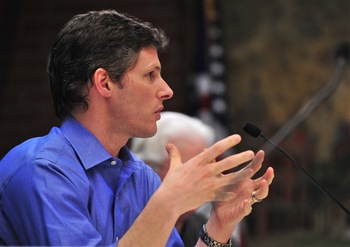
Council Member Carsten Hohnke, D-5th Ward, is looking forward to the conversion of Jackson Avenue from four to three lanes.
Ryan J. Stanton | AnnArbor.com
"I can certainly confirm the narrowness of that," he said. "There are a few white-knuckle moments if you're driving next to a large bus or trucks that are often going up and down there, so the narrowness of those lanes I know is a concern for a lot of people."
Hohnke said the conversion sounds like a no-brainer.
"Going from four to three would steady out the traffic flow, it would allow for a dedicated lane for left-turn deceleration and reduced collision points, maybe include bike lanes," he said, summing up the benefits. "That all sounds too good to be true."
The council's resolution is being forwarded to MDOT to share with the Southeast Michigan Council of Governments and the Federal Highway Administration.
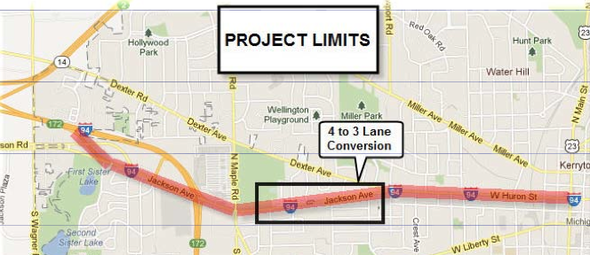
With the final approval of the FHWA, the proposed lane conversion will be implemented by MDOT with its Jackson Road-Huron Street resurfacing project, which spans from the I-94 interchange to North Main Street, either in 2013 or 2014.
The section city officials are interested in converting to three lanes extends from east of Maple Road to Revena Boulevard, which is where Huron Street splits into Jackson and Dexter avenues.
East of Maple Road, Jackson has four narrow traffic lanes that measure about 10 feet wide each, said Homayoon Pirooz, head of the city's project management unit.
He said that's narrower than is ideal for safety.
Pirooz said one of the advantages of switching to three-lane street is the addition of a new center turn lane, which provides for safe deceleration when making left turns. He said three-lane streets also eliminate lane weaving and unsafe driving.
Uniform speeds at three-lane streets also have traffic calming effects and research shows going from four to three lanes can reduce crashes and their severity, Pirooz said.
The extra pavement width that is saved by eliminating the fourth traffic lane can be converted to bike lanes, Pirooz said, noting the new center turn lane also creates new opportunities for the addition of marked and safe pedestrian street crossing locations.
While there are five-foot-wide sidewalks on each side of the street, Pirooz said there are no bicycle lanes or safe and convenient pedestrian crossing points between the two signalized intersections at Maple Road and at Revena Boulevard.
Pirooz said it's understood by industry experts that going from four to three lanes in cases where average daily traffic is less than 15,000 vehicles can be very successful. He said the area of Jackson Avenue being evaluated has about 15,500 vehicles per day.
Pirooz said the city has successfully completed conversions from four to three lanes on a number of streets, including the following:
- South Main, Ann Arbor-Saline to Eisenhower (13,300 ADT)
- Platt, Packard to Ellsworth (13,800 ADT)
- Packard, Stadium to Jewett (12,000 ADT)
- Huron Parkway, Nixon to Plymouth (6,100 ADT)
- West Stadium Blvd., Seventh to Pauline (14,900 ADT)
- Green, Plymouth to Glazier Way (9,200 ADT)
Council Members Mike Anglin, D-5th Ward, and Jane Lumm, an Independent who represents the 2nd Ward, were the only two to oppose the conversation Monday night.
Marcia Higgins, D-4th Ward, was absent.
Anglin said he wanted to postpone the vote to get more community input.
"I was very much in favor until I looked at some of the ramifications. The road will not be widened," he said, expressing concerns it could be dangerous to add bicycle lanes.
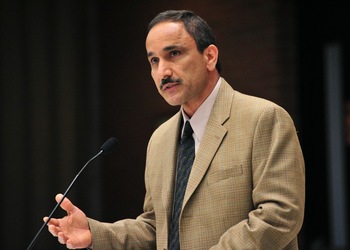
Homayoon Pirooz, head of the city's project management unit, said four-lane roads were common many years ago, but over the years traffic engineers have found out that it's not the safest arrangement.
Ryan J. Stanton | AnnArbor.com
He used the example of Platt Road, which the city converted from four to three lanes from Packard to Ellsworth. Prior to the changes, he said, there were 20 to 30 accidents per year, but now in the last two years it's down to six or seven.
He recalled there were a lot of concerns about the conversion at the time, but it has worked out.
He said if the three-lane conversion on Jackson doesn't work out for whatever reason, it's relatively easy to switch back to four lanes by repainting the lines.
Pirooz acknowledged there might be some downsides to three lanes, including additional wait time at unsignalized intersections and added vehicle stacking at signalized intersections, as well as slower traffic and loss of passing opportunities for faster traffic. That didn't deter council members, though.
MDOT held a public meeting at Slauson Middle School in February and presented the proposed conversion from four to three lanes. At the meeting, MDOT staff ran a traffic simulation model to show participants the difference between the two configurations.
From the written comments and the emails received afterward, Pirooz said, most members of the public who attended were in favor of the conversion.
According to MDOT's presentation in February, the road rehabilitation project it has planned for Jackson and Huron will span 2.4 miles and cost an estimated $6.5 million. The tentative timeline calls for construction from April 2013 through November 2013.
Pirooz said the project might be pushed back to 2014.
The city is talking about reconstructing Miller Avenue in 2013 and there are concerns about having both roads under construction at the same time.
Ryan J. Stanton covers government and politics for AnnArbor.com. Reach him at ryanstanton@annarbor.com or 734-623-2529. You also can follow him on Twitter or subscribe to AnnArbor.com's email newsletters.
Comments
Ming Bucibei
Sun, Apr 15, 2012 : 12:31 p.m.
Totally insane The mayor and city council are totally anti car and have been for years Every thein the city does shows a tremendou anti-car mind set ing Bucibei
Jim Walker
Sat, Apr 7, 2012 : 4:37 p.m.
If implemented, this will be a disaster on many fronts. The traffic volume is too high, so congestion will increase. Getting past a bus will be impossible, leading to long lines of stopped vehicles when buses stop. Some commuting traffic will divert to Liberty, Dexter and Miller and those roads are not appropriate for major increases in traffic counts of people avoiding Jackson Road. This is a part of Business I-94 and a main commercial route serving downtown. It is not appropriate to treat it as a neighborhood collector street. The city has been trying for 20+ years to institute some sort of traffic calming on Jackson Avenue. If it still existed, the city would likely use the "Residential" designation to post an inappropriate 25 mph speed limit. Fortunately, that over-used designation is gone in state law as of 11/9/2006. This is simply a bad idea to satisfy a small minority of Ann Arbor residents in that area, with little or no thought to the majority it will harm. A city-wide survey would come up with a totally different result than the limited sample surveyed from the neighborhood. James C. Walker, National Motorists Association, www.motorists.org, Ann Arbor, MI
Ron Granger
Fri, Apr 6, 2012 : 3:33 p.m.
Roads are for people, not cars. Cars don't pay for roads, people do.
Left is Right
Fri, Apr 6, 2012 : 12:48 p.m.
Dumb idea. There are plenty of collateral streets for biking and it's a state and federally funded trunkline. And what about buses? Didn't we have this conversation before? Bad ideas just have a way of resurfacing in Ann Arbor.
E. Crowe
Fri, Apr 6, 2012 : 11:20 a.m.
Let's fix the entrance ramps to I-94 first... Ridiculous design and a huge hazard. Especially the entrance for I-94 East.
Joe_Citizen
Thu, Apr 5, 2012 : 11:55 p.m.
I guess the counsel is just considering themselves again. They obviously didn't consider Rush hours, emergency vehicle's to U of M hospitals, student move dates, Fire Station right there next to Vet's Park, and so on. The emergency vehicle's are the most major concern, and it just may be illegal to make the roads smaller because of the traffic problems already in existence.
paul wiener
Thu, Apr 5, 2012 : 4:32 p.m.
It's hard to imagine a worse idea, or one more typical of Ann Arbor, one guaranteed to decrease safety, privilege the few over the many (and growing number of) drivers, who are constantly discriminated against here in the state that invented auto transportation. Our driving roads are in abominable condition. Bikers are few, often careless, flaunt traffic rules, crowds their own lanes, often wear no protective or reflective gear, are rarely ticketed, pay no license fees. Lanes are arbitrarily drawn. Jackson Road is treacherous in the best of times, with the Jackson/Stadium intersection (or Jackson/Seventh) possibly among Southeastern Michigan's Most Horrific. I'm thoroughly disgusted with our poor excuse for town and road planners, who everyday manifest their enslavement to political, social and environmental correctness. Next we'll be hearing of bike lines on M14 or US23.
Wolf's Bane
Thu, Apr 5, 2012 : 2:17 p.m.
Excellent idea! It would hopefully slow down the traffic and save lives.
Hot Sam
Thu, Apr 5, 2012 : 11:54 a.m.
I lived on Huron for twenty years, and was an active member of the Jackson Huron Neighborhood association. We visited this idea extensively bout twelve years ago... First of all, if you don't do it all the way downtown it's useless... Second, as with all things emotional, this idea would not be as bad as the opponents predict, or as good as the supporters hope for. At the time, there were extensive computer models done, and yes some backups a couple times a day did occur. They weren't any worse however than what a left turn at Seventh can cause at the wrong time of day... The left turns, and narrow lanes, make this road a speed and safety challenge... I believe, and always have, that the three lane idea would be an improvement for most of the day... With that said, the state, who has the ultimate say, has always been adamantly opposed to the idea..I suspect it will go nowhere...again.
Thinking over here
Thu, Apr 5, 2012 : 11:24 a.m.
no,no,no. The traffic is already over the 15,000 recommended for such a conversion and it's only going to get worse as they continue to develop out there.
CB
Thu, Apr 5, 2012 : 10:04 a.m.
No road will ever be wide enough as long as those uneducated drivers who drive in the left lane for no reason are allowed to do so. The problem is with those drivers who think that they need their "own lane" and do not consider others. It is unbelievable that these people are allowed to block traffic with no consequences. I used to work at the corner of Jackson and Maple and watch the long traffic jams caused by those driving 15 miles under the speed limit while blocking the PASSING lane.
SMC
Thu, Apr 5, 2012 : 2:05 p.m.
Amen.
townie54
Thu, Apr 5, 2012 : 4:56 a.m.
Anyone who rides a bike on this street is outa their mind and taking their life in their hands.Maybe after its narrowed we can put a couple crosswalks in too.
townie54
Thu, Apr 5, 2012 : 4:50 a.m.
some of you seem confused ..Stop talking about by Webers and Zeeb and that way.They are talking about East of Maple road by Vets park and further east which is always been called HURON STREET in my lifetime
blahblahblah
Thu, Apr 5, 2012 : 2:46 a.m.
"Pirooz said there are no .......safe and convenient pedestrian crossing points between the two signalized intersections at Maple Road and at Revena Boulevard. " So in addition to all the bikers who feel left out on Jackson Rd., riding along side the semi's and other stressed commuters, let's add in some "safe" pedestrian crossing points to further add to the mess. Sounds like a "no-brainer" formula for success: Jackson Rd. - 2 traffic lanes + new bike lanes + new pedestrian crossing points = a very dangerous situation invite all the brave bikers and pedestrians willing to
slug
Thu, Apr 5, 2012 : 2:21 a.m.
Nooooooooo!!!
Marvin Face
Thu, Apr 5, 2012 : 1:24 a.m.
After they change Huron from 4 to 3 lanes they should do the very same thing to Main from Stadium to William.
Matt Postiff
Thu, Apr 5, 2012 : 1:22 a.m.
I was interested in Mr. Pirooz's analysis on the safety of three-lane as opposed to four-lane roads. I suppose that might be true if the whole stretch is 3-lane. But what would be nice is an explanation of how safe it is to go from 4-lane to 3-lane and then back to 4-lane. The merging point on both ends seems dangerous. I disliked the conversion on Stadium at Seventh for that very reason. It is just harder to drive through there now. If the 4-3-4 change is statistically safer, I wouldn't mind the change. With traffic at or above the 15,000 mark, you've got to wonder if there is any plan for growth and development in the city looking forward. I would also concur with some other comments on the lack of use of the bicycle lanes. Let's have sidewalks to accommodate that. Much safer.
foobar417
Thu, Apr 5, 2012 : 2:55 p.m.
Cyclists are much safer in the road than on a sidewalk. The dangers of cars pulling through sidewalks before stopping to look are much higher.
Joe
Thu, Apr 5, 2012 : 2:12 p.m.
Sidewalks are the most dangerous place for cyclists to ride.
jcj
Wed, Apr 4, 2012 : 11:32 p.m.
Hopefully some of the present council members won't be around to complain to if this happens!
Marvin Face
Thu, Apr 5, 2012 : 1:26 a.m.
Mike Anglin sits on his hat.
glenn thompson
Thu, Apr 5, 2012 : 12:09 a.m.
Mike Anglin and Jane Lumm voted against the change, all others voted for it. If you want to make a change in the Council then you must vote, work, or donate to the opposition of the present Council majority.
Cici
Wed, Apr 4, 2012 : 9:52 p.m.
Good Grief! Wasn't what they did to Packard Street bad enough?? Horrible and a waste of money for a main city street!!
SMC
Thu, Apr 5, 2012 : 4:10 a.m.
No, city council will not stop until they've made driving in this town such a headache that motorists will simply give up and ride bicycles everywhere.
nowayjose
Wed, Apr 4, 2012 : 9:45 p.m.
Pretty soon the city will just have bike streets with car lanes on the side. This ridiculous
Joe
Thu, Apr 5, 2012 : 2:11 p.m.
So it's ridiculous when your preferred method of transportation is marginalized?
kathryn
Wed, Apr 4, 2012 : 8:12 p.m.
I say wonderful! The current two lanes are too narrow in that stretch; it's really dangerous. (I currently will reroute through Liberty to avoid going through there.) Please do it.
SMC
Wed, Apr 4, 2012 : 8:26 p.m.
If they go through with this unbelievably stupid plan, I do hope that you remember how you were in favor of it, when vehicular traffic starts cutting through your neighborhood to save time and avoid the traffic backups on Jackson.
Roy Munson
Wed, Apr 4, 2012 : 7:54 p.m.
Why all the complaining? You liberals voted your own people into office. They are just pushing the liberal agenda that you asked for.
Forever27
Wed, Apr 4, 2012 : 8:08 p.m.
this is not a "liberal" or "conservative" issue, this is simple city management. Your complete generalization of an entire political ideology belies your ignorance of the world around you.
chucklk
Wed, Apr 4, 2012 : 7:30 p.m.
Left turn jam ups could be prevented by disallowing left turns at most side streets on Huron exactly as is done on Washtenaw.
EyeHeartA2
Wed, Apr 4, 2012 : 11:04 p.m.
"Traffic congestion could be reduced, if people simply drove somewhere else." I vote for down your street.
SMC
Wed, Apr 4, 2012 : 8:09 p.m.
Traffic congestion could be reduced, if people simply drove somewhere else.
Macabre Sunset
Wed, Apr 4, 2012 : 6:54 p.m.
It's a sign of effective leadership to move backwards and assume negative growth. I'm waiting for Council to assume we're returning to the horse and carriage as a primary mode of transportation.
SMC
Wed, Apr 4, 2012 : 7:38 p.m.
Horses leave too much waste behind, so that won't work. I'm thinking those old-timey pennyfarthing bicycles are the transportation of the future.
Basic Bob
Wed, Apr 4, 2012 : 7:34 p.m.
They took a vote and steam locomotives won!
demistify
Wed, Apr 4, 2012 : 6:51 p.m.
"The extra pavement width that is saved by eliminating the fourth traffic lane can be converted to bike lanes, Pirooz said" First, he claims that change is needed because the four lanes are too narrow. Then he proposes to solve this by cutting back to three equally narrow lanes. To make life more interesting for the drivers, add in bike lanes. Brilliant! Incidentally, Jackson Road is labeled I 94 BUS. The purpose of the interstate system is to facilitate the movement of traffic, not to "calm" it. Presumably, federal funds are coming in for this purpose and they could be jeopardized by trying to turn it into a country lane. Why not shift the social engineering over by one block to Liberty?
SMC
Thu, Apr 5, 2012 : 4:05 a.m.
They can widen the roadway, it just mean sacrificing a few blades of grass to do it, plus the odd tree here or there. The Lorax will just have to deal with it.
foobar417
Wed, Apr 4, 2012 : 9:37 p.m.
The math is pretty simple. The roadway is 40 feet wide. 4 lanes = 10 feet each. 10 feet wide is too narrow, plus, the combination of driving and turning lanes is unsafe. You can't widen the roadway. There's no room. New configuration: 4 +11 +10 + 11 +4 = 40. Start by widening the 2 driving lanes to 11 feet each. Make the center turn lane 10 feet wide. That leaves 8 feet, which you can split into 2 bike lanes. The driving force here is widening the driving lanes to a safer width and getting the turning lane out of the way of the driving lane. That's why MDOT likes 4-to-3 conversions if the traffic count is under 20k. The bike lanes simply fall out from the math.
SMC
Wed, Apr 4, 2012 : 7:42 p.m.
Because then it doesn't demonstrate Ann Arbor's conviction to eco-friendly bicyclists, to the passing travelers and commercial traffic that visit the city. It's the same reason Prius owners bought their car; sure, there are plenty of other cars that get good gas mileage, but none are as good at conspicuous conservationism.
st.julian
Wed, Apr 4, 2012 : 6:49 p.m.
Every time some silly item comes up for ocuncil approval makes me happier we moved to Dexter instaed of Ann Arbor when we migrated. Anything to impede the flow of traffic into downtown on Jackson Road further indicates the councils distance from reality. The mayor and council in their sale of the city to real estate interest are promoting more traffic to come in for buiness. This effor is silly and ocunterproductive as so many recent city initiatives are Bike lanes yes but not on a cramped thproug fare. Perhaps the bikes should be routed down Liberty street
Joe
Thu, Apr 5, 2012 : 2:10 p.m.
If you're destination is on Jackson, then you have to bike on Jackson. And telling people to ride on the sidewalk is just cruel. The sidewalk is the most dangerous place you can ride a bike. It is not where bikes belong.
mtlaurel
Thu, Apr 5, 2012 : 10:55 a.m.
"some random other road" are known to most as Miller/Dexter/Liberty/Pauline. What is so random ? They are well known thoroughfares.
SMC
Thu, Apr 5, 2012 : 4:13 a.m.
You can always take an alternate route on your bicycle. It's called the sidewalk. In places where it's unsafe to use the roadway, use the sidewalk. If motorists can learn to drive cautiously when traffic and weather dictate it, surely such an enlightened group as the cycling community can do likewise.
foobar417
Wed, Apr 4, 2012 : 9:38 p.m.
There are destinations bikes might want to get to *on* Huron. For example, Vets pool, Webers, houses along Huron. Suggesting that bikes take some random other road from some unspecifiied origin to some unspecified destination don't make a lot of sense.
EcoRonE
Wed, Apr 4, 2012 : 6 p.m.
First, I favor the change from 4 lanes to 3 with bike lanes. I would like to know the nuber of accidents on Platt per ADT. Saying the number decreased without referencing the before and after ADT is meaningless. Please however, don't do stupid like collapsing the center turn lane BEFORE the major shopping center like you did on south main. I suspect most of the cars using these roads don't live in AA so I don't really care if you slow them down or charge a toll.
SMC
Thu, Apr 5, 2012 : 4:21 a.m.
Are these the same MDOT engineers who have done such a stellar job of maintaining the roads and freeways in our state? You'll forgive my skepticism towards the validity of their traffic studies. I have a broken watch, and it's right twice a day.
foobar417
Wed, Apr 4, 2012 : 9:41 p.m.
@SMC: And MDOT's traffic studies for major businessways are pretty clear. Under 15k traffic count: Just implement the road diet. It's safer and doesn't add to congestion. Under 20k traffic count: It's a little more nuanced, so they require a comment from the city. However, they (MDOT) clealry think it will work, as they demonstrated in their presentation. Over 20k traffic count: Too much. In this case, the expected traffic count is 15,500. Very close to a slam dunk, but still requiring input from the city. Why are you more qualified to judge than an MDOT engineer?
SMC
Wed, Apr 4, 2012 : 7:47 p.m.
EcoRonE, there's a world of difference between decreasing the lanes on Platt, and doing so on Jackson, which is major commercial route to and from downtown. In fact, it is designated as a business route, which is why MDOT is in charge of maintaining it. You are correct that a good deal of the cars and trucks on Jackson every day are owned by non-residents, but they still need to be here. I suppose your solution would involve building a wall around the city, and throwing boiling oil at passing travelers?
Linda Peck
Wed, Apr 4, 2012 : 7:09 p.m.
EcoRonE, I do live in this neighborhood and all of us neighbors use this road constantly as a way to get around. I am on this stretch of Jackson many times a week. I disagree with your opinions here.
a2jean
Wed, Apr 4, 2012 : 5:21 p.m.
All for it! I drive that road during rush hour and the left-turners really need their own lane. It'll cut down on stress for everybody.
foobar417
Wed, Apr 4, 2012 : 9:44 p.m.
@Forever27: That's not how the road works in practice as I'm sure you know if you actually drive it. In practice lots of drivers speed and weave back in forth to avoid the left turns and right turners. This is why MDOT likes road diets. They prevent people from weaving, and they prevent having people in one lane who are stopped to turn while others are flying along and possibly not seeing they are stopped.
jcj
Wed, Apr 4, 2012 : 6:30 p.m.
If this happens. Come back and tell us how much you like stop and go traffic! Foolish computer generated idea. Not based on real world conditions!
Forever27
Wed, Apr 4, 2012 : 5:42 p.m.
they already have their own lane, the left lane. two lane roads are not meant to be two lanes of traffic all going straight. the right lane is the main lane and the left lane is the passing/turning lane.
JRW
Wed, Apr 4, 2012 : 5:19 p.m.
Stop spending money on road projects (and this one is a bad idea) until ALL potholes in the city are fixed in the proper way. It's just unconscionable that potholes are left as craters season after season, and new road projects are discussed! Fix the potholes!
foobar417
Wed, Apr 4, 2012 : 9:45 p.m.
Um, that's why they are doing it. To repave the road to fix the potholes ...
MRunner73
Wed, Apr 4, 2012 : 5:15 p.m.
To AA.com: How about adding a poll question? Then City Counsel can take a look at the results.
SMC
Wed, Apr 4, 2012 : 7:48 p.m.
You say that, as if the City Counsel actually cared about the opinions of their constituents, or what might actually be good for the city.
JRW
Wed, Apr 4, 2012 : 5:09 p.m.
Adding bike lanes along that stretch of Jackson Rd is not a good idea. Bike lanes need to be added where there actually bikers using the lanes. I have lived here all my life and driven that stretch of Jackson many many times and have NEVER seen one bicyclist on that road. The lanes will not be wider if the unneeded bike lanes are added. Further, only one lane in each direction on a busy road full of truck traffic, such as Jackson, will accomplish one thing: more congestion, which is a major contributor to accidents. It's impossible to see around the big trucks and not being able to move to another lane will only add to dangerous driving conditions.
SMC
Thu, Apr 5, 2012 : 10:11 p.m.
Cyclists only add to congestion, Joe, because other people have to swerve around them.
Joe
Thu, Apr 5, 2012 : 2:07 p.m.
I have ridden on Jackson, and, on the rare occasion that I've driven down Jackson, I've seen multiple cyclists. Providing bike infrastructure will only encourage more people to bike, which, coincidentally, will help to ease congestion.
Dan Ezekiel
Thu, Apr 5, 2012 : 1:56 a.m.
I have often biked on Jackson between Revenna and Maple, as it is the most convenient way to get from work to Kroger, etc., but I have felt I was taking my life in my hands to do it. If Jackson had a safe bike path, I think it would be heavily used by bikes.
foobar417
Wed, Apr 4, 2012 : 9:46 p.m.
Why would I ride on Liberty if I'm trying to get to a House on Huron? Or Vets pool from downtown? That's about as sensible as telling a driver to just use 94 instead of Huron.
SMC
Wed, Apr 4, 2012 : 7:49 p.m.
There are plenty of other east-west routes through town for cyclists to use. Liberty has bike lanes, why not use that road instead?
jcj
Wed, Apr 4, 2012 : 6:28 p.m.
Bound to be safer traveling at 10 mph!
foobar417
Wed, Apr 4, 2012 : 5:19 p.m.
You've never seen a biker because it's completely unsafe for bikers and drivers. Each lane is 10 feet wide (total width 40 feet) and the road is in terrible shape. The new design will have 11 foot car lanes, which are safer for drivers, 4 foot bike lanes, and a 10 foot turning lane.
Are you serious?
Wed, Apr 4, 2012 : 5:08 p.m.
The traffic may be "calmer" but I doubt that the drivers in the calmed cars are "calmer." Did I miss it or were there any statistics on travel time for people traveling these "calmed" roads? Would be interesting to see how much more time is wasted by people who have to travel these "calmed" roads. BTW I have lived in AA since 1970 and a side street a couple of houses off Jackson for over 10 years. During my thousands of trips on this stretch of road I have NEVER seen a single serious accident. A few people get rear ended but nothing serious. As for those who worry about being blown into a semi because of a gust of wind, I suggest they take some quiet street through the neighborhoods. Oh, and please avoid the freeways where speeds are much higher and the wind gusts may result in a flaming vehicle upside down in the ditch! (Never seen one of those either.)
SMC
Thu, Apr 5, 2012 : 4:01 a.m.
You're right, it's silly for anyone to question the wisdom of MDOT. After all, they've been amazingly competent at maintaining our state's road network, to a standard of quality far exceeding that of the average developing country. Oh wait, that paragraph contains absolutely no truth whatsoever. You may choose to believe the MDOT brain trust over the opinion of someone you don't know on the internet, but putting aside the pro-cyclist position for just a minute, there is no way that anyone with a shred of common sense could imagine that this could improve the traffic flow on this roadway. MDOT does not have a computer simulation to explain why random, non-accident traffic jams happen every day on our freeways, but they do, despite all the traffic engineering that they do.
foobar417
Wed, Apr 4, 2012 : 9:50 p.m.
Yes, I'm more likely to believe an MDOT traffic engineer who has done a simulation study and has a wealth of past experience with similar traffic engineering changes on simlilar roadways elsewhere than a random internet poster on a newspaper message board. But, like any good engineer, neither MDOT engineers nor the city's engineers are claiming that that there is no chance for error. They think on balance its very likely to be successful and they have a fallback that requires only repainting. In other words, sound engineering practices all around.
SMC
Wed, Apr 4, 2012 : 8:15 p.m.
And computer models are always correct, yes? Perhaps someone could explain how 15,000 cars will move faster in single file than they do two abreast? This is after they've all safely and courteously merged from two lanes down to one, which is a skill that you've surely seen motorists exercise all the time, near your home in never-never land.
foobar417
Wed, Apr 4, 2012 : 5:49 p.m.
MDOT had detailed simulation models they presented at the public meeting.
Sara Christensen
Wed, Apr 4, 2012 : 4:51 p.m.
This is one of the best ideas for road improvements in AA I've heard in ages! I used to drive that section of Jackson regularly and I hated it. Even in a tiny little escort I feels like the lanes are too narrow and people dodging out to get around folks turning left make things extra dangerous. Three lanes with a left turn lane will really improve safety there. Also, to the folks that are up-in-arms about the idea of adding bike lanes: 1) the primary benefit here is improved safety for drivers; the bike lanes are a side benefit. 2) You don't see very many cyclists in Ann Arbor because there are not that many safe roads to cycle on. Add enough connected bike lanes and/or wide clean shoulders and you'll see many more cyclists.
Joe
Thu, Apr 5, 2012 : 2:05 p.m.
Absolutely. That's the funniest thing about these comments. Most people think that bike lanes are a fringe benefit for a minority. They make roads safer for everyone. Every time a car has to move out of the way suddenly to pass a bicyclist, that's putting everyone in danger. Other cities have proven, without a doubt, that investing in a comprehensive network of bike lanes will increase bike riding while decreasing car/bike collisions.
jcj
Wed, Apr 4, 2012 : 6:27 p.m.
"Three lanes with a left turn lane will really improve safety there." Can't be too dangerous when cars will be traveling at 10 mph! "Add enough connected bike lanes and/or wide clean shoulders and you'll see many more cyclists." Not!
Greg
Wed, Apr 4, 2012 : 4:46 p.m.
I am a bicycle and car commuter on this section of Jackson, and I think this is a good idea that needs to be tried. Currently I use the sidewalk for biking, which rightly annoys pedestrians, but avoid risking my life on this section of road. I think the main advantage of 3 lanes is in calming traffic. With 4 narrow lanes on BL94 everyone is stressed trying to weave past trucks and potholes in this residental area. There's a lot of negativity here from people who could just get off their butts and exercise, but think that driving fast and kibitzing is better.
Joe
Thu, Apr 5, 2012 : 2:03 p.m.
All roads are for bicyclists to use, business route or not. How would you like it if we made significant portions of the city inaccessible by car? We could just tell you to deal with it and ride a bike like a normal person. Or, we could give every person the freedom to use a means of transportation that fits their needs.
SMC
Wed, Apr 4, 2012 : 7:55 p.m.
This is the worst idea that anyone has ever come up with in the history of humanity, which itself has been a history of bad ideas. You refer to it as BL94, which means it is a dedicated commercial route. This means that, unfortunately for the cyclists, they'd be better off cycling someplace else. When driving my car, I often find it terribly inconvenient to stay on the roadways, but I accept that it is not OK to cut across people's lawns or drive on the sidewalk to save time. I can't understand why cyclists think that every road must be made for cyclists. Smart motorists learn which roads to take, and which to use to avoid traffic, and when. Cyclists should do the same, but for reasons of safety.
EyeHeartA2
Wed, Apr 4, 2012 : 4:39 p.m.
So we want to encourage businesses to locate downtown? We want people to shop downtown? We just don't want to let the customers or employees in or out. Un(fill in the blank)believable. Based on the fact that this is the same brain trust that came up with the cross walk/mind reading ordinance which resulted in numerous rear end accidents, I am fully expecting to get rear ended with this one as well.
Ron Granger
Wed, Apr 4, 2012 : 4:21 p.m.
If car drivers would obey the speed limits, and follow the traffic laws, this would not be such an issue. There would be fewer accidents and fatalities. Too many people are racing to get somewhere, like it's a big emergency.
SMC
Wed, Apr 4, 2012 : 7:57 p.m.
Those people aren't racing, Ron. They're driving. If speeding were such a scourge on this town, I'm certain that our wise and infallible city council would not have gutted the public safety budget, but instead hired more officers specifically for traffic enforcement. But, they haven't.
jcj
Wed, Apr 4, 2012 : 6 p.m.
"If car drivers would obey the speed limits, and follow the traffic laws" If if's and buts were candy and nuts! Plan for the REAL world!
gofigure
Wed, Apr 4, 2012 : 5:49 p.m.
If car drivers would obey the speed limits, and follow the traffic laws, this would not be such an issue........ Do as I say not as I do? Day in and day out, I seen bicyclists blow through red lights, stops signs, cutting in and out of traffic, just to name a few. Why??? Because they think they have the right of way and that they're entitled. 2 wheels instead of 4 does not give you any more rights.
Frustrated in A2
Wed, Apr 4, 2012 : 4:13 p.m.
Well we know city council will not read these comments as they are out of touch with the community as a whole, they base their decisions based on the bubbles they live in. Hopefully someone from the state will read all of these comments and do the right thing and just resurface the road and leave it like it is or widen it. You cannot narrow down a major state trunk line and put in the bike lanes that nobody uses. For once city of A2 let's do something to help and not hinder the majority of the road users which are vehicles. Even Councilman Hohnke doesn't ride his bike on the Jackson/Huron corridor. And while you're at it don't mess up E. Stadium blvd with the bike lanes either. I see enough road rage incidents on S. Main and W. Stadium with people driving crazy to get over before their lane ends.
foobar417
Wed, Apr 4, 2012 : 5:22 p.m.
These comments are not the only forum for "community comments". Many people avoid reading them because of the tenor of the commentary, which starts with the assumption that anyone with a contrary viewpoint is a complete %*&^%*&^% idiot. There was a large, well-attended (40+ people) meeting face-to-face at Slauson a month or so back. And it included a wide range of viewpoints and a well aired debate without the anonymity of a newspaper comment section that does nothing to encourage courteous debate.
hocksk8
Wed, Apr 4, 2012 : 3:59 p.m.
Annoying I have to drive this everyday because ann arbor public got rid of our busses. Its already to busy with 4 lanes 3 would make it worse. Oh ya and bikes dont follow the road rules or the speed limit they really make me mad on the road which is for cars and not bikes. Sorry i am not a fan of bikes on the road!!
SMC
Sat, Apr 7, 2012 : 12:19 a.m.
Well, since those paved roads only exist because of the motor vehicle traffic they were built to carry, I'd say the bicyclists right to the road is less than that of the motorist. Or, to put it another way, let's allocate the pavement each vehicle type should use by the width of their tires, or vehicle weight. That's fair, isn't it? Or, we could just ban vehicular traffic entirely inside city limits. All the deliveries to local businesses could be done on bicycles, like they are in the developing world. If the safety of cyclists means inconveniencing the majority to appease a minority, then the system is broken. No one is forcing anyone to cycle to their jobs on that stretch of Jackson Rd, and even if they were, it can't be that many people, since it's not a commercial zone. If you feel you have to cycle on Jackson (and you don't, because you have other options available to you), there's always the sidewalk.
Joe
Thu, Apr 5, 2012 : 2:01 p.m.
SMC, why do you insist on practicing your lifestyle on roads that I want to ride my bike on? Also, I don't ride a bike out of a sense of "self-righteousness," but rather I ride out a sense of "getting to work." If I work on a business route, big deal. Motorists can go practice their lifestyle somewhere else.
SMC
Wed, Apr 4, 2012 : 8:01 p.m.
Bicycles may be legally entitled to use the roads, but I would think that common sense and self-preservation would overrule the cyclists self-righteousness, and they might consider practicing their lifestyle on roads that are not designated business routes by the state. There are no bicycle lanes on an interstate freeway. You may wish to pause and consider why that is.
foobar417
Wed, Apr 4, 2012 : 5:24 p.m.
Bikes are legally entitled to use the roadway and discouraged from using sidewalks. If you don't agree, convince the state to change the rules. (Seems unlikely, since that's true in all 50 states.) And car drivers and pedestrians and cyclists all include significant fractions who break one or more rules of the road very regularly.
Dog Guy
Wed, Apr 4, 2012 : 3:31 p.m.
I am not counted in the current 15,500 motorists on this part of Jackson Ave. Traffic calming and crazy lanes diverted me to driving through subdivisions years ago. I am part of that continuous stream of traffic on your formerly quiet residential street. If you build it, they will go elsewhere.
golfer
Wed, Apr 4, 2012 : 3:09 p.m.
Jackson road is becoming the main road for new business. They are expanding out towards Dexter. So I say stay away from it. It is like putting a bike path on Washtenaw ave. you got tons of traffic going down Jackson. Find another place to put your bike paths.
golfer
Fri, Apr 6, 2012 : 6:21 p.m.
joe all i got to say is based on one of your comments. "bicyclists have been denied safe and consistent access to roads". then they should follow the laws and not think they can just ride between cars. go to the head of the line and not wait with the rest of those whom are waiting for the light to turn. they should stay in the bike lanes when riding two at one time. they are always out of the lanes and into the cars lanes. try tis on jackson and washtneaw.
Joe
Thu, Apr 5, 2012 : 1:58 p.m.
All roads are used by all road users, including bicyclists. Until recently, despite paying taxes to use the roads, bicyclists have been denied safe and consistent access to roads. Installing adequate biking infrastructure on all roads should be a priority for municipal governments. Riding a bike isn't any less of a right than driving a car. If a bicyclist works on Jackson, there isn't "another place." They need bike lanes on Jackson.
Linda Peck
Wed, Apr 4, 2012 : 7:12 p.m.
Well said!
SMC
Wed, Apr 4, 2012 : 3:17 p.m.
There are already bike paths along Jackson anyway. We call them "sidewalks."
Tanzor
Wed, Apr 4, 2012 : 2:48 p.m.
This is not a good idea, inserting a "bottle neck" into this heavily utilized roadway will cause huge traffic backups and cause great frustration for the people of Ann Arbor. I am sick and tired of our city council implementing changes that vast majority of the citizens do not want. Hay city council members, anybody with common sense knows that making this change to Jackson Avenue is a stupid idea.
jcj
Wed, Apr 4, 2012 : 5:56 p.m.
foobar417 MDOT staff ran a traffic simulation! Big deal! They can run a simulation and make the pretend drivers do whatever they want! Does not work that way in the REAL world! If I could use all caps to get the point across I would. Not to mention a few other words. You say. Based on what? Common Sense!
foobar417
Wed, Apr 4, 2012 : 5:25 p.m.
Based on what? Did you do a road study? Are you a traffic engineer? Do you have traffic simulations that you have run? Believe it or not qualified MDOT engineers have actually done all that. How about a discussion based on facts, no wild assumptions?
JRW
Wed, Apr 4, 2012 : 5:12 p.m.
100% agree!
Ron Granger
Wed, Apr 4, 2012 : 2:48 p.m.
Excellent idea. This will give people who want to suddenly turn left a lane from which to do it. Currently, there is a lot of jockeying for lane position to get around those folks, and those lane changes cause accidents and "crazy" driving. This will also diminish the "race track" like nature of that road segment by drivers who think they are already on I-94.
SMC
Wed, Apr 4, 2012 : 8:06 p.m.
Ron, it's a designated business/commercial route that happens to run through a residential area. Until someone builds a freeway tunnel that emerges downtown, truck traffic has to get there somehow, and Jackson Rd is one of those somehows. But, I will take everyone's approval of this road-narrowing plan as their tacit approval of the impending traffic shift of cars taking shortcuts through the adjacent neighborhoods, once this ill-conceived and poorly-executed plan comes to pass. The 4-wheeled traffic will probably bring their imaginary "race track" mentality down the side streets, along with plenty of horn honking and loud music. I can't wait to hear the indignant outcry when that happens.
jcj
Wed, Apr 4, 2012 : 5:49 p.m.
"This will also diminish the "race track" like nature of that road segment by drivers who think they are already on I-94." Really? I guess your right. Because traffic will be at a standstill during rush hours.
foobar417
Wed, Apr 4, 2012 : 5:27 p.m.
There's no room to widen Washtenaw. They are trying to fit a safe road within a 40 foot roadbed. 4 10-foot wide lanes are not safe to drivers, cyclists, or pedestrians. They are going for 11-foot wide lanes, a 10-foot wide turning lane, and 4-foot wide bike lanes, which is much safer for drivers, and also adds benefits for cyclists and pedestrians.
Ron Granger
Wed, Apr 4, 2012 : 3:47 p.m.
SMC, it's a residential area. Spending millions to widen the road to turn it into "washtenaw" doesn't seem to fit with the character of the neighborhood, or what we want Ann Arbor to be. If it's a residential area of Ann Arbor - and this is - people should be driving safely. And that means sane speeds. It ain't Washtenaw. But you could buy a home for cheap on Washtenaw, if that's what you want.
SMC
Wed, Apr 4, 2012 : 2:52 p.m.
Here's a brilliant idea that the brain trust at city council hasn't come up with yet: If a center turn lane is needed, they should widen the road to add one. Problem solved.
coffeedrinker
Wed, Apr 4, 2012 : 2:46 p.m.
Channeling 2 lanes of traffic into one on one of the busiest roads into and out of town does not sound like a smart idea. Yes the lanes are narrow but at least the traffic is flowing. We already have rush hour gridlock to the north, south and east now a plan for rush hour gridlock to the west. It will also be backing up when the trash and recycling are being picked up.
SMC
Wed, Apr 4, 2012 : 2:42 p.m.
The monumental incompetence of our city council simply defies belief. If this bunch were in charge of the whole country, the interstate freeway system would be one lane in each direction, flanked by bike lanes. Of course, these are mostly the same people (including Mayor McHieftje) who suggested that closing Huron River drive to motor vehicle traffic was an appropriate solution, since installing bike lanes wasn't feasible. If a center turn lane is really necessary, the correct thing to do is to WIDEN THE ROAD to accommodate 2 lanes in both direction, and a center lane. Reducing the traffic lanes will only cause traffic backups from the merging points to State street in one direction, and Wagner in the other, and for what? So bicyclists have an easier time of it? There are plenty of other ways for a committed cyclist to get from one side of town to the other, so why on God's earth would they choose a road that is a business route, a bus route, and carries commercial truck traffic? It seems like the city council, in all their misguided wisdom, wish to make Ann Arbor shrink, instead of grow. The one factor that has historically spurred the growth of a community is access to transportation. It is why Michigan went to war with Ohio, over Toledo. It is why Chicago is such a big city, and why Atlanta is the only major city that did not grow around a source of water (instead, it was a confluence of rail lines). Does the council really believe that by making it harder to access the downtown area via a major traffic artery, they will somehow cause the city to grow? This proposal is eerily similar to the pedestrian ordinance debacle. All it takes is a small, vocal special interest group, fueled by environmental anti-car self righteousness, and the council will traipse down whatever foolish path you'd like.
SMC
Thu, Apr 5, 2012 : 10:13 p.m.
Wrong, Joe. The following options are available: 1) Walk 2)Ride your bike on the sidewalk (which is what it's there for) 3)Drive a car 4)Take the bus 5)Take a taxi The choice to travel by bicycle is a choice, not a necessity.
Joe
Thu, Apr 5, 2012 : 1:56 p.m.
If a cyclist works on Jackson, their only option is to ride their bike on Jackson. It doesn't make sense to not provide infrastructure for all road users.
Brad
Wed, Apr 4, 2012 : 2:37 p.m.
"Pirooz said it's understood by industry experts that going from four to three lanes in cases where average daily traffic is less than 15,000 vehicles can be very successful. He said the area of Jackson Avenue being evaluated has about 15,500 vehicles per day." So at 15,000 it CAN be successful, but we already have 15,500? And what happens after we add those thousands of new jobs in the next few years? Are those people going to be parachuting into work? And what exactly is their definition of "successful" anyway? Everybody walking or biking or taking the bus?
foobar417
Wed, Apr 4, 2012 : 5:43 p.m.
What they actually said was: MDOT doesn't even ask permission below 15k, it's such a slam-dunk safety-wise. Between 15k and 20k, they ask the city for permission, as there could be some congestion impact but the safety benefits generally outweigh it. Over 20k, they don't do it, as it too much congestion.
Craig Lounsbury
Wed, Apr 4, 2012 : 3:58 p.m.
that's not entirely true SMC. They will be allowed to enter the city on a train. then transfer to the bike at the train station.
SMC
Wed, Apr 4, 2012 : 2:45 p.m.
Anyone hired for one of the thousands of new jobs shall be required to bike to work, from wherever they live, regardless of distance. It is the will of the council.
ArthGuinness
Wed, Apr 4, 2012 : 2:33 p.m.
I ride my bike to work a couple times per week (in reasonable weather). Some of the bike lane work around town has been useful, and I think in general I think it keeps drivers more alert to the possibility of having to share the road. Other work, like the pedestrian crossing at Seventh and Washington, has made it a bit more dangerous for bicyclists because it's so confusing for drivers. Each lane suddenly narrows which squeezes any bicyclists traveling on Seventh. And most drivers incorrectly treat bicyclists on Washington as pedestrians, which causes all sorts of problems. Anyway, I can't really envision this Jackson conversion working unless they also extend the bike lanes all the way down Huron. The thought of biking on Jackson or Huron at all gives me the creeps, your likelihood of getting injured or killed seems significant. The traffic is pretty busy at all hours of the day. Can they really not widen the road a bit?
Joe
Thu, Apr 5, 2012 : 1:55 p.m.
I agree that incomplete bike lanes are almost useless. Except for the few people for whom it will work out geographically, most commuters will either bike there no matter what (with or without the investment in bike lanes) or won't ride their bikes there at all (since there aren't bike lanes all the way). Rear-end car on bicycle accidents are actually very rare, even on high speed roads. As long as you make yourself visible, it's fairly safe. Bike lanes would not only separate bikes from cars, but it would keep bicyclists from moving onto the sidewalks, which would be far more dangerous than riding with traffic.
Paula Gardner
Wed, Apr 4, 2012 : 2:25 p.m.
Just a reminder: No name-calling, folks.
SMC
Wed, Apr 4, 2012 : 2:31 p.m.
This rule only applies to opinions that do not follow Ann Arbor's pro-cyclist, anti-motorist thought guidelines.
Stephen Lange Ranzini
Wed, Apr 4, 2012 : 2:21 p.m.
According to @Glenn Thompson, Lynne Kirby at MDOT is the person to make a public comment about this proposal. Her email is kirbyl@michigan.gov and I just emailed her to find out if she is the correct person to direct public comments about this proposal to at MDOT. If you also want to send a letter, the address of the MDOT contact is: Lynne Kirby MDOT BTSC 10321 E Grand River, Suite 500 Brighton Michigan 48116 FAX 810-227-7929 kirbyl@michigan.gov
Stephen Lange Ranzini
Wed, Apr 4, 2012 : 5:41 p.m.
@Glenn Thompson: a quick search of the internet based on your excellent info indicates that kirbyl@Michigan.gov is her official email. Thanks for the explanation of where you got your info! @Frustrated in A2: she has not responded (yet).
glenn thompson
Wed, Apr 4, 2012 : 4:48 p.m.
The name and address are from the comment sheet distributed at the meeting. Am email address was not given on that sheet.
Frustrated in A2
Wed, Apr 4, 2012 : 4:07 p.m.
Did she reply to you saying that she is the correct person to email?
Machine
Wed, Apr 4, 2012 : 2:20 p.m.
I found this quote interesting: "Going from four to three would steady out the traffic flow, it would allow for a dedicated lane for left-turn deceleration and reduced collision points, maybe include bike lanes," I remember being taught left-turn lane deceleration in driver's ed 30 years ago but it seems everyone else has forgotten. I have to slam on my brakes frequently because someone decides to slow down BEFORE they enter the left turn lane instead of waiting until AFTER they are in the left-turn lane to begin braking.
Marvin Face
Wed, Apr 4, 2012 : 2:16 p.m.
This is a fantastic idea. Well done and I hope it happens soon. I think about this evry time i'm on that street which is infrequently. I haven't read any of the comments here but my guess is that its a bunch of drivers that want to get somewhere faster. I'll take a look later.
HeimerBoodle
Wed, Apr 4, 2012 : 4:54 p.m.
I see what you did there, well played.
1bit
Wed, Apr 4, 2012 : 3:50 p.m.
Marv: I voted you up because people don't get you.
Marvin Face
Wed, Apr 4, 2012 : 2:51 p.m.
@SMC - Hmmm...
SMC
Wed, Apr 4, 2012 : 2:28 p.m.
You drive on this road infrequently, and so you think it should be narrowed from 4 lanes to 2. You must be on the city council.
ddjames
Wed, Apr 4, 2012 : 2:16 p.m.
The only real dangerous thing in this general area is trying to pull out of the Westgate Shopping Mall onto Jackson Road to head West. Now THAT IS DANGEROUS and I have already told my teens to avoid this at all times. In addition if the number of lanes is reduced by one then this whole stretch will turn into one long bumper to bumper mess. People will then just turn off onto Dexter Ann Arbor in order to avoid and create issues on that stretch of road.
Ann English
Thu, Apr 5, 2012 : 12:52 a.m.
I know it is very difficult to turn left on Jackson from the Westgate Shopping Mall; if I turn left on it, I'm usually at the westbound exit ramp of I-94 and Jackson. Once, while waiting in a long line of cars to turn north on Maple, I left a gap between my car and the one immediately ahead of me, and about five motorists safely turned left onto westbound Jackson Road, through the space I left for them. But I'm getting the impression that such a situation is rare today. People will not merely substitute Dexter Avenue for Jackson, but Liberty Road, too, if they care to learn the residential streets that lead to them, such as Crest, and the streets that DON"T connect them, such as Allen.
glenn thompson
Wed, Apr 4, 2012 : 2:08 p.m.
I find it strange that Mr Pirooz suggests that drivers wanting to make a left hand turn onto Jackson use the center turn lane and then merge into traffic. This is specifically prohibited by the Michigan code. It also seems to be illegal to use the turn lane to pass another vehicle like a stopped bus of refuse collection truck. The legality may depend on exactly how the lane is designated, but a left turn lane can generally only be used for left turns from that lane. Both of these will probably be ignored, but it seems very poor practice to design a street to encourage illegal behavior. MDOT will have the final decision. If you want to express disapproval of the proposed change I encourage you to contact: Lynne Kirby MDOT BTSC 10321 E, Grand River, Suit 500 Brighton MI 48116 FAX 810-227-7929
glenn thompson
Thu, Apr 5, 2012 : 12:04 a.m.
It is not in the story. He made the statement at the Council meeting as part of the argument that the change would not impede traffic turning onto Jackson Ave from side streets. You can verify this from CTN's video on demand website if you wish. I do not think AA police will enforce this. But it is like the cross walk ordinance, should different towns and cities have different rules and enforcement? Wouldn't it be better to be consistent at least across Michigan? After all, it is a Michigan driver license.
ffej440
Wed, Apr 4, 2012 : 9:07 p.m.
Where does he suggest that ? Read the story many times, still don't see it. Although you are correct on the law, the only departmant around that writes that ticket is Pittsfield. I often see AA, Wash County and Saline police cars doing this themselves.
kathryn
Wed, Apr 4, 2012 : 8:27 p.m.
Thanks for the information. I will be sure to send a letter in SUPPORT of three lanes in that stretch of Jackson Road. I know that the narrow lanes are a hazard and need to be fixed.
EyeHeartA2
Wed, Apr 4, 2012 : 2:12 p.m.
Didn't you read? In Ann Arbor, we do people different.
jackson72
Wed, Apr 4, 2012 : 2:07 p.m.
Although I don't think that the system is being hacked, I agree with Mr. Ranzini that the voting has been compromised and it's probably by Mr. Hohnke and his neighbors that are trying to push this project though. The VAST majority of the comments have been against this project, but the trolls have been trying to just vote them down. Don't let this ridiculous project get rammed down the throats of the majority by this neighborhood minority led by Mr. Hohnke. Tell the council and Mr. Pirooz know how you feel.
jcj
Wed, Apr 4, 2012 : 2:06 p.m.
"He said if the three-lane conversion on Jackson doesn't work out for whatever reason, it's relatively easy to switch back to four lanes by repainting the lines." Covering his rear already! This does not instill much confidence in Homayoon Pirooz. So his method of planning is trial and error.
G. Orwell
Wed, Apr 4, 2012 : 2:04 p.m.
Why does the AA city council do so many things that make no sense? It is very simple. They are merely following orders. They are implementing UN Agenda 21. Google it. According to the UN Agenda 21, the future, private ownership of cars will not be allowed. That is why AA is pushing expansion of AATA countywide and bike paths.
Joe
Thu, Apr 5, 2012 : 1:51 p.m.
hahahahahahaha... I think UN Agenda 21 is also responsible for 9/11 and the Kennedy assassination, right?
jcj
Wed, Apr 4, 2012 : 2:02 p.m.
"The city is talking about reconstructing Miller Avenue in 2013 and there are concerns about having both roads under construction at the same time." DAH! Ya think? The ignorance makes me mad enough to spit!
Jack
Thu, Apr 5, 2012 : 2:59 a.m.
Yeah,and Miller Road will wait yet another year or so for repairs. We've already waited 3. The lower part of Miller has been repaved twice while we are still waiting for the Newport to Maple improvements.
jcj
Wed, Apr 4, 2012 : 2 p.m.
Hopefully the State has MORE sense than the local yokels! This would be the biggest boondoggle this town has ever seen. And that is hard to do. For all those that think this is a great idea. Lets see what you think when east bound traffic is backed up from Vets arena though the light at Jackson and Stadium at 8 am. And west bound traffic is backed up to God knows where at 5pm. Anyone that thinks differently has there head in the sand!
Stephen Lange Ranzini
Wed, Apr 4, 2012 : 1:57 p.m.
Is someone hacking the voting system on this article? Despite the fact that the overwhelming number of comments are against this proposal, in the past 45 minutes all the comments against the proposal lost about 10 net votes, after a steady climb all morning, so that now many of the comments against the proposal are at a negative net vote total.
EyeHeartA2
Wed, Apr 4, 2012 : 2:11 p.m.
...or maybe all the bike riders made it to the Starbucks by now.
EyeHeartA2
Wed, Apr 4, 2012 : 2:10 p.m.
That was me. I'll stop now.
Ignatz
Wed, Apr 4, 2012 : 1:52 p.m.
If the city wants more bike lanes, tax bike to build them.
Joe
Thu, Apr 5, 2012 : 1:49 p.m.
I ride a bike. I pay federal, state, and sales taxes. I am taxed to pay for bike lanes.
JDed
Wed, Apr 4, 2012 : 7:05 p.m.
http://www.wisegeek.com/what-is-frost-heave.htm
JDed
Wed, Apr 4, 2012 : 6:55 p.m.
Who pays for the damage done by the environment? just car owners?
akronymn
Wed, Apr 4, 2012 : 4:55 p.m.
As I mentioned in another comment, bicyclists' contribution to tax are proportional to their contribution to wear on the road and emissions.
zanzerbar
Wed, Apr 4, 2012 : 3:19 p.m.
Most cyclists also own cars so they are contributing to taxes that maintain roads.
SMC
Wed, Apr 4, 2012 : 2:48 p.m.
This is Ann Arbor. Cyclists get a free ride.
Carolyn
Wed, Apr 4, 2012 : 1:52 p.m.
The Jackson - Maple intersection would be a problem....there is already a 4 - 5 light wait during peak hours to make a left turn there. It would only work if they included right turn lanes and longer left turn arrows (in both directions, at the same time, vs. waiting for one side to complete). Getting out of the Maple -Jackson shopping Center would be a problem with all the stacking - it already is difficult on weekends, especially. I would like to see the whole configuration with traffic at peak times illustrated vic computer modeling before moving forward.
bunnyabbot
Wed, Apr 4, 2012 : 2:23 p.m.
on weekends? try weekdays around 5pm! (the worst), but it is getting worse and worse several hours earlier than that. I've been in the left turn lane waiting to go N on Maple as far back as the Verizon entrance and had people doing U turns behind me to get into the East bound lanes, sometimes twice in one light rotation! Not to mention the countless people exiting and entering the shopping center blindly turning hoping there is no one on coming. The additional exit near the Roadhouse shouldn't even be there, people try to turn left out of it back up shoppers trying to exit. That whole area is a mess.
xmo
Wed, Apr 4, 2012 : 1:42 p.m.
If shifting from 4 lanes to 3 lanes is good what about shifting to 2 lanes, Hey, maybe just eliminate Jackson Road completely!
SMC
Wed, Apr 4, 2012 : 2:47 p.m.
it will not be eliminated completely. Rather, it will be renamed "Jackson bike path" after they ban motorized traffic entirely.
Homeland Conspiracy
Wed, Apr 4, 2012 : 1:39 p.m.
"Going from four to three would steady out the traffic flow, <- WTH? it would allow for a dedicated lane for left-turn deceleration and reduced collision points, <- NICE IDEA maybe include bike lanes," <- WASTE OF ROAD he said, summing up the benefits. "That all sounds too good to be true." <- BECAUSE IT IS TO GOOD TO BE TRUE! These ppl have WAY to much time on their hands. I will not be FORCED to ride a bike to work! It's to hard to carry my ladders on a bike let alone my drop cloths & sprayer too. Not all of us sit in an office.
Joe
Thu, Apr 5, 2012 : 1:48 p.m.
Who's forcing you to ride a bike? How about offering other people the freedom to choose a mode of transportation that best fits their needs?
toothless wonder
Wed, Apr 4, 2012 : 1:34 p.m.
Every couple decades a Grand new idea comes to mind- Put in a center lane road! Then come those low-speed deaths from folks not using signals and simultaneously turning into the same lane. The A2 roads;particularly Miller Ave W. of the Food Co-Op have been re-laned, re-striped, and really have been redesigned so as to be baffling, Good job planners!!
Carole
Wed, Apr 4, 2012 : 1:29 p.m.
Sorry folks, I had the wrong portion of the road. -- Please excuse my writings.
einy
Wed, Apr 4, 2012 : 1:27 p.m.
What? A round about isn't the answer?!
Carole
Wed, Apr 4, 2012 : 1:20 p.m.
I don't get it. They just finished the Jackson Rod. expansion to 4 lanes a year ago - at least the second portion. Now they what to tear it up again to add a bike path. Not very good pre-planning. There are sidewalks that bicyclist can use and probably be safer. I say no to the plan and use the funding to repair the many streets that need repairing -- Huron is getting extremely bumpy.
Joe
Thu, Apr 5, 2012 : 1:47 p.m.
Bicyclists do not belong on the sidewalk. Riding on the sidewalk is far more dangerous than riding in the street.
Ann English
Thu, Apr 5, 2012 : 12:36 a.m.
"Jackson Road expansion" - I think that term refers to the Jackson Boulevard road work, which will end at Baker Road when the third portion is finished. Turning the road into a boulevard, with left-turn islands and prohibiting drivers from making left turns right in the middle of intersections, has really kept traffic moving on it. Nobody's talking about adding a bike path to that section of Jackson Boulevard, only to Jackson Avenue at its east end.
jackson72
Wed, Apr 4, 2012 : 1:19 p.m.
Homayoon. Pirooz, Carsten Hohnke and some council members are stacking the deck in favor of their personal agendas by quietly holding a neighborhood meeting with MDOT and the majority of us be damned. From the comments here, it's clear that the majority of people feel that changing Jackson Ave. from 4 to three lanes would be a bad idea. Here's Mr. Pirooz's e-mail address: hpirooz@a2gov.org Here's Carsten Hohnke's e-mail address: CHohnke@a2gov.org I would suggest that we start filling Mr. Pirooz's and council's in-boxes with our feelings before they jam another bad idea down our throats. I would also suggest that we let MDOT know how we feel...if we can find Mr. Pirooz's contact there.
MRunner73
Wed, Apr 4, 2012 : 3:34 p.m.
thanks for the info, i'll get on it.
glenn thompson
Wed, Apr 4, 2012 : 1:52 p.m.
The address of the MDOT contact is: Lynne Kirby MDOT BTSC 10321 E Grand River, Suite 500 Brighton Michigan 48116 FAX 810-227-7929
bunnyabbot
Wed, Apr 4, 2012 : 1:15 p.m.
I do agree with others here. I don't see how switching to the idea would make it more safe and better for traffic flow. If you want to keep people from jockinging for road position then paint solid white lines between lanes for a length of raodway so that people cannot switch lanes like they have on portions of curvy freeway. This isn't worth the very few people that would possibly use a bike lane. The amount of people that do could use the sidewalk with limited use problems from walking pedestrians or other cyclists. as it is I do not see MDOT allowing this, they would probably say a big fat NO.
Pete Warburton
Wed, Apr 4, 2012 : 1:14 p.m.
Question ? Why not just maintain the roads we have now ? Do not consider additions or subtractions to the system.
Forever27
Wed, Apr 4, 2012 : 1:14 p.m.
This is a terrible idea. Why does this city constantly acquiesce to the desires of bicyclists? That is not a stretch of road that will be used by bikers and it will only cause further congestion during peak hours by removing one lane on either side. I'm sorry, but the roads are for cars, lets stop pretending that everyone rides their bike everywhere.
SMC
Thu, Apr 5, 2012 : 1:54 p.m.
By that logic, Joe, the interstate freeway system should have bike lanes as well. You paid for them, so you should get equal use of them!
Joe
Thu, Apr 5, 2012 : 1:46 p.m.
The roads are not just for cars. Roads are for all users. You may wish that bicyclists did not exist, but we do. We pay for these roads that usually do not safely accommodate us. Let's stop pretending that roads exist solely for the convenience of motorists.
mtlaurel
Wed, Apr 4, 2012 : 12:55 p.m.
Pauline/Liberty/Miller/Dexter are enough E/W thoroughfares for bikers and are close enough to all the residential areas. Why would anyone want to ride a bike adjacent to higher speed vehicles AND trucks...I avoid Jackson Rd in a vehicle....unspeakable misery for a bikeriding experience.
SMC
Thu, Apr 5, 2012 : 1:59 p.m.
I know how you'd get to work, Joe: by car. Or bus. Or taxi. Or you could walk, because there's a sidewalk there. Heck, you could even ride your bike on the sidewalk. That's what a sidewalk is for. Don't even pretend that your cycling is due to anything but preference.
Joe
Thu, Apr 5, 2012 : 1:44 p.m.
It's not about what we want, it's about what we need and have a right to. If I worked on Jackson, how else would I get to work? I would have to risk my life to bike down Jackson. It seems the excuse for not making Jackson safer is the argument that Jackson is unsafe.
golfer
Wed, Apr 4, 2012 : 12:54 p.m.
all you have to do is look at stadium blvd. that is one mess when bikers ride side by side. bikers need to follow the law. they do not. so with the traffic on jackson. here is one comment we should look at. "Pirooz acknowledged there might be some downsides to three lanes, including additional wait time at unsignalized intersections and added vehicle stacking at signalized intersections, as well as slower traffic and loss of passing opportunities for faster traffic. That didn't deter council members, though". i say fix crosswalks first (lights) then tackle jackson road. what ever you do make sure the police give bikers tickets when they do not follow the law>
golfer
Wed, Apr 4, 2012 : 5:31 p.m.
no what i am saying is that when you ride side by side and go OUTSIDE the lines that is not good. i have driven down stadium blvd and three out of four that i say. were in the car lanes.
akronymn
Wed, Apr 4, 2012 : 4:53 p.m.
Just a note on the law regarding bikers. It sounded like you were suggesting that bikers are not allowed to ride side by side. To clarify, this is not the case in Michigan. It is legal here (and in many states) for cyclists to ride two deep.
annarboral
Wed, Apr 4, 2012 : 12:52 p.m.
I believe four lane roads are by far the safest for bicyclers and also provide the very best traffic flow. They are best for bikes as they provide a full lane for them to use so they are not dangerously close to high speed cars traveling in the lane next to them. One slight waver by the bike or car and a tragic accidient could occur. They are better for traffic flow as that center lane for left turns is always poorly used. Ever notice how people turning left will almost come to a complete stop before entering the left turn lane? The biggest issue for bikes are found by looking into the mirror. Bicycle lanes in Ann Arbor are 99.9% empty and as such useless. Bikes do not have adequate safety equipment like hi-intensity flashers on front & back. Bikes are the worst "skoff laws" in the city as they ignore almost every traffic rule.
Robert Hughes
Thu, Apr 5, 2012 : 2:38 a.m.
The bike lane isn't empty when there is a bicycle in it.
ranger007
Wed, Apr 4, 2012 : 12:50 p.m.
They probably will pass out idling tickets to everyone stuck in the huge traffic jam this will create. Next they will fabricate a law that says if stuck in traffic for more than 30 sec you must shut your engine off.
SMC
Wed, Apr 4, 2012 : 8:45 p.m.
They would have to hire more police officers to do to that, but that would make sense, so they won't.
thecompound
Wed, Apr 4, 2012 : 1:06 p.m.
Do not give them any ideas ;)
Richard
Wed, Apr 4, 2012 : 12:46 p.m.
I see a bumper to bumper, single line of cars from downtown to Stadium/Maple not moving, in a constant traffic jam. At least it might be repaved.
EyeHeartA2
Wed, Apr 4, 2012 : 12:35 p.m.
The buffoonary in this sad excuse for a town never seems to end.
Dan Ezekiel
Wed, Apr 4, 2012 : 12:35 p.m.
I am glad to see this initiative. I have tried to ride a bike on Jackson, and the lanes are just too narrow for a car to safely pass a bike.
SMC
Thu, Apr 5, 2012 : 2:06 p.m.
Or, use the preexisting bike path that's adjacent to the roadway. We call it "the sidewalk."
Joe
Thu, Apr 5, 2012 : 1:42 p.m.
Dan, if the lanes are too narrow for a car to pass you on a bike, take the lane so that cars have to pass in the next lane. You have the right to do so and it will be much safer.
SMC
Wed, Apr 4, 2012 : 2:14 p.m.
I'd suggest riding your bicycle somewhere else. Yes, this is "share the road" A2, but at some point, your self-preservation should overrule your self-righteousness.
Carole
Wed, Apr 4, 2012 : 1:23 p.m.
Then ride on the sidewalk which runs the entire length of Jackson. Much safer.
bunnyabbot
Wed, Apr 4, 2012 : 1:20 p.m.
so you are what? one of ten people who want to bike jackson?
Forever27
Wed, Apr 4, 2012 : 1:18 p.m.
how about taking a different path? Perhaps you could go down liberty, which already has a bike lane. Or, maybe you could take dexter road? that's parallel with jackson and has fewer cars, driving slower. The least logical conclusion to your dilemma is to redesign traffic flow for the main entrance to a city because you want to ride your bike down that specific street, rather than the myriad alternative options available.
jackson72
Wed, Apr 4, 2012 : 12:30 p.m.
I'm an avid bicyclist and ride approximately 2,000 miles a year and even I think reducing Jackson Ave. to three lanes is a bad idea. I also drive a car and know that Jackson Ave. is a main artery in and out of downtown and should not be bottle-necked by making it one lane each way. Four lanes allows for much more free flow of traffic. All you have to do is look at the traffic backups that are being caused the past few days by the construction at the Dexter intersection reducing traffic to one lane for one block to see what a bad idea this is. The "public meeting" at Slauson that is talked about in the article was anything but "public". I'm guessing that local residents were alerted to the meeting (conveniently held in their neighborhood), but not the general public who uses that road every day. Of course the people were supportive. They knowingly moved into an area with a busy street and now want to change the traffic patterns to suit their own desires. I do not buy Homayoon Pirooz's assertion that four lane roads are less safe and would like to see his statistics. I fell that he is trying to jam this down our collective throats. Furthermore Mr. Pirooz is being more than disingenuous when he says if the conversion to three lanes doesn't work, it's "relatively easy" to switch back to four lanes by just repainting the lines. We all know that if he gets Jackson Ave. to three lanes, no matter what happens there is no way it will go back to four. says it is to repaint the lanes. As usual the City of Ann Arbor is trying to jam their agenda down our throat without alerting those that are really affected by the change. How about holding a meeting with MDOT where you take the time to invite the thousands of drivers that commute on and use Jackson Ave. every day? The city has already needlessly bottle-necked Stadium Blvd for one mile between Pauline and 7th. Don't do it on another main artery.
Greg M
Wed, Apr 4, 2012 : 1:27 p.m.
http://www.fhwa.dot.gov/publications/research/safety/10053/index.cfm
Linda Peck
Wed, Apr 4, 2012 : 12:29 p.m.
This would be a big mistake. Perhaps younger people don't remember what horror the three-lane roads used to be - Telegraph was called Bloody Telegraph because it was a three-lane highway and the middle lane was the scene of many accidents. Jackson Road is just too busy to have bikes there with the cars and making it three lanes is asking for an increase in the accidents. We are already seeing a big increase in pedestrian and bicycle accidents are more people are jogging and biking. These sports and methods of transportation need dedicated paths, not to be shared with cars.
SMC
Thu, Apr 5, 2012 : 10:15 p.m.
There's a bigger increase in motor vehicle traffic, Joe, and motor vehicles are the reason paved roads exist in the first place. Don't forget that.
Joe
Thu, Apr 5, 2012 : 1:40 p.m.
"We are already seeing a big increase in pedestrian and bicycle accidents are more people are jogging and biking." Exactly. That's why we need bike lanes. Cities that invest in bike infrastructure see an increase in biking and a decrease in accidents.
SMC
Wed, Apr 4, 2012 : 8:47 p.m.
Telegraph was a 3-lane? It's 4 lanes in both directions now! What's changed? Oh wait, that's right: the population and communities have GROWN, and the roads have grown to accommodate. Roads getting bigger... What a crazy notion!
bobslowson
Wed, Apr 4, 2012 : 12:28 p.m.
"Hohnke said the conversion sounds like a no-brainer"...Does anyone else see the irony in this statement!!??
Basic Bob
Wed, Apr 4, 2012 : 7:13 p.m.
Your point is???
Mitch
Wed, Apr 4, 2012 : 12:27 p.m.
Yes, please widen the road, include the bike lanes. But do not, DO NOT go to 3 lanes, we beg you, do not make this bottle neck where busses block traffic 2-5 times before Maple Rd. Do not make that rotten piece of road way worse!
RRinAA
Wed, Apr 4, 2012 : 12:26 p.m.
Alright! Seeing as how there are more "no" comments, City Council has its marching orders - proceed as planned! The only thing missing here are traffic circles -- maybe they can work those into the intersections at Jackson/Maple and Jackson/7th Avenue? :) Sarcasm aside, I agree with @Todd DeLand that it'd be nice if Ann Arbor could at least be consistent about which lane ends. The current policy appears to be consistent only with the city's policy to "keep drivers guessing" (i,e, different laws for crosswalks from the rest of MI). I also agree with @inarea that traffic flow would be impeded without bus pulloffs. Counting the days til I can sell and move from A2... (and not believing the rumor about the city planning to build low incoming housing next door that will likely eliminate whatever remains of my home equity).
cinnabar7071
Wed, Apr 4, 2012 : 12:22 p.m.
And the bike riders on helping fund this how? I might be wrong but I don't believe they pay 1 penny towards roads. A little skin in the game would be nice. "He said if the three-lane conversion on Jackson doesn't work out for whatever reason, it's relatively easy to switch back to four lanes by repainting the lines." You mean like the crosswalk debacle?
Joe
Thu, Apr 5, 2012 : 1:38 p.m.
I pay federal, state, and sales taxes. All of these go towards road funding. Gas taxes have not covered the cost of roads for decades.
Robert Hughes
Wed, Apr 4, 2012 : 10:56 p.m.
Anyone who pays taxes pays for the roads.
JDed
Wed, Apr 4, 2012 : 7:03 p.m.
http://www.wisegeek.com/what-is-frost-heave.htm
JDed
Wed, Apr 4, 2012 : 6:37 p.m.
Its not just cars and bikes that contribute to wear and tear. I would guess one of the biggest, if not the biggest, is the MIchigan environment and its multiple thaw and freeze cycles.
Thomas
Wed, Apr 4, 2012 : 6:19 p.m.
The AABTS paid for a portion of Huron River Dr. for your information.
akronymn
Wed, Apr 4, 2012 : 4:49 p.m.
Yep bikers don't pay tax on gas which is how much road work gets paved. Bikers also don't create even a tiny fraction of the wear and tear on roads that cars do. Even if we were 1:1 cars to bikes, the bikers' contribution to wear would be negligible. Add to that the complete lack of emissions and there's really no reason to even bring up whether bikers are contributing.
CPLtownie
Wed, Apr 4, 2012 : 12:17 p.m.
Interestingly enough, the article above is "Ann Arbor Does It Up Different." Well. Different isn't always good. What we have here is a clear need for an Emergency City Manager. This idea is insane, serves very few, & will cause a huge traffic/safety nightmare. How about repaving the road (preferably after the Dexter project, although your penchant for causing mayhem would indicate you start now.) Who ARE these people in City Hall? More wasteful spending, more heads in the sand when it comes to dealing with the real issues in town.
CPLtownie
Wed, Apr 4, 2012 : 9:45 p.m.
Hello, Sarcasm...you have a call on the White Courtesy Phone. Sheesh. The only thing Ann Arbor is poor on is Intellect. For that, we should have an emergency manager.
akronymn
Wed, Apr 4, 2012 : 4:48 p.m.
Are you kidding? An EM has nothing to do with this. An EM is the state appointed lackey who goes into broke cities and forces them to liquidate all their assets. Ann Arbor is far from broke. Also you should realize that the redesign aspect of this project isn't where the cost lies. Jackson needs to be repaved regardless and that's the bulk of the cost here. Also MDOT is paying part of the bill too.
antikvetch
Wed, Apr 4, 2012 : 12:16 p.m.
Let's eliminate all the car lanes and make them all bike lanes. Also, install unicorn and hovercycle stations. If you build it, they will come
CPLtownie
Wed, Apr 4, 2012 : 12:18 p.m.
Don't forget the Segway riders. They need a lane too!
jmac
Wed, Apr 4, 2012 : 12:13 p.m.
Yeah, thanks a lot for that 4 to 3 lane conversion on Platt between Packard and Ellsworth. It now takes 3-4 light changes to get through the intersection southbound at Platt and Packard because of that. There may be fewer accidents and the traffic is certainly 'calmer' - probably because it isn't moving!!!!
Ann English
Thu, Apr 5, 2012 : 12:04 a.m.
I wonder if you mean turning left onto Packard from Platt. I don't like the long wait at that intersection, either, so I use the residential streets to bypass that intersection.
akronymn
Wed, Apr 4, 2012 : 4:45 p.m.
Not sure when you're driving there. I drive through that light on Platt consistently both during high and low traffic times including rush hour and never have a problem.
justcurious
Wed, Apr 4, 2012 : 12:12 p.m.
Has someone lost their mind?
CPLtownie
Wed, Apr 4, 2012 : 9:51 p.m.
That would require them to have a mind to lose
leezee
Wed, Apr 4, 2012 : 12:11 p.m.
Let's just get rid of cars all together and insist on making everyone ride a bike everywhere they go. Call it the Hieftje Initiative. So tired of the craziness.
Craig Lounsbury
Wed, Apr 4, 2012 : 12:09 p.m.
"understood by industry experts that going from four to three lanes in cases where average daily traffic is less than 15,000 vehicles can be very successful. He said the area of Jackson Avenue being evaluated has about 15,500 vehicles per day." Since it already exceeds the "magic number" where less is more is the assumption that Jackson Road is going to see less traffic as time goes by? Or perhaps we can sell 14,999 user permits a day for Jackson Road. The question is should it be first come first serve or a bidding process?
Ann English
Thu, Apr 5, 2012 : 12:01 a.m.
I think of Jackson west of Wagner Road as "Jackson Boulevard," where left-turners don't slow other drivers, with all the left-turn islands along it, like Eisenhower Parkway has. East of Wagner Road, it's "Jackson Avenue," where motorists have to wait for one another to make turns, even right turns. This article only deals with Jackson Avenue east of Maple to where it begins, at Revena. Between Wagner Road and Weber's Inn, it's a divided road, like part of Huron Parkway is, built so that left-turners don't inconvenience traffic behind them.
Carole
Wed, Apr 4, 2012 : 1:28 p.m.
The flow of traffic on Jackson has increased since being converted to four lanes. Especially so when there are back ups on I-94 -- Jackson Road already is a somewhat dangerous road to travel -- there have been numerous accidents in the past give years since the road was expanded. Now they want to add bikes to the equation.
B2Pilot
Wed, Apr 4, 2012 : 12:06 p.m.
So will the bus stops be eliminated or will these just be add to the "traffic calming" effects? I disagree with the stadium lane reduction it has created a bottle neck and was unneccessary i don't see that many bikes using it & for how many millions did we pay for that.
foobar417
Thu, Apr 5, 2012 : 10:50 a.m.
The bike lanes end abruptly at Seventh. They haven't brought them east past Pioneer or over the Stadium Bridge yet. (Note, there may well be no need to reduce lanes in front of Pioneer. In fact if you look at the sidewalk placement they did last year, I fully expect them to widen the road there.) Since the bike lanes were installed west of Seventh, the bridge has been closed or so narrow that you can't bike over it. So most folks would take an alternate route for now. Just a like cars wouldn't use a road that abruptly ended, bikes are less likely to use a bike lane that abruptly ends. Once they redo Hutchins to Kipke and tie into the new lanes across the bridge, bikes will start taking that route.
Major
Wed, Apr 4, 2012 : 12:06 p.m.
This is absolutely outrageous!!! The added traffic delays will dump tons of pollutants into the air..hello!!! This self serving council has got to GO!! Do they sit up there in the Rogmahal and think of (more) ways to step all over the good people of this city?? These four to three lane conversions w bike lanes DO NOT WORK!! Every single one stretches traffic out single file so there are no breaks for side street traffic to enter. Add to that, the poorly timed traffic lights. I sit and idle for many minutes waiting anywhere along Packard. I so rarely see any bicycles on them, actually I have to say I never see them. I wish someone would do a calculation of the thousands of gallons of fuel wasted while idling, waiting for crosswalk lights, waiting in traffic, waiting, waiting, waiting...oh the insanity!!!
SMC
Thu, Apr 5, 2012 : 4:43 a.m.
Yes, and since they're predominantly opposed to this horrible plan, I'd say it's the small portion of Ann Arborites who are in possession of common sense. A very small portion, indeed.
Robert Hughes
Wed, Apr 4, 2012 : 10:55 p.m.
MRunner73 these posts come from a small portion of the Ann Arbor demographic.
MRunner73
Wed, Apr 4, 2012 : 3:32 p.m.
Too bad this unscientific poll in a large number of these posts do not sway the City Council members. Let's see, they love four to three lane road conversions, adding roundabouts and of course, art items.
CPLtownie
Wed, Apr 4, 2012 : 12:21 p.m.
Ah HA! You, sir, are and Idling Ordinace Scofflaw! Someone! (well it has to be a someone, we haven't any police) ARREST THIS MAN,
Stephen Lange Ranzini
Wed, Apr 4, 2012 : 12:04 p.m.
For all the many reasons expressed above, this is a really awful idea! 1. Busses will now block traffic when they stop. 2. The road could be widened. 3. Traffic surges at rush hour will cause even worse back ups. 4. It will be a lot harder to turn onto Jackson from a side street. 5. The other roads converted to three lanes from four are failed "experiments". Inconveniencing almost 15,000 cars a day, just to help the few bicyclists who use the road instead of a sidewalk? I commute to work by bicycle on Huron and Washtenaw and would never consider using the roadway. I value my life and use the sidewalks.
Stephen Lange Ranzini
Thu, Apr 5, 2012 : 2:23 a.m.
@Ann English: I was very happy even though that is past my daily commute. I'll be even happier when they build out the sidewalk all the way to U.S. 23 and when they figure out a safe way to go under U.S. 23, I-94 and M-14 where they cross at the city limits as I've had occasion to bicycle out that way and felt lucky to be alive each time I run that gauntlet!
Ann English
Thu, Apr 5, 2012 : 12:11 a.m.
Jim says, "nice residential streets paralled to Jackson Road, safe and quiet." I agree that Longman Lane, Fairview, Worden, Burwood, Abbott and Charlton are safe and quiet residential streets. I don't use them to avoid Jackson Avenue, but to avoid the Jackson-Maple traffic signals.
Ann English
Wed, Apr 4, 2012 : 11:50 p.m.
I can readily imagining you jumping for joy, clapping your hands and emitting shrill whistles when they got done laying down a sidewalk on the north side of Washtenaw Avenue. People do use it.
Jim Osborn
Wed, Apr 4, 2012 : 11:07 p.m.
I rode my bike from downtown AA to a business near Jackson and W Stadium a few times last summer and I would never use Jackson. I wold not use it even if it had bicycle lanes. WHy, there are nice residental streets that parallel Jackson that are safe and quiet. Why does a bicycle lobby want to ride next to cars that can harm them? I like to ride bikes and drive cars, and I leke to keep them far apart. Ditto for walking and bikes and cars. It just makes sense, something this city council has little of.
Stephen Lange Ranzini
Wed, Apr 4, 2012 : 8 p.m.
@jscd91 & 1bit: being 47 years old, I like to ride at a leisurely pace and assure you that I yield the way to pedestrians on the sidewalks when necessary and am exceedingly polite! Also when possible I ride on side streets, where traffic is less, and I don't have to worry for my safety. I assure you my young children do not want to end up as orphans, so for me, riding on Huron and Washtenaw (or Jackson) in the street just isn't going to happen, except to cross the street to the other sidewalk!
1bit
Wed, Apr 4, 2012 : 6:14 p.m.
jsc: Ann Arbor ordinances allow biking on sidewalks. Yes, I've been nearly run down many times too.
akronymn
Wed, Apr 4, 2012 : 4:44 p.m.
The road diets that have been completed around Ann Arbor have been a great improvement.
jscd91
Wed, Apr 4, 2012 : 3:56 p.m.
They are called sidewalks for a reason, and not siderides. While you clearly value your own life, what about those who actually use the sidewalk for walking. I find it incredibly annoying when I'm walking on the sidewalk and have bikes whizzing by me. Bikes should ride in the road.
1bit
Wed, Apr 4, 2012 : 3:46 p.m.
Stephen: The Green road section seems to have worked out pretty well. Stadium too (but I don't drive it in rush hour times).
Stephen Lange Ranzini
Wed, Apr 4, 2012 : 1:52 p.m.
@Greg M: "Pirooz said the city has successfully completed conversions from four to three lanes on a number of streets, including the following: South Main, Ann Arbor-Saline to Eisenhower (13,300 ADT) Platt, Packard to Ellsworth (13,800 ADT) Packard, Stadium to Jewett (12,000 ADT) Huron Parkway, Nixon to Plymouth (6,100 ADT) West Stadium Blvd., Seventh to Pauline (14,900 ADT) Green, Plymouth to Glazier Way (9,200 ADT)" I drive on and have been inconvenienced by stopped busses, traffic jams and/or other verrrry slow moving traffic on South Main, Packard, and West Stadium. Ever drive Packard during rush hour? I never travel on the other three. My own experience is echoed in many of the comments I've heard from people in town, and in comments on-line in both this and other articles in the past. If these roads reverted back to being four lanes, drivers wouldn't be so inconvenienced. The vision here of a car-less, pedestrian and bicycle ruling elite city is very wrong. I love to bicycle and it is important to have adequate sidewalks and bike paths in the city, but not at the expense of causing traffic jams!
Greg M
Wed, Apr 4, 2012 : 1:24 p.m.
Out of curiosity, which other roads converted to three lanes are "failed experiments?" Having lived in Austin, TX during a cutover from 4 lanes to 3-with-center-turn, I personally enjoyed driving on the 3 lane road more - driving was more predicable with fewer stops for people turning against traffic. However that's anecdotal. There are some interesting studies available regarding traffic flow and crash statistics, which find 3 lane routes safer with little impact on throughput: http://www.ctre.iastate.edu/research/4laneto3lane.htm http://scholar.googleusercontent.com/scholar?q=cache:6pPhPs8Za-AJ:scholar.google.com/&hl=en&as_sdt=0,23 http://www.fhwa.dot.gov/publications/research/safety/10053/index.cfm I agree with one part of your post - there's no need for bike lanes on such a busy street. As an occasional cyclist, alternate routes like Huron seem safer to me. Buses could then use dedicated pull off areas (which could cut slightly into the easement) to avoid blocking traffic. I think we should let the science and statistics guide our improvements, not fear, uncertainty, and doubt.
1bit
Wed, Apr 4, 2012 : 11:55 a.m.
My biggest concern is that the map has Jackson Rd going right through Weber's! This stretch of road is definitely narrow. I have been pleasantly surprised at how well the other "road diets" have worked as I was very skeptical. The concerns raised about traffic volume and buses are certainky legitimate and it would be nice to get the input of people who live there. If the road is widened, it will eat into their front yards and traffic will likely speed up. Although convenient for motorists like me, it may make those with small children more concerned. Maybe a more economical solution would be to create bus stop areas so that cars could pass.
RUKiddingMe
Wed, Apr 4, 2012 : 11:50 a.m.
So the economic forecast they used to help justify the ridiculous new train station talked about 30,000 new workers coming in to the area. This stretch of road is already one of the most highly trafficked. And the "calming" of traffic is produced by DEcreasing lanes? If by "calming" you mean bringing to a screeching halt, yes. Traffic accidents WILL be less severe when everyone's going 5 mph. I don't get how reducing lanes in a high-volume trafic area, given that they expect only MORE traffic, is the solution to anything. I totally agree the narrowness is difficult. But really, come on. So this becomes yet another area that everyone tries to avoid, especially at busy times. Do you know how long the list is of places we tell visitors to avoid, and how circuitous the route is that we give people who are coming into the city? WIDEN the roads, man. If that's impossible, OK, but don't REDUCE lanes, c'mon.
Bcar
Wed, Apr 4, 2012 : 11:36 a.m.
This is a REALLY BAD IDEA! There is a LOT of traffic on Jackson EVERY afternoon, going to one lane each way will turn into a huge traffic jam, esp when busses stop all over. the lanes are plenty wide for anyone with half a brain and knows how to drive... I have no issues passing busses in my wife's large SUV... Also, why not just put bike lanes on liberty, dexter, and miller? they're only ~1 block away and parallel Jackson... I avoid Jackson like the plague on my bike, but then again, it does take FOREVER to ride one block over and take liberty or miller downtown..... That road does need to be resurface though, it is more like an ox cart path.
Sieben 7
Wed, Apr 4, 2012 : 11:35 a.m.
I find it interesting that the city does not reduce Huron, between Ravena and Main, from 4 to 3 as well. Here are some reasons I don't think that his proposal is well thought out. 1) As anyone who has tried to turn left on the proposed section knows there is already a problem during the rush hours. To reduce lane usage in half will only compound this problem. As I'm sure that the city officials are aware it is illegal to make a left turn into the middle lane of a three lane road. 2) Often at 5 o'clock I have seen traffic backed up past the fire house. With one lane you can double that at least and you could have traffic all the way to Virginia. This will not promote traffic flow and the energy savings of bicyclists will be far outweighed by all those cars idling in stopped traffic. 3) The other roads that they cite that are so "successful" are not major trunk lines and do not have the volume of traffic that Jackson does. By the traffic engineer's own figures (max 15000) this road exceeds the volume now and there is no reason to think that the volume will decrease in the near future. 4) The solutions to me are to first install a sidewalk on the north side from Vets east to the existing walk, widen the existing roadbed by two feet, and ban bikes from the street. 5) If the city, in it's great wisdom, insists that they go to three lanes I would like to suggest that the center lane be designated as a traffic lane (two lanes east bound in the morning, west bound in the afternoon) during high usage periods with traffic indicators installed.
Sieben 7
Wed, Apr 4, 2012 : 5:42 p.m.
akronym - of course you can ban bikes from roads. Bikes are banned from all interstates to the best of my knowledge. As a state trunkline, the power may exist to regulate their usage there as well. Also if "Sidewalks are not for bikes." why would this exist.? MICHIGAN VEHICLE CODE (EXCERPT) Act 300 of 1949 257.660c Operation of bicycle upon sidewalk or pedestrian crosswalk. Sec. 660c. (1) An individual operating a bicycle upon a sidewalk or a pedestrian crosswalk shall yield the right-of-way to pedestrians and shall give an audible signal before overtaking and passing a pedestrian. (2) An individual shall not operate a bicycle upon a sidewalk or a pedestrian crosswalk if that operation is prohibited by an official traffic control device. (3) An individual lawfully operating a bicycle upon a sidewalk or a pedestrian crosswalk has all of the rights and responsibilities applicable to a pedestrian using that sidewalk or crosswalk. I would hope that you are not one of the bike riders that I have seen riding down Jackson in the dark without proper illumination because you feel that sidewalks are not meant for bikes and the roadway is as much yours as a motorized vehicles. There is the law but sometimes common sense must be your guide.
akronymn
Wed, Apr 4, 2012 : 4:42 p.m.
You can never ban bikes from the road. That is not an option. If you want bikes off the road there needs to be a multi use path parallel to the road. Sidewalks are not for bikes. Multi use paths (8+ feet wide asphalt) are fine for bikes.
glenn thompson
Wed, Apr 4, 2012 : 2:22 p.m.
Actually Mr Pirooz specifically stated vehicles making left hand turns onto Jackson would not be inconvenienced because they could make the illegal turn you describe.
MRunner73
Wed, Apr 4, 2012 : 11:33 a.m.
The merger point (squeeze play) where the bike lanes begin causes drivers to jockey for position and lead to occasional back ups. The squeeze play on southbound Main Street is one where there is a right turn lane into the shopping center. Some folks are using it correctly to right and off Main while others remain there until the lane ends. The shrinking of several of these roads to accomodate bike lanes is bad idea. We need more lanes for traffic, not less. In nearly all cases, the bike traffic utilizing these newer bike lanes is not that great. The project is a waste.
Ann English
Wed, Apr 4, 2012 : 11:42 p.m.
Those of us who regularly shop at the Woodland Plaza know how to use the right turn lane, and how to approach the entrance from Main Street from the opposite direction, too. You'd think a few surprises for the other drivers would teach them to use a lane to the left if they don't intend to shop at Busch's or CVS.
countrycat
Wed, Apr 4, 2012 : 11:19 a.m.
The city needs to utilize eminent domain to widen the roadway instead.
CPLtownie
Wed, Apr 4, 2012 : 9:49 p.m.
City needs to enact eminent domain to bulldoze city hall
Thomas
Wed, Apr 4, 2012 : 6:15 p.m.
I'm sure the residents will appreciate their property being taken.
Here
Wed, Apr 4, 2012 : 11:16 a.m.
You are going to miss the second lane a lot just as soon as the entire road comes to a stand still when the buses stop and block the single lane. That stretch of Jackson is going to be a stop and go nightmare when buses are running (unless they build bus pull outs). Great for the air to have 15,000 cars spending an extra 5 minutes idling...
MRunner73
Wed, Apr 4, 2012 : 11:37 a.m.
Good point about the traffic flow in this particular area. For one, there are not that many students commuting from that area. The Stadium Ave area stretch seems to be the only practical one for bike lanes but the merger points are a pain for motorists.
misty80
Wed, Apr 4, 2012 : 11:02 a.m.
I have lived on Jackson Avenue on this stretch of road for over 25 years and going from 4 to 3 lanes will not solve the problem. Major congestion will occur. This street is a major thoughfare into the City off of I-94. I believe there will be more frustration especially those vehicles that are stuck behind an AATA bus making frequent stops and vehicles getting impatient and can't pass because of cars or bikes. This might look ok on paper but once this is done it willl be a disaster.
Joe_Citizen
Thu, Apr 5, 2012 : 11:14 p.m.
I agree, and to add, Football, and student departure and arrival days, that street can turn into a parking lot, and that's with only 4 lanes. This is going back in time, not forward.
Marvin Face
Thu, Apr 5, 2012 : 1:53 a.m.
I think we should make Huron 6 lanes. We could REALLY move some cars then!
Ann English
Wed, Apr 4, 2012 : 11:35 p.m.
I like the way Washtenaw Avenue is designed, for those buses making frequent stops. Of course, it's five lanes wide.
Frustrated in A2
Wed, Apr 4, 2012 : 4:02 p.m.
I feel sorry for you if you had to leave your home between 4:30-6pm, especially if you have to back out of your driveway.
jns131
Wed, Apr 4, 2012 : 1:20 p.m.
Not just AATA but school buses as well. If I am not mistaken some buses drop children off in that area. I too remember Jackson Road. As a two lane country road. Then they added a middle lane and then just completely rebuilt it. It is huge. Not sure I want to be in that area when they tie up traffic again. The stretch from Zeeb to Dexter area was a mess.
ranger007
Wed, Apr 4, 2012 : 12:46 p.m.
Its backed up passed the fire station everyday...put all the cars in one lane it will be backed up well passed hillside terrace. People will start using dexter rd and turn that into a mess as well.
1bit
Wed, Apr 4, 2012 : 11:46 a.m.
Although I agree about the congestion, I think you could still use the middle lane to pass a bus.
Jimmy McNulty
Wed, Apr 4, 2012 : 10:58 a.m.
Why not continue that same idea eastward up to 1st street at least. The lanes are really narrow on that whole section of road.
Todd DeLand
Wed, Apr 4, 2012 : 10:55 a.m.
Can we at least have the "correct" lane end (right)? Stadium at Seventh, and south of Pauline are opposite, in which lane ends, and not the same as the rest of the state, when going from 3-to-4. Bikes...whatever. They do know they will NEVER win against a car, right?
a2grateful
Wed, Apr 4, 2012 : 10:52 a.m.
Bike lanes are wonderful when they meet approved standards for bike lanes. Ann Arbor bike lanes are typically horrible because they are arbitrary road paintings that do not meet approved safety standards. For example many Ann Arbor bike lanes end before intersections. The lanes abruptly veer into curbs. This leaves bicyclists most vulnerable in intersection traffic paths where most protection is needed. Main reasons that bicyclists avoid Ann Arbor bike lanes: 1) Poor and dangerous design 2) Poor maintenance 3) Automobiles drive in bike lanes. Lane marking paint is worn off most off Ann Arbor roads, for cars and bikes, alike. Who knows where to drive anymore? I am for bike lanes when they meet approved design, safety, and maintenance standards. However, Jackson Road is also known as Business Loop (BL) 94, a state of MI high-traffic thoroughfare. Given the traffic volume on Jackson Road, I would advise most people to avoid bicycling there . . . regardless of bike lane status.
Ann English
Thu, Apr 5, 2012 : 12:22 a.m.
Thank you for explaining what BL means pertaining to roads. I-96-BL/Howell means a high-traffic thoroughfare in Howell. Business Loops get the point across to visiting motorists almost as well as a picture or video of the area does: Pay attention to the other motorists, know where you want to go so that you get into the correct lane on time.
Forever27
Wed, Apr 4, 2012 : 3:26 p.m.
the "bike lanes" for the downtown area are laughable. They didn't do anything but paint stick figure bikers on the road and boom! it's now a bike lane. never mind the fact that it's right in the middle of the only lane, and if it were actually for only bikes, there'd be no room for cars on the road.
Kronoberger
Wed, Apr 4, 2012 : 1:18 p.m.
I agree the bike lanes in Ann Arbor are awful. Marking off a couple of feet on the right side of the road and calling it a bike lane just doesn't get it. Better to make the sidewalk on one side of the street for pedestrians and make one very wide bike lane on the other side of the street.
aa1940
Wed, Apr 4, 2012 : 10:50 a.m.
Bad idea, why not widen the road to create wider lanes. 15,000 cars a day vs how many bikes per day ?
aa1940
Wed, Apr 4, 2012 : 8:26 p.m.
In the shor term, yes but think about the increase in volume of traffic in years to come.
Thomas
Wed, Apr 4, 2012 : 6:11 p.m.
Because widening the road would be cost prohibitive vs re-striping.
lugemachine
Wed, Apr 4, 2012 : 10:45 a.m.
Odd how bike-lane crazy the City has gone, yet I still see VERY few cyclists... and then only a few of them actually use the bike lanes. It seems that the good of the few outweighs the good of the many. Spock would be appalled.
SMC
Thu, Apr 5, 2012 : 3:46 a.m.
Well, Robert, that would be the very same special interest group that was behind the ill-conceived and poorly executed pedestrian crossing ordinance, aka the Washtenaw Bicycling & Walking Coalition. www.wbwc.org. The automobile lobby doesn't bother with local governments, they're too busy with congress.
Robert Hughes
Wed, Apr 4, 2012 : 10:41 p.m.
SMC I have to laugh. What cyclist lobby can hold a candle to the automobile lobby?
SMC
Wed, Apr 4, 2012 : 8:39 p.m.
That may be the stated reason, Epengar, but the truth of the matter is that the city council (pushed by the cyclist lobby) wants bike lanes next to every road. If they were in charge of the interstate freeway system, it would have bike lanes instead of shoulders. If this were not a good opportunity for them to lobby for the conversion of the whole town into one big happy biking trail, they would simply let MDOT repave the road in its current configuration and be done with it. There is simply no data that supports the notion that Jackson avenue is currently unsafe due to anything beyond its current state of disrepair.
Thomas
Wed, Apr 4, 2012 : 6:10 p.m.
Epengar, great point that everyone is missing. I drive this stretch of road east bound where I have almost been ran off the road because someone didn't want to wait for a car turning left, therefore they cut me off. a dedicated left turn lane would really benefit this area.
Epengar
Wed, Apr 4, 2012 : 5:43 p.m.
The main reason for the lane conversion is safety for vehicles, not bike lanes.
SMC
Wed, Apr 4, 2012 : 2:54 p.m.
The reason you don't see the cyclists is because there aren't that many of them, and the ones that do exist are rarely wearing the recommended high-visibility clothing.
ranger007
Wed, Apr 4, 2012 : 12:40 p.m.
I see most riding down the lane for cars or in between cars to run a red light.....same road same rules.
Trevor
Wed, Apr 4, 2012 : 10:41 a.m.
I drive this stretch everyday sometimes multiple times a day. I think this plan is a great idea, I hate having to get to that narrow part when you are next to a bus or something big, the road just isn't wide enough and is dangerous.
Jake C
Fri, Apr 6, 2012 : 8:44 p.m.
@SMC: If your front yard bordered on this stretch of Jackson Road, you probably wouldn't feel the same way about losing a "few blades of grass". Maybe you'd be losing the shade tree that covers your south-facing windows for 50 years, and 10% of your property's square footage..
SMC
Thu, Apr 5, 2012 : 4:47 a.m.
It's not physically impossible to widen the road. A few blades of grass may be killed, but that's the cost of doing business.
Thomas
Wed, Apr 4, 2012 : 6:07 p.m.
SMC, the easement probably prohibits the widening of this road.
SMC
Wed, Apr 4, 2012 : 2:09 p.m.
If the road isn't wide enough, the correct solution is to make it wider, not narrower.
A2James
Wed, Apr 4, 2012 : 10:32 a.m.
Terrible idea. Jackson Road is high-volume already, and narrowing it will only make things worse for the car-driving majority, just to make a bike-riding minority happy.
Jake C
Thu, Apr 5, 2012 : 7:06 p.m.
Two lanes are not the same thing as 3 lanes (plus two bike lanes).
A2James
Thu, Apr 5, 2012 : 3:59 p.m.
Maybe you should be the one reading that traffic engineering book, lol! Turning a heavily traveled interstate business corridor (I-94) into a two-lane road will create back-ups, no matter what.
theodynus
Thu, Apr 5, 2012 : 2:14 p.m.
Bust out your traffic engineering textbook, James. Conversion of four lane roads to two lane with a "two way left turn lane" has a minimal effect on level of service and improves safety, particularly with sub-optimal lane widths. Most studies show somewhere between no speed difference and a 3-4 mph peak hour reduction on roads with similar volume. Every study shows neutral to positive safety improvements.
Ann English
Wed, Apr 4, 2012 : 11:27 p.m.
I don't drive on that stretch of Jackson Road more than twice a week. I use it from Burwood to Longman Lane or Worden in order to avoid the long traffic signals at Jackson and Maple. I know, I do hold some drivers up as I wait for westbound traffic to clear so I can turn onto one of those residential streets and take it to Dexter Road. The prospect of reducing the number of lanes to three makes me wonder if the wait for eastbound traffic to clear on Jackson Road will be much longer at 4 pm. I won't be holding other drivers back, but it sounds like I'll be waiting longer myself. That stretch of road is mostly residential. I've seen people in the left-turn lane on Stadium meet other motorists coming from the opposite direction, but one driver is ready to turn left into the business desired, so they don't just stop and wait for each other to back up. Platt is different because it isn't close to downtown and doesn't lead to three other roads at one intersection, as Jackson Road does: Dexter, Huron and Revena.
Frustrated in A2
Wed, Apr 4, 2012 : 4 p.m.
The evening rush hour has two lanes of traffic backed up to the fire station and beyond (east). Funnel all of that traffic into one lane and let it back all the way up to the Dexter split. Makes sense to me (not!). I agree with you A2James!
SMC
Wed, Apr 4, 2012 : 2:08 p.m.
In that case, Jake C, they should add a center turn lane to the existing 4 traffic lanes, by widening the road.
Jake C
Wed, Apr 4, 2012 : 1:11 p.m.
Jackson Road is high-volume west of Maple Road, but much of that traffic turns onto Maple/Stadium. And the traffic that goes through the proposed stretch of Jackson Road could greatly benefit from a center-turn-lane.
Halter
Wed, Apr 4, 2012 : 10:26 a.m.
Excellent idea. The current stretch is artificially two lanes in each direction anyway with people just jockeying for position since two cars really can't fit safely side by side in that stretch, and yet everyone speeds through there trying to pass each other as if they can. Bravo for ths safety improvement.
Don
Wed, Apr 4, 2012 : 10:26 a.m.
Now that we have smaller roads and bike lanes everywhere-which few use. our roads are more inconvient that ever! It is more difficult to drive knowing that your lane ends, and you have slow down and to merge into one lane. Great when you have 30 or 40 thousand new folks to the area which dont know how to use our strange road system. Everyone needs a job, everyone needs something to fix. Lets screw up all the roads! you survey is bunk. don't buy it, dont want it. don't need it They were better before. The round abouts however are fun to drive though
Jake C
Fri, Apr 6, 2012 : 8:41 p.m.
Umm, thanks for confirming my point, SMC. I said it's not the good drivers in subcompact cars that are the problem, it's the XXL-sized SUVs and industrial delivery trucks, regardless of how good the drivers are. UPS may have fantastic drivers, but it doesn't change the fact that a commercial delivery truck takes up an uncomfortable amount of room on one of these lanes with not a lot of leeway on either side.
SMC
Wed, Apr 4, 2012 : 2:56 p.m.
I've driven that stretch of road regularly for almost two decades, usually in compact or subcompact cars, and I've never had a problem keeping my vehicle in its lane. Don't blame the roads, Jake. Blame the drivers.
Jake C
Wed, Apr 4, 2012 : 1:10 p.m.
Do you drive on that stretch of Jackson Road regularly like I do? If you're driving next to a large truck, it basically takes up 90% of its lane. A good gust of wind or a pothole can send a vehicle into the neighboring lane (or the oncoming lane) pretty easily. Don't blame the roads, blame vehicle manufacturers for making trucks bigger and bigger so you need wider roads just to handle them safely.