

Revised Moravian site plan gets approval from Ann Arbor Planning Commission, despite residents' objections
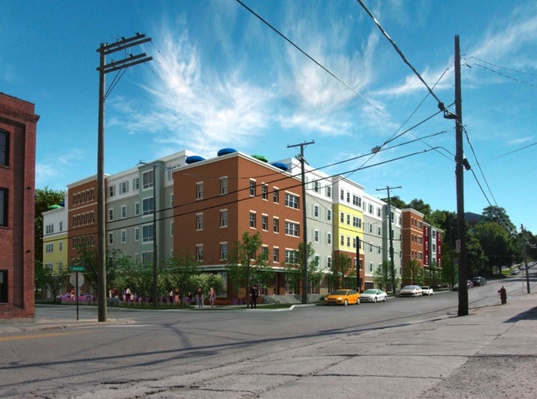
A revised plan for the Moravian shows a five-story, multiple-family residential building with 62 units and 150 bedrooms.
More than a dozen Ann Arbor residents stepped up to the podium Tuesday night to voice their opposition to the controversial Moravian apartment project encroaching upon their neighborhood just outside the city's downtown.
But ultimately, after a long debate - one that has spanned two years and included numerous plan revisions - the Ann Arbor Planning Commission gave its blessing to the latest version of the 62-unit development.
By a 7-1 vote, the commission approved a revised plan submitted by developer Jeff Helminski of the Moravian Co. The approved Planned Unit Development zoning district and site plan - which now go to the Ann Arbor City Council for consideration - would allow the developer to move forward with a five-story apartment complex on 0.85 acres at 201 E. Madison St., just south of downtown Ann Arbor.
The action recommends the rezoning of the site from R4C (multiple-family dwelling district) and M1 (limited industrial district) to a PUD. The developer plans to construct a five-story, multiple-family residential building with 62 units and 150 bedrooms, according to the latest plans.
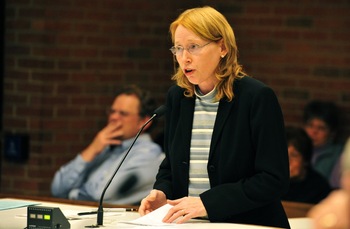
Beverly Strassmann, president of the Germantown Neighborhood Association, spoke out against the Moravian project at Tuesday's meeting.
Ryan J. Stanton | AnnArbor.com
Several frustrated residents stormed the podium after the vote, shouting criticisms at the Planning Commission. Many of them live on South Fourth and South Fifth avenues.
"This battle is not over," said Beverly Strassmann, president of the Germantown Neighborhood Association, which has led the opposition to the project.
"We know that your legal vulnerabilities are awesome and that you can't get away with a project like this that violates state law, that violates our zoning and that ... violates the central area plan, and so there's just absolutely no way that this can stand," she said. "It's all been a pack of lies. The public hasn't been listened to whatsoever."
Because the Moravian doesn't conform to the city's existing zoning code, the project required special PUD approval - for which the developer has offered various public benefits in exchange for the zoning exception. One of the public benefits offered is affordable housing since the recommended density is exceeded.
Helminski, who plans to market his building to young professionals, said he's glad he won a battle Tuesday night, but acknowledged the fight isn't over.

Developer Jeff Helminski faced a tough crowd Tuesday night.
Ryan J. Stanton | AnnArbor.com
"We're certainly pleased with the recommendation of the Planning Commission and look forward to going onto the next steps, which is City Council for the first reading and then second reading probably in the March timeframe," he said. "At this point, we're probably into the spring of 2011 for start of construction, and this is probably a 16-month project."
Helminski said the project represents an overall investment of more than $10 million in Ann Arbor, which he used as a selling point before the commission Tuesday night.
"It's important to consider, especially in the times that we're in where we're being forced to eliminate important services and personnel in our community, that this project provides an opportunity to increase tax revenues by over $200,000 annually," he said. "That's a very significant number, especially in times when we're laying off firefighters, laying off police officers - we're underfunding our school districts, we're getting rid of teachers in the classroom."
When the project last came before the Planning Commission in October, it included a four-story building with 63 units and 164 bedrooms. Commissioners postponed action on the project at that meeting and asked Helminski to scale back the proposal and work out concerns regarding the number of bedrooms, the height of the building, lack of open space, and general concerns about density and whether the project fits its surroundings in the neighborhood.
The Moravian site plan still calls for 90 spaces of underground parking, which city officials cite as a benefit.
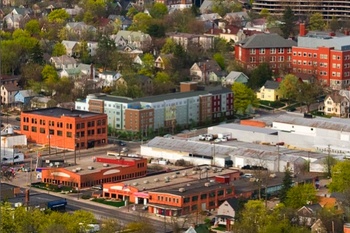
An image provided by the developer features the Moravian building graphically superimposed to show its relation to surrounding properties.
The city's planning staff issued a report prior to Tuesday's meeting that recommended approval of the project. It says the the uses, physical characteristics, design features, and amenities proposed are beneficial to the city, and the multiple-family use is consistent with the city's master plan.
Among the revisions highlighted by Helminski are further detailing of the exterior to meet the suggestions contained in the city's proposed A2D2 design guidelines. The revised design creates a base-middle-top appearance throughout the building and features outdoor terraces that have been added to the corners of the building on South Fourth Avenue to increase the amount of usable open space.
The new drawings also include additional architectural details such as cornices, sills and headers, banding and shutters. Helminski points out changes in color and material - along with slight plane changes - further articulate the facade, while the window area of the living rooms has been increased.
The mansard roof has been eliminated in all locations other than the corner of South Fifth Avenue and East Madison Street, which the developer noted reduces the height and scale of the building, particularly at the tallest locations. The maximum permitted height has been reduced from 70 feet to 60 feet.
The number of affordably restricted units has been increased to include three more one-bedroom units, making more than 19 percent of the project considered affordable housing. Also, a series of live-work commercial spaces has been elevated to alleviate floodplain concerns.
"Flex rooms" and laundry-storage rooms now are included in the larger apartments and have replaced a bedroom-bathroom pairing in all previous three- and four-bedroom units. That was done so units can be better used by a wider market segment.
Helminski says his new proposal calls for a lesser level of variance while achieving benefits not met by any previous market-rate PUD.
"This is definitely a better project than the one that we saw before," said Commissioner Jean Carlberg, who said the project fits well with the future vision for downtown and the surrounding area.
"It's not perfect, but I think I can imagine it being a good addition to the neighborhood over time," said Chairwoman Bonnie Bona.
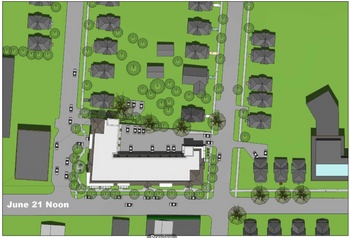
An artist rendering shows an aerial view of the Moravian in comparison to surrounding homes and other buildings.
Bona said she's encouraged the project offers a wide range of public benefits. The city has stipulated the development obtain LEED certification, and a renewable energy source - such as geothermal energy - must be used as the primary energy source for heating and cooling systems.
The only commissioner to vote against the project Tuesday night was Erica Briggs, who said she was swayed by the fact that such a large portion of the neighborhood came out to oppose the project.
"This has been a particularly difficult decision for me," she said. "I was reminded tonight that a lot of people could be looking at it from the other angle. There really are people there who are saying, 'This is out of character with our neighborhood,' and I don't think we should dismiss that."
Tom Whitaker, a resident on South Fifth Avenue, told commissioners he didn't think the development offered enough public benefit to justify granting a PUD.
"Make no mistake, PUDs are giveaways to developers because they provide windfall variances from stricter, underlying zoning requirements. In return, the city is supposed to receive a benefit that is very substantial," Whitaker said.
"The immediate surroundings, our neighborhood, will be harmed - not benefited - by the Moravian," he said, suggesting the city has better places for the type of project Helminski is proposing. "There is no need to force this square peg into a round hole when there are square holes available."
Kim Kachadoorian is another resident who voiced frustration over the Moravian at Tuesday's meeting.
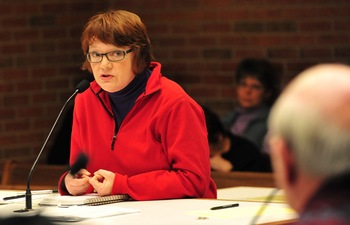
Ann Arbor resident Kim Kachadoorian shared her concerns about the impact of the Moravian project Tuesday night.
Ryan J. Stanton | AnnArbor.com
"Germantown is the last intact near-downtown neighborhood," she argued. "Dismembering this neighborhood for more student housing is just really kind of disheartening to me."
Strassmann told commissioners prior to Tuesday's vote that most residents who have invested in property in the neighborhood have done so because they appreciate the historic streetscape.
"Those houses that are going to be torn down date to the mid-19th century," she said. "They are some of the oldest houses in the city. They do have historic qualities. And so the intrusion of this massive apartment building that is completely out of scale with the neighborhood is an offense."
Strassmann ran through a list of the reasons why her group thinks the project doesn't fit the neighborhood.
"Let me just say that it's 60 feet tall, whereas the surrounding zoning allows for 30- and 35-foot-tall buildings," she said. "It's 270 feet on the diagonal, whereas the surrounding homes are 30 feet on the diagonal. It is a massive, whopping 74,000 square feet, whereas the homes max out at 3,000 square feet, so it's 25 times the size of the largest houses in the area.
"This is just a complete rewriting of the zoning. It is just incredible that this could go forward," she said.
Audio: Listen to Beverly Strassmann address the Planning Commission
Ryan J. Stanton covers government for AnnArbor.com. Reach him at ryanstanton@annarbor.com or 734-623-2529.
Comments
wordup
Wed, Mar 3, 2010 : 3:12 p.m.
Can we say "NIMBY"???? That's what downtown Ann Arbor is best at! Why would we possibly want any sort or private investments in our city?????
wordup
Wed, Mar 3, 2010 : 3:10 p.m.
Four simple letters, can we say "NIMBY"????? Ann Arbor is really good at that one!
Dan
Wed, Mar 3, 2010 : 11:46 a.m.
Sounds good to this young professional.
kaw-goosh-kaw-nick
Fri, Jan 15, 2010 : 7:16 a.m.
Now that Mrs. Kaw-goosh-kaw-nick and I are back in town, we have had a chance to finally watch the meeting (thank you TiVo!). At least one member of the public once again raised the question of unpaid property taxes by the developer. In my experience at least, most developers only have offers to purchase real estate that are contingent upon gaining the required approvals from the city for their designs. I would assume that the developer does not yet own the property, and is not required to pay property tax until he owns the properties. I would assume that an escrow would be set up by the title company to pay any back taxes to the city that are owed by the the land owners at the time closing, and would be deducted from the proceeds of the sale to the existing land owners. If indeed any back taxes are owed to the city, this is an additional incentive to get a responsible and tax paying land owner onboard, not to mention the additional $200,000.00 per year in added property tax that the developer states would be paid by the new owner EVERY YEAR, once the property is built. This does not even include the over $10,000,000.00 investment that this guy wants to do in our neighborhood! I think this guy needs to be applauded for his responses to many of our concerns to add more affordable housing, to reduce the building masses on Fourth and to change the design details to help it fit into our neighborhood. How many other geo-thermal and LEED projects do you see around town? Nearly all of the parking in located in a lower level parking deck to conceal it from our view and to reduce the building height. An improved storm water system is apparently designed to help reduce our flooding problems. I will continue to support this project as I see the benefits of this proposal far outweigh any of my concerns.
Bill
Wed, Jan 13, 2010 : 5:51 p.m.
When someone uses the word stormed, I think of the Bastille or at the least, a batter rushing out to the pitcher's mound, bat in hand, not to just say hello. Also, is this Moravian group the same group that owed over $100,000 in back taxes? Or they broke or just deadbeats?
glacialerratic
Fri, Jan 8, 2010 : 7:13 p.m.
You did not characterize accurately what Strassmann said. This is a digital page. Use as much space as necessary to get it right.
glacialerratic
Thu, Jan 7, 2010 : 8 p.m.
Based on the recorded transcript, Amalie, the snippet of Strassman's remarks that you used in the story truncated what she actually said. Strassman expressed reluctance to use the word "lie," but appears to pick up the phrase from the remarks of a previous speaker. You omitted this important nuance. Nor do you speak to her point about your use of "storming the podium." Colorful and dynamic language, but perhaps less than accurate. On the other hand, there does seem movement afoot to the barricades...
Beverly Strassmann
Thu, Jan 7, 2010 : 2:54 p.m.
The following quote was falsely attributed to me (Beverly Strassmann) but actually came from Richard Jacobson: "It's all been a pack of lies..." This needs to be corrected to set the record straight. Also, it is untrue that residents "stormed the podium." Instead we approached the podium after the hearing was over to sign the sign-up sheet for receiving notice of future hearings. This was a fitting and proper thing to do.
Lokalisierung
Thu, Jan 7, 2010 : 2:22 p.m.
"If the city begins to throw out zoning and the protections/responsibilities that came with it, I guess you can expect to see a Taco Bell in the middle of the Old West Side." 1. That's most lickely a hisotric district so no Taco bells 2. Changing the zoning happens all the time and isn't rare at all.
happy
Thu, Jan 7, 2010 : 10:15 a.m.
I've read all the comments and it seems potentially appealing to add a complex of this sort....BUT, WHY CAN'T THE DEVELOPER DO IT UNDER THE CURRENT ZONING? If the city begins to throw out zoning and the protections/responsibilities that came with it, I guess you can expect to see a Taco Bell in the middle of the Old West Side. The old "Y" site looks like the PERFECT place for a project like this (on even a larger scale) and the CURRENT zoning will allow it! The neighborhoods surrounding the downtown core are still neighborhoods.
townie
Wed, Jan 6, 2010 : 8:41 p.m.
A Tale of Two Proposals: Near North and the Moravian Near North: Combining multiple small lots with R4C and office zoning; floodplain/floodway issues; several existing old houses in an established neighborhood; parking under the building; LEED certification; industrial architecture; 100% affordable housing; strong neighborhood opposition. Staff recommendation: Denial. The Moravian: Combining multiple small lots with R4C and M1 zoning; floodplain/floodway issues; several existing old houses in an established neighborhood; parking under the building; LEED certification; industrial architecture; three times the size of Near North, but only 12 affordable units (10 mandated by ordinance); strong neighborhood opposition. Staff recommendation: Approval.
Eric P
Wed, Jan 6, 2010 : 7:31 p.m.
"The number of affordably restricted units has been increased to include three more one-bedroom units, making more than 19 percent of the project considered affordable housing" so I got to ask, is the other 81% Unaffordable housing? What exactly is considered affordable housing currently?
The Picker
Wed, Jan 6, 2010 : 7:18 p.m.
How much will each bedroom cost per month? How much per parking space per month? Are the utilities included? Inquiring minds want to know.
voiceofreason
Wed, Jan 6, 2010 : 2:08 p.m.
neighborhood fan, The bottom line is that this is a small group of people attempting to kill a good project using arguments that have no real bearing on them. If this is not the definition of "NIMBY" or "Vocal Minority", I am not sure what is. The particular area has been in need of transformation for some time, and the developer has already allowed the neighborhood group a great deal of input into the project(a lot more than necessary). If this development fails to obtain final approval, it could be many years before another developer is willing to risk time/money/effort in improving the area. I just don't believe it is wise to let a good project like this be sabotaged by a small group of neighbors.
crayzee
Wed, Jan 6, 2010 : 1:52 p.m.
I totally agree with TF's observation, and add me to the list of people who think this project looks like a great idea. That whole area around Fingerle is ripe for improvements, and more people in that area could eventually make Main Street more viable south of William. Since Leopold Bros. closed, Main Street is pretty boring between William and Madison.
Lokalisierung
Wed, Jan 6, 2010 : 1:38 p.m.
"It doesn't matter what the planning commission thinks. Now these few residents will start crying to the the city council and which ever council member is from that area will start throwing roadblocks in front of the developer" Brucae couldn't be more correct. Just pass the project already! Nieghbors don't want to wake up to the sound of contruction everyday and boo hoo this and boo hoo that. You're living in a city, you wanted to live 1 block from downtown, is it really that much of a suprise that the city is gorwing and moving towards you? That's like um, what cities do.
neighborhood fan
Wed, Jan 6, 2010 : 12:54 p.m.
ArgoC, you wrote: If the neighbors had mega-input, what would they change? Replace the houses with new detached houses? Lop off another storey? What, specifically? (shrugs shoulders): I don't know. You'll have to ask them. You might be pleasantly surprised by their response. Just saw hearing on cable access. There appear to be some issues, re: underground parking. The affordable housing component has been swung by the developer as a carrot to the city, but one speaker at hearing, Jim Mogenson (sp?), recalled that there were other recent projects by developers that had affordable housing components built into their development agreements, only to come back a short time later to ask that those components be removed as these were not viable and a financial drain to them. In other words, the developer is promising something that there is a good likelihood given recent history in Ann Arbor that he probably perhaps can't deliver. Also there is the question of underground parking in a floodplain. What would the neighbors want? Probably something even much less massive than what is proposed now. Of course, that could be something that also isn't economically viable now either. @TF: I don't think "the Ann Arbor residents" you are talking about want to be considered a suburb of Detroit. At the same time, they may be (culturally at any rate) as liberal as Portland or San Francisco, but prefer a small city (town?) atmosphere which is Ann Arbor. Much more to write here, but given what I've just written above in last paragraph, you can see the tension and potential for conflict over priorities here.
cgrantski
Wed, Jan 6, 2010 : 12:51 p.m.
That rendering is probably done in 3D on the developer's computer. Mr. Helminski, could we get a view of what it looks like from one of the side streets? And, is the detailed facade going to go all the way around the building?
Lokalisierung
Wed, Jan 6, 2010 : 12:44 p.m.
This seems like a great idea to me. If the neighbors weren't there to complain about everything then they wouldn't be neighbors I guess. Just as the neighborhood has a right to complain and be against such a building project, the developer has a right to try to build something. If it meets the requirments to the building department, & Planning commission; what's the issue?
ArgoC
Wed, Jan 6, 2010 : 12:13 p.m.
One more comment, sorry. "In my view they have a point" which is? They're not being treated with respect? The neighborhood people don't have the same resources? What resources are needed here? They have a BIG resource in that logic and reasoning and facts and publicity really matter around here in a public forum. A convincing, valid argument goes a long way with the public here. And, as others have implied, the arguments against the current version of this development just aren't that strong to many of the rest of us townies, although the earlier versions of the project WERE bad enough to be very vulnerable to the same arguments. If the neighborhood can't convince other townies or students with logic, reasoning, facts, and visuals, then I really do think it smacks of NIMBY, like it or not. More student housing, and that's bad? I suspect that this development will reduce the ratio of students in the area. Big? Well, averaged out, it's 1,200 sf per unit whereas the houses are much larger, up to 3,000 sf per house. Historic value? Old, well yes, or at least the original structures, what's left of them, date back pretty far. Architectural value --- have you been inside those chopped-up, endlessly-reworked houses? As I recall there's a little original trim left, but, really. Bigger, and bigger is bad? Freestanding houses with bits of yard are very nice, but would a block, like a 19th century downtown block or the Packard-Hill area, really be out of character? I think it's better than the detached house urban decay with big dirt parking areas that is there now. If the neighbors had mega-input, what would they change? Replace the houses with new detached houses? Lop off another storey? What, specifically? It almost sounds like they want it to stay the way it is. Really? If my neighborhood (circa 1880-1920) had those houses and dirt lots and scrub trees, I really wouldn't mind getting them replaced with a nicely done multi-unit job. The current landlords apparently aren't gonna do it, so maybe bigger market forces will be the cause of a visual upgrade.
TF
Wed, Jan 6, 2010 : 12:03 p.m.
It's interesting how Ann Arbor residents talk about wanting to be hip and urban and ride around on trolleys and dream about San Francisco and Portland, but their action show that they really just want to be a suburb of Detroit, propped up by a nice university.
Matthew
Wed, Jan 6, 2010 : 11:57 a.m.
neighborhood fan, It kinda sounds like the only sincere/respectful solution the residents would accept is for the property to remain vacant at no cost to themselves. How is that workable?
neighborhood fan
Wed, Jan 6, 2010 : 11:38 a.m.
I don't live in this neighborhood, but with respect to a2grateful's comments and others here, it's easy to throw bricks at the Germantown folk and dismiss them as a bunch of NIMBYs. @voice of reason: how many John Q. Public folk, or Germantown neighbors, or that so-called vocal minority you have characterized them, have the extra income, "putting its money where its mouth is" or can be encumbered with that responsibility. Not many people I know. For general consumption. If I understand what's happening with the Germantown neighborhoods, I can only imagine they feel bombarded right now by the city as well as by the development community, with the development on 5th Avenue and the destruction of historic homes on one end, and what began as a high-rise at the other end. They are going against developers who have limitless resources at their disposal to get as much as what they can. Ask these developers and they will complain, perhaps with some validity, of their mistreatment by the city, by the constant changing of the rules and understanding in midstream. In that, they have a point. They are used to scenarios where they entirely get their way with much less opposition. Neighborhoods, beit Germantown or other communities in Ann Arbor and beyond, just don't have the same resources. Folks with kids and/or jobs/livelihoods that are dependent on their attention elsewhere other than engaging the Planning Department (or what they call themselves these days) are going to feel, appropriately, that the deck is stacked against them. They feel like their backs are against the wall, and they are fighting back as best as they can. As far the current proposal is, maybe it is a better one than what was originally submitted. But what appears to me as to what needs to happen, whatever one's point of view of the project, is that this developer needs to stop entirely, and make a SINCERE effort to work directly with the neighbors at the ground level, not just a simple presentation to satisfy a city ordinance, and treat the neighbors with RESPECT and though they do not have a financial interest, otherwise as equal partners in the process. From what I've seen, that isn't happening. These people's fears need to be addressed, and their hurt needs to be healed, both by the developer and frankly planning staff, if the neighborhood feels they have been ill-served by this city. So let's take a step back and stop dismissing the Germantown assn. as a bunch of NIMBY's and other ad-hominem attacks and instead think about where they're coming from. In my view they have a point.
ArgoC
Wed, Jan 6, 2010 : 11:26 a.m.
David - Former versions had a mansard roof that was removed to lower the height of the building. Too bad. Agree about the flat line. How about some short but interesting facade extensions at the top, like on Main Street?
David Paris
Wed, Jan 6, 2010 : 11:18 a.m.
I applaud this decision, it fills several holes in the community, improving the tax base, parking, a gap in housing, and it's aesthetically pleasing. If I could only make one suggestion: can you improve the roof-line, notice the building in the upper-right of the photo by comparison? I know flat roofs are cheap, but they look it, too.
Jody Durkacs
Wed, Jan 6, 2010 : 10:52 a.m.
Despite all the hullabaloo, I have yet to hear a convincing, compelling argument against this development. Is it just NIMBY for the sake of NIMBY?
ArgoC
Wed, Jan 6, 2010 : 10:49 a.m.
bruce, I wonder if your prediction is right. This particular one feels like it's being done about as well as it could be done, IF that space were to be redeveloped in the first place. I think there's a decent chance of it actually happening. To the developer - interesting and period-specific architectural details, please, the more the better!
bruceae
Wed, Jan 6, 2010 : 10:34 a.m.
It doesn't matter what the planning commission thinks. Now these few residents will start crying to the the city council and which ever council member is from that area will start throwing roadblocks in front of the developer
Resident Tourist
Wed, Jan 6, 2010 : 9:58 a.m.
It's impossible to create a compact, vibrant downtown without increasing housing density. I would love to move to an apartment downtown within walking distance of everything...there just really isn't the supply. It's pretty sad when the cost of urban living in Ann Arbor is more expensive than many major US cities. No wonder we have trouble retaining young talent.
ArgoC
Wed, Jan 6, 2010 : 9:43 a.m.
I used to live in one of those to-be-replaced houses when I was a student. They were the architectural low point of my student period, though the location was excellent. And I do remember the homeowners there being, shall we say, a staunch group. Can anybody provide a breakdown of how many of the surrounding properties are actually owner-occupied? Just visually, this is a big improvement in my eyes. But I'd like to know the impact on the displaced student (rental) population. Will they still be able to afford living in the same area? How many students would be displaced? What's likely to happen with the other student housing rates there? Now that I'm a grownup, I wouldn't mind living in that same area again. I think the planning commission did a good job this time in pushing the developer to improve their proposal.
TAG
Wed, Jan 6, 2010 : 9:20 a.m.
As far and the new building fitting into the neighborhood - there's a lumberyard across the street - it looks like it could be a good transition from the commercial (i.e the lumberyard) to the residential areas to the north.
aaudubon
Wed, Jan 6, 2010 : 8:59 a.m.
1. I agree that there really isn't any relevance to Green-Plymouth example - many of those spaces are still empty only because Pfizer left. I doubt all the downtown employers are going to close up shop the same way. And, with the variety of units available, they won't have any problem filling up. 2. I think it is a mistake to assume this will just serve as student housing - it's likely to attract young couples and singles who want to settle down closer to downtown but can't afford a house. In fact, as a young professional who both works and spends money downtown, I know my husband and I dream of moving into a place like this. 3. I've been into a few of the rental houses on this block, and they are not by any means well preserved historic homes. In my opinion, the Moravian could bring both more vibrancy and in many ways a more aesthetically appealing design to this portion of the neighborhood. What many people don't realize is the degree to which design and landscaping can blend buildings into neighborhoods. Studies have shown that people can be given two pictures of buildings with the same density, height, etc. and think one is much less dense than the other. Why? Because of the design. It seems like Helminski is meeting standards and recommendations to make sure the design is helping to do just that. 4. If you look in urban neighborhoods all across the US, the most desirable ones are mixed use, with well planned variety of housing types and variety of densities. This even goes for historic neighborhoods. Again what will be important is the design of the buildings and of landscape.
xmo
Wed, Jan 6, 2010 : 8:46 a.m.
Ann Arbor is such a wonderful town, I cann't believe that there are people out there who do not want more people to live here. It creates more taxes for the city, more jobs for its residents and more interesting people in our town. Please put this complex up soon!
limmy
Wed, Jan 6, 2010 : 8:27 a.m.
It doesn't increase the tax revenue unless new people move into Ann Arbor. At this point, people that are already here will move into it and vacate another place. It is just shuffling the same tax dollars to something new.
a2grateful
Wed, Jan 6, 2010 : 8:26 a.m.
If the houses proposed for demolition are precious to neighbors, they may be able to save them by purchasing them from the owner, and then moving them to another site. Offer the owner $1 for all of the houses, and he will likely sell them to you. Buy some insurance, hire a contractor, and move the houses. As a sidebar, these properties have been listed for sale on the local MLS. A coalition of concerned property owners could have purchased the houses and properties at any time. They may still be for sale for such a transaction. An image above graphically superimposes the Moravian to show its relation to surrounding properties. The roofline fits within the downward slope of the Madison properties, as well as properties to the north. Proposed density for the Moravian, although exceeding that of the 1970s ordinance, is well within the existing density of the 1900's vintage housing it neighbors. The density of the existing neighborhood is highly valued, as the neighbors attest. The Moravian complies with the density aesthetic established 100 years ago, and maintained in the neighborhood today.
voiceofreason
Wed, Jan 6, 2010 : 8:22 a.m.
Yeah, I don't really understand the outrage to this one. The "Moravian" is going to replace a group of dilapidated rental houses. It's not like the developer is knocking down a block of Victorian homes from the 1800's to build this. At some point, the vocal minority needs to begin "putting its money where its mouth is" and outbidding the developers for properties.
Gill
Wed, Jan 6, 2010 : 7:59 a.m.
What does housing next to U of M campus have to do with housing out near Pfizer? And, if people don't want this development they should buy the property. Make the developer an offer on the property and then fix up or tear down the rental houses that are there.
resident
Wed, Jan 6, 2010 : 7:24 a.m.
It is too bad that once again (notice what was put at the corner of Green and Plymouth when you exit 23) AA planning commission will allow building of something the residents are against, is not needed (again, notice how few condos/now apartments are still empty at the corer of Green and Plymouth) and is really ugly (did I mention the corner of Green and Plymouth)