

Ann Arbor residents raise concerns about trimming of trees at Leslie Park Golf Course
Tom Wassmer says he was walking through Ann Arbor's Leslie Park Golf Course last winter when he noticed the first sign of what he considers a series of alarming events.
"I saw this nice, 150-year-old oak tree lying down one day and it didn't seem that it needed to be cut," said Wassmer, who counted the rings on the tree and estimated its age at 150 years old.
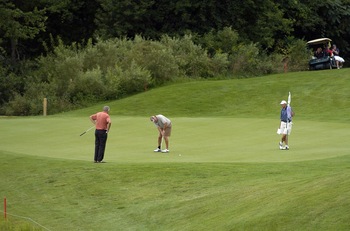
Dave Kempner of Ann Arbor, center, rolls in a 12-footer for birdie on the 17th hole in this file photo taken at Leslie Park Golf Course.
Lon Horwedel | AnnArbor.com
"Then the next thing that happened was actually the next tree in front of the golf course was decorated with a green dot — a bull’s-eye," he said, mentioning another tree slated to be chopped down by the city. "I'm a biologist, not a forester, but I think the tree is actually healthy."
The northside resident said he continued to notice other questionable acts, including clear-cutting and harsh pruning of other trees on the city-owned golf course.
Wassmer and other Ann Arbor residents aired their concerns during a sit-down meeting with city officials Thursday evening.
Neighbors say the Leslie course is a much-loved green space. Recently, however, they say a great deal of clearance of vegetation, major removal of branches of healthy trees, and harsh pruning of trees that provide cover for birds and animals has taken place. That work has been done, in part, in the name of enhancement of wildlife habitat and indigenous vegetation, but also to improve playability on the course and increase ease of maintenance.
Thursday's two-hour discussion, which took place on the clubhouse patio, was at times acrimonious. But in the end, some common ground was reached.
Wassmer and his wife, Amy, along with neighbor Susan Wright, who has a background in biotechnology, submitted a proposal to city leaders calling for the formation of a committee to advise the city on the following:
- Incremental removal of invasive plants
- Protection of the many valuable trees and old orchards on the course
- Maintenance of cover and roosting sites for wildlife
- Protection of water resources from run-off from pesticides and fertilizers
- Protection of the valuable aesthetic features of the park
The residents proposed the committee include a qualified forester, ornithologist, representatives of the Huron River Watershed Council, and members of the Northside Neighborhood.
"It is essential to recognize that the golf course is part of a complex ecosystem that includes land, mature trees, old orchards, Traver Creek and associated ponds that are part of the Huron River Watershed, wild animals, and a rich variety of birds," they wrote. "No part of this system can be addressed without thinking of the impact on other parts."
It turns out their suggestions might fit perfectly with an initiative under way to have the golf course become Audubon-certified.
"As part of the Audubon certification process, we need to have a small advisory committee to help us," said Doug Kelly, the city's director of golf. "This committee would be a temporary committee to help us obtain this certification and do it the right way. Through that Audubon certification is a lot of the issues that were brought up."
Colin Smith, the city's parks director, wrote in a recent e-mail to City Council Member Sabra Briere that staff at the golf course had been questioned about a number of recent changes regarding trees and plantings. Smith acknowledged various invasive species along Traver Creek had been removed in collaboration with Natural Area Preservation, a department of the city that protects and restores natural areas.
"Trees that interfere with the playability of the course have been trimmed where appropriate," Smith wrote. "What is important to note is that work done around Traver Creek is the beginning of an ambitious project to become certified with the Audubon Co-Operative Sanctuary Program for Golf Courses. There are almost 900 golf courses in the state of Michigan and only nine hold this certification."
Smith also said Audubon awards certification to golf courses that protect the environment, conserve natural resources and provide wildlife habitats. Achieving certification, he said, demonstrates a course’s commitment to environmental management.
Residents at Thursday's meeting said they support the city's environmental goals. In fact, they said their own goals include seeing the golf course managed in a way that enhances wildlife habitat and indigenous vegetation, removes harmful invasive plants, and protects water resources through vegetation along the creek and ponds.
They said the problem is how those goals are implemented and achieved. They claim methods currently being used by the city need to be modified to maintain all components of a balanced ecosystem.
Residents say huge branches of healthy trees have been removed recently. As one example, they cite the cutting of a willow tree over the creek that provided cover for many birds, including kingfishers and blue birds. They also say harsh pruning of the old orchard trees has been carried out, with results detrimental to both trees and the landscape.
Kelly, who took over as golf director last January, made it clear Thursday night that Leslie Park Golf Course is a business operation first and foremost. He said it's a golf course, not a park, but that doesn't mean city staff is gong to ignore environmental stewardship.
Kelly added he isn't sure why a 150-year-old oak tree was cut down at the golf course before he arrived last January.
"I didn't understand why the first one was cut down," he said. "I do understand the safety issues of the second one. I would hate to see it go, but that's not my call nor is it my judgment to evaluate how safe or secure that one is. I just voiced concerns of, 'Can someone look at this?' And it has been rated poor by the outside consultant of the city that evaluates the trees, as well as the arborist in the city."
Briere, D-1st Ward, attended Thursday's meeting. She left confident cooperation could be achieved between the city and residents.
"The whole idea is increased cooperation and less of a sense of struggle and animosity," she said. "The people in the neighborhood clearly have been watching what's happening and feeling that they were left out of the decision. And that since has frustrated them."
City officials say it's ironic they're taking heat now that they're taking measures to better manage invasive species.
"Suddenly people try to make changes and that very change is threatening, even if it's good change," Briere said. "In this case, the golf course management is trying to make the golf course more ecologically sensitive. But to do that required both trimming and removal of plants and those were some drastic changes. As witnessed by the neighborhood they were significant visual changes and the neighborhood felt that these were lacking in care for the environment — even though they were intended to benefit the environment. It's an interesting problem."
Originally designed by E. Lawrence Packard and opened in 1967, Leslie Park Golf Course underwent a two-year renovation in 1994-95. The 18-hole course recently was rated by Golf Digest as one of best places to play.
Residents say if the city is serious about achieving environmental sustainability for the course, the following goals should be met:
- Replace the golf carts that currently use diesel fuel with electric carts
- Phase out the use of poisonous and environmentally detrimental pesticides and fertilizers
- Protect the water resources with vegetation
- Cease the massive cutting of trees and harsh pruning
Ryan J. Stanton covers government for AnnArbor.com. Reach him at ryanstanton@annarbor.com or 734-623-2529.
Comments
Stephen Lange Ranzini
Mon, Apr 19, 2010 : 1:38 p.m.
Sorry, meant Gallup Park! Thanks for the heads-up, @Ypsidweller!
Ypsidweller
Mon, Apr 19, 2010 : 11:16 a.m.
There is no public park in AA called Geddes Lake Park. There is a private condo complex called Geddes Lake.
Stephen Lange Ranzini
Sun, Apr 18, 2010 : 1:32 p.m.
My Mother (who is an expert) noted that the trees at Geddes Lake Park are not being correctly maintained. She informs me that new wood chips were spread around the trees and right up to the trunk. This should not be. By doing this, insects can more quickly invade the trees. The wood chips should be in a ring with dirt between the chips and the trunk to properly maintain the health of the trees. Both this issue and the severe cutting of healthy limbs of healthy trees or cutting down of ancient healthy trees discussed in this article indicate to me a degree of lack of knowledge among the maintainance people working for the City's Parks department.
Useless
Fri, Apr 16, 2010 : 3:03 p.m.
Cutting and trimming trees is part of running a golf course. In 15 years of playing the course, I don't think the course has ever looked in better shape. Kodos to the course manager.
John Androsavich
Fri, Apr 16, 2010 : 12:55 p.m.
"Kelly, who took over as golf director last January, made it clear Thursday night that Leslie Park Golf Course is a business operation first and foremost. He said it's a golf course, not a park, but that doesn't mean city staff is gong to ignore environmental stewardship." Kelly must have forgotten that the course is named 'Lesley PARK Golf Course' and it is, in fact, merely one part of a larger unit - which includes the trails of black pond woods nature area, Leslie Science Center, and other recreational areas - preserved for the enjoyment of the community. I think the natural park atmosphere of the course is what makes it so unique and enjoyable and stands in stark contrast to other meticulously pruned private courses that have a faux quality. The golf course should exist and operate in connection with the other areas of the park and not as a sole 'business' entity and I applaud Tom for his initiative and ambition in trying to make sure this happens. and I applaud Tom for his ambition in trying to preserve and enhance.
nowayjose
Fri, Apr 16, 2010 : 12:35 p.m.
I say cut'em down. I could use a clearer approach to the 8th green anyway. Sometimes my drives aren't always straight. A little pruning could shave a stroke or two.
Lon Horwedel
Fri, Apr 16, 2010 : 12:01 p.m.
As an avid golfer at Leslie Park, and a golf writer, I was asked by Doug Kelly to attend last night's meeting but couldn't make it due to my work schedule. It sounds as if things went well for both sides, but I would like to come to Leslie Park's defense on one huge issue that I don't believe was mentioned. Yes, they did some severe pruning of the pear trees between holes #6 and #8, but having grown up in a fruit orchard community, I can assure you that pear trees don't last forever, and now these trees may actually produce more fruit because of the pruning (not that fruit producing trees are important to a round of golf). More importantly, Leslie Park lost several hundred trees because of the emerald ash borer a few years back, and not only have those trees been replanted, but the city was smart enough to vary the species of the trees to keep something like this from happening again. Granted, several of the trees are merely saplings, but 15-20 years from now, Leslie Park will mature once again into a true tree-lined gem, and I, for one, still plan on playing that place until I keel over from walking up the hill to the 14th tee!
genericreg
Fri, Apr 16, 2010 : 11:16 a.m.
There is nothing 'green' about a golf course, no matter how many electric carts you put on it.
BobbyJohn
Fri, Apr 16, 2010 : 10:16 a.m.
why is the city spending money to certify the golf course by the Audubon Society. Even if it is $100, it is $100 the city doesn't have. Ryan, could you find out if there is any expense for the city?
Jon Gordon
Fri, Apr 16, 2010 : 9:06 a.m.
I think this is part of a pattern. The City did the same thing in the neighborhood surrounding Sugarbush Park.
SemperFi
Fri, Apr 16, 2010 : 8:32 a.m.
I haven't been to Leslie GC in awhile, so I may be out of the loop on some issues. But, I have to question the final points of this article. Do they really use 'diesel' carts? I'm betting they're LPG powered. Do the citizens know what herbicides, pesticides and fertilizer is currently being used? What exactly do they mean by protecting the water resources with vegetation? This Audubon initiative sounds like a step in the right direction already. As for the massive cutting and harsh pruning... let's leave that to the forresters and golf course professionals to promote a first class golf course in a responsible fashion. I'm glad to see that there is some civility being demonstrated and that citizens will voice their opinions and listen to flip-side of the coin.
logo
Fri, Apr 16, 2010 : 8:30 a.m.
Leslie is a well run operation and as noted one of the best courses in the state. The whole city operation has high environmental standards and they are striving for an even higher standard with the Audubon award. Trees grow and sometimes need to be trimmed or taken down. It's a golf course not a forest. I bet the complaining neighbors don't even play golf. If they get their way the trees will take over the fairways, people will stop playing golf, it will become just another park in a city with too many.
PittsfieldTwp
Fri, Apr 16, 2010 : 7:38 a.m.
Golf Digest last year ranked Leslie Park Golf Course, Michigan's #1 municipal golf course, and golf writer and talk show host Michael Patrick Shiels rated Leslie Park in the top 10 if the state based on the criteria most fun to play. Should increased playability be included on the list as a reason to modify trees on the course? If there is danger of fallen branches, up-keep, or environmental impact, then different story. But I like playing there the way it is and I think I am in good company based on these awards.
Brian Kuehn
Fri, Apr 16, 2010 : 7:16 a.m.
First of all, I believe there are signs on the fences at Leslie Park that indicate entry onto the grounds when the course is closed is trespassing. Perhaps these rules do not apply to self-appointed guardians of the golf course. While no one supports thoughtless cutting of trees or clearing of land, the management of the golf course should be left to the people hired to run the operation. The Leslie Park Golf Course is surrounded by over 100 acres of Natural Area (Leslie Science Center, Black Woods Pond Nature Area, Traver Creek Nature Area, Leslie Woods Nature Area). The loss of some small pieces of habitat on a working golf course should be balanced against the large areas we have already set aside for preservation. It galls me to think that a small group of busy bodies will somehow insinuate themselves into the operation and maintenance of the City's golf course. The golf operations are already struggling with revenue & expense issues. Adding oversight by a committee of neighbors is the first step toward adding another 150 acres of non-revenue producing Nature Area to our City's inventory.
The Picker
Fri, Apr 16, 2010 : 6:56 a.m.
Is anyone suprised. Their just getting the golf course "spruced up" for its sale.
jcj
Fri, Apr 16, 2010 : 6:47 a.m.
At first glance it looked like another radical tree hugging citizen complaint. However it looks like the city responded appropriately and that the citizens group offered some good suggestions. This is how it should work.