

Ann Arbor school board homes in on 2-year timeline for next countywide millage
The Ann Arbor Board of Education brainstormed and got the ball rolling on a variety of “next steps” for bringing in more operational dollars to the district Wednesday night.
Among the most significant steps was setting a two-year timeline for leading a drive to pass a countywide tax to fund education, similar to the 1.5 mill levy proposal that failed in 2009 by large margins in all areas except Ann Arbor.
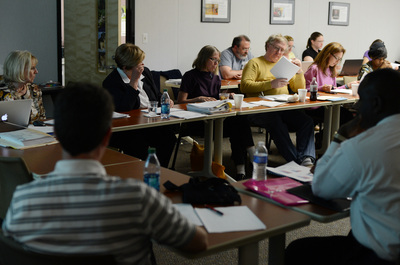
The Ann Arbor Board of Education, shown here in a May file photo, put together a plan for accomplishing its financial goal of 2012-13 Wednesday night. The plan will include some legislative and local advocacy as well as marketing and student-tracking strategies.
Melanie Maxwell | AnnArbor.com
The board’s work prior to that two-year mark will need to include researching the financial, economic development and housing market benefits that each district in the county could see as the result of better schools and passing the millage, said Vice President Christine Stead.
“My sense is that it will take a substantial amount of work to build this sort of a case and to create a compelling story… I anticipate we would have some well-funded opposition and with anything short of that level of work, I don’t think we’d be successful,” Stead said.
Meeting at Scarlett Middle School Wednesday night, school board trustees took on the task of paring down the topic of finances into meaningful and manageable pieces that the board can accomplish throughout the next school year — and in some cases, two.
At their annual board retreat in August, trustees established finances as one of two board goals it would tackle for 2012-13. The other goal was trust and relationship building among the board itself.
President Deb Mexicotte said finances have been a priority of the board’s for a long time, despite this being its first organized attempt to “do more.”
As the budget constraints became greater and the cuts tougher in the past few years, board members collectively decided that somewhere along the way the district crossed a threshold, causing the board to believe it no longer has adequate resources to accomplish the mission and vision of the Ann Arbor Public Schools, Mexicotte said. This ties in directly with the district's Strategic Plan, in which the district states its intent to ensure adequate resources to accomplish its mission.
Trustee Irene Patalan said she believes the threshold for most of the board — and also for the community — was high class sizes. Others quickly agreed.
“While we’ve been out talking with people … not only do (people) feel a heightened responsibility to reach out to legislators, to reach out to their neighbors, to become more active in their advocacy role for what they think their schools need, but they’ve also indicated to us that they don’t think our efforts to-date have been enough,” Mexicotte said.
“And I haven’t taken that as criticism, I’ve taken that as our joint understanding that the way we have traditionally worked on these things isn’t sufficient, and what we want to do is take it to the next level. Because until we get some countywide buy-in on some of these things, until we get the legislative interest in some of these things, until we understand exactly what it is we need (to achieve our mission), then we are not going to be able to make progress.”
The board identified several areas of interest, with tangible action items, that would be uniquely good for its members to carry out, in an effort to bring extra operational money into the district down the road. The first was to develop documents making the case for another countywide educational millage.
In addition, the board identified three areas of legislative policy and advocacy work it would like to take on. The tasks were:
- Drafting an amendment to Proposal A, which reformed property taxes and the way schools were funded. The board would like to see an amendment that would restore local levying power to the individual districts.
- Putting together a campaign for Ann Arbor’s sinking fund millage that currently expires in 2014.
- Developing allies and support for persuading the Michigan Legislature to repeal a law that says districts cannot charge students to ride a bus.
Trustee Andy Thomas brought up the last item. He said making students and families pay for transportation to and from school would be a “common sense solution” to the increasing costs of providing busing to students. He said this seems like an issue a number of school districts across the state would rally behind.
Trustee Glenn Nelson addressed the sinking fund, which was last renewed by voters in the Ann Arbor Public Schools in 2008. Ann Arbor’s sinking fund levies 1 mill and allows the district to spend taxpayers’ money as it is collected, unlike a bond millage, which involves the district borrowing the full amount of the bond upfront from a third-party lender.
Per state law, sinking fund dollars can be used for the purchase of real estate, construction projects or building repairs. Sinking fund money cannot be used for operational, transportation or technology costs. However, in addition to building the case for the district's next sinking fund renewal, Nelson would like the school board to work in tandem with other districts to lobby the state to expand what sinking fund dollars may be used for, such as for transportation or technology costs.
School board members said they also want to look at the district's real estate holdings and how the district can increase and maintain enrollment.
The board requested from administration a list of all the real estate holdings in AAPS’ name, their values and a relative description of the properties, such as whether they are simply land or have facilities on them or have any easements or zoning restrictions and can’t be developed.
Superintendent Patricia Green said the administration has a thorough enrollment and facilities report scheduled for the board in December. She said she would expand the report to include the information the board asked for on the real estate holdings that are currently not in use by the district.
To increase and maintain enrollment, school board members identified a few things:
- Directing administration to consider developing entrance and exit surveys of incoming and outgoing families to track families’ reasons for leaving/moving to the district.
- Providing more customer service training and professional development for building-level staff.
- Researching the marketing habits of private and charter schools in the area to match their reach and advertising strategies in order to be more competitive around enrollment time.
Communication will be an important action step in following through on these various components of the board's finances goal, Mexicotte said.
“Each one of the goal steps we put in place (Wednesday) evening has measurable outcomes that you can say, ‘Yes. Check. Done with that one and now what’s the next part,’” she said.
Mexicotte’s primary role will be delivering progress reports on the board’s finances goal to the public and the administration at each regular meeting.
“Someone on the board has to own this work because this is the board’s goal. And whoever that is for each thing brought forward tonight is going to need to make sure that the group or administration doesn’t ignore it for five months,” Mexicotte said.
To show the community board members are serious about taking their work pertaining to finances to the next level, the board will consider passing a statement of support at its next regular meeting on Oct. 10.
Danielle Arndt covers K-12 education for AnnArbor.com. Follow her on Twitter @DanielleArndt or email her at daniellearndt@annarbor.com.
Comments
alarictoo
Mon, Oct 8, 2012 : 6:22 p.m.
"...took on the task of pairing down..." The proper homonym in this case would be 'paring' (like a paring knife). That is unless you were being clever, and saying they were doubling down. ;^) Spell-check is no replacement for a competent copy editor.
Julie Baker
Mon, Oct 8, 2012 : 6:48 p.m.
Thanks, that's fixed.
RUKiddingMe
Fri, Oct 5, 2012 : 11:39 p.m.
What A2Comments said. There is so much fat that needs trimming you can't even see the meat. This whole "more millages, more millages, more millages" approach is WAY out of hand. Wake up, residents. WAKE UP!!
A2comments
Fri, Oct 5, 2012 : 10:49 a.m.
Administration costs, administration costs, administration costs...
snapshot
Fri, Oct 5, 2012 : 5:36 a.m.
So the board is brainstorming on how to manipulate the public into paying more taxes instead of finding ways to live within it's ample means. Teachers unions balk at any decrease in wages or increase in contributions but are perfectly happy with increasing my tax contributions by 10-20% in increased property taxes. I say when I see that 85% of revenue going to pay for salaries, benefits, and pensions brought down to 65% then you'll have the money from the source most able to pay for it.
Don Henley
Thu, Oct 4, 2012 : 8:25 p.m.
Can I be taxed for a tax? If school boards use a millage to base what taxes they should collect to pay for schools, to cover overhead, personnel and services for instance, and busing is a service, why should I have to pay for something that I am already paying for? Is this similar to taxing a tax? Can you be taxed for a tax? I understand budgets are hard. I know that cultivating young minds, making the leaders of tomorrow etc. is difficult but this is your job. If you have deadlines, meet them. If you have goals, reach them. It appears that the AAPS has failed at making a budget and is looking for ways to double bill the public. Of course you are struggling to dress up your story, you can't find a shade of lipstick that would look good on this pig.
DonBee
Sun, Oct 7, 2012 : 4:55 p.m.
Mr. Henley - Washtenaw County has lots of history with doing this. It used to be that the countywide millage provided Sheriff Department services to everyone. Then they decided they wanted a new Jail with all the trimmings. So now you pay the countrywide millage and then local millages if you want Sheriff patrols. The county board has been very good at shifting basic services out of the main millage so they can pay for special interests, AAPS is just following that logic.
DonBee
Thu, Oct 4, 2012 : 7:35 p.m.
Dealing with the real estate that is surplus should have been done a couple of years ago. At least bring the rental rates to market levels. Fixing the high overhead of the district needs to be done - 1 dollar in 8 is now spent on overhead - that that 1 in 8 includes all of the bond and sinking fund money - not just the general fund. Right now overhead is north of $27 million according to the filing the district did with the state. $3 million for varsity sports? Really? The Teacher's contract promises them a piece of any new revenue, so any enhancement millage will go much less distance than it would without this open ended promise. We don't know what verbal promises Mr. Allen has made to the Administrators, or other employee groups. Most likely passing an enhancement millage will result in almost no noticable change for the students. Most of this money is already promised to existing employees. Don't expect class sizes to fall or other significant changes to make education better. The first year of this two year period should be spent getting the non-classroom finance issues in order, and not the lunchroom $55,000 savings, but the millions in administrative overhead added since 2007. If AAPS can show they are getting the non-classroom costs in order and that they are being transparent about their finances, then I would consider voting yes. But right now the waste in AAPS is way too high.
Macabre Sunset
Thu, Oct 4, 2012 : 6:25 p.m.
It would be nice if the school board worked to provide better schools with the money they have, rather than spending all its time wishing it had more. We have a leadership gap in the public schools.
Basic Bob
Thu, Oct 4, 2012 : 3:02 p.m.
Forcing only some families to pay for busing is unfair. I guess if you fortunate enough to live within walking distance, have flexible schedules, can hire a nanny, or can buy your high schooler a car, you shouldn't have to pay.
DonBee
Thu, Oct 4, 2012 : 7:28 p.m.
Basic Bob - I could become a "social justice" cause, since so many of the lower income families live in the townships, and not in the city proper - lower rents/property prices. Paying for busing may bring some of the social justice lawyers into the discussion. Add that to the ever present achivement gap, and AAPS may find it difficult to deal with the fallout of being one of the lead districts to push for pay for busing.
Dog Guy
Thu, Oct 4, 2012 : 2:57 p.m.
Including wide-eyed puppies and kitties would help "to create a compelling story." Who could resist "Please, Mommy, vote for the puppies and kitties." Will AAPS have to pay royalties to the Humane Society of Huron Valley to use puppies and kitties?
sbbuilder
Thu, Oct 4, 2012 : 1:40 p.m.
"My sense is that it will take a substantial amount of work to build this sort of a case and to create a compelling story…" Sort of says it all, doesn't it? That's because the story ISN'T compelling. I'm sure most of the people who will vote "no" on the coming proposal also believe in good schools. That's not the primary point at issue here. The salient point is that most people have reached a tipping point in their finances where no amount of "compelling" storytelling will convince them to spend any more of their money.
fjord
Thu, Oct 4, 2012 : 1:08 p.m.
Please fix the headline. The phrase is "home in on," not "hone in on."
BHarding
Fri, Oct 5, 2012 : 12:51 p.m.
Even better description of the phrase: http://www.newyorker.com/online/blogs/books/2012/09/dont-try-to-hone-in-on-a-copyeditor.html
Blicero
Thu, Oct 4, 2012 : 2:19 p.m.
Webster disagrees: http://www.merriam-webster.com/dictionary/hone%20in
Cindy Heflin
Thu, Oct 4, 2012 : 1:42 p.m.
indeed it is. That has been fixed.
brimble
Thu, Oct 4, 2012 : 12:40 p.m.
Families pursue results. Families want schools where there kids learn well and gain skills, where they can grow and thrive. Marketing isn't the answer. Changing the fundamental culture of the less successful schools is the answer. Put resources into the classrooms. Fire administrators and hire teachers. Support ongoing teacher education (core knowledge, teaching techniques, not 'customer service' training). Rightsize the system as a whole to reflect the realities of enrollment ('fess up to the taxpayers with the enrollment numbers!). It isn't about more money -- the AAPS system is extremely well-funded on a national scale! It is about delivering value for the money, which is where AAPS fails.
DonBee
Thu, Oct 4, 2012 : 7:26 p.m.
dotdash - If you go to the state database and run the numbers - Ann Arbor is in the top 10 school districts in the state for per student funding. We do not spend less than half of Cambridge MA, and much of what you are quoting are bond funds for new schools, which are MUCH more expensive in Cambridge than Michigan. I don't know where you got your idea. The state numbers are provided by the School District.
dotdash
Thu, Oct 4, 2012 : 4:14 p.m.
AAPS is not "extremely well funded". It's just not. It's only in the middle of the state of Michigan in terms of spending per student, and Michigan is below average nationally. Cambridge, MA spends $26,000+ per pupil. We spend less than half that. HALF. I don't know where Michigan people got the idea that their schools are well-funded. I've never lived in a place that has lower per-pupil spending.
dotdash
Thu, Oct 4, 2012 : 12:01 p.m.
All that matters is the amendment to Proposal A. Without that, AAPS will down down with the rest of the boats in this anti-education, anti-tax flotilla called MIchigan.
DonBee
Sun, Oct 7, 2012 : 4:52 p.m.
Dotdash - And always in the top 5 in teacher compensation
dotdash
Fri, Oct 5, 2012 : 1:39 a.m.
I've looked at many of these rankings, DonBee, and Michigan is always in the middle of the pack. You can quibble about the numbers, but Michigan is mediocre at best in terms of education funding.
DonBee
Thu, Oct 4, 2012 : 7:23 p.m.
dotdash - Your source is a secondary source that does NOT indicate what is counted in the "per pupil" funding. In digging into the primary sources, our use of local special education, sinking fund and bond funds do not count in the numbers you are quoting. I would suggest you take some time and do some more research on where Michigan actually ranks. Some states have a single "bucket" of money for capital (bonds), sinking (maintenance), special eduction and general fund. This means their totals are much higher than Michigan. AAPS for instance is spending on the order of $14,000 per student per year when you total the whole budget, more than $4,000 higher than the source you are quoting.
dotdash
Thu, Oct 4, 2012 : 4:05 p.m.
You misunderstand me, Bob. Michigan should be funding ALL its schools at a higher level -- the funding level for the state is below the national average by $1000/student and below many of the East Coast states by $4000-5000. Per pupil. Ann Arborites are willing to pay more for better education and have proven that at the polls, but the rest of Michigan is not. Until Ann Arbor disentangles its funding from the rest of the state, we will continue to be outvoted on increased school funding. I'd like the whole state to value education more, but if I can't have that, I'd like Ann Arbor to be able to support their values and have better schools. link to data: http://datacenter.kidscount.org/data/acrossstates/Rankings.aspx?ind=5199
Basic Bob
Thu, Oct 4, 2012 : 2:56 p.m.
Really? Ann Arbor has the best students and the most money. The people in this town that are dissatisfied with that are anti-education and anti-tax for the rest of the state, or they would feel some empathy for those that have to make do with being average.