

Ann Arbor school board mounts spirited defense of district spending
A feisty Ann Arbor school board came out swinging Wednesday night against those who say the district is mismanaged and lacks transparency.
Led by school board member Randy Friedman, board members returned time and again to the topic. Their remarks followed public comment from three leaders of a group that opposed the recent countywide schools millage.
Tonight's meeting is likely to be the start of what could be contentious talks as the board considers several million dollars in budget cuts this school year. On Thursday, the board has a 5:30 p.m. study session.
In February, district administrators hope to finish up a budget for the 2010-11 school year that's likely to include more than $15 million in cuts.
It started tonight with presentations by Kathy Griswold, former Saline schools Superintendent Beverley Geltner and Ted Annis. The three are among the leaders of the Coalition for Responsible Schools for All Students, a group formed to oppose the countywide schools enhancement millage, which failed last month.
In their remarks, the trio said the group is now working to get administrative and economic reform of school districts. They also said they plan to use forensic auditors to try to analyze what they characterized as a dense school budget.
After they finished, Friedman spoke up, even though the board rarely responds to public commentary.
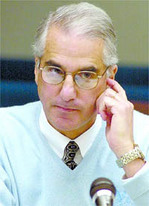
Ann Arbor school board member Randy Friedman
“There’s an expression in retail,” he said. “If you break it, you own it. I’m glad that A2crss.org has made tangible for the community the identity of those, who through their misinformed opposition to the millage created the mess we are in."
He accused the group of putting out “slanderous” material during the campaign about the management of the school district by administrators.
Friedman also took on Albert Berriz, the CEO of McKinley Inc, a real estate firm. Berriz largely bankrolled the campaign of those who opposed the millage.
Friedman said he and Ann Arbor Superintendent Todd Roberts met with Berriz during the run-up to the millage vote to explain the district’s finances and budget.
“He brought almost no constructive, informed input to the table,” Friedman said, adding that he told Berriz to be straight with the public about his motivation for leading the fight against the millage.Â
Friedman said that motivation was saving money on McKinley’s property tax bills since McKinley is one of the largest private property owners in Washtenaw County.
“I simply can’t respect the opinion of people who don’t try to learn before they complain,” Friedman said.
Berriz, who was not at the school board meeting, had a different take on the meeting.
He said he met with Roberts and Friedman to walk them through his five points of transformation he wants to see the district take.
“At that point I had not come out in vocal opposition to the millage,” he said in a telephone interview with AnnArbor.com.
He has previously said he didn’t run his anti-millage campaign to save money on his property taxes.
“My reputation in the community speaks for itself,” he said Wednesday night.
Berriz also said he’s still interested in helping the school district solve its budget crisis. He gave AnnArbor.com a letter he sent to school board President Deb Mexicotte on Nov. 23.
“I would like to submit for your consideration the idea of assembling a Blue Ribbon panel
of financial and business executives to advise you on ways to improve your financial performance and help with your budget issues," it reads. "We have some of the brightest financial minds in the Midwest right here in the Ann Arbor region, and I am certain that if I called them personally, we could assemble a formidable group that would be willing to advise you as to best practices and creative ways to address your current budget crisis. It is my recommendation that this process go on concurrent with the public input process that you intend to start in January.
“I believe the business community is very interested in helping you, and this assistance could be of significant value to you and your team in the upcoming budget discussions you will be having with the entire community.”
Berriz said he hasn't heard back.
Friedman wasn't the only board member to counter-punch against the idea that the district isn't transparent with its finances.
Trustee Glenn Nelson used a copy of the budget, the first-quarter financial report and the district audit to illustrate what he said was a transparent way to track the district’s finances.
Nelson also took on the notion that the district hasn’t been making cuts.
“For people to stand at the podium and act like there haven’t been cuts … is disingenuous," he said. "The cuts are real. The cuts are people who do affect the education of students in this community.”
David Jesse covers K-12 education for AnnArbor.com. He can be reached at davidjesse@annarbor.com or at 734-623-2534.
Comments
Detroit Lion
Sat, Dec 5, 2009 : 4:34 p.m.
Why don't these opposition folks run for school board rather than put together an outside committee to do the school board's job? Sounds like they are trying to save face rather than admit their campaign successfully forcing school boards to make tough, tough decisions that impact kids and the community members that work for the district. As I recall, Ann Arbor itself passed the millage with the voters that did turn out from the city....
Terrin
Fri, Dec 4, 2009 : 10:36 p.m.
Five years ago the value of homes were increasing every year, unemployment was at an all time low, retirement savings were increasing in the double digits, and the cost of health care was manageable. Nowadays houses are worth less then what is owed on them, people have lost their jobs, their retirement savings are gone, and health care costs are way up. The most important change in my view is the value of housing dropping. It used to be the case if taxes got to high, a home owner could sell the home. Nowadays most home owners owe more then the house is worth, so if the taxes get to be too much there is no recourse for many to get rid of the house other then foreclosure. Steve Norton writes, "five years ago we all (voters) passed a special county millage for special education. We did this because we wanted to offer a good education to every student."
skfina2
Thu, Dec 3, 2009 : 10:21 p.m.
I am constantly astonished at people who think that teachers are overpaid. Imagine any other profession (and I do mean PROFESSION, i.e. physician, engineer, lawyer, etc., not skilled or unskilled labor) where someone with an advanced degree and 25 years of experience is limited to a maximum of $80,000 a year. My business school classmates are off making hundreds of thousands, if not millions, of dollars a year, and I am making $54,000 doing a job that many would consider to be more important: contributing to the education of a child (125 of them this year, to be exact). Teaching is not an easy job, contrary to what many uninformed people think, and good teachers are worth every penny. Public education should be financed by the public, not by public school teachers.
DonBee
Thu, Dec 3, 2009 : 6:19 p.m.
Steve - Thank you for your answers, but I want Mr Nelson to answer for himself here, please. If I look at the spending 5 years ago it was $161 million, last year it was $188 million. If I read the audit report correctly - WISD gave the district from the special education millage $19 million and another $1 million in other special education money came in. That makes an add of $20 million for special eduction. If I subtract $20 million from $188 million - I get $168 million, which is $7 million more than 5 years ago and there is a drop of roughly 400 students. In my world if you spend more than you did before, you have not cut your spending. You may be offering fewer services, but the statement everyone is making is that we took millions of dollars in cuts. My problem with it is that none of that shows in the numbers that are public. As to principals - lets see roughly $12 million for principals or approximately $750 per student in the district. So, yes, based on available numbers and quick checking (I will do more work to verify that it is out of line over the weekend) this looks about xx (I will withhold the number until I have more verification I can post) out of line. Again - I hope someone can provide narrative on the audit report so that it is easier to review and people do not make mistakes in how they read it. Thank you again Steve for speaking up - I appreciate someone trying to get the facts on the table.
mmouradian
Thu, Dec 3, 2009 : 5:46 p.m.
I was a teacher in the AA public schools. Most of the teachers I knew had masters and above. I know we are in tough economic times, But we must pay folks for all that added education. I now supervise student teachers and see them choose teaching while carrying a $20-$40,000 debt. Also fewer than 40% of starting teachers continue this job after three years. It seems like we want to lower all pay to the level of third world countries. Maybe we could bring in guest workers to teach our children for minimum wage.
Steve Norton, MIPFS
Thu, Dec 3, 2009 : 4:33 p.m.
@DonBee, Didn't want to disappoint you, but I will have to: I don't have answers to those questions, but district administrators will. Some things worry me (like the underfunded liability for sick days) and other things do not. You mention the cost of principals - I assume you think that is too high? That's as may be, but there is nothing mysterious about it. I do want to address the question you aimed to Trustee Glenn Nelson: how can the district have been cutting the budget when the dollar amount has actually gone up? The answer is really kind of simple: things don't cost the same as they did five years ago, whether it is diesel fuel, building materials, or heath care. Our schools are measured by the programs they offer. If they must reduce services provided to our community in order to balance the budget, I call that a cut, even if the dollar amount of the budget went up slightly. Put another way, the district has had to eliminate $12 million worth of services over the past four years in order to balance their budget. Our student count has declined slightly since five years ago, but then again each child that left took their share of the foundation allowance with them. Our schools' spending is entirely determined by the number of students we have. After years of meager increases, our state's budget problems (which stem from poor tax policy) are forcing us to educate each child with less money for each child. Hard times, yes, but I do not think this is a wise place to save money. In any case, that means we are able to do less for each student. The public meetings in January will be our community's opportunity to decide precisely what we can and cannot live without. One last note: as I have written elsewhere, five years ago we all (voters) passed a special county millage for special education. We did this because we wanted to offer a good education to every student, regardless of the difficulties they may face; we also did it because the legal requirements to provide many of these programs were eating into what could be spent on general education. Most of the increase in the general fund spending over the last seven years, and all of the increase above inflation, is due to the added funds for special ed that pass through the general fund budget.
scooter dog
Thu, Dec 3, 2009 : 4:16 p.m.
I think Ya All otta switch to the decalf
Macabre Sunset
Thu, Dec 3, 2009 : 2:52 p.m.
Why must we compare apples to oranges, though? I fail to see the relevance of comparing Ann Arbor's high-paid professions with Flint's lower-paid professions. What does that give you? And, yes, it's more than a hypothesis that Michigan teachers receive more in pension and health care benefits than teachers in most, if not all, other states. When you factor those in, Michigan's teachers are the best compensated in the country. I'm afraid that the solution to our education funding mess rests squarely on the state and its over-compensation of teachers. Not that they're not worth it, but no one's truly paid what he or she is worth.
Lehigh
Thu, Dec 3, 2009 : 2:18 p.m.
Imply, not apply, sorry. And one more, because why not -- if the hypothesis is that Ann Arbor teachers (or any set of teachers) gets much better health/retirement benefits than another set of teachers, then yes, the analysis is limited. Though hopefully the in-state comparisons are still valid.
Lehigh
Thu, Dec 3, 2009 : 1:56 p.m.
Macabre, good points, but the analysis above tries to do that. Assuming that all teachers everywhere get health and retirement benefits, comparing teacher pay across the metro areas is apples to apples. Similarly, comparing teacher salaries to salaries for all occupations and/or low end occupations tries to control for the effect of education. The analysis shows that if we compare Ann Arbor teachers to all Ann Arbor occupations, teacher pay is not that great -- because Ann Arbor has (had?) so many high-paying jobs. But Ann Arbor teachers still do well vs. the low-end jobs. The point isn't the absolute pay of the teachers, or the absolute ratio of teacher pay to pay for others -- it's where Ann Arbor stands in the rank of 363 communities. Because we're comparing ranks, it's more like-for-like (not perfect, and still quick and dirty, but I think a bit more robust than you apply).
Macabre Sunset
Thu, Dec 3, 2009 : 1:43 p.m.
Because of the effect of union negotiations, we can't study teacher compensation relative to other professions without adding in health care benefits and pension benefits. While it's interesting to compare Ann Arbor incomes to the rest of the country, it shouldn't be done without normalizing for education level. We have many companies (starting with the University) that require more education for that higher pay.
Lehigh
Thu, Dec 3, 2009 : 1:20 p.m.
Sorry, one more comment @Art. The analysis shows that Ann Arbor teachers are paid in about the top 15% across all 363 metro areas. But if we compare teacher pay to pay for all occupations, Ann Arbor teachers in the bottom half of the 363 metro areas. Because Ann Arbor has such a high number of professionals, I also looked at the ratio of Ann Arbor teacher pay to the pay for low end jobs -- and there, Ann Arbor ranks in the top 20% across all communities. So, the Ann Arbor metro area is not top 5-10% in terms of teacher pay. It is top 15%, but then if we compare what teachers make to what other people make in the same community, Ann Arbor teachers are a bit lower on the scale, depending on your point of comparison.
Lehigh
Thu, Dec 3, 2009 : 1:15 p.m.
Art, I should have been more clear -- the rankings I have are *national*, based on the top 363 metropolitan areas. So when Ann Arbor ranks 24th in median educational admin salary, that's 24th out of 363 national metro areas (and also tops in the state of MI).
Lehigh
Thu, Dec 3, 2009 : 1:13 p.m.
@Andrew Thomas: That's a reasonable hypothesis, but one that the data I have can't address very well. The data is broken up by metropolitan area, but that doesn't match school districts. I should have been clearer in my post that the salaries are for 'Ann Arbor metro area' teachers, not necessarily AAPS teachers only (and I don't know how the two overlap). Looking at the median pay for educational administrators, the top 10 metro areas are Nassau/Suffolk County NY, followed by Bridgeport-Stamford-Norwalk CT, Anaheim-Irvine CA, San Diego CA, Chicago, New Haven CT, Newark-Union NJ, Danbury CT, Los Angeles, and Napa CA. Ann Arbor, at 24th, is just behind Edison, NJ and just ahead of Kingston, NY. If I look at the total number of employees evaluated by the OES across all occupations (a proxy for the size of the metro area), the only metro areas *smaller* than Ann Arbor's that rank higher in educational admin pay are: Danbury CT, Napa CA, and Waterbury CT (Kingston NY, just behind Ann Arbor in the educational admin ranks, is about 1/3 the size of the Ann Arbor metro area). Another number I'd like to see comparative data on, but don't know how, is ratio of total administration pay to whole budget, and ratio of total administration pay to total teacher pay, across all Michigan school districts or all nationwide school districts or some such metric. That would give us a sense if not just salaries for admin folks but also the sheer number of admin folks is out of whack.
Art Vandelay
Thu, Dec 3, 2009 : 1:11 p.m.
Lehigh, that's an interesting look at Michigan salaries but what about nationally? A few years ago Michigan teachers were nearly the highest paid in the country, behind Washington DC and Alaska which both had a much higher cost of living. I haven't seen anything recently but I suspect we are still in the top 5-10. This isn't just an Ann Arbor problem, it's statewide and we'll need some help from our inept leaders there to solve it.
tdw
Thu, Dec 3, 2009 : 12:52 p.m.
typical of the school board, blame everyone else for the problems they have caused
Andrew Thomas
Thu, Dec 3, 2009 : 12:38 p.m.
@ Lehigh: Very interesting, informative post. Could you go one step further? Could you examine the relationship between administrative salaries and size of district (based on number of students)? My hopothesis is that, the larger the district, the higher the median salary for administrators. I assume "administrators" includes principals and assistant principals as well as central administrative positions, such as superintendent and finance director. I would expect the principal of a high school with well over 2,000 students to make significantly more than the principal of a high school with fewer than 500 students. Same with central administrators -- I would expect the superintendent of a district with over 15,000 students to make more than the superintendent of one with fewer than 1,000 students.
DennisP
Thu, Dec 3, 2009 : 12:30 p.m.
Mr. David Jesse, with all due respect, you authored the stories that first questioned Mr. Friedman's residency status. You now dismiss that inquiry without any other ado other than to say his legal residence is Ann Arbor. I've searched AA.com for any stories expanding on this conclusion but found none. Can you direct me to the basis for your conclusion? I hope you aren't being deluded into thinking that where a person declares a homestead for purposes of property taxation exemption determines residency. Obviously, that can't be the case because it would leave a lot of renters without a legal residence. For the purposes of election law, a person's residence is defined in MCL 168.11. See: http://www.legislature.mi.gov/(S(0bstj5avxgd520450b2f5145))/mileg.aspx?page=getObject&objectName=mcl-168-11 This is directly relevant to district residency requirement in the School Board member requirement laws at MCL 168.310(2)(i). If you note, MCL 168.11 doesn't define a residence by any single provision. In fact, it states that when a person has more than 1 residence or when husband and wife are separately domiciled--as appears to be the case for Mr. Friedman--residence is determined by where the person spends most of his or her time. That's a question of fact and you've not presented anything to settle that question in any article. So, I cannot see how you can simply dismiss the valid and important question of Mr. Friedman's residency. This is something that needs to be determined by the State Elections Board or by the School Board. You raised the issue, but you've written nothing I can find that justifies such casual dismissal of the question. If you have, please direct me to it so I can rest easier about this issue.
glacialerratic
Thu, Dec 3, 2009 : 12:06 p.m.
Jesse--could you please put information about tonight's meeting in the main body of the article?
Lehigh
Thu, Dec 3, 2009 : 11:56 a.m.
A few comments: 1) While I believe Berriz was completely disingenuous about his opposition to the millage (he was trying to protect his own pockets, nothing less), and while I wonder how much Berriz discounted his rents after Proposal A passed in 1994... Berriz's opposition was not why the millage lost. The millage lost fairly handily, and millage supporters (like myself) need to get over it. I have spoken to people who normally would have been pro-millage but said the idea of funding a tax increase with no concrete plan was ridiculous. 2) The board is better off with Mr. Friedman's active participation in it, and I hope he continues that role. 3) The Bureau of Labor Statistics produces an Occupational Employee Statistics data base -- basically, tracking salaries for numerous job classifications across all major metropolitan areas (including Ann Arbor). The most recent data is 2008 estimates, so it does not reflect the recent economic downturn. But it's the best data available. There are 363 metropolitan areas that have teacher salary information available. The teacher salary information is broken down by elementary, middle school, and secondary. I downloaded the data last night with the hypothesis that Ann Arbor teachers were overpaid relative to their peers. Both average and median salary information is available; I used median salary information to avoid any skewness caused by outsized or undersized salaries. For simplicity, I took a straight average of the median elementary, middle, and secondary salaries (this is definitely quick n dirty analysis). Im also not going to argue about whether teaching is a full-time job like a lawyer or a factory worker thats why everything here is presented as ranks vs. other communities. Out of the 363 metropolitan areas, Ann Arbor teachers rank 46th in median salary. For some comparison, Warren-Troy-Farmington Hills ranks 16th, Flint 53rd, Lansing-East Lansing 64th, Monroe 65th, Holland-Grand Haven 111th, Grand Rapids-Wyoming 133rd, and Detroit-Livonia-Dearborn 173rd. With the exception of Detroit, theres evidence that the more conservative western part of the state has lower teacher salaries. If we look at the median education administration salaries, Ann Arbor ranks 24th -- highest in the state. Warren-Troy-Farmington Hills is 29th, Detroit-Livonia-Dearborn is 61st, Flint is 73rd, Holland-Grand Haven is 111th, Monroe 124th, Lansing-East Lansing 134th, and Grand Rapids-Wyoming 143rd. Thats the first WOW finding. Yes, Ann Arbor teachers draw a fairly high salary relative to the 363 metropolitan areas. But the Ann Arbor education administrators are faring even better. Ann Arbor has the highest paid education administrators in the state, according to the OES data. But median salaries of the positions are only part of the story. Its not so much how much teachers or administrators are paid, but how much are they paid relative to the rest of the community The OES data handily includes a classification that includes All Occupations. If we compare the median teacher salary to the median salary of all occupations, Ann Arbor ranks 232nd out of 363 metropolitan areas. So while Ann Arbor ranks high on teacher pay, it ranks even higher on pay for other occupations. Bay City (20th) has the highest ratio in the state of Michigan; relative to people in other jobs, Bay City teachers are the best-paid teachers in the state. Flint is 48th, Warren-Troy-Farmington Hills is 68th, Monroe 71st, Holland-Grand Haven 124th, Grand Rapids-Wyoming 190th, Lansing-East Lansing 206th. The pattern for education administrators is similar; for Ann Arbor, the ratio of education administrator pay to the pay for all occupations ranks 174th out of 363. Administrators still make out better than teachers, but Ann Arbor is not where administrators do best relative to all other workers (move to El Centro, CA if you are an administrator and want to make more than any other job in the area). But, you may argue, Ann Arbor is a highly professional, highly educated town, and we shouldnt use all occupations as our gauge to see how well teachers are paid relative to other jobs. What if we compare teacher salaries to those for low-end jobs? Three low-end jobs with a high number of employees are cashiers, food service, and personal care/service. I took the straight average of those median salaries, and compared them to teacher salaries for the 363 metropolitan areas. Warren-Troy-Farmington Hills ranks 6th out of 363 meaning that only five other metropolitan areas have teachers with higher salaries relative to the pay for low-end jobs like cashiers and food service. Flint is 19th, Monroe 32nd, Lansing-East Lansing 40th, and Ann Arbor is 71st. Holland-Grand Haven is 136th, Grand Rapids-Wyoming is 146th. If we look at the ratio of median education administrator salary to low-end job pay, Warren-Troy-Farmington Hills is 21st, Flint 23rd, Ann Arbor 32nd, Monroe 91st, Lansing-East Lansing 111th, Holland-Grand Haven 134th, and Grand Rapids-Wyoming 167th. Once again we see Ann Arbors education administrators making out better than the teachers. Again, this analysis is based on 2008 OES data; salaries since the economic downturn have not been included. But the clear conclusion from the data is that its the education administration salaries that are the most outsized relative to peers. To sum up: -Based on raw data, Ann Arbor teachers are paid fairly well relative to teachers in other communities (45th out of 363 metro areas) -If we compare teacher pay to pay for all jobs in a community, however, Ann Arbor teachers are below average (232nd out of 363 metropolitan areas in the OES data) -If we compare teacher pay to pay for low-end jobs in a community, Ann Arbor is in the top 20%, at 71st out of 363. -Ann Arbors education administrators fare much better. Relative to administrators in other communities, Ann Arbor administrators rank 24th in pay, about average in pay relative to all occupations (174th out of 363), and in the top 10% in pay relative to low-end jobs (32nd out of 363). So, if compare teachers to other jobs, Ann Arbor teachers arent paid quite as well as we would think if we just look at their average salary. Im not saying that teachers shouldnt have to open up their contracts and make concessions; I think they should. But I certainly believe, based on this data, that the pay for Ann Arbor's education administrators deserves more scrutiny.
texorama
Thu, Dec 3, 2009 : 10:05 a.m.
Friedman's comments about Berriz, who for goodness' sake was a primary backer of the recent greenbelt millage, show how far out of touch the school board is. The people have spoken, and the cozy times are over. The county board, it seems to me, worked out a reasonable solution with its unions, and it is time for the board to do its job and do the same -- or resign and let someone else do it. Hearing constant invective in place of solutions is deeply disappointing.
schoolsmuse
Thu, Dec 3, 2009 : 10:02 a.m.
Just yesterday, I put up some posts regarding what we mean when we talk about transparency in the public schools. You can find them here: bit.ly/4uQldn a2schoolsmuse.blogspot.com
jcj
Thu, Dec 3, 2009 : 9:40 a.m.
Mr Emsayin I also like to see teachers out in the community "shopping, dining, attending local and school events" But I also would like to see kroger employees, auto workers, fast food workers, mechanics and retirees be able to do these things. The difference is these workers don't get raises based solely on their years of employment! With little regard to performance!
Dr. I. Emsayin
Thu, Dec 3, 2009 : 8:19 a.m.
Mr. Vandelay, One thing I like is seeing our public school teachers out in the community, shopping, dining, attending local and school events. When teachers can afford to live in Ann Arbor, they can be more part of the fabric of the community. In districts where few teachers live, there is clearly less of an overall investment in the ongoing life of the community. Ann Arbor has a high cost of living, teachers deserve to have pay commensurate with that so they can live and educate the children in the manner to which their families are accustomed. I enjoy my teacher neighbors and so do the children.
Art Vandelay
Thu, Dec 3, 2009 : 8:02 a.m.
The budget problem doesn't need more transparency or forensic audits. It can be easily solved by moving the unionized teacher's pay closer to a market wage. Some help from Lansing would help by cutting the defined benefit pension, but the board could have easily solved this year's budget if they had held off on spending the hoped for money on teachers first and then screaming poverty when the inevitable cuts came in. When we can't find qualified teachers then we can talk about raises again. Let's not follow the UAW and Big Three with our kid's education system.
susan
Thu, Dec 3, 2009 : 7:50 a.m.
Albert Berriz thinks way too highly of himself and his "reputation". The millage probably would not have passed whether he "bankrolled" the opposition or not. The no voters had already made up their minds way before Mr. Berriz came along. He gives himself way too much credit and his ego gets in his way.
David Jesse
Thu, Dec 3, 2009 : 7:42 a.m.
Two notes: Randy Friedman's legal primary residence is in Ann Arbor. Secondly, DagnyJ, the board will hear from the administration tonight at 5:30 p.m. in a public meeting about recommendations for budget cuts for this year. I'm planning to attend and will post a story as soon as possible. The public can also attend. It's at the district's headquarters on State Street
DagnyJ
Thu, Dec 3, 2009 : 7:13 a.m.
It's nice that the board feels all feisty and angry at millage opponents. But...how about getting to work on the budget, and telling the public about planned cuts?
DennisP
Thu, Dec 3, 2009 : 7:08 a.m.
Now, I'd like to address this particular story. It seems to me that Mr. Friedman is taking to berating those who opposed a county-wide millage solely because they could mount an effective opposition to a large tax increase that resonated with county voters facing harsh economic trials in the worst recession since the Great Depression. This millage was proposed to the WISD initially and unilaterally by the AA school district to help it out of financial difficulties that were created well before the millage was ever a ballot issue. I wasn't at the meeting but assuming Mr. Jesse's reporting is accurate, it's brazen for Mr. Friedman to blame those citizens for "the mess they are in" while ignoring the actions of Gov. Granholm's political line item veto fiasco and the district spending over the years that brought it to the point where it desperately needed the millage. All citizens have a right to oppose a millage, these citizens did so publicly and without equivocation. Their demands were simply to insist the board address expenses in the type of reasoned manner that "Don Bee" above seems able to do before it came to the taxpayers seeking a millage as if it were an entitlement by right. I get the impression that Mr. Friedman arrogantly excoriated these citizens for exercising their right to oppose a ballot item and impugned them by alleging "hidden interests". Of course Mr. Berriz wants to keep his taxes reasonable, what's wrong with that? And all the county residents knew it. Somehow, Mr. Friedman seems to think we'll fall for his implication that Berriz was driven by rank profiteering while the Board was solely motivated by a holy altruism. The fact is none of the people Friedman complains of could successfully mount an opposition campaign if it didn't comport with the opinion of the large majority of voters. For the record, while initially opposed, I voted "for" the millage despite the efforts of Mr. Berriz and others but, unlike Mr. Friedman, I fully understand why many voted against it and don't resent them for it at all. Mr. Friedman, you are now being called upon by the citizens to do the hard work that the board avoided over the years. Rather than grouse and point fingers, roll up your sleeves and do it. I dare say that with today's economy, I doubt that Mr. Friedman could even wage a successful campaign for a tax increase in his "other" home--Birmingham-- let alone Washtenaw...even with the big income tax deduction on property taxes he and the other high rollers there would enjoy.
Commoncents
Thu, Dec 3, 2009 : 7:01 a.m.
Don Bee is the truth.
DennisP
Thu, Dec 3, 2009 : 6:54 a.m.
What is the current status of the question of Mr. Friedman's residency? This issue was brought out by AA.com on 11/18 but it seems to have died. Before people shout that this is not relevant to the article, I believe his residency is a valid issue regarding any and all actions by Mr. Friedman because State law requires him to be a resident else his position becomes IMMEDIATELY vacant by operation of law regardless of the actions of the school board. See MCL 168.310(2)(i) at: http://www.legislature.mi.gov/(S(4q1fpd4544ady1nelwx40555))/mileg.aspx?page=getObject&objectName=mcl-168-310 I'm not questioning Mr. Friedman's abilities nor his dedication to the district, but this is a serious issue and, I've not heard that it has been officially resolved. The actions of the board become suspect and possibly void if the legal residential status within the district of one of its members is unclear. From today's articles, Friedman will vote on budget allocations, school board election cycles, etc. On any close vote where it can be said his is a deciding vote, that action can be challenged in a court of law. At any meeting where his presence is needed to meet a quorum to conduct business, it can be said the meeting is inherently void. This question of residency is not merely a matter of appearances, but has legal implications and needs to be clarified if it hasn't already been done so by the Board.
Basic Bob
Thu, Dec 3, 2009 : 5:56 a.m.
Now that we have a brand-new half-full high school AND the enrollment has declined, they should be looking at some consolidation at the high school level. The question when Skyline was built was whether the district could afford to operate the additional building without increasing costs. Since it is not practical to close one of the three large high schools, what can be saved by closing Community High School? The school board needs to quit griping that they didn't get the WISD bailout, and direct the administration to make the necessary cuts.
DonBee
Thu, Dec 3, 2009 : 12:25 a.m.
I have read the audit report. I also looked at the auditor's presentation. I am disappointed with the presentation, it lacks detail and narrative. In looking at the audit report several items jump out: - the underfunded liability for sick and vacation days - the fact that the daycare and rec&ed do not break even - the very small amount of adult education for the community (both in revenue and expenses) - the cost of athletic directors at the 3 high schools - the cost of principals - the fact that the electric bills exceeded budget in a year when wholesale prices of electricity were down - not up There is no narrative in the audit report (and I would not expect one) for why these costs are where they are. There is none in the approved budget and no notation in the quarterly reports (that I can find) for the variation on the electric bills. Numbers alone do not explain why they are what they are. If Mr Friedman is really interested in an open and transparent discussion, I would hope he would provide narrative to go with the audit report and a clean PDF of the 2009-2010 budget. Until then I will stumble through what is available and draw my own opinions. I know Steve will respond to this, I hope he does so with clear narrative on these items. I did not put numbers here because I don't want to suppose anything. I just find these lines interesting in a first and second read of the audit report. I look forward to an open and spirited discussion of these items. Please note I am not picking on the classrooms here (other then the utility bills) but overhead. If I read the article above right and my math is right, overhead is still over 40% of the total spent by the district. It is in that 40 percent I hope the school will concentrate their cuts. As to the comment by Mr Nelson - I have one question - since the total number of students in the district has declined in the last 5 years in absolute numbers and the total expenditures in total dollars have increased - please explain how the expenditures have been cut? Not the budget - what people wish to spend, but the real expenditures - what people did spend. I see in the numbers AAPS provided an increase in real expenditures and a decrease in student count. If I am wrong in what I see Mr Nelson, please correct me. Thank you to all. I appreciate the work and digging that is going on. OBTW - I am not allied with any of the organized groups, have not talked to any of them and do not read their materials. I am an independent minded citizen who is willing to dig and ask questions. Again if any of my writing is misinformed, please correct me.
Macabre Sunset
Thu, Dec 3, 2009 : 12:02 a.m.
Astonishing. Friedman blames the mess rampant spending has placed the district in on the people who opposed massive tax increases to bail them out. The people spoke. They want the school board to cut costs. There are plenty of people out there who can help them do that, but it sounds like Friedman is willing to put the district under instead.