

Ann Arbor school officials consider alternatives to cutting bus service for high schoolers
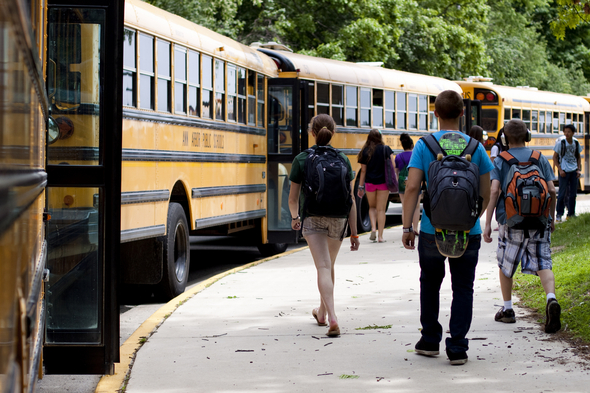
Huron High School students walk to their buses after school on Friday afternoon. The budget calls for eliminating all busing for high school students next fall, but the school board is looking at other alternatives.
Jeffrey Smith | For AnnArbor.com
Trustees were presented with a number of options to achieve the $1.482 million in savings that would come from eliminating bus transportation and after-school shuttles for high schoolers. On the list of alternative solutions was enforcing a board policy requiring a half-mile "walk zone'' around bus stops, meaning there should be at least a half-mile between any two bus stops. Applying the policy would save the district about $500,000.
Interim Superintendent Robert Allen said district administrators were not aware the board policy wasn't being followed and made that the top recommendation to the board.
“The assumption was all those policies were being enforced,” Allen said. “When we went back and looked at the distance between the stops, we found some inconsistencies, so that’s what triggered, ‘Let’s go back and look at all of it and see where we can make it more consistent.’”
Among the other solutions proposed by Allen at Friday’s meeting were:
- Eliminating noon-hour transportation, which would result in morning kindergartners not being brought home and afternoon kindergartners not being brought to school, a savings of $400,000.
- Widening the walk zone around school buildings from 1.5 miles to 2 miles, meaning students who live within two miles of their school would not receive bus service. That would save $800,000.
- Having a single, common bus stop for a larger area, rather than several bus stops in that area, which would save about $670,000, including fuel.
Trustees were also presented with a plan by administrators to add 7.2 full-time teaching positions back into the budget to help limit the increase of class sizes. The current budget proposal includes eliminating 70 full-time teaching positions.
No final decisions to include the proposals in the proposed budget were made Friday during the study session. Board members will vote on the proposed budget on Wednesday. The meeting also featured a discussion on possible revenue drivers.
Administrators said parents are already required to be with their kindergartners at the bus stop when students are picked up and dropped off, so the elimination of transportation for that group would not affect as many families. About 228 students use those services, officials said.
District spokesperson Liz Margolis said widening the walk zones around school buildings would have a greater effect on elementary school students than any other group. She estimated 50 percent of elementary school students, 30 percent of middle school students and 20 percent of high school students would be impacted.
Trustee Andy Thomas was among the board members who said they wished they had more data to base their decision on. He said he wanted the board members to announce a major change in transportation would come in September 2012 instead of September 2011 and take a year to figure out what the best options would be.
“There’s a lot of room for discussion and figuring out some approaches to this but I’m not all that comfortable with trying to implement this for three months from now,” Thomas said.
Board President Deb Mexicotte said one of the reasons she was originally comfortable with the cut to high school transportation was because of the various ways high school students can get to school.
She said high school students could drive, carpool, take public transportation such as the Ann Arbor Transportation Authority or walk to school in a much safer fashion than younger students.
Mexicotte emphasized she definitely did not like having to consider these types of cuts and the possible effects they could have on the district’s future.
“I’m scared to death of this budget, I’m scared to death of the state (government) and I’m scared to death of the fund equity,” Mexicotte said.
Part of the issue in making budget plans is the uncertainty over exactly what funding local districts are in line to get from the state.
The state Legislature passed a school aid budget last week that included a new $300 per pupil cut, a $170 per pupil cut from last year that was not restored and a number of provisions to restore $100 per pupil in funding. Retirement costs are expected to go up by $230 per pupil, but the budget passed by the Legislature allows for a one-time $100 per pupil increase in funding to help with retirement costs.
If the Ann Arbor school district was to qualify for the $100 per pupil increase for meeting state best-practices, that would mean about $1.4 million would come back to the district. The retirement payment means the district will receive about $2.6 million back from the state.
Allen said he understood the state’s motivation in offering these payments to districts but said he was concerned that the details might actually prevent districts like Ann Arbor from reaping their benefits.
“I see the spirit of what they’re trying to do but there are some details where I don’t want them to penalize districts that have gone beyond (what they’re proposing),” he said.
Kyle Feldscher covers K-12 education for AnnArbor.com. He can be reached at kylefeldscher@annarbor.com or you can follow him on Twitter.
Comments
Andrew Thomas
Sun, Jun 5, 2011 : 3:24 a.m.
I normally stay out of these on-line discussions, but I feel the need to address a suggestion made by several posters that the District charge a fee for use of transportation, with a fee waiver for kids eligible for free or reduced lunch. I agree that this is a very sensible suggestion. Unfortunately, in Michigan, state law specifically prohibits districts from doing this. We have looked, and there does not seem to be any way around this law.
Kyle Feldscher
Mon, Jun 6, 2011 : 2:55 p.m.
Andy- Thanks for replying with this, I've been away from my computer and was going to jump in and post the same thing. Thank you.
AMOC
Mon, Jun 6, 2011 : 12:41 a.m.
Thanks for the clarification, Andrew. It would have been a useful bit of background information to have included in the discussion during the board meeting too. Perhaps it was, and AnnArbor.com didn't include that in their summary of the discussion of this issue.
jns131
Sun, Jun 5, 2011 : 5:04 p.m.
Time to do what Massachusetts is doing? No buses unless you pay $500 a year? Sounds reasonable to me. Especially if you are paying this to play varsity sports. Yes, it is $500 to play varsity sports. I know. Ours wants to play in one and I am shuddering at the price tag.
Beth
Sun, Jun 5, 2011 : 1:31 a.m.
Would there be a way to have families who want/ need to use the school bus service pay a small fee? And offer free/ reduced rides as well, similar to the free/ reduced lunch system? I really don't know how this would work logistically, but I know I'd personally rather pay for a bus service than see further cuts to the classroom.
tim
Sat, Jun 4, 2011 : 11:41 p.m.
Kids in the 9th and 10th grade ( before their 16th birthday) are going to have a hard time getting around. If there are going to be restrictions maybe it should be on kids that can drive.
jns131
Sun, Jun 5, 2011 : 5:03 p.m.
At age 14 and 9 months they can drive if a parent or someone responsible is with them to drive. At age 15 they have a restricted license until age 18. Ours will be driving at 14 and then at 15. Has to happen because this AATA dance is getting real old real quick.
Eileen Peck
Sat, Jun 4, 2011 : 11:36 p.m.
School transportation isn't required by law, except in narrow circumstances but public schooling is. Each school district gets a fixed amount per-pupil. Therefore, every dollar spent on transportation is a dollar taken away from the classroom. *If* you had to choose between the two, would you sacrifice the classroom for the sake of the bus system, or would you sacrifice the bus system to improve what goes on in the classroom? Under the circumstances, having families pay to use the school bus seems astonishingly reasonable.
John Q
Sat, Jun 4, 2011 : 11:01 p.m.
Isn't it funny that the people who balk at funding or using public transportation come out of the woodwork in support of .... public transportation.
Cash
Sat, Jun 4, 2011 : 9:38 p.m.
Why worry about money??? Just use this fund raising video....it worked for the Snyders....it could work for US!!!! <a href="http://www.youtube.com/watch?v=jAfBHj9Lc8E&feature=youtu.be" rel='nofollow'>http://www.youtube.com/watch?v=jAfBHj9Lc8E&feature=youtu.be</a>
skfina2
Sun, Jun 5, 2011 : 3:39 a.m.
Oops, I meant <a href="http://www.firericksnyder.org" rel='nofollow'>www.firericksnyder.org</a>!
skfina2
Sun, Jun 5, 2011 : 3:38 a.m.
Yes, apparently $17,000 per student is not enough money to educate Governor Snyder's kids, but $7000 per student is just fine for the public school students in my district. And apparently small class sizes are only for the fortunate few. <a href="http://www.firericksnyder.com" rel='nofollow'>www.firericksnyder.com</a>
lionslover
Sat, Jun 4, 2011 : 9:18 p.m.
something I found interesting today...if you go to freep.com and click on the article "about the recall effort underway targeting Snyder and 12 GOP'S - you'll notice there have been upward of 220 comments expressed by readers. By my count only about 20% of those comments would have made it through the A2.com's North Korean style political censorship gang. It's a real shame that we as citizens can't comment honestly in this poor excuse for a newspaper. It's also a real shame that in this moment in our beloved country's history that we as a state are subtracting from rather than adding to our public education system. talk about short sightedness - this is - in my opinion - a terrible way to prepare our young people to compete in the new global economy. At least the effort in Ann Arbor is staying focused on finding ways to cut without effecting the quality of education too directly, but busing kids to school who live outside the city limits is pretty important also- it seems. Tough choices with this new Gov. - unless you're a business/corporate leader.
My A2 cents
Sat, Jun 4, 2011 : 8:27 p.m.
I believe that there is a strong connection between school attendance and academic achievement. If AAPS is serious about academic achievement then it has to continue to invest in the transportation to ensure that all students will be able to get to and from school each day.
Jon Saalberg
Sat, Jun 4, 2011 : 5:54 p.m.
I guess our esteemed school board is encouraging more teenage driving at rush hour - given the high rate of youth crashes per miles driven, compared to any other age group, this seems like a pretty poorly thought out plan. I also must assume that none of the Board are concerned about the difficulties that many, many parents are going to have getting their kids to school. Why not eliminate all bus service, while you're at it? Why just pick on high school kids - most don't have their own cars, and many do not have a driver's license. Why not make all parents and children share this burden equally?
Elno Lewis
Sat, Jun 4, 2011 : 5:23 p.m.
I have an idea. Get some external auditors to go through the list of administrative/non academic type employees and determine which ones are essential and which ones are not. It seems to me Ann Arbor Public Schools has more white collar welfare going on than you can shake a stick at. I would love to see the Public Schools organization chart published in some newspaper, maybe even this one. Then perhaps the citizens could see where their tax dollars are going that necessitates the removal of bus services for their children--which is essentially just another TAX on said parents in that they will have to encumber further expenses/inconveniences due to....having to pay for unidentified administrative fat.
DonBee
Mon, Jun 6, 2011 : 12:20 a.m.
Here is a fun one Mr. Lewis - Try to file a freedom of information request for this information and find out how far the schools will go to keep you from getting it. They will (even without names in the boxes) tell you it violates privacy laws to give it to you.
ViSHa
Sun, Jun 5, 2011 : 1:16 a.m.
excellent idea!
lefty
Sat, Jun 4, 2011 : 4:37 p.m.
InsideTheHall, it was decided to give education LESS money and MORE to business. You have your more in the wrong place.
MissMagic
Sat, Jun 4, 2011 : 4:33 p.m.
No, teens can't carpool to school. With the new Michigan driving law, teenagers holding a level 2 graduated license (mostly teens around 16 years old) can only legally have one other passenger in the car. So sure, there can be two teens in a car, but that's hardly carpooling and will not be more efficient than having bus service.
InsideTheHall
Sat, Jun 4, 2011 : 4:29 p.m.
This is what happens when teachers become part of the ruling class. School costs are dumped in the parental lap. It is high time for the teachers to decide, are they for kids or are they a typical union that knows but one word....MORE!
AMOC
Mon, Jun 6, 2011 : 12:37 a.m.
sh1- Their step increases (automatic raises for seniority and additional grad school credits), for one. Those were budgeted at $1.6M for the 2010-2011 school year. While the AAEA agreed in the last negotiations to freeze the pay at each step, the teachers who continue to have jobs continue to get raises every or every other year.
sh1
Sat, Jun 4, 2011 : 8:25 p.m.
Not sure what you're talking about. What "MORE" did the teachers get that took money from transportation?
lefty
Sat, Jun 4, 2011 : 4:19 p.m.
Lets see, not enough money to safely transport our greatest assets...maybe business with an extra 1.8 billion could lend the company car! Remember why there are cuts, its business over students and education!
lynel
Sat, Jun 4, 2011 : 4:07 p.m.
I'm not too too old. I walked home from Eberwhite to Snyder Street near Main both after school and at lunch time, BUT in those days parents weren't afraid for their children to be unsupervised. Times have changed!
xmo
Sat, Jun 4, 2011 : 3:54 p.m.
One way to save money, save the planet and save our children s to eliminate the bus service all together! We could save $1.482 Mill by not having the bus service, Save the planet by not have "GREEN HOUSE " gas from the buses go into the atmosphere and by making our children walk to school they could lose weight and get their exercise for the day! As cruel as this sounds, this is what our grand and great grand parents had to do. So stop babying the kid and lets make them tough!
DonBee
Sat, Jun 4, 2011 : 8:46 p.m.
xmo - Tomorrow morning at 6AM start walking from Gotfredsen and Plymouth-Ann Arbor to Huron. Please note the following: 1) There is no where to get off the road at 3 bridges. 2) There is no time to cross Ford Road given the traffic signal timing 3) There is no good way to cross US-23 as a child on the existing overpass 4) There are no marked cross walks at the first 2 stop lights after you get into Ann Arbor proper 5) The first place you can actually use a sidewalk is after you get to Green Road 6) Note that the posted speed is 55, but the average car is going 65 to 70 MPH Now tell me, even if it was not almost 7 miles each way, would you want a 14 year old walking this on an icy winter morning in the dark?
Beth
Sat, Jun 4, 2011 : 5:56 p.m.
XMO, this only works if your neighborhood's school is close to you. We are 5+ miles from our elementary school, with no AATA service, and many other Scio and Pittsfield Twp. residents are in similar situations.
Bob Heinold
Sat, Jun 4, 2011 : 2:50 p.m.
Why not extend the AATA option by adding feeder buses to commuter parking areas from which students could be picked up? As far as the K-6 students, still use feeder buses but have volunteer monitors on both legs. Charge the family's a minimal fee for pass cards that supplement any AAPS subsidy to AATA. Bob Heinold
A2Dave
Sat, Jun 4, 2011 : 2:32 p.m.
Mike Gatti: Of course we are. Elect Republicans and you can expect our kids, our elders, the sick, and the working middle class to pay the freight. You get what you vote for. Michigan has done this to itself. Schools, roads, infrastructure, health care-- all will suffer to increase business profits for owners and investors. You get what you vote for.Enjoy!
Greg Gunner
Sat, Jun 4, 2011 : 1:57 p.m.
Let's see if I have this right. The Ann Arbor Schools are planning on saving money by putting their students at risk? It sounds pretty consistent with Slick Rick's education policy. Afterall, according to Slick Rick, it's better to have a few more millionaires than it is to provide our children with the best education possible. To sum up the policy it is to shove more children into a classroom (Anyone can teach 30-35 kindergarteners at the same time, right?), pay their teachers less (Those teachers are way over-paid anyhow. Did you know some of them can actually pay their bills and live a middle class lifestyle if both husband and wife work.) , eliminate public transportation (Those kids need the exercise anyhow. Let them walk.), etc., etc. It's pretty obvious that this administration and its supporters place little value on the lives of our children.
cette
Sat, Jun 4, 2011 : 1:54 p.m.
What do people do right now with their kids in the township, leave them alone until the busses come? Door to door service? Where's the parents at 6:30 in the morning, that they can't drop off the kids at a designated drop off place for a 7:00 oclock pick up?
AMOC
Mon, Jun 6, 2011 : 12:32 a.m.
Cette- The HS buses in the townships start their pick-ups at 6:15 am, so unless the parents both work rather early shifts, everyone leaves the house at the same time. For the elementary kids, where the pick-up time was 8:30 am or so, we hired an early-morning and after-school sitter to see the kids onto and off the bus, or arranged staggered work shifts for the adults in the family. That second one is only feasible for people who have flex-time available with their jobs.
Christy Summerfield
Sat, Jun 4, 2011 : 1:44 p.m.
This is such a complicated issue. I had 5 kids go through AA Public Schools. First, it seems infinitely reasonable to me that parents pay a small surcharge so that buses will pick their kids up relatively close to home--cheaper than a car or parents driving their kids to school & probably less than public transportation. Parents pay for athletic equipment & other things their kids need that can be labeled nonessential. Second, with the incredible amount of research we have showing that high school starting times are too early for kids that age who need more sleep than elementary school kids, it boggles my mind that we refuse to change the H.S. starting time. My kids never got enough sleep & I swear they sleepwalked to the bus stop in the morning. And it's very dark that early in the morning in the winter. Third, I'm firmly convinced that high school & middle school kids would behave responsibly with elementary school kids on the bus with them. Most older kids have a tendency to step up & take care of younger ones & I believe they would deal with their peers who don't display that care. It's at least worth a try. I admit I don't know how many school buses would have to be added in order to pick up kids of all ages at the same time. Perhaps we could start with just high & middle school kids on the same bus. I believe more elementary school kids go to neighborhood schools that are fairly close to their homes. Fourth, in theory I don't see anything wrong with older kids walking a reasonable distance to school or a bus stop if it's not in the dark. Kids sure need more exercise & it's up to parents to make sure their kids walk in a group. We live in a town full of intelligent people who can certainly work this out for the benefit of our kids.
DonBee
Sat, Jun 4, 2011 : 1:30 p.m.
So here is the $1 million dollar question. Some parents will have to drop off students prior to the building opening, and some will have to leave students at school well after the school is over to pick them up. Right now the buildings are closed, students who are not in organized activities are kept out of the building. Will the district force those students to stand outside for an hour or more in sub-zero weather? How much publicity will it take before they have to provide staff to allow the students into the building? Given the change to busing, there are several alternatives (in our case, the Plymouth-Canton bus starts its route about 500 yards down the road) - how many families will choose an alternative high school situation (either another public district, a private school or the new charters)? Then the real issue - regardless of the decision to stop high school busing, there are Federal and State laws that cover special needs children and other students that are in special categories. Is the district going to hire taxies, run vans or run buses to pick these students up? While they may be talking about no high school busing, Federal Law will mean a number of students will still get busing. With the 3 of these issues, will they really save any money when it is all said and done? Really?
kms
Sat, Jun 4, 2011 : 1:04 p.m.
Does the BOE have statistics on how many students actually have cars to drive themselves to school? Most parents can probably figure out a way to get their kids to school in the morning, but how many can leave work at 2:30 in the afternoon to pick them up? I foresee a huge loitering problem after school as kids wait, possibly hours for a ride home. We live outside the boundaries for AATA so that's not an option for us.
KJMClark
Sat, Jun 4, 2011 : 1:04 p.m.
These proposals seem much better to me, though the district would have to give more thought than they usually do to where the stops go. -M Gatti - When I was a kid, we had one bus stop for our neighborhood for Jr. High and High School. The walks for kids in the neighborhood were up to 1/2 mile to get to the bus stop. This was Wayne/Westland schools, and I can point you to the neighborhood on google maps. - Assuming that we're talking about high schoolers here, I don't see anything wrong with walking a mile and a half in sub-zero weather. We're just under a mile from Northside and we've walked/biked it in subzero weather with our kids the whole time they were in elementary school. My wife and I bike to work in subzero weather every year. No problem. - The real problem for these longer distances is lack of safe walking/biking routes. This is partly the school district's fault. They keep siting high schools in lousy places for walking/biking, and then do next to nothing to support kids who walk/bike. For instance, they typically clear their parking lots before most of their sidewalks in the winter. They do next to nothing to push the city to provide safe walking/biking routes. The only safe routes to school action is due to the city and concerned citizens. I'd like to see the school board members walk/bike two miles to Skyline in the dead of winter every school day for a month. Then they'd have some basis to decide what's reasonable. They're adults - they should be able to handle it.
LarryJ
Sat, Jun 4, 2011 : 1 p.m.
It's not right to expect kids to walk 1/2 mile in winter to the bus-stop. Maybe 1/4 mile. And it's certainly not right to expect kids who live 2 miles from the school to walk both ways every day. Take away the bus service, and it generally means a parent needs to find a way to NOT be at work. Our whole society becomes less efficient. And how is a single parent going to handle this? Who is going to speak up for the bus drivers? These are generally people of modest income. Their pay goes straight back into the community. We are a society of enough wealth to afford buses for a kids. Yes, raise the taxes.
babmay11
Sat, Jun 4, 2011 : 5:50 p.m.
You can't expect kids to walk 1/2 mile in winter? Are you serious? Have you not grown up in Michigan? I walked, rode my bike, or got rides with friends the 2+ miles I had to go for high school (Midland). Seems like kids are really soft or somewhat spoiled these days. Whomever mentioned the obesity epidemic among kids might have something there.
lynel
Sat, Jun 4, 2011 : 2:21 p.m.
If the bus stops every 1/2 mile no one would walk more that 1/4 to get to a bus stop.
jns131
Sat, Jun 4, 2011 : 12:57 p.m.
I had to walk 2 miles to school every day. No big deal there. Would also help the obesity problem as well. I do know that up near Nixon and Plymouth there were a lot of 100 feet stops. The other alternative would be to eliminate hi school busing for those that can get an AATA bus. For those that can't? Designate a time and place parents can drop theirs off at. I remember a bus stop like that years ago. Otherwise, hi school busing will get the axe. Just like they did to transportation late one evening a year ago June. The board will do what the board wants to do and there isn't anything anyone can do about it. Good luck drivers having a job in September. Ours will start driving as soon as possible so we don't have to continue the transit bus dance. The other thing that sucks about AATA? You have to physically walk in and get a student bus pass. They won't do this on line.
Dr. I. Emsayin
Sat, Jun 4, 2011 : 12:09 p.m.
There was a failed millage that asked families to pay less than the price of a car, less than the cost of insurance, less than the gas it would take to drive a few miles to school daily for a year... but the county turned it down. When class sizes increase, when language offerings decrease, when administrators are cut, parents cry foul. But some misinformed folks vote against a millage because they think it goes into the pockets of teachers who are grossly overpaid. These teachers pay for their required master's degrees, their travel to conferences, and every school related expense. Any other private sector employee as highly educated makes more money and very likely has less stress and gives less back to society than a teacher does. It may be time to look at asking those citizens with property to give a little so those who cannot afford personal transportation can get to school, and those who wish to learn a language other than Spanish can take it in their school. The cuts to language and school libraries and vocational and elective programs will impact all of society. Taking elementary library time from the children who enjoy reading new books and from the children who need extra one on one help that the librarians give is no way to cut the budget. We citizens can't tell you where to cut because we don't know where the hidden money is, but I've been in the administration building and I would like to get a thorough review of all of the money that is spent there and for outside consultants for BOE and cabinet retreats.
Edward R Murrow's Ghost
Sat, Jun 4, 2011 : 10:28 p.m.
Better question: Where does DonBee get his numbers? He throws them around like candy, but he NEVER provides the source of those numbers. Given past practice, they are not to be believed without links. Good Night and Good Luck
macjont
Sat, Jun 4, 2011 : 9:42 p.m.
Question: where does DonBee get his information about what or how the "average citizen feels?" I suspect this is what DonBee feels. And who or what is "the average citizen?"
DonBee
Sat, Jun 4, 2011 : 8:39 p.m.
sh1 - The millage was not about spreading anything. It was about more money and power, not actually fixing anything. As to teachers, I have never advocated teachers get paid less. We could easily match Plymouth Canton on administration cost per student and save $4 million or work to the state median and save $6 million. We could eliminate PEG and save another $400,000 a year, we could focus the sinking fund money on the actual classrooms and supporting building rather than spending $600,000+ on football stands. We could... It does not have to come out of the teachers salary. But remember most of the tax payers that you are asking to keep your salary and benefits the same have seen major drops in salary, overtime, increases in health care costs and dramatic drops in the value of their retirement funds. In short they have little sympathy for someone who is paid with tax dollars and does not want to contribute to making the budget work. Right now the average citizen feels better about the custodians than the teachers when it comes to compensation.
sh1
Sat, Jun 4, 2011 : 1:56 p.m.
@Don, I was just asking what is more fair, spreading the cost over an entire county or just spreading it out through the teaching staff.
DonBee
Sat, Jun 4, 2011 : 1:23 p.m.
That millage was poorly explained, budget numbers were not offered to the public for review and the need was not established. The Education professionals assumed they would have no opposition and they could do business as usual. Now they are hiding numbers again (OBTW - did you know that special education got $2 million dollars more this year than last year from state and county sources?) and not posting information they promised the public. And you expect the public to be ready to pass more millage. The busing and teacher layoffs are intended to make parents angry and ready to go to the polls and pass a millage, they are not the smart choices to manage the costs of the schools, rather they are the political choices to get more funds.
jns131
Sat, Jun 4, 2011 : 12:59 p.m.
And the children lost a great bus driver to ones who do not care and do not get paid enough to care. What a waste of a vote to keep things the way they were.
sh1
Sat, Jun 4, 2011 : 12:34 p.m.
I'm still surprised by people who weren't willing to spread the costs out over the entire county but still think it's fair to spread those same costs out among the teaching staff.
A2comments
Sat, Jun 4, 2011 : 11:47 a.m.
I find it appalling that the head of the school board would encourage kids driving to school and kids car pooling w other kids. She needs to review accident and fatality stats for that age group. She'll find a high incidence of accidents one the way to school and it's proven that adding kids in a kid's car increases distraction and causes accidents. Not to mention increased pollution from cars over a bus. While we could afford to both give our children cars and allow them to drive to school, we did neither. I gave my oldest the USE of a car in his 3rd yr of college when we had an extra one (he pd insurance) and gave him a 11 yr old car when he graduated from college (worth $3,000). The sense of entitlement in society is amazing.
John B.
Sat, Jun 4, 2011 : 5:56 p.m.
@A2comments: Right on!!!!
jns131
Sat, Jun 4, 2011 : 1:01 p.m.
Why do you think they changed the law this year? I am against that change and always will be. Too many PC cops in this world. Ours is getting a car the minute ours can drive. Can't keep this up much longer.
local
Sat, Jun 4, 2011 : 11:07 a.m.
How about what Dexter schools do. All the schools start at approximately the same time, so a bus picks up all age groups at once in the morning and once in the afternoon. Clearly you might need a few more buses, but it saves from having a 3 pick-ups in the morning and 3 drop-offs in the afternoon. School can start at 7:50 for high school because they would be first drop off, 8:15 for middle school (2nd drop off) and 8:35 for elementary school. Just trying to think outside the box, clearly cutting busing all together for high school might not be greatest idea. We need to get kids to school, not give them a reason to go elsewhere.
DonBee
Sat, Jun 4, 2011 : 1:19 p.m.
A2comments - In 90 percent of the state districts, schools run one set of buses. Only in a very few do schools run multiple buses. If it is not a problem for them, why should it be a problem for AAPS. On most buses in single route districts, small children sit up front, and the oldest in the back. It is not driver enforced, but rather the way the students like it. The oldest want to be far from authority, and don't mind moving as the bus accelerates, the younger ones want to be close to the heaters up front. I rode single route buses for years. Spent an average of 2 hours on them each way. It would have been even longer if the buses only carried for 1 grade level.
kms
Sat, Jun 4, 2011 : 1:11 p.m.
This sounds like a logical approach. If parents end up driving their kids to high school, i can't imagine the traffic jams...the school driveways weren't designed for hundreds of vehicles dropping off kids every day. I've waited as much as 20 minutes, inching along in a snake of traffic to drop my kid off at Skyline on a rainy morning.
local
Sat, Jun 4, 2011 : 11:57 a.m.
A2comments I have friends in Dexter whose kids do this everyday. In fact, you might be surprised that maybe the older kids won't be such idiots with 5 and 6 year olds around. Something different will always be opposed at first, but often these things turn out alright in the end. Just so you know, i support getting rid of busing to high school kids, I was trying to propose an idea that could possibly save in the long run and keep busing for all.
A2comments
Sat, Jun 4, 2011 : 11:37 a.m.
A few more buses? Maybe 2x? Do you want your 5 year old sitting next to a group of 16 yr olds telling dirty jokes?
shipdog7
Sat, Jun 4, 2011 : 10:47 a.m.
I can't imagine walking during sub zero weather a mile and a half to two miles to school. A biting wind in your face. My thought is don't send your student to school that day or any other day in extreme weather conditions. I know they have to make up some of those days, but if the schools is half empty maybe your voice will be heard. How come we don't hear how much lottery money the school is getting? Or the administrative staff is willing to take pay cuts to help the budget?
sh1
Sat, Jun 4, 2011 : 11:49 a.m.
Lottery money is a ruse. It goes into the state's general fund, and the state spends the exact amount of money lottery brings in on non-education items.
mike gatti
Sat, Jun 4, 2011 : 9:53 a.m.
The real shame is that we are discussing ways to give our kids less than our parents gave us and not ways to prevent that from happening.
cbirm
Sat, Jun 4, 2011 : 8:32 a.m.
What about the kids that live in Scio Farms Estates? There is no city bus out this way. They would have to take the WAVE bus which costs $2.00 and then that takes them to Jackson and Wagner and then they would have to go downtown and take another bus. That is ridiculous.
Carole
Sun, Jun 5, 2011 : 2:16 a.m.
Unfortunately, we do pay taxes --
John B.
Sat, Jun 4, 2011 : 5:51 p.m.
Yeah, but you get to have them attend AAPS without paying a dime in Property Taxes, so it's still a heck of a deal for you.
WhyCan'tWeBeFriends
Sat, Jun 4, 2011 : 6:56 a.m.
There is a perception, given we are in an affluent area, that everyone has money to spend on personal vehicular transportation for their children. Our budget was tight and our children rode the bus longer than most. If it came down to extensive walks in bad weather or driving them, we would drive them, though it would impact our jobs. We have jobs, pay taxes, and rely on certain givens. The era of the one-room schoolhouse is done. Be realistic. Get the kids to school and cut somewhere else.
fight hunger
Sat, Jun 4, 2011 : 6:02 a.m.
i hope it dont happen to them
AMOC
Sat, Jun 4, 2011 : 5:02 a.m.
Yeah, right. We're going to expect 14-year-olds to walk a half mile at 6:30 am in the dead of winter just to get to the bus stop. Out here in the townships, where there are no sidewalks and no street lights; with 50 or 55 MPH speed limits on most of the roads the buses travel, and lots of careless commuters hurrying to work at that time of day. Deb Mexicotte is right to be afraid. The first student killed or crippled by speeding commuter on his or her way to school will wipe out any possible savings pretty darned quick.
Brad
Sat, Jun 4, 2011 : 6:42 p.m.
Hark! Is that the sound of lower taxes and cheaper home prices?
DonBee
Sat, Jun 4, 2011 : 1:14 p.m.
skfina2 - Your logic does not work. Some children have a 1/4 mile to 1/2 mile walk on subdivision roads that buses do not travel to the county road, then they would have to walk to a corner, since it would make even less sense to stop between two homes or streets, where there is no clear area to stand. So one student might have to walk a mile and one would have to walk as little as 100 yards (short driveway and the chosen bus stop). Averages work for theory, but not in practice.
jns131
Sat, Jun 4, 2011 : 1:04 p.m.
Canton has this problem too. Out near Joy Road. No sidewalks and they too are cutting back on buses as well.
skfina2
Sat, Jun 4, 2011 : 12:06 p.m.
If bus stops are .5 miles apart, the most a student would have to walk is a quarter of a mile. Even at a leisurely pace, that's about a 4 minute walk. I don't think that's much of a hardship.
WhyCan'tWeBeFriends
Sat, Jun 4, 2011 : 6:03 a.m.
Agreed, in the dead of winter, sometimes making it down the country driveway can be a challenge. And waiting for the bus in adverse conditions can be treacherous - I remember huddling the neighborhood elementary kids under a large quilt while we waited - our house was the designated country stop. On really cold days, these little kids would not have been able to hack it. And is it safe? Doubt high schoolers are into warmth - it's all about fashion.
snapshot
Sat, Jun 4, 2011 : 3:42 a.m.
How about we reduce the retirement costs instead of student access to the schools. It's for the kids. Passing transportation costs onto families is no less "contract breaking" than reducing pensions, salaries, and other employee perks. Parents aren't in a position to sue as are employee unions when just a minor 3% change is asked. Less reduce already retired "consultant" perks.
macjont
Sat, Jun 4, 2011 : 8:37 p.m.
Another bad idea from this source. Let's move on.
teepartidude
Sat, Jun 4, 2011 : 3:49 p.m.
Teacher pay is now a "perk"?
DonBee
Sat, Jun 4, 2011 : 1:11 p.m.
sh1 - I would be happy to pay 3% more for transportation, even 10% more for transportation, so long as it went to TRANSPORTATION, not into some general fund.
spj
Sat, Jun 4, 2011 : noon
Retirement costs are dictated at the state level. And the amount the district pays retired folks to consult may be too much, but it doesn't match what the transportation costs are.
sh1
Sat, Jun 4, 2011 : 11:48 a.m.
I believe a minor 3% surcharge for families who want their children bused to school would also solve the problem. Should I assume you would approve of that?
Will
Sat, Jun 4, 2011 : 3:12 a.m.
There's a real problem when district administrators just 'assumed' that a board policy was being enforced when it wasn't. Is there not a director or supervisor of transportation? Surely some director or administrator in transportation had to know. What other board policies are they 'assuming' are being followed?
jns131
Sat, Jun 4, 2011 : 1:19 p.m.
Trust me, even having a director of transportation to keep things moving? Was a joke. They took a Huron hi school principal and put him in charge of transportation when he had no clue as to how to run things. His salary? $120,000. WISD told him he would not be hired into the new scheme of things, but transferred to Balais and was given a new title. The new tittle? Supervisor of Custodial work. No clue as to what they are paying him now. But what sucks big time? They put him in charge and the custodians ended up making huge cutbacks and sacrifices just to save their jobs. The new director? Works thru WISD and over sees Ypsilanti, Ann Arbor and Willow Run. Yes, he knows what is going on. Does he care? Probably not. WISD take over is a joke because all they know how to do is special ed. Which is why I said vote no on that last mileage. They will use it to pay their new superintendent an outrageous salary and keep bus drivers under their thumbs under payed. Ann Arbor does not know how to manage anything.
jns131
Sat, Jun 4, 2011 : 1:10 p.m.
From what I heard Ypsilanti went with this lunatic idea to outsource busing and save money thru WISD. They ended up hiring Trinity for $180,00 a year more then what was expected because they could not get enough drivers. Ypsilanti is actually thinking of eliminating transportation altogether. Which would bring Trinity in as a privatized bus source to save even more money in the long run. WISD is a joke and always will be. They promised to hire the existing drivers and ended up cherry picking those they wanted. I even heard they pulled hired drivers during orientation last year and told them to go home. Ann Arbor cannot keep the drivers they have now. How can they when you pay $4000 in deductibles on insurance. Ann Arbor, Ypsi and Willow Run lost big time.
DonBee
Sat, Jun 4, 2011 : 1:10 p.m.
spj - In our area, WISD just picked up the bus routes and implemented them there were no changes, so the issues with board policy existed (at least for the 7 buses that pass our house each morning) before the WISD take over.
spj
Sat, Jun 4, 2011 : 11:58 a.m.
Transportation was outsourced to WISD in a consolidation of services that was supposed to save money. Can't have it both ways -- if you want districts to consolidate services, they lose local oversight, and that can cost money.
Carole
Sat, Jun 4, 2011 : 11:44 a.m.
Lots --
Rachel
Sat, Jun 4, 2011 : 2:16 a.m.
I am in complete support of this plan rather than the alternative. However, I would still like to see cuts to the administration, and maybe consolidate services across the districts.
jns131
Sat, Jun 4, 2011 : 1:22 p.m.
Cut what? Services are cut to the bones and the administrative fat cats are sitting on their laurels keeping their fat paychecks. There is nothing to cut expect at the administration level and that isn't going to happen anytime soon. Especially in Ann Arbor. Keep wishing. Balais saves their own.