

Ann Arbor area's resources for help stretched thin
When Judy Gardner moved to Ann Arbor nine years ago, it was a strategic decision.
Without much money, Gardner wanted a place where her kids could be safe growing up - unlike their home in Detroit, where they slept on the floor to avoid bullets coming in the house and hitting them.
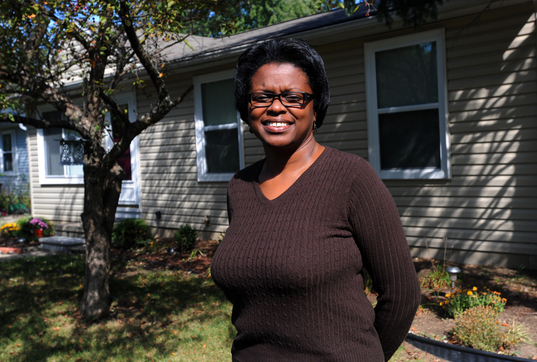
Judy Gardner moved to Ann Arbor in part because of the resources available to those living in poverty.
Melanie Maxwell | AnnArbor.com
She found more than just safety.
“If you're not lazy and you want to be better, this is a great place to be poor,” she said.
From scholarships and camps to groups that will pay rent to help people avoid eviction, there’s no doubt Ann Arbor has many resources for those living in poverty.
But those resources are being stretched as governments cut contributions, philanthropy dries up and need increases.
“The safety net is weaker now,” said Larry Voight, president of Catholic Social Services of Washtenaw County. “It’s frightening.”
The resources
Every week, Fran Deering gets requests from residents in the Green Baxter public housing site, in northeast Ann Arbor. They ask for help filling out forms to request food from the food pantry Deering keeps as the director of the Community Action Network’s community center at Green Baxter.
People even ask her for advice on how to best spend their limited money.
Recently, a resident came to Deering with a dilemma. Her car needed repairs so she could get to her job, but she couldn’t afford to make her rent that month and pay to fix her car.

Deering’s advice? Pay for the repairs.
Deering said she could find money to help cover the resident’s rent faster than she could get money for car repairs.
For hundreds living in Ann Arbor’s public housing sites, the resources offered by the Community Action Network and other groups that operate community centers are often a short walk from their apartments.
“It’s a big, bad world out there,” said Aaron Pressel, CAN’s director at the Hikone Community Center. “Here there’s a safety net. You can really slip and we’ll be there to catch you, if not for your sake than for your child.”
While those groups offer some specific services - they have emergency food pantries open to residents only - they often serve as a guide to other available resources.
Local resources can help cover rent checks, give you food, get you medical care and assist in other ways.
But the first step is going to the state’s Department of Human Services, said Bonnie Billups Jr., executive director of the Peace Neighborhood Center.
DHS runs a State Emergency Relief Program, which can help cover food, heat bills, electricity and other necessities.
The state program has also seen the strain. In August, its Food Assistance Program caseload set another record high with 751,922 households in Michigan, up 191 percent from 258,287 in January 2000.
In August, more than 17,100 of those state food assistance cases were in Washtenaw County, up from about 14,000 cases in October 2008.
Ann Arbor area residents in need say the wait to get help or even apply has gotten longer and tougher at the packed Ypsilanti DHS office. It often takes 10 days for the department to make a determination on how much, or if, it will help.
Once someone facing financial trouble gets a determination letter from DHS, local agencies can kick in to help.
An informal network of Washtenaw County agencies has developed in recent years. If one organization can’t help with utilities or food, it's able to say which agency might be able to. That's often how people looking for help make their way through the local patchwork safety net.
The formal resource for coordinating help in Ann Arbor is the 211 phone number, run by the Washtenaw United Way and staffed by Huron Valley Ambulance. The goal is to help those lacking the most basic resources get back on their feet quicker by navigating the assistance network.
One thing those seeking help don’t get is cash, said Voight. The agencies work directly with the bill-holders to make sure assistance is spent where it’s needed.
Hard to get help?
Despite the numerous agencies that exist, it can be a hassle to get help, say both those who receive aid and those who help them.
“There’s just so much paperwork, and you have to have exactly the right paperwork and be willing to wait in line for a long time,” said Ann Arbor resident Mindy Howell, 35, who has two school-age kids and has used assistance agencies in the last year. “Some of them, especially the state, don’t really want to give you any help, so they make it as hard as they can.”
Deering agrees.
“Everything works out. It’s just a pain ... getting it,” she said.
The problem?
“The system has too many people who don’t care,” said Joan Doughty, executive director of the Community Action Network. “They see themselves as guards for the system.”
Getting help can even depend on the time of year, Aaron Pressel, director of the Hikone Community Center, said.
“Christmas holidays are the worst. For two weeks, your kids are off school, so no meals for them there," Pressel said. "There’s no Food Gatherers for the food pantry. I’m not here, so no (emergency) food pantry. It’s the end of the month, so food stamps are gone.”
Voight said his agency has seen a tripling in the need for food.
“People can’t pretend they don’t need help anymore,” Deering said. “There’s nothing left to cut out their budgets.”
Some agencies are getting federal stimulus funds to help. But that’s not the answer either, said Mary Jo Callan, the director of Washtenaw County’s Community Services Department.
“A lot of the stimulus funds are aimed at the new poor (those who lost their jobs recently because of the economy)," Callan said. "It’s actually stipulated that you have to serve the most likely to succeed. That’s not always the people who need the most help.”
Hear CAN's executive director Joan Doughty describe what it's like to live on a low income in Ann Arbor.
Hard to succeed
There are those who abuse the system, Voight acknowledged, but even those who are using the system correctly often need immediate help before they can be helped out of poverty.
“If you’re really, really hungry, you’re not going to learn how to fish," Voight said. "You might spend enough time to catch a fish for that night’s dinner, but that’s about it. Once you’re really, really hungry, your brain is on overdrive to eat.”
Once people’s basic needs are met, it’s time to move on, Billups said.
“It’s about reconditioning their mind,” he said. “We’ve got to break that generational cycle.”
So Peace Neighborhood Center targets its young people. It offers several programs focused on mentoring kids to achieve in school and gain self-confidence. It puts on a summer day camp that gets kids out on trips to museums, theater performances, and the zoo to fill their idle time with experiences they might never have otherwise.
The center pushes kids to get involved in a college prep club and takes kids to local employers, job training programs, on college visits and offers support to help them.
It offers parenting classes and wellness classes to the adults, and offers incentives that encourage learning about positive personal and financial choices - all in an effort to break the cycle of poverty, Billups said.
But Gardner, who serves on CAN’s board of directors, said enabling can be a problem in Ann Arbor.
“Ann Arbor just wants to take care of these people, not teach them how to get out of poverty," Gardner said. "It’s a lot easier to just give them money than to help them make the changes they need to.”
Comments
JudyG
Thu, Nov 12, 2009 : 5:40 p.m.
David, I do appreciate your attempt to tell this story, and I also appreciate your professionalism in keeping things transparent and providing an avenue to make corrections and continue dialoge. Keep up the good work. Everyone is entitled to fair representation..everyone. Matt...what?
David Jesse
Thu, Nov 12, 2009 : 4:33 p.m.
@Matt: There have been several folks who have written in to ask how they can help, but there's no real updates. We're working on the next several installments of the series. I'm disappointed Judy felt like her views hadn't been fully reflected, but wanted to let her have an extended chance to express her viewpoint (which is of course something we'll let anyone do in the comments section). However, we've heard from lots of people who are living in poverty in this town, or are working with those who are in poverty, who are appreciative of the story. We've also heard that there's been lots of community discussion about the tons of issues raised in this overall report. That's what we hoped would happen and will continue as we continue to look at this issue.
Matt Hampel
Thu, Nov 12, 2009 : 4:25 p.m.
Any updates outside of that massive correction?
David Jesse
Thu, Nov 12, 2009 : 3:26 p.m.
Judy Gardner sent me the following e-mail as a clarification on her positions represented in the above story. Here's her comments: "Ann Arbor did not afford me the chance to be better Ann Arbor didnt make me who I am. This is the kind of thing that those from privileged backgrounds look and say look where our tax dollars are going when they dont even know the story. This is so wrong on many levels. "I am a graduate of the University of Michigan, worked hard all my adult life but found myself wanting a nicer environment to raise my children, after divorce without much money strategically chose Ann Arbor to live. My sons were appalled at the message that your article sent to the public about me as a person and what it said about their mother. I never sought out this place to take advantage of the services, I also moved because I secured full time work and there were support opportunities to buy a home.but not handouts for me. I am very grateful for this as others may not have had the opportunity for whatever reason. Also, my children did not sleep on the floor while living in Detroit! They slept in beds away from windows.I didnt raise them in a barn! "Also stating that I think those living in Public housing want to stay poor is wrong too. What I said is that some dont mind that type of life, as Betty Jean mentioned that she was happy with her life. Well, thats Betty Jean and her choice. She contributes a great deal of volunteerism to the Hikone community. "CANs director Joan Doughty is correct, some people cant and will never leave Public Housing because of cognitive or mental health issues and I agree. Being poor is so subjective, lets not create an article that only tells one side of the story. "I have never been so frustrated. I am not sure what your goal was, but it didnt paint an accurate picture of who I am as a tax paying resident of Ann Arbor and what I am passionate about in relation to helping those that are disadvantaged. If I had to do it (interview) all over ----- I wouldnt. Am I proud of my accomplishments in Life? you bet, has it been easy? No way. I have been a divorced single mom for 10 years and have worked extremely hard just to have an article make it seem like Ive been living off the donations of others and trying to get over. "I am compassionate for the poor those without basic necessities. I am intolerant of those who milk the system. I have empathy for those struggling to make ends meet, cause I have been there. I hate those who exploit others to for their advantage to gain readership. Its wrong on all levels."
David Jesse
Sun, Nov 8, 2009 : 2:05 p.m.
Matt: We'll check with the folks at CAN and see how people can help.
Matt Hampel
Sun, Nov 8, 2009 : 1:45 p.m.
I'm curious about the statement that Christmastime is the worst. It's usually a season we associate with increased giving. I'm not at all criticizing the need for the dedicated staff of both organizations to have time off during the holiday season, but if it's such a hard time for people in need, why are Food Gatherers and Hikone unable to operate? What can we do to help?
John Reed
Sun, Nov 8, 2009 : 1:42 p.m.
I have a small clarification to one of the quotes in this article. Food Gatherers has trucks on the road 6 days a week (Monday through Saturday) all year long, closing only for Thanksgiving Day, Christmas Day and New Year's Day with rescheduled service offered for deliveries missed on those days. Food Gatherers' Community Kitchen located inside the Delonis Center offers free meals to the public every day of the year (except Thanksgiving Day when Cottage Inn has traditionally offered free meals).