

Argo Dam cleanup will improve ecology of area, help Ann Arbor respond to state orders
Earth Day is being celebrated today, but the spirit of environmental stewardship in Ann Arbor won't end when the sun sets.
Members of Ann Arbor's rowing community plan a large-scale volunteer cleanup effort on Sunday at Argo Dam, partnering with the city to attack and remove invasive plants that have built up along the dam's earthen berm and improve the ecology of the area.
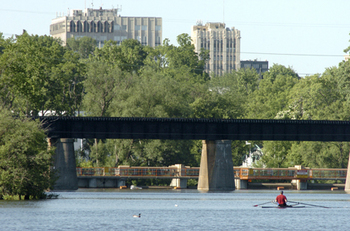
Argo Pond rowers will take a break from the water and get to work removing invasive species along Argo Dam's earthen embankment on Sunday.
File photo
"The rowing community is really active in Argo Pond itself and it's an opportunity for them to come out and support that area," said Jason Tallant, a technician in the city's Natural Area Preservation Unit.
NAP is expecting as many as 50 to 60 volunteers — mostly rowers from Pioneer, Huron and Skyline high schools — to remove shrubs on the headrace embankment. The city has entered into a consent agreement with the Michigan Department of Natural Resources and Environment to do a first round of vegetation clearing as part of ongoing discussions about long-term management of the embankment.
The city and state have been discussing the safety of the embankment since last summer when the state issued a safety order that asked the city to take action on several dam-related issues.
City officials reached a partial agreement with the MDNRE last month to begin removing dead and overhanging trees and woody brush, acknowledging that the deep-rooted woody plants obstruct the dam's toe drains and embankment. City officials agreed the root systems of the plants cause a shift in the groundwater flow, potentially compromising the stability of the embankment.
"It's a pilot project for larger-scale invasive control," Tallant said of Sunday's work, which will involve cutting and hauling away common buckthorn — an invasive shrub — and bush honeysuckle.
Tallant said the removal of those plants will increase visibility of the headrace's earthen embankment to allow for routine inspections and help prevent the spread of invasive plants to nearby natural areas.
Sunday's work is not expected to involve an endangered plant species known as the purple turtlehead, which grows n the area and has been a concern of state officials. Tallant said the city is waiting to hear back from the state on how to manage that issue.
Cheryl Darnton, a regular volunteer with NAP, is helping to organize Sunday's effort. She said anyone is welcome to lend a hand.
Volunteers will meet at 11 a.m. at the Argo Canoe Livery pavilion, 1055 Long Shore Drive, for sign-in and instructions. Darnton said she expects the work to last until 3 p.m., but volunteers can come and go as they please.
There is limited parking space at the Argo Canoe Livery, and it is illegal to park along the road in the area. Darnton said a company called RSS, at 416 Longshore Drive, just up the hill from the livery, has agreed to lend space in its parking lot, but she recommends volunteers also consider bicycling, carpooling or getting dropped off.
Darnton, who has two sons in the Pioneer Rowing Club, said about 20 to 50 volunteers are needed for the main invasive removal project on Sunday. NAP also has made Argo Park a priority area for removal of garlic mustard because it is killing wild flowers on the forest floor, she said, and volunteers may do some of that.
"Ideally, we will be able to work on both fronts to make a big difference around the body of water we all value so deeply," she said, calling it an effort to improve the ecological health of the area.
Darnton has made a career out of environmental stewardship. She teaches an ecological restoration elective course for seventh- and eighth-graders at Mill Creek Middle School in Dexter.
"I have been doing this kind of work for the past 17 years, and my sort of home area is the Eberwhite Woods where I've done a lot of invasive species removal," she said. "This is work that is part of my life."
Darnton said it'll be much easier working with high school students with saws and clippers on Sunday.
"They are a tremendous workforce," she said. "This is a very dynamic and powerful group of young workers, so they are going to make a big difference. ... Our goal is to be a helpful force for NAP because, like every government entity, they're underfunded and understaffed."
Darnton said there will be many tools and snacks to share, but volunteers — if they can — are encouraged to bring their own gloves, hand saws and loppers, water, snacks, sunglasses and sunscreen. She also said to wear closed-toed shoes, long pants and long sleeves.
Ryan J. Stanton covers government for AnnArbor.com. Reach him at ryanstanton@annarbor.com or 734-623-2529.
Comments
blahblahblah
Sat, Apr 24, 2010 : 8:14 a.m.
I agree with Wystan Stevens. The north Main corridor has tremendous mixed development potential. In fact, I can't wait until the day when I can pull up my canoe in Bandemer park and walk over to a cafe and have a pint while gazing upon Argo pond. The river already runs too fast between Dexter and Barton pond for many canoers (remember all the rescues and mangled canoes every other spring?). If you remove Argo dam you might as well remove the city's investment in the Argo canoe livery because only expert paddlers will be able to navigate that stretch. You therefore not only push out the rowers, but you push out the recreational canoers and kayakers as well.
ribs1
Sat, Apr 24, 2010 : 7:11 a.m.
This dam will be taken out for sure. I it only a matter of when.
sweet_life
Sat, Apr 24, 2010 : 12:47 a.m.
"Does anyone realize that if we got rid of all the dams that we would have natural reproduction of Salmon and Steelhead right here in Ann Arbor?" ribs1, How far should we extend this logic? Should we also get rid of Barton Pond- currently the city's water supply and a source of hydropower - which eliminates the production of some greenhouse gasses and other pollutants? Ditto for Superior Dam - also a source of hydroelectric power? Should we get rid of the Welland Canal, which would eliminate the major source of invasive aquatic species in the Great Lakes - but also the most environmentally efficient and cost-effective way to move international freight into and out of the upper midwest?. Should we get rid of the farms, which would eliminate the agricultural runoff that also has a huge impact on native species? Should we just get rid of the people and fix everything that we have changed, because then the native salmon may eventually return to all the rivers? I grew up around water and spent my childhood setting up fishtanks with local lake water and studying the aquatic invertebrates that live in them (never really appreciated fishing - even catch-and-release seems too much like torture to the fish, but I do appreciate the environmental ethic of most fishermen I have met). I am an environmentalist - it has been my job for over 20 years. I also understand and accept that we can't have a population of 300 million in this country while maintaining a pristine environment. Everyday, we make personal choices that prevent that - we get in our cars, we turn on a light using fossil fuel energy (not to mention the industrial impact of creating and disposing of the bulb), we eat relatively cheap food grown around the globe, we wear clothes made of natural fabrics produced on factory farms or artificial fabrics produced from petroleum products. There is a lot we can do to mitigate the impacts of our activities, but we can't remove every bit of air pollution, or return every river to its pristine state. Rivers provide a lot of benefits besides salmon and people make choices about which benefits are most important to them. In some cases it is power generation, it others it's irrigation or water for human consumption, in some cases it is recreation, and is some cases it should be keeping or returning a river to it's wild state full of salmon. I ask again - do you see no human value in the current use of the the local impoundments by people other than fly fishermen and white water kayakers? No value in a large number of young people enjoying the river every day and getting more exercise in two hours than most of us get in a month? No solution that allows and encourages other uses of the river? If not, this discussion is hopeless. If so, maybe we can find common ground and look for ways to mutually work together to improve the river while continuing to allow multiple uses.
Wystan Stevens
Fri, Apr 23, 2010 : 10:25 p.m.
ARGO POND: LET'S TAKE THE LONG VIEW The pond now called Argo has been a fixture of the local landscape since 1832, when Anson Brown erected a grist mill beside an early wooden version of the Broadway Bridge, and built the first dam to hold water back to power the mill. (Born a New Yorker, Brown started the settlement known as Lower Town Ann Arbor, calling Broadway and Wall Street after thoroughfares in New York City. Brown owned the mill, but was not the miller, and he died in the cholera epidemic of 1834.) An internet search wont find early 19th-century references to Argo, because the pond didnt have that name until 1892, when a group of Ann Arbor businessmen, investors in the Michigan Milling Company, took over the operation (then known as the Sinclair Mills) and rebuilt the structure that they named the Argo Flouring Mills. The dam and pond took their name from the mills, but no one knows where that name came from. Did the mills golden grain suggest a comparison to the brave ship Argo of Greek myth, which bore Jason and his men in search of the Golden Fleece? (The Michigan Milling Company had its offices at the Central Mills on First Street, where the Blind Pig is now and where, Im told, a certain golden liquid flows a beverage made from grain.) Through the decades, the dam was rebuilt a few times (and probably made a little higher, after the Eastern Michigan Edison Company acquired the water rights). But in a freak calamity that drew a crowd of spectators, the Argo mill exploded and burned on January 4, 1904. Firemen came, and the water that doused the flames left a white pall of icicles on the tall buildings ruined skeleton, a scene captured in dramatic photographs. The companys plutocrat investors decided not to rebuild, and a picturesque milling era we might call it the Flouring of Ann Arbor came to an end. From Argos ashes rose the Phoenix of a new era of power generation. Within a few years, the company later known as Detroit Edison had erected a power generating station on the mill site, running its turbines and generators with water from the millrace. Three weeks after the mill disaster, on January 27, 1904, the Ann Arbor Railroads trestle collapsed, dropping a heavy freight train and its cargo onto the ice of Argo Pond. In the days that followed, parties of gawkers turned out for that spectacle too, including small boys like the late Ray Spokes, who went out onto the ice and looted water-soaked crates of Beemans Pepsin Gum. The inadequate early trestle which stood close to the dam got replaced months later with another of thick steel, on massive concrete piers, a landmark still in place. (That year, 1904, was a bad one at both ends: on the last day of December, the Ann Arbor High School burned to the ground.) Throughout the 19th century, and early decades of the 20th, winter ice was harvested on Argo Pond, and stored in great blocks in straw-lined ice houses on the Main Street riverbank. Some of the ice buildings were owned by downtown caterers like Jacob Hangsterfer, whose big emporium depended on a steady supply of ice to preserve meats and other perishables, and to refresh thirsty customers at his ballroom, year round. Another enterprising German immigrant was Paul G. Tessmer, who in 1898 sold his grocery business and opened a boat livery the U. of M. Boat House on the ponds Main Street side. By 1906, Tessmer had a stock of 160 canoes and 40 rowboats, all built by himself. He and his big family lived in a house on Sunset hill, overlooking the pond a building that became the Elks Pratt Lodge. Tessmers docks and boathouse later were moved across the pond, to the foot of Longshore Drive, and became William J. Saunders canoe livery, then Jack Wirths, until 1969, when the Ann Arbor parks department took over. On moonlit evenings in June, the pond was jammed with U-M students in canoes, boys in blazers treating their sweethearts to a mandolin serenade. Around 1900, these romantics began calling the path along the headrace embankment Lovers Lane. (In the 1930s and 40s, the embankment became part of Ann Arbors hobo jungle.) One of the citys public works projects during the Depression years was the building of a public bathing beach at the foot of Longshore Drive, where the canoe livery is now. Tons and tons of Lake Michigan white sand were hauled in and spread around, to make the beach comfortable and pretty. Repeated summer polio scares in the 1940s eventually led to its closing. The pond was drained in 1930, when Edison built a new dam, and again in the early 1970s, when Joe ONeals construction company built the present dam for the city a project completed in 1972. Treasure hunters prowled the muck for artifacts, and collectors found old Ann Arbor bottles for their collections. Construction workers pulled a particularly heavy souvenir out of the mud: a set of ribbed steel wheels, from one of the boxcars that fell off the old railroad trestle in 1904! Argo Pond is an essential element of the history of Ann Arbor; it helps define our citys character. In historical terms, Ann Arbor has always had that pond, has grown up around it, and would not be the same without it. Some folks have called it stagnant, but of course that is absurd. It is a dynamic body, as dynamic as the city itself. The waters of the Huron have flowed since time began, and they have been flowing through the pond and over the dam, ever since Ann Arbor was a tiny village in the wilderness west of Detroit. By all means let us maintain momentum, improve the ponds surroundings, clear out shabby factory buildings on North Main Street, and replace them with an attractive multi-use facility, one which includes cafes and a dining terrace that overlooks trees and water. It is a view to be enjoyed in every season. But let us not rashly sacrifice our beloved Argo Pond, Ann Arbors urban waterfront. Argo is an asset, an amenity of the type that other communities long for. We should consider every means of enhancing access to it, and keeping its shining surface intact. Dont pull the plug on Argo dont let it go down the drain. My enjoyment of the river has been passive. I havent been out in a boat, havent stopped to watch the oarsmen, never even dipped a toe in Argo Pond but I appreciate Argos contribution to the quality of life in this place, and I like to see it now and then, and know that it is there. I hope that it will forever remain in the heart of our city, where it has been bubbling and rippling for 178 years.
braggslaw
Fri, Apr 23, 2010 : 10:14 p.m.
a2mutant, I read your links and all I could think of was the Scopes monkey trial. The science is almost as bad as creationism. We can look to Mill creek(in Dexter) to see many of the benefits. Stocking Brown trout in Mill Creek due to the fall in water temp appears to be viable. I am sure everyone can find an "expert" but the vast amount of science indicates that the removal of the am is the environmentally correct action.
ribs1
Fri, Apr 23, 2010 : 9:15 p.m.
Here is just a little snapshot of the devastation these dams have caused just in the last 2 weeks. Right now it is small mouth bass spawning season. These fish need consistent flows to prevent their eggs exposure to air when flow is low, or eggs and fry washed downstream when flows are high. http://i75.photobucket.com/albums/i314/ribs1/hurongraphgif.png Take a look at these spikes in flow. 6 different events in only about 14 days. Flow spikes as low as 70 cfs and as high as 1200 cfs in a matter of less than an hour. Almost 10 times the flow rate. This pretty much ruins all spawning activity below argo dam. Sure I have an interest in those as part of my income comes from guided fly fishing but I don't think anyone likes a river without fish.
ribs1
Fri, Apr 23, 2010 : 9:04 p.m.
A2 Mutant, The Mayor and the rest of city council are up for reelection this year. As to the argument of "why not geddes dam instead" how about geddes dam also? Does anyone realize that if we got rid of all the dams that we would have natural reproduction of Salmon and Steelhead right here in Ann Arbor? Currently the Salmon and Steelhead can not make it past the dam at Belleville. The DNR has to constantly stock the Huron with Salmon and Steelhead every year because there is almost no natural reproduction. These fish need the gravel substrate that we have this far upstream to reproduce. Take out the dams and we would have an incredible river. It's too bad we can only do one at a time but it's a start.
a2mutant
Fri, Apr 23, 2010 : 6:03 p.m.
krc: would you please help me to understand why many persons with an apparent environmental point of view target argo dam for removal while saying nothing about gallop, even arguing rowing should relocate there, as you just did. by the criteria offered for removal of argo (stops the flow, weeds, sediment, temperature, not energy generating, etc), shouldn't gallop go as well? why, then, the distinction? this has never made sense to me. thanks in advance.
a2mutant
Fri, Apr 23, 2010 : 5:31 p.m.
braggslaw and others: please read carefully the link below for a careful and thoughtful rebuttal to the "science" of dam removal put forth by the hrwc. much of this information is assembled by a retired civil engineer with over 40 years experience. http://home.comcast.net/~friends_of_argo_pond/documents/Response%20to%20HRWC%20Science%20Brief%20on%20Argo%20Pond%20Oct%202009.pdf then move on to this second link, which explains why the nirvana of a meandering river proposed for the argo site proposed by the hrwc and depicted in their artist's rendering is a hallucination that can never exist without the expenditure of megabucks to remediate the highly contaminated site of the former coal gassification plant that lies immediately downstream of the current dam and is the reason for the severe elbow deflecting the stream from its normal course at that location. http://www.erosioncontrol.com/blogs/donald-gray/the-pros-and-cons-of-dam-removal-62578.aspx for these and other reasons, the mayor and city council have as much as said that the dam is not going away. it is time to move on!
flyingpatricio
Fri, Apr 23, 2010 : 2:22 p.m.
Much of the Argo or any other dam discussion shouldn't just focus on who uses the river and for what. The real issue is the health of the river. Dams do harm to the natural flow of life in a river. There are very few dams that actually contribute to the well being of anyone anymore. Only the largest dams produce enough electricity to be economically viable. It's nice to see the rowers are intersted in cleaning up their rowing area. It looks beautiful from the surface, but what they don't see is what is the problem. Indigenous species no longer proliferate in these areas and since these "dam ponds" break up the flow of the river the natural balance is runined.
braggslaw
Fri, Apr 23, 2010 : 2:17 p.m.
For those interested in the environmental science. The HRWC website explains the impact of the dam.(siltation, invasive species, low oxygen levels, impact on native species, etc.) It also shows what North Ann Arbor could be.
Rork Kuick
Fri, Apr 23, 2010 : 2:01 p.m.
a2mutant: We complain about Argo dam cause it is the one that the DNRE was complaining about needing expensive fixes, which could be avoided by just removing the dam. It is also facing estimated $225,000 maintenance in "2-3" years. It is the subject of the article too. Complaining about the other dams is just not as on topic, but Geddes and Peninsular dams are high on my personal list. krc: Barton dam is upstream of Argo and is a higher dam. Someone needs to report why public access is so poor there, and if that violates the dam's charter.
braggslaw
Fri, Apr 23, 2010 : 1:52 p.m.
http://www.hrwc.org/take-action/argodam/ This link includes the scientific analysis on why the removal of Argo dam is beneficial to the community as a whole. The science is rock solid and is supported by virtually every environmental group that has looked at the issue.
braggslaw
Fri, Apr 23, 2010 : 12:12 p.m.
Everybody should get used tothe fact that the Argo dam will come down. At this crossroads in history, people understand science of riparian issues. People should just accept that the dam is going down and make plans accordingly.
sweet_life
Fri, Apr 23, 2010 : 12:05 p.m.
"There are many licensed fly fishing guides using the river including myself. Most of us are on the water much more than 2 hours per day 5 days a week." ribs1, Congratulations - sounds you you have a great job! But can you appreciate the fact that many other people, including the rowers, enjoy the river for different reasons, and have just as big a commitment to those reasons and to the river, as you do? It seems unlikely and probably detrimental to have 200+ high school kids fly fishing that stretch of the river for a couple of hour every day. Why eliminate their activity in favor of yours? "This dam is relatively modern compared to the ancient Argo and is much more efficient." krc, The current version of Argo Dam was built in the 1970s and is in perfectly good shape. If that's ancient, there are many structures in Ann Arbor that must be prehistoric. I also question in what way Geddes Dam is "more efficient" than Argo Dam. Beyond that, I seriously doubt your hypothesis that removing Argo Dam will have any effect on goose poop in Gallup Park. Removing Geddes Dam would be much more likely to affect the goose population at Gallup, but of course that would also affect a lot of other people who use the river for recreation at Gallup, including you. As the saying goes, "What's good for the goose is good for the gander."
krc
Fri, Apr 23, 2010 : 10:43 a.m.
@A2mutant, To be honest, I forgot about the Gallup Dam. However, we can't do everything at once. As far as I know downstream from the actual Park there are no geese. I assume this is because the water flows faster as it nears the dam. This dam is relatively modern compared to the ancient Argo and is much more efficient. Gallup Park used to be my favorite place to get in a brisk mile walk. There's no such thing as 'brisk' now because of all the goose **** on the walkway, especially up at the top. It really slows a person down when you have to tiptoe through it. Sorry if I've gone off topic. I still think it would benefit the park greatly if Argo Dam was removed.
Tee
Fri, Apr 23, 2010 : 10:22 a.m.
The dam is not going anywhere folks. So to constantly pen it should be removed is a mute point. And to poke fun of well meaning folks trying to make the best by volunteering their time to clean up Argo Pond is counterproductive to the larger message to respect and make the best of our natural environment. I applaud the efforts, especially by our youth, to make a difference in the ecology of the river. This is what Earth Day is all about, getting outside, helping our planet thrive and making the best of our imperfect planet, in positive productive ways.
a2mutant
Fri, Apr 23, 2010 : 10:16 a.m.
krc: would you please help me to understand why many persons with an apparent environmental point of view target argo dam for removal while saying nothing about gallop, even arguing rowing should relocate there, as you just did. by the criteria offered for removal of argo (stops the flow, weeds, sediment, temperature, not energy generating, etc), shouldn't gallop go as well? why, then, the distinction? this has never made sense to me. thanks in advance.
krc
Fri, Apr 23, 2010 : 10:08 a.m.
I have an idea! How about moving the whole shebang to Gallup Park? Plenty of room to row there (although probably not 6 abreast) and you could do the park a great service if you would clear away the nests of the invasive Canada Geese and then scour the walkways there to get rid of their giant, nasty droppings. And correct me if I'm wrong, but isn't Argo dam the only one upstream from Gallup? The water at Gallup is so slow moving it borders on stagnant. If the dam was removed it would freshen the stream, and maybe it would flow quickly enough that the geese would move on. Can't stand 'em.
a2mutant
Fri, Apr 23, 2010 : 9:59 a.m.
rib1: thank you for your most recent post, which helps us all to understand the source of at least a part of your zeal for removing argo dam and expanding opportunities for your guided fly fishing excursions. from your previous posts, we had been left with the apparently erroneous impression that your interest was solely driven by environmental concerns and missed the key fact that they were also motivated by personal recreation and business interests.
ribs1
Fri, Apr 23, 2010 : 9:13 a.m.
"These kids are on the river 2+ hours a day, 5-6 days a week, almost 6 months of the year (more if you include the time many of them spend in the AARC youth program). Can any of the rowing critics say they use the river more than that?" Sweet Life, There are many licensed fly fishing guides using the river including myself. Most of us are on the water much more than 2 hours per day 5 days a week.
braggslaw
Fri, Apr 23, 2010 : 9:13 a.m.
Tee don't agree with your premise that the dam will never come down and we should just accept it. The dam will eventually come down.
Gary Schmidt
Fri, Apr 23, 2010 : 8:27 a.m.
I believe the dam should come out. But I applaud the work of the rowers to clean up the area; these are good folks doing hard work, and there's no reason to attack them for it. The problem, though, is that cleaning up Argo Pond is like the old joke about a kosher pig. You can do all the right things to make it kosher--but it's still pork, and it can't ever really be kosher. The heart of the issue is that even though it's called Argo "Pond," it's not really a pond: it's a river. And it's been handcuffed; it can't do what it's supposed to do, which is flow. Cleaning up the embankment is like planting flowers around a polluting factory: it doesn't have anything to do with the substance of the problem. That's why environmental groups like HRWC, the Ecology Center, the DNRE, American Rivers, Trout Unlimited and many others have said that Argo should be removed. Argo Dam is bad for the Huron River.
Tee
Fri, Apr 23, 2010 : 7:50 a.m.
The Dam will not be removed now or anytime in the near future so it really does a disservice to our community to make disparaging remarks and belittle those that don't agree with this fact. What I am hearing is a community that cares about the ecology of the Huron River and collectively we need to find realistic solutions to improve the river with the dam in. If the river is really that important to you, then I hope you'll consider volunteering your time this Sunday at Argo Pond. It's time to move on and stop all the negative rhetoric.
Rork Kuick
Fri, Apr 23, 2010 : 7:40 a.m.
I agree that killing buckthorn and honeysuckle is good work. The dam may be sighted for causing lots of loosestrife, but not these woody plants or garlic mustard. The banks of the river need help many places, like the workday this weekend at Dexter-Huron metropark, flower paradise and iconic of the free-flowing reaches, now being hammered by invasives. Kudo's to anyone helping. Thanks Cheryl Darnton. Ofcourse it doesn't make the dam a good thing. PS: Argo dam has nothing to do with flood control (unless you, like the state, are considering the chances of it failing, which might lead to some flooding). Barton dam increases the water level fluctuations in town, and would someone please see if they can fix that. In years of drought, it becomes painfully obvious.
bedrog
Fri, Apr 23, 2010 : 7:03 a.m.
i am a rower, but not affiliated with any organized group of such...and on reflection i do support dam removal. the progressive growth of weeds in dammed areas over the years has been quite noticible.. and argo pond is hardly alone. the areas above the big barton pond dam and the dixboro dam are also afflicted. as to 'ragnars ' suggestion of privatizing water ways, wars have been fought over such matters ( 'upstreamers' useage often adversely impacting 'downstreamers').... apropos of which is it an effort at ironic humor that 'ragnars' screen name is that of the viking warrior who sacked paris in the 8th century?
braggslaw
Fri, Apr 23, 2010 : 6:48 a.m.
KJM, does the Argo dam generate electricity now? Are there any future plans for electrical generation? If there is a proposal what is the cost per killowatt/hour? My understanding is that there are no present or future plans for electrical generation and that it would not make economic sense evenif they tried. Thus the only argument to keep the stinky pond is to give the rowing clubs a place to row.
KJMClark
Fri, Apr 23, 2010 : 6:24 a.m.
Sorry bragslaw, but T is mostly right. The dam was originally put in to run mills, then to make electricity. It should be put back into making electricity. I'm not a rower, and I'd challenge you to back your statement that all the environmental organizations back dam removal. There are quite a few environmental organizations, the HRWC is only one. You'll also want to see how many of them back clean power. The rowing clubs may be a minority, but the majority of residents and council don't agree that removal is necessarily the most environmentally friendly option.
T
Fri, Apr 23, 2010 : 1:52 a.m.
I never hear anything but two special interest groups arguing about Argo. If you folks were interested in all the options you would look at getting GTE back into power generation. They sold it, but that doesn't mean there is not route to making power. If we can make power from wind and solar, we can make power from hydro. If there is a money stream, maintenance will be well funded, the pond doesn't have to be stagnant, and you can do anything you want. I'm not for or against this (Barton is a better place to generate power), I'm just pointing out that the reason Detroit Edison stopped generating power is obsoleted by a smart grid that accepts power from lower grade sources like wind and solar. And nobody seems interested in the river as a cash source to pay for the uses of the river we all really want. In the very beginning, Argo was approached as a "who is interested" issue instead of making an effort to get all options on the table. Most of the discussions I've read on Argo read like the money to do whatever must grow on trees and ignores flood control. When all I hear are two special interest groups I start yawning. Personally, I just use the river to canoe, so all I want is to get rid of the portage. I don't fish and the river isn't rated for swimming. I'm easy to please. Move the canoe livery to the park next to the Broadway bridge and leave the dam or leave the livery where it is and move (remove) the dam. Get rid of the portage, talk about flood control, and talk about where the money to do what you propose will come from. I have always wondered why nobody has asked just how hard it would be to force DTE into becoming a benevolent despot that paid all the bills for our ludicrous imaginations.
sweet_life
Fri, Apr 23, 2010 : 12:51 a.m.
"This is just a ploy by the rowing community, which obviously isn't very big seeing as the majorty of the volunteers will be the rowing teams from Pioneer, Skyline and Huron." The Huron and Pioneer crew teams have historically has 75-90 members each athletic season (there is both a fall and spring season for crew, the only local two-season sport). These make them among the largest participation sports in the AAPS. They are in fact the largest if you consider the total participation for both seasons. Skyline HS, which currently has only a freshman and sophomore class, has about 35 rowers this season, up from 25 last season. These kids are on the river 2+ hours a day, 5-6 days a week, almost 6 months of the year (more if you include the time many of them spend in the AARC youth program). Can any of the rowing critics say they use the river more than that? The high school rowers care about their sport and the river. They aren't couch potatoes sitting indoors all day - they are very fit and spending more time outdoors everyday than most of their peers and their elders. That time they spend on the river has a very high human value in their personal development. According the HRIMP report on Argo Dam, the Ann Arbor Rowing Club has an additional 300 members who use Argo Pond and the UM Men's Crew team has 50-70 who are on Argo Pond every day. Altogether, rowers account for about 41,000 river trips per year. So the rowing community is obviously not small - they are in fact the largest group of regular users of Argo Pond. "If the rowers want to paddle in something let them paddle a fast moving stream." - Rowing and whitewater kayaking are obviously very different sports. I sincerely doubt that you would see 200+ high school kids joining the kayaking team. I don't see any reason why rowers can't use parts of the river and whitewater kayakers other parts of it. Maybe you should take the time to talk to talk to some of the rowers about why they row, what they get from their sport, and how much they care about the river. Stop viewing the rowers as the enemy, cool down the rhetoric, and look for real long-term solutions that are both good for the river and good for the people who most want to use it.
bruno_uno
Thu, Apr 22, 2010 : 10:29 p.m.
city folk fighting an urban river...hmmmmmm
ribs1
Thu, Apr 22, 2010 : 10:24 p.m.
"If the teams did not do their share of the work to attempt to control invasive plant species and bring the ecosystem into balance, those same people would criticize the teams for their lack of effort." Cheryl, the best way to bring this ecosystem into balance would be to remove argo dam. It's clear to everyone else here that the rowing community is primarily interested in removing these plants in order to prevent their roots from clogging the toe drains. No one would consider preservation of a stagnant carp filled pond to be anything resembling natural areas preservation.
braggslaw
Thu, Apr 22, 2010 : 8:33 p.m.
Cheryl, I understand all the hard work you are doing to keep your rowing lanes open. I understand that people are passionate about rowing on Argo pound. that does not change the fact that the dam should be removed and that weed removal work would not have been necessary if the dam was not there. The rowers oppose the environmentally correct solution because they want to row in that pond. It is that simple
Cheryl Darnton
Thu, Apr 22, 2010 : 8:29 p.m.
I am responding to the people who question the purpose of the work day to remove invasives at Argo on Sunday, April 25. Both Pioneer and Huron rowing clubs have conducted work days at the Bandemer/Argo area for the past few years. Both teams have trained work day leaders among them who are lifelong environmentalists. These are large teams with a lot of human power to offer against the threat of invasive species. People who would criticize the work these teams do to remove invasives clearly have not embarked on such a work quest themselves. Anyone seriously interested in seeing progress toward the war to control invasives would only celebrate the efforts of strong, healthy, energetic athletes who choose to join the battle. Huron and Pioneer rowers and their siblings and parents have conducted half a dozen work days over the past few years, usually without fanfare or media coverage. Critics may limit themselves to being able to see only in green and black. They cannot understand that these rowers and their families are the real deal. Megan K., a senior coxswain, and Chris D., a JV rower, were in my Eberwhite Woods Forestry Club when they were in first through third grades at Eberwhite. They worked in Eberwhite Woods with me and a couple dozen other kids one day per week at lunch recess during the warm months of the school year. They picked up trash, pulled garlic mustard, and removed buckthorn in those early days, and here they are, doing the same stuff at Bandemer and Argo with the same passion. These kids and their families are environmentalists. Critics have blinded themselves to the reality of the shaky science behind the push to remove the dam. They will never comprehend the fact that the kids who love Argo Pond as an athletic venue where they prepare to compete at the national and international level have developed a sense of place in nature. They have developed a sense of place in nature that compels them to spend their very limited free time and their sweat (and a little blood) fighting the invasives that threaten the ecology of the watershed. Anyone who has ever spent 3 or 4 hours hunched over pulling garlic mustard, cutting buckthorn or other woody invasives only to look up and see acre upon acre photosynthesizing before his or her eyes would not discourage these young people and their families from contributing to the watershed ecology at Argo. Real environmentalists want to get EVERYONE involved in the work to control invasives. As a NAP volunteer workday leader, it is my responsibility to maintain the safety of the volunteers. In my professional life as a full-time English and global studies teacher at Mill Creek Middle School, I teach a field-based outdoor education elective, "Ecological Restoration." I have 25 twelve to fourteen year-olds who work with saws, loppers, spades, shovels, and a tree ripper to remove invasives on the school property and bring native plants back into the ecosystem. Twenty-five kids this age is the safe limit for the course. In my experience, 40 high school kids and their parents are equivalent to 25 middle school kids in terms of the amount of safe supervision and instruction I can provide as a single workday leader. Mature buckthorn in the Bandemer Park area typically measures 6 to 10 inches in trunk diameter and towers 10 to 25 feet above the ground. When these invasive trees come down they can be a hazard when there are 40 people at the site sawing, sweating, dragging, pulling, lifting, carrying, and guiding trees to the ground. It requires the workday leader to understand the potential hazards before they become reality, to redirect volunteers, to draw their attention to hazards, and to maintain a calm, professional demeanor. There is a reason NAP allows groups to conduct private workdays that are not on the NAP schedule. In the field, I know all of my volunteers. In order to safely lead 40 people on a workday by myself, I need to be confident that I can reach the people in my group, that they will respond to me in an instant if something is not safe, and that they will check with me if they are not sure whether a tree is invasive or not. We take our instructions from NAP, we use their tools, and it is my role to make sure instructions, tools, and the safety of the volunteers are honored. This weekend there will be at least one NAP staff member on site as an additional work day leader in order to make sure we have enough supervision for the project. This makes it possible for us to open it up to several teams and the public. Come one, come all! Critics want the rowers to be villians. They will deliver a one-sided critique of any rowing team action. If the teams contribute to the great work Natural Areas Preservation does, they will question the motives of the teams. If the teams did not do their share of the work to attempt to control invasive plant species and bring the ecosystem into balance, those same people would criticize the teams for their lack of effort. Instead, I encourage people to come to the work day. It is good exercise. You will learn something. Many people who do not recognize invasives go home to find that they or their neighbors unknowingly harbor such plants on their property. There is a lot of work to do on every acre that surrounds Argo Pond.
ribs1
Thu, Apr 22, 2010 : 7:37 p.m.
Colin, Nearly all environmental groups agree that dam removal is the best option. Mowing weeds to protect your rowing lanes and removing invasive vegetation to protect the toe drains in a feeble attempt to keep an aging berm does not count as a conservation project. If you guys really want to get involved with Huron River conservation projects think about habitat improvement in areas other than just your precious Argo pond. All you have to do is read the fish surveys from the DNR to find out that Argo pond is mostly full of Carp with very few pike, catfish, walleyes, and small mouth and largemouth bass. Not a very diverse environment. Contrast that with the free flowing sections of stream and Mill creek. Full of just about every species of warm water fish.
braggslaw
Thu, Apr 22, 2010 : 7:25 p.m.
Colin, All of the environmental groups support removal of the dam. All of the rowing clubs support keeping the dam. the Watershed council has produced compelling information that has never been refuted by the Rowing clubs. YEs the rowing club mows the lawn on top of the stinky pond all summer. That growth would not exist if the river flowed freely.
Colin Darnton
Thu, Apr 22, 2010 : 7:18 p.m.
As a young rower, I am offended by these assertions. You say that the only environmentally sound decision is to remove Argo Dam when this is not the case. In fact if you study the evidence that has been presented over the last year and a half, you will find that there is a great deal of controversy about what is the environmentally sound decision when it comes to the dam. You make it sound like there is no scientific controversy, when in fact there is. In addition, we have donated countless hours of our time to the clean up of the Argo dam area. This is not a ploy. We care about our environment.
Ryan J. Stanton
Thu, Apr 22, 2010 : 6:31 p.m.
Here's a link to a recent power point presentation given by the MDNRE on dam removal in Michigan. There's a pretty good map of the many dams in Michigan and another showing a handful that have been removed. It cites Ann Arbor as an example of the kind of community contention that can come with dam removal issues.
ribs1
Thu, Apr 22, 2010 : 5:42 p.m.
I wonder why they didn't invite anyone from either of the fishing organizations to this event. Every year the fishing clubs do a river cleanup and other conservation projects on the river and we always send an invite to the rowing clubs but in years no rower has ever shown up. Rowers would gain a lot of credibility if they were to take on real conservation projects to help the river instead of just projects to save the dam. Maybe we could even work together to get other dams removed like Peninsular?
Rork Kuick
Thu, Apr 22, 2010 : 3:21 p.m.
I hope that soon, we can celebrate removal of that dam every earth day. Help me: I can't find announcements on Natural Area Preservation Unit web pages about this event. I do not see it on stewardshipnetwork either. That's odd, since several other NAP events appear at both sites (as you'd expect). What's with that? PS: There are nearly a dozen other volunteer opportunities listed at stewardshipnetwork for this weekend. It's gonna be hard deciding between DNR (Waterloo rec area, near McClure, some of the best stuff in the county) and metroparks work for me.
flyingpatricio
Thu, Apr 22, 2010 : 3:14 p.m.
This is just a ploy by the rowing community, which obviously isn't very big seeing as the majorty of the volunteers will be the rowing teams from Pioneer, Skyline and Huron. The maintenace of the dam is becoming an issue and a future safety hazard if time is allowed to pass and something isn't done in either direction. A one time removal would end all maintenance. Fixing it and it would need fixing in another 20 years, so on and so forth. Draining much needed money for A2. The quality of the Huron would much improve if Argo was removed. I live in Dexter and fish the Mill Creek area. The removal of the dam has brought a vitality back to the stream. The water runs quicker, cooler and cleaner than before. They are even doing a study this Summer to see if the stream could support a Brown Trout Fishery. This is because of the cool ground water entering into a quicker flowing stream, which in turn makes it run cooler and cleaner. The Huron would be the same if Argo and some of the other dams were removed. If the rowers want to paddle in something let them paddle a fast moving stream. A little benefit of removing the Mill Creek Dam. http://www.americanwhitewater.org/content/River/detail/id/6820/ The Penninsular Dam in Ypsi should go as well. People would be amazed at what would come of the removal of these dams. Nature would regain it's grip and reverse much of the damage that's been done to the system. Cleaner, cooler and quicker running water would benefit us all.
braggslaw
Thu, Apr 22, 2010 : 2:53 p.m.
Dams were put in because, at the time, people thought they were a good idea. Experienc has shown that most dams are not a good idea.
Ragnar D
Thu, Apr 22, 2010 : 2:25 p.m.
Braggslaw and Val Losse, Aren't you two blanking out the facts for why the dams were put there in the first place? We should privatize the ownership of the waterways and then individuals would have a self-interest in protecting there property and the government would be legally obligated to protect their rights.
braggslaw
Thu, Apr 22, 2010 : 2:24 p.m.
DK, no need to speculate. I live in Ann Arbor, I use the Huron weekly in the summer. The Huron is a better resource for all if Argo Dam is removed. A vocal minority will not change this. I get it, the rowing clubs haver their own special interests that conflict with the good of all.
DK
Thu, Apr 22, 2010 : 2:01 p.m.
The rowing community has been cleaning and clearing for years in the park. I suggest the Braggslaw (whom probably does not live in Ann Arbor) gets his or her information straight. The dam is not going anywhere for a long time-get use to it.
Val Losse
Thu, Apr 22, 2010 : 1:58 p.m.
And where will the city get the $500,000 to fix the dam? When it doesn't have the money to fix the bridges over State Street and the railroad. Look at the area in Dexter where the dam was removed. It returned the stream to what it was a 100 years ago, clean and free flowing.
braggslaw
Thu, Apr 22, 2010 : 1:44 p.m.
Just a ploy by the rowing clubs to show how "green" when the real reason is to prevent removal of the dam. The only enviromentally sound decision is to remove the dam. A minority of rowing clubs is standing in the way. High gradient water will be less vulnerabe to invasive plants (which like stagnant ponds) and invasive species like carp. Do the right thing, tear the dam down.