

Bee aware: Ypsilanti Food Co-op supports The Local Honey Project as a way to stem the decline of honeybees
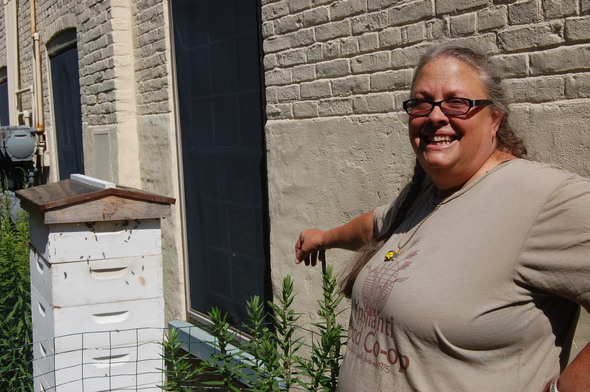
Lisa Bashert, a beekeeper, Ypsilanti Food Co-op member and manager of The Local Honey Project, stands near one of the project's beehives in Ypsilanti.
Janet Miller | For AnnArbor.com
Since then, Lisa Bashert, beekeeper, co-op member and manager of The Local Honey Project, has been as busy as a bee: She has single-handedly captured a giant swarm of honeybees as it moved through Frog Island, seen 80 percent of the project’s honeybees die the first year and (yes) been stung more than a dozen times.
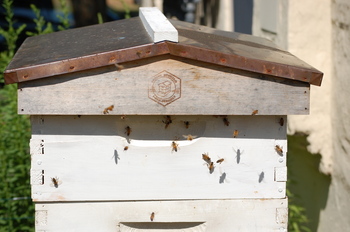
There are typically about 60,000 bees in a hive.
Janet Miller | For AnnArbor.com
The Local Honey Project has become an open classroom to explain food issues, sustainability, threats to honeybees and the environment, Bashert said.
Bashert favors the term honeybee as opposed to simply bee to (ahem) take the sting out of the word. Bees get a bad rap, she said, and are often mistaken for the more ferocious wasp. “People relate bees to anything that stings,” she said. “Honeybee is positive, it gives people a warm, fuzzy feeling.”
The Local Honey Project has five urban hives - two in Honeybee Alley next to the food co-op in Ypsilanti’s Depot Town, two at The Farm at St. Joseph Mercy Health System and one at the Ypsilanti non-profit Growing Hope. Typically, there are about 60,000 bees in a hive. Many of the bees for The Local Honey Project have connections to the food co-op: Some of the hives were established using bees that had set up shop inside a co-op wall. About 12 volunteers work with the hives.
While the project’s hives suffered an 80 percent loss the first year, a figure not surprising for new hives, Bashert said, losses dropped to 40 percent this year. The hives have been supplemented with swarms of captured bees and feral bees, including a giant swam of about 20,000 bees Bashert captured at Frog Island last summer. “Bees are in their most benign state when they are swarming. They are full of honey, they have no brood or home to defend and they are vulnerable,” she said.
The hives are expected to eventually produce 45 pounds of organic honey each, but that won’t happen this season. “We want them to get up and healthy before we start stealing their honey,” Bashert said.
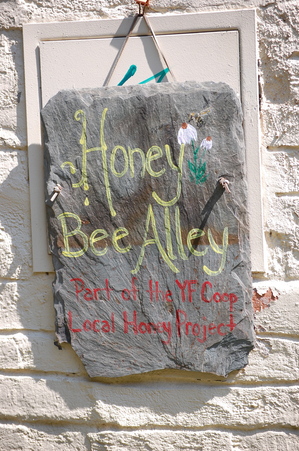
The sign for Honey Bee Alley, located next to the Ypsilanti Food Co-op in Depot Town.
Janet Miller | For AnnArbor.com
The Local Honey Project will produce queens (most hives have a single queen, but about 20 percent have two queens) and bees to start local hives. Bees shipped from warmer states such as Texas and Georgia are not as hardy as homegrown bees, Bashert said, and die at a higher rate. They are also treated with chemicals in order to make the mail order journey and arrive stressed. It’s another example of buying local being better, she said. “It can become an entrepreneurial venture where we supply queens and bees.”
Bashert was behind the city of Ypsilanti adopting an ordinance that allows homeowners to keep up to two hives in their backyards after one of Bashert’s Normal Park neighbor had complained about her hive. She launched a campaign to make city beekeeping legal, which was approved in late 2009.
While the Local Honey Project is about growing the Michigan bee population and producing organic honey, it’s also about education, Bashert said, such as the presentations she’s made at the two Ann Arbor Whole Foods Markets. Honeybees pollinate about one-third of what we eat, she said. “They are little, but they are very important piece of our food system.”
Comments
dextermom
Tue, Jul 10, 2012 : 12:50 p.m.
Wonderful work Lisa. We love your honey!
brimble
Tue, Jul 10, 2012 : 12:25 a.m.
Kudos to Ms. Bashert for helping to educate about this critical element in the integration of local food and a healthy ecosystem, and at the same time, creating a little local buzz about the issue of colony collapse.
Epengar
Mon, Jul 9, 2012 : 6:53 p.m.
Out of curiosity, I checked the Ann Arbor ordinances about bee-keeping. You can have hives in the city, but only a couple: "No person shall keep or possess an apiary containing more than 2 stands or hives of bees within the City of Ann Arbor. "
Woman in Ypsilanti
Mon, Jul 9, 2012 : 4:52 p.m.
I cannot say how happy I am that our community has someone as passionate about bees and honey as Lisa Bashert seems to be. I don't have time to keep bees myself but I love that others in Ypsilanti are doing it.
Ash
Mon, Jul 9, 2012 : 4:52 p.m.
Great job!
jns131
Mon, Jul 9, 2012 : 4:31 p.m.
If anyone is interested, The Ypsilanti library on Whittaker road is going to have a movie on this called "The Vanishing of the Bees" at 6:30 on July 25. I too have heard of the bee problem. I plan on attending this one. Sounds like maybe we can do something to help our buzzy little friends. It is in collaboration with Whole Foods and Ypsi Coop and their series Do Something Reel-film. Something else to do on a Wednesday nite.
Carole
Mon, Jul 9, 2012 : 3:39 p.m.
Congratulations there Queen Bee -- I remember as a child going with my grandpa to his hives -- it is totally awesome. Great work and best wishes on a very important project.
Ross
Mon, Jul 9, 2012 : 12:32 p.m.
Awesome! Keep up the good work.