

Candidates for Washtenaw County commissioner seats differ on issues in first public debate
Republicans Melinda Day and Joseph Baublis say they're interested in decreasing the size of Washtenaw County government, lowering taxes and getting out of the way of businesses.
Democrats Yousef Rabhi and Leah Gunn say they strongly believe in the role a healthy government can play in providing important services to citizens, including helping those in need.
Their viewpoints were shared during a slightly contentious one-hour debate hosted by the League of Women Voters of the Ann Arbor Area on Monday night.
All four candidates are seeking seats representing parts of Ann Arbor on the Washtenaw County Board of Commissioners in the Nov. 2 general election.
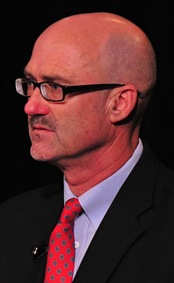
Joseph Baublis
Rabhi and Baublis are competing for the 11th District seat being vacated by Democrat Jeff Irwin. Day is challenging incumbent Barbara Levin Bergman, D-8th District, who did not attend Monday's debate due to a personal commitment.
Gunn is defending her 9th District seat against Republican Mark Tipping, who also did not participate in Monday's debate.
The debate was taped at CTN studios for rebroadcast.
One of the hot topics of the night centered on the role of county government in providing human services funding to assist local nonprofit agencies. Baublis suggested the private industry, not government, should be addressing the homeless problem.
"Bear in mind that we have people living in Ann Arbor in tents because there's not enough room at the Delonis Center. That's something that private business could fix," he said.
Rabhi dismissed Baublis' assertion.
"In no world do private companies take care of homeless people," he said. "That's not part of the free market. That just doesn't fit in. That's when governments step in. That's when the people step in, and they take care of people that need help. That's what we need to be doing."
Day agreed with Baublis that government should step aside and let the generosity of the American people — not taxes — take care of the less fortunate.
"I believe that the government actually gets in the way of people succeeding," she said. "The best thing we can do for underemployed and unemployed people is to find them a job."
Gunn said the county already is working on job placement, but that doesn't change the fact that it's a tough economy and there are people who need help surviving.
Day said one problem is that property taxes are too high.
"I think that we need to find a better way of taxing our citizens, so that when you actually buy a house and you pay off the mortgage, you actually own the property and you're not just renting it from the county, because that's basically what our tax system is," she said.
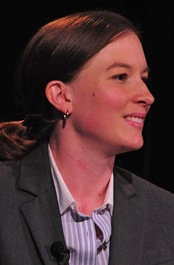
Melinda Day
Gunn fired back.
"I'd like to point out that the state law requires us to levy property taxes," she said. "We have no choice. If we want that changed, we have to go through the state Legislature."
Day said if she were elected to the county board, she would work to make cuts and find ways to make government more efficient. She suggested there's room for consolidation of police services, such as having a joint call center for the city and county.
"The county is already doing that," Gunn responded. "We have a combined dispatch center for all of the county sheriff police services and the city of Ann Arbor, located in the city of Ann Arbor. We also have a combined data center for our IT, and we've been working together trying to consolidate as much likenesses that we can do."
Gunn said the county also has taken over labor negotiations and human resources for the Road Commission and has collaborated with other local governments on IT services.
"In a perfect world, I wouldn't be here right now," said Day, a PhD student in life sciences at the University of Michigan. "I instead would be focusing on my degree, but unfortunately this isn't a perfect world. What we have is an epidemic of unemployment among young people.
"We cannot continue down this road of fiscal irresponsibility," she said. "The county is facing revenue shortfalls for the next several years. We need new people on the board of commissioners who will work diligently to maintain a balanced budget."
Baublis, a self-described handyman, real estate broker and appraiser, said he feels he has the most credentials to represent the 11th District.
"I also bring alternatives to the status quo," he said. "For example, my priority is to protect the taxpayers, and that priority does not even exist on the current board's list."
Rabhi, a University of Michigan student and longtime community activist in Ann Arbor, summed up why he's running for the 11th District seat.
"The reason I'm running is because I believe that our human services are the core of what the county provides, and they need to be protected in the future and today," he said.
The four candidates offered views on Ypsilanti Township's potential collaboration with the city of Ypsilanti for police services, instead of with the sheriff's department.
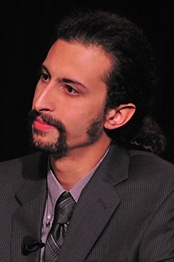
Yousef Rabhi
"Ypsilanti Township sued the county, and we spent millions of dollars in legal fees," Gunn said. "The Michigan Supreme Court, the Appeals Court and the Circuit Court have all ruled that this is a non-mandated service. We are not obligated to provide police services for any township. Citizens in the city of Ann Arbor are paying twice. We are paying for our own police department, and we are paying for subsidizing the contracts of the township police."
Gunn concluded that if Ypsilanti Township thinks it can get a cheaper price from the city of Ypsilanti, "I say go for it, because it will mean we do not have to pay for that service."
Rabhi agreed all residents should pay a fair share for the cost of having the sheriff's department patrolling in their community.
"Whether or not that's happening now is still up for debate," he said, adding he's always an advocate of governmental efficiency and looking at ways to save money. "And if it in fact saves money for Ypsilanti Township, then that's what they should be doing."
Baublis said a lawsuit never should have been filed.
"This is crazy for our governments to be suing each other," he said, adding the parties should have settled out of court. "The savings from that alone probably would have paid for a considerable amount of the sheriff's duties now."
Day said she's a firm believer in public safety and leaves the decision up to Ypsilanti Township to decide how it wishes to proceed.
The candidates offered their views on the potential formation of a corridor improvement authority to assist with the redevelopment of Washtenaw Avenue from Ann Arbor to Ypsilanti. Baublis said no improvements should be carried out without significant input from businesses.
Gunn and Rabhi agreed the idea is worth talking about, and they agreed with Baublis that the business community should be consulted.
"If such an entity were to come about, it should have a focus on how we can make that corridor not only more efficient for transportation, but also more environmentally friendly," Rabhi added. "We need to have runoff systems that are preventing pollutants from going into our waterways."
Day said she doesn't think a corridor improvement authority is needed.
"If you actually look on Washtenaw Avenue and you look down the corridor, there's plenty of businesses there," Day said.
Baublis said throughout the debate that he doesn't have faith in government.
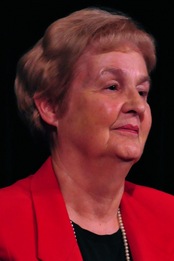
Leah Gunn
"We're running out of money, and unfortunately some parts of the government have led the people to believe that they can rely on the government," he said. "Now it's time to do the reverse. We have to start getting the people to rely on themselves, their own communities, and their own families. How do we do that? And where are we going to make the cuts? No. 1, let's remember that the government is spending the people's money, not its own money."
Rabhi said he's not interested in busting unions and firing people. Rather, he thinks jobs and services can be maintained by getting more efficient. He said that includes efficiency in electrical and water usage, which saves money and moves the county toward sustainability.
Baublis touched on declining tax revenues and loss of business.
"What can the government do about that? Nothing. It's up to the people," he said. "How can we get people to invest in a county that is going broke? Why would a business want to come here knowing that it'll be on the hook to pay the taxes for services that are inefficient? The way I see it, we need to scale back government taxes, get the government on a balanced budget, and then maybe we can entice some businesses with employment to come back to the county."
At another point in the debate, Baublis expressed his disappointment with what he considers an over-assessment of properties in Washtenaw County.
"I think they're ripping off people who own property," he said. "We're not getting justice out of the state law. And the assessors in Washtenaw County, they're not helping the people."
Day said she specifically would like to reexamine some of the funding the county doles out to nonprofit groups such as Planned Parenthood. Gunn defended the allocation.
"I would go to the mat for human services, including our prenatal grant for Planned Parenthood," she said. "We give prenatal care to low-income women who can't get it elsewhere, and we've produced over 1,000 healthy babies."
On transportation, Gunn said she's in favor of the proposed north-south and east-west rail lines connecting Ann Arbor to the surrounding region, as well as express bus service to Ypsilanti.
Rabhi said he, too, is in favor of improving mass transit.
"This is an issue that's extremely near and dear to my heart because, first of all, it's an issue of sustainability, and, second of all, it's an issue of social justice," he said. "We need to make sure that everybody in our community has access to everywhere in our community. And beyond that, we need to make sure that our community is connected to the communities around us, including Detroit. I want to get to Detroit without driving my car."
Day said she doesn't think Southeast Michigan has the population numbers to justify or sustain a commuter rail system between Ann Arbor and Detroit.
Baublis said he simply doesn't think government is an efficient mechanism for implementing transit. "Private industry would do a better job," he said. "Let's look at that as an option."
Ryan J. Stanton covers government and politics for AnnArbor.com. Reach him at ryanstanton@annarbor.com or 734-623-2529.
Comments
Lokalisierung
Wed, Sep 29, 2010 : 1:23 p.m.
There you go RobertInSaline. Ed has provided a link for you to a different studio that will not playing these videos. Thanks?
Lokalisierung
Wed, Sep 29, 2010 : 1:09 p.m.
"You'd find that video on Cable 19," I don't think he would in Saline.
Lokalisierung
Wed, Sep 29, 2010 : 12:54 p.m.
"The debate was taped at CTN studios for rebroadcast." I believe these are live shows Ryan? RobertinSaline Do you get ctn in Saline?
RobertinSaline
Wed, Sep 29, 2010 : 12:32 p.m.
Why does the League of Women Voters of the Ann Arbor AREA exclude other County Commissioner candidates in these debates?(BTW, in looking at the list of LWVAAA members, some members hail from Ypsilanti and other places, well outside of Ann Arbor) The answer has always been - "we only include candidates for elected offices in the city of Ann Arbor", but obviously County issues affect all of us. Ryan - can you get a straight answer from the League?
Chris
Wed, Sep 29, 2010 : 9:06 a.m.
Regarding Melinda Days comments on the generosity of the private marketplace to provide for the less fortunate. What happens when the economy tanks and private business must decide between generosity and keeping the doors open and the lights on? Generous donations dry up and the government is then left in the tenuous position of trying to provide services without the necessary resources because taxes have been cut. Suddenly, we have a bigger crisis because now government is faced with potential budget deficits, reduced resources, budget cuts etc., etc. There will be no resources available to address the central issue of providing services to the homeless. Ms. Day I implore you, either become better informed on your community or concentrate on finishing your degree. I believe my Washtenaw county property taxes are quite reasonable given the services I receive in return. Secondly, I do not believe a platform advocating solely for tax payers is well founded. Are taxes too high, maybe but the real question is Ms. Days inability to see the bigger picture and future needs of Washtenaw County. Ms. Day lacks the vision necessary to recognize that Washtenaw County and Ann Arbor has become one of the most sought after areas in the State of Michigan to live in, raise a family and operate a business precisely because our local and county governments continue to be well run. The County has demonstrated fiscal responsibility and levied taxes appropriate in relation to the services us as residents demand and expect in return. Before Ms. Day extols the detriment of high taxes a more thorough analysis should be undertaken to assess how those tax dollars have been spent and allocated. Ms. Day may discover that in relation to other cities and counties of comparable size both in and outside the state our taxes are actually quite reasonable. As far as the lack of employment opportunities for young people, I completely agree. However, the solution to attracting employers to the area that will employ smart young and hardworking professionals is to market our great community, great schools and quality of life. Low taxes may serve as an incentive but the real issue is the State business tax structure which is an absolute debacle and real impediment to attracting business to the state. Until our legislature can actually take the time necessary to resolve this problem modifying the local tax structure would actually prove to be more detrimental in the long run.
Chris
Wed, Sep 29, 2010 : 9:04 a.m.
I must agree with Yousef Rabhi, government is the best entity to provide the required services for the less fortunate. Baublis is entirely out of touch with reality if he believes private business is a model to solve the issue of homelessness. I have yet to see private business providing low or no cost services to people on little or no income. Of course private business does have a place in assisting non-profit or government entities in providing financial resources and donating time and services but there is a reason why private business is not in the business of providing such services, because you simply cannot make money if you give it away for free. Secondly, Joseph Baublis must believe that homelessness is a new problem. Apparently, Mr. Baublis is blind to the current plight of many people who are now homeless thanks in part to the fine banking and financial institutions that refuse to provide homeowners with workouts. But of course in the private market place it is better for the bank to evict the homeowner and foreclose on the property than reduce the payment and modify the loan in order to reduce homelessness, neighborhood blight, crime and financial ruin for many working class middle income families. It is simply a travesty that now Mr. Baublis should be advocating that the private market place is better able to address the issue of homelessness when it is the private market place that has enabled the economic deterioration to occur placing tremendous strain on government resources and Washtenaw families. Thats fair, thanks Mr. Baublis for sharing your great ideas. If Mr. Baublis so strongly believes there is a shortage of housing for the homeless then I nominate Mr. Baublis to utilize his real estate background to leverage his property holdings making them available to the homeless. Sounds like a win-win to me. Private business has had ample opportunity to step up and undertake solutions to resolve this crisis. Of course as we have all seen with the recent economic downtown private business is simply not in a position to provide the level of resources that governments can offer to address the issue of homelessness in Washtenaw County. This is precisely why as citizens and tax payers we pay taxes to the government. To ensure those less fortunate have the services necessary that ultimately benefit society as a whole. This is why we pay teachers, police officers, fire fighters and public servants. I am happy to pay my county taxes as a Washtenaw county resident knowing that my tax dollars have a tangible benefit on the people that need it the most. My vote is for Rabhi.
Jenna Thom
Wed, Sep 29, 2010 : 8:14 a.m.
@Mr. Ed - Although Gunn is a county commissioner, she still represents the city of Ann Arbor. She should not allow the out county areas to take advantage of the city. If the out county areas do not want to pay for services, then fine they have that choice, but the residents of the city of Ann Arbor should not have to subsidize them. Besides, "what is right for the county" (as you said) is actually what is right for the ENTIRE county, including Ann Arbor, not just the outlying areas. Gunnn does a great job of reminding some of the other egocentric commissioners of that fact I agree with a2huron, Gunn represents us well. We are lucky to have her represent us.
Mr. Ed
Wed, Sep 29, 2010 : 8:10 a.m.
a2Huron That could be said with all the tax dollars. I'm sure more money is spent on housing inmates in the jail than from Saline vs Ann Arbor. I'm sure more money is spent in social services in Ann Arbor than say Northfield. Gunn does represent her district but she also represents the County as well. We need a charter County to take some of the power away from the board and hold one person responsibility at the election process for our County. The talking horse
Ed Kimball
Wed, Sep 29, 2010 : 8:04 a.m.
If private industry would do a better job of implementing transit, why haven't they done it? Why haven't they done it anywhere???
a2huron
Wed, Sep 29, 2010 : 7:26 a.m.
Gunn is absolutely correct. Even as a county commissioner she is charged with representing her city district. Just being on a county board doesn't mean you should overlook the huge funding disparity the county has in how it spends public safety dollars. Start sending money to the city's police dept each year in an amount equivalent to the subsidy given to areas such as Ypsi Twp and then my perspective would differ. I commend Gunn for her leadership and for actually representing those that elected her.
KeepingItReal
Wed, Sep 29, 2010 : 5:54 a.m.
I'm actually looking for someone to vote for instead of Commissioner Bergman. However, I suggest that Melinda Day focus on getting her PhD.
Mr. Ed
Tue, Sep 28, 2010 : 10:22 p.m.
Is Gunn a Washtenaw County Commissioner or an Ann Arbor City Council member. Her theory regarding paying twice for police is absurd.I realize she needs to do what is right for her district first but she also needs to do what is right for the County. If she can't do both then run for the City of Ann Arbor Council and leave the County Government to someone with an open mind. The talking horse
Basic Bob
Tue, Sep 28, 2010 : 10 p.m.
Outsourcing public services to the needy can't work. Because the government will need to hire a huge staff of accountants, lawyers, and directors to ensure that the privatized services are being provided. The private company will need to hire a huge staff of accountants, lawyers, and directors to answer to the government that the services are being provided. Then there are the senseless and unavoidable court battles. So the desire to return to small government actually creates larger and less efficient government. The size and cost of government can be reduced by two ways: reduce services, and reduce the personnel costs. Outsourcing just concentrates the costs into waste and indirect labor.
care2comment
Tue, Sep 28, 2010 : 8:57 p.m.
Melinda Day makes sense. She's got my vote