

Candidates in Ann Arbor mayoral and council races say much is at stake in Tuesday's primary
What's at stake in Tuesday's Democratic primary election? The future of Ann Arbor, say the candidates running for city offices.
A slate of four challengers headed up by mayoral candidate Patricia Lesko is hoping to overthrow Mayor John Hieftje and three council members, claiming the incumbents have mismanaged the city's budget and lost sight of basic priorities.
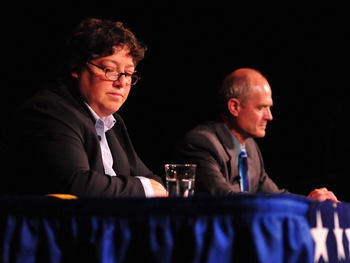
Patricia Lesko takes on Mayor John Hieftje in a debate last month hosted by the League of Women Voters of the Ann Arbor Area.
Ryan J. Stanton | AnnArbor.com
The mayor and the three incumbent council members say that Ann Arbor is faring exceptionally well despite Michigan's economic downturn, and that many of the arguments made by the opposing slate either lack merit or demonstrate a poor understanding of how city government operates.
After months of heated political warfare amongst the candidates, it is now up to voters to decide on Tuesday if it's really time for a changing of the guard inside city hall.
"There's so much at stake. There's so much good we can do," Lesko says. "So I think it's important to recognize that there is dissemblance going on, that there is lots of business as usual, and that I'm offering a completely different kind of governance — one that is not concerned with my next political post. My basic vision is to have a city that is like a neighbor to the people inside of the city."
In addition to the mayoral matchup between Hieftje and Lesko, voters in three city wards will weigh in on Ann Arbor City Council races on Tuesday.
In the 1st Ward, Sandi Smith, a local real estate professional, will defend her seat against Sumi Kailasapathy, a certified public accountant.
In the 4th Ward, Margie Teall, whose background is in social work and photography, will defend her seat against Jack Eaton, an attorney who practices labor law.
In the 5th Ward, Carsten Hohnke, a consultant and president of West Pole Inc., will defend his seat against Lou Glorie, a real estate professional.
All of the candidates running are Democrats. Winners of the mayoral race and 5th Ward race will face challengers in the November general election.
"This is as ugly as it's ever been," Hieftje says of this year's races. "I think it's a Tea Party-like movement. Very similar to the Tea Party, we have people involved in this movement who have never been involved in city government, never even applied to serve on a board or a commission, and yet they want to lead the city."
Eaton, who has been a neighborhood activist for several years, says he doesn't think either side is going to simply sweep the election. Rather, it will be a race-by-race decision, he says, and there's no telling how it will turn out.
"I think what's at stake is simply our vision of what our city is going to be like in the long-term," Eaton says, "whether big development and vacancies and unstable real estate prices are going to continue to be our problem for the next five or six years, or whether we're going to hunker down and take a look at what's really important in the budget and take care of our infrastructure."
Hieftje, who has been in office a decade now, has grown visibly frustrated with the opposing slate's allegations of cronyism and back-room dealings. After a recent debate, he admits, he went out and removed some of his campaign signs from yards where they were placed next to signs for one of the challengers.
"I was offended by what I heard that night," Hieftje says. "You can only put up with so much. I would hope that there isn't a place in Ann Arbor politics for the kind of rhetoric that's been thrown around during this campaign."
But beyond the rhetoric, the challengers have raised real concerns that city spending is on the rise, leaving the city with more and more debt. City records show the city's debt rose more than 25 percent between 2006 and 2009, going from $167.2 million to $209.9 million. Meanwhile, governmental activities spending increased from $96.9 million to $130.2 million.
Narrowing the focus to the city's general fund, spending rose from $69.2 million to $83.9 million from 2006 to 2009. However, the budget is on downward trend now that the city is being forced to deal with declining tax revenues. The general fund budget for the 2010-11 fiscal year that started July 1 amounts to $81.45 million.
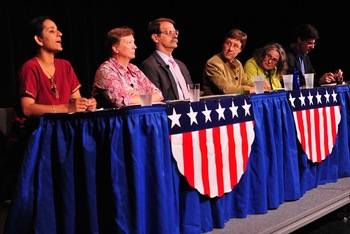
The three council challengers take on the three council incumbents in a debate last month hosted by the League of Women Voters of the Ann Arbor Area.
Ryan J. Stanton | AnnArbor.com
Hieftje and council members argue recent cuts to city services and employee losses have been minimal compared to what other cities in Michigan are facing.
"This election is of vital importance," Hieftje says. "There are council members who are up for reelection who have done a great job in a very tough environment, and I think it's very clear what's at stake: Are we going to be able to continue on a prudent but progressive fiscal course, or are residents going to go with a slate of candidates headed up by my opponent that hasn't offered any solutions?"
Kailasapathy calls Tuesday's primary a referendum.
"Do we want more of the same," she says, "or really take a radical different path from what's happening and get back to the core mission of providing the core services and living within our means and actually listening to the constituents?"
The challengers question why the crumbling Stadium bridges aren't yet fixed, while the city is issuing bonds for a new police-courts building and constructing a new underground parking structure downtown. The incumbents defend both projects, saying they are needed and revenue streams have been identified to fund them.
Lesko isn't buying it.
"If that bridge falls, I'll get elected — so will Jack, Sumi and Lou, and untold number of people will die," Lesko says. "Fix the bridge. It doesn't take a rocket scientist."
Teall says she doesn't think the challengers have proven they would work well with city staff if elected. For example, she says, staff has explained over and over again the plan to wait until next spring to repair the Stadium bridges.
"When do you stop second-guessing and micro-managing and trust that you have hired excellent people?" Teall says. "How do you move forward in the city when you keep going back to these old issues after things have been explained?"
Lesko says her transition into office would be difficult only if City Administrator Roger Fraser and his staff aren't willing to be held accountable.
"I've taken exception to some of his work because I've seen it to be flawed," Lesko says. "And it frightens me, frankly, to think that the person on whom council relies and depends is managing information in such a way that sometimes it's not accurate."
Smith says she's interested in smart growth, and she thinks the challengers would bring development in Ann Arbor to a halt if elected.
"I think it would be very difficult to get things done," she says. "They don't seem to be very strong consensus builders and they're not really willing to work with the people who are already there. They haven't shown that they know how to work well with others."
Hohnke says the incumbents offer a more positive and progressive vision for Ann Arbor. He says the challengers are offering solutions based on misinformation and illegal suggestions about how to redirect money from restricted funds.
Glorie says Tuesday's election is about the people. What's at stake, she says, is the continued livability and affordability of Ann Arbor, and the ability of citizens to have some input into their government and the direction it's going.
"If the incumbents all won, we would see a continuation of us managing by crisis," Eaton says. "We would go from year to year not addressing the structural problems in the budget. If all the challengers won, I think you would see a focus on essential services. We would look in the budget for those areas that have grown rapidly and unnecessarily and try to divert that money to areas that actually serve the taxpayers."
Ryan J. Stanton covers government and politics for AnnArbor.com. Reach him at ryanstanton@annarbor.com or 734-623-2529.
Comments
Jordan Miller
Tue, Aug 3, 2010 : 3:20 p.m.
Did anyone else find Glorie's comment (above this one) to be a bit bizarre? This is an excerpt: "Their hosannas are often sung in praise of the good citizens who vote and then get out of the way so government can be run efficiently. They also conflate "efficiency", a tool, with an actual principle from which to derive governing policy, transforming a tool into an end in itself.... Principles are replaced with a form of idolatry (tool worship) and appeals to authority." What on earth? Personally, I'd rather be governed by experience than by inflated rhetoric. And what I haven't seen from the challengers as a whole is a willingness to take the steps to participate in their government and learn the nuts and bolts. Attend city council meetings. Sit on boards. Volunteer for committees. I'm all for change where change is due. But that change must be backed up by something more than words, and words are all I have seen from any of the challengers.
Mick52
Mon, Aug 2, 2010 : 11:27 a.m.
Sigh. I say retain the mayor but vote out the incumbent council members, especially since the three running are an accountant, attorney and a real estate agent. The sitting council has made too many poor decisions to earn re-election. I do not see how it could get any worse, but what has been going on much end. The strong arming of DDA funds to help balance the budget was the final straw for me. Don't see how that will not keep happening with this bunch in the saddle so its time for some changey hopey stuff. The mayor's race is fairly clear due to Ms. Lesko's constant attempts to prove she should not hold office.
Snarf Oscar Boondoggle
Mon, Aug 2, 2010 : 10:49 a.m.
"If that bridge falls, I'll get elected so will Jack, Sumi and Lou, and untold number of people will die," Lesko says. "Fix the bridge. It doesn't take a rocket scientist." and this is the stability anne arbour would want leading our city? i don;t tink so.
PersonX
Mon, Aug 2, 2010 : 10:25 a.m.
The use of the term "slate" to describe all the challengers in this year's election is a unfortunate effort by the status-quo supporters to make sure that no change whatsoever takes place. It is fairly certain that Pat Lesko cannot win. I make no judgment on her run, only on he very obvious state of affairs. It would be unfortunate, however, if all three challengers lost as well. Whatever one thinks of Lesko, it would be bad for Ann Arbor if Sandi Smith had another term. She has done many good things, but her approach to development is a disgrace. As far as I can tell, her main reason for supporting the undoing of existing zoning and for allowing the near-downtown areas to be turned into faceless blobs by a few developers is that this would produce more tax revenue. I fully understand the need for more revenue but one has to have some sense of standards and of the long-term needs of the city. Do we want an anonymous city or do we want to combine the old with the new? Is it anything goes for money? We need some new faces on city council.
Barb
Mon, Aug 2, 2010 : 10:11 a.m.
Well. It's nice to see someone post here who isn't into name calling. The fact that it's a candidate speaks volumes about how lucky we are to have these choices this time around. We all have a lot at stake and to stoop to some of the childish behavior seen on these boards leads me to believe that we deserve what we get. I thank all the candidates for their commitment and for bringing ideas and debate to the table for the first time in years. Everyone please vote.
Patricia Lesko
Mon, Aug 2, 2010 : 9:32 a.m.
This, most likely, will be the last piece posted to AnnArbor.com about the Democratic primary. I have refrained from commenting here for the simple reason that it's more important to listen than to talk, IMHO, when running for office. Believe me when I say I have listened very carefully to your thoughts, questions (many of which I've answered, as I announced on another thread here, on posts at my blog, A2Politico.com), criticisms, fears, and words of support. Please know that as the next mayor, I'll continue to answer your questions directly, and read your comments on the various online sites, such as this one, AnnArborChronicle.com, etc... I intend to blog on the city's web site, as the Mayor of Madison does, and hand off A2Politico to someone who will, I imagine, grill me to perfection. I'll keep my Facebook page, and Twitter account, as well, so you can know what I'm doing during the course of my duties and always have a chance to participate and comment. I'll continue to go door-to-door after I'm elected, as well. Keeping regular weekly office hours is a good basic step, but I feel like that puts the onus on you to come to me, and I want to change that dynamic. Every Sunday, weather permitting, I'll walk the neighborhoods of our city. You might just say hello; you might not be home (I'll leave a note), or you might be ready to sit down and have a talk. For the first time in a long time, Ann Arbor will have a mayor with school-age children. You should know that I have a keen interest in rekindling the once close relationship between the School District and the City. There is a committee of Council and the School Board, I was told by a School Board member, that hasn't met for years. The School District and the city receive almost exactly the same amount from each tax dollar you pay (28 cents), and there are many opportunities to find synergy in that relationship, shared resources, a shared commitment to economic vitality, a shared commitment to keeping and growing Ann Arbor as a magnet community for families. Above all, I want those of you who have posted here, and who live in Ann Arbor, to know that I'll work to make government more transparent and inclusive. I applied to sit on the AATA Board in 2008, and the lack of follow-up and communication from the incumbent and the city was disappointing and, ultimately, instructional. I'll make bipartisan appointments to boards and commissions, and I'll open up the applicant pool by nominating more individuals to serve, as opposed to nominating individuals to serve on multiple boards. I will, one last time, thank the incumbent for his decade of service. I also want to pass on some kind words I got from some voters at the University Commons debate recently: They thanked me for running, because to run for office is to make a commitment to one's community in a very tangible way. So, I want to thank Sumi Kailasapahy, Sandi Smith, Jack Eaton, Margie Teall, Carsten Hohnke, Lou Glorie, John Floyd, Newcombe Clark and Steve Bean (in advance), Tony Derezinski and Christopher Taylor, as well, for making the sacrifices and personal commitment necessary to run for local office. Finally, and as I've said in public many times, I plan to work together with city staff and Council to refocus city government on the basics: responsible spending, services, infrastructure and neighborhoods. We won't always agree, but I'll always listen and expect to be held accountable. The issues are of paramount importance, and so is increased interest and participation in local government. On A2Politico.com today, I wrote about the plebis scitum. I look forward to tomorrow evening, and hearing exactly what your decree will be. Thank you.
friend12
Mon, Aug 2, 2010 : 9:18 a.m.
Alan Goldsmith which canidate are you? As far as the bridge is concerned, if it is so bad why hasn't MDOT closed the road and the road under it?
bedrog
Mon, Aug 2, 2010 : 8:57 a.m.
re dagny...'losing' is 'winning', 'true colors' of incumbants but supposedly ( and oxymoronically) 'colorless' GREENS ( known for over the top, defamatory rhetoric)...this all sounds like it should have been on a george orwell related thread of a week or so back.. and 'canuck'...would that your views about bipartisan overuse of fevered rhetoric prevailed... but one side started/escalated it and for some of us' turning the other cheek' is no longer an option once all 4 cheeks have been turned and the abuse/defamation continues. fair's fair. and chuckl... since when are your mantra-like 'wit' and 'urbanity' a bad thing, as you imply?? seems a little like the nazi use of 'cosmopolitan' to attempt to separate jews from the supposed/ mythical 'salt of the native earth-ers' you GREENS fantasize about speaking for.
DagnyJ
Mon, Aug 2, 2010 : 7:58 a.m.
@ChuckL, I have to agree. Lesko has already won by revealing the true colors of the incumbents. The sign removing incident, the talking points from the incumbent camp that supporters use. You can imagine the mayor thinking up the worst words to say about Lesko (say she is with the Tea Party, say she is like Sarah Palin, use the phrase train wreck, say that she and the other challengers don't work well with others). Personally I am voting ABTM this election season--Anybody But The Mayor.
Top Cat
Mon, Aug 2, 2010 : 7:37 a.m.
When all is said and done, I will be extremely surprised if any incumbent loses.
Canuck
Mon, Aug 2, 2010 : 7:35 a.m.
Re: above, I should have written ALL sides of the political spectrum to acknowledge the behavior of local democrats who, one would assume, share some political perspective.
Canuck
Mon, Aug 2, 2010 : 7:19 a.m.
The use of emotionally charged language does not further a healthy political debate. Painting a number of political challengers (or the incumbents) with a single brush stroke rather than recognizing their individual strengths and weaknesses is illogical and disingenuous. We would all be well served (and better informed) if the name calling, hyperbole, rhetoric and pigeonholing stopped - on both sides of the political spectrum! Disclaimer: I am neither a democrat nor a republican, I do not know any of the candidates, and I have yet to decide who will receive my vote(s) in the upcoming civic election.
demistify
Mon, Aug 2, 2010 : 7:04 a.m.
As Lesko and her running mates juggle support from the Green Party gang and rhetoric purloined from the Tea Party, I propose that we call them the Green Tea Party.
Steve Pepple
Mon, Aug 2, 2010 : 6:49 a.m.
A comment was removed because it contained a personal attack against another commenter.
M-Fan
Sun, Aug 1, 2010 : 9:30 p.m.
This explains why I am supporting Pat Lesko for Mayor and Lou Glorie for my Council representative, and not the present incumbents. I am a townie, and proud of it. I have lived in Garden Homes, which is on the northeast of Miller Ave. and Maple Rd. for over 50 years. Anyone who is aware of the area knows what a great neighborhood it is. Garden Homes was annexed to the City of Ann Arbor in 1969, when Bob Harris (Dem) was elected Mayor. Our neighborhood was suffering from lack of proper wells, septic fields, etc. The 1st thing the new Mayor did was ask what the residents of the area, both owners and renters, wanted! This resulted in the Garden Homes Association being formed, surveys taken, and City Council listening to the neighborhood as to how to proceed. The City hired a project co-coordinator to work with the neighborhood (Laurie Wargelin, who became the Citys 1st CD Director). It took a few years, but the work of the people and expenses (covered by the City) resulted in the HUD project, Neighborhood Development Plan, being successfully implemented. The neighborhood association decided they wanted JJ&R to work with us. We worked with 3 mayors, Harris, Stevenson (Rep) & Wheeler (Dem) to build our neighborhood into what we have today, and I am sure, the tax revenue has more than paid the City back for the investment it made in the project. The point??? The mayor and council worked with the citizens (voters) towards what they wanted. Today, when land is available, the current administration calls all the developers who contribute to them and ask what they want to do. It seems like its the citizens who will be impacted have to fight the City/Developer group, and of course, they usually win. I want a mayor and council representative who will ask me what I want, not the developers. This is why I support Pat Lesko and Lou Glorie over the present administration. Also that fact that our roads and bridges are falling apart while we pay 800,000 for a fountain also support my decision.
demistify
Sun, Aug 1, 2010 : 9:16 p.m.
Lou Glorie needs to explain whether she seeks or accepts the support that has been tendered by Henry Herskovitz (who demonstrates in front of the synagogue during its religious services), Charles Loucks (who teamed up with him to run for the food coop board on a platform of boycotting Israeli couscous), and Blaine Coleman (who has repeatedly been ejected by the police for disrupting City Council meetings).
ChuckL
Sun, Aug 1, 2010 : 9:14 p.m.
demistify, Have you checked a2politico.com recent threads in regard to comments made by former councilwoman Joan Lowenstein's denials that she has been trash talking Lesko's campaign? Lowenstein is not well regarded by Lesko to say the least. How you infer an anti-semitic remark is truly amazing and amounts to a slander on me. But, I say go ahead a cry wolf, we all know how that fable ends.
bedrog
Sun, Aug 1, 2010 : 9:01 p.m.
longfellow...what article do you refer to? the only one's i recall 'espousing' on this site are 5 excellent exposes of our local synagogue harassing extremists ( incl. 'chuck l.) in the WASHTENAW JEWISH NEWS dec, feb and march issues, including a particularly telling and poignant one from a former member of this tiny but noxious cult.. wish ms.glorie had been as diligent a reader as you, per mine earlier, and confirmed by chuckls above..
bedrog
Sun, Aug 1, 2010 : 8:43 p.m.
long and chuck...reliable allies ( to my case)as ever.im sure ms. glorie et al are happy for your support. and chuck: p.s re. people weighing in on places where they don't live, are you posting from the middle east?.
ChuckL
Sun, Aug 1, 2010 : 8:16 p.m.
Lesko won't win? I say she already has no matter what happens on August 3rd. Lesko has put a major chink in this Mayor's armor as evidenced by the so called nastiness of the campaign. If the Mayor was confident he would win by a landslide of 4-to-1, he would not even acknowledge her existence much less debate her multiple times.
Marvin Face
Sun, Aug 1, 2010 : 7:56 p.m.
Ladies and gentlemen of Ann Arbor, lets all be crystal clear on one thing: Lesko will not even come CLOSE to winning the primary. With all due "respect" to those writing here so breathlessly in support of Lesko and those shocked, SHOCKED! at the incumbent's administration, i say, enjoy several more years. As a matter of fact, if Hieftje wins by less than a 4:1 margin I promise to reveal the true identity of "David Cahill".
disbelief
Sun, Aug 1, 2010 : 6:58 p.m.
The term slate (whether unofficial or informal) has been used ad hominim to detract and ridicule the challengers. The slate theorists have argued that we should not vote for the challengers solely because they belong to a slate! Talk of the Tea Party is intended to tar every one with the same brush, is it not? It beats me why it is not cool to belong to a slate. Dont some of the incumbents (i.e. current council majority) belong to a slate as well? And should this be a negative factor that should influence whether or not we vote for them? Several residents have been witness to the Mayor driving Ms. Smith around in the first ward. And when the residents posed questions or concerns to Ms. Smith, it seemed as though it was the Mayor that answered on her behalf. Does the fact that the Mayor is chauffeuring Ms. Smith around and answering questions on her behalf imply that they make up the real slate? Does this in itself mean we should not vote for them? Has it come to a point in the race that the Mayor is afraid he is going to lose his yes (wo)men?
ChuckL
Sun, Aug 1, 2010 : 6:54 p.m.
More urbane and witty comments from people who don't even live in Ann Arbor and can't even vote here. So, some people who never saw Israel commit a human rights abuse and want to egg the US into a war with Iran are whining about politicians who actually respect the Democratic process; we should not be surprised with these folks. Do these comments represent our tax dollars at work (this is what $3 billion in annual military aid to Israel gets us)? For people's information, Henry Hershkovitz lives in the 5th Ward which is Lou Glorie's Ward. But certain urbane and witty folks who have admitted they live in a suburb of Ann Arbor see nothing wrong with imposing a litmus test on these 5th Ward residents from on high. Don't worry Lou, these folks are part of the Joan Lowenstein's beautiful people set who support Hieftje and you would not want their support anyway.
Bill Wilson
Sun, Aug 1, 2010 : 6:52 p.m.
Frankly, taking Bedrog at his word is like believing that BP is "on the job" cleaning up the oil: a nothing burger, all bread, no meat. I read the article he espoused a few weeks ago. It was the most convoluted piece of nonsense I'd read in some time. Ignore his silliness.
bedrog
Sun, Aug 1, 2010 : 5:16 p.m.
lou glorie...according to one of his frequent online screeds to his followers, henry herskovitz, the leader of ann arbors longtime synagogue stalkers, reports that you...of all the candidates... went out of your way to have coffee with him, although stopping short of endorsing his heinous activities and 1-issue agenda. this is not good,if he's telling the truth ( which admittedly he mostly doesn't do)... in any case by his reports, others had the sense to pariah-ize him as he deserves, although sadly not publically disavowing the online support of his cronies like prominent GREEN partyers.
RSJ
Sun, Aug 1, 2010 : 5:05 p.m.
Lesko's track record is scary. All I hear is how she starts strong and interviews well. Then, within a short time starts to cause so many problems. Do we want someone who has communication problems? We need someone who knows how to negotiate, has experience and is well-liked by their peers (at least most of them). I see Lesko as trouble. Ann Arbor has it's issues and I think the bridge and roads are high on that priority list of "things to do". I still vote for Hieftje. He's done a good job with Ann Arbor. Nobody will be perfect, but we are fortunate. We don't need a HUGE change. He understands Ann Arbor and I think the people have made it clear about what needs to be done.
lou glorie
Sun, Aug 1, 2010 : 4:34 p.m.
Im thankful for this article, and some of the comments that follow, for the illumination they have provided. The incumbents have run a marvelous, well organized campaign that provides them with shelter from their disastrous policies and the disaffection of the electorate. Yet the mayor is still whining and posing as the abused party. I have to admit a grudging admiration for the work of this machine. It has been a beautifully orchestrated slash and burn opus. But, it is democracy that suffers when personality becomes THE issue rather than issues being the issue. Sadly the mayor's campaign has shown contempt for democratic process and the citizens of Ann Arbor. Challengers, to his rule-by-puffery, are suspect. When boosterism fails, the solution is to swiftboat the opposition to the desolate Isle of Tea Party. His disdain for diversity of opinion is aptly illustrated by his bizarre sign-removal activities. For those fallen away voters a lesson--diversity of opinion is verboten. Will "untidy thoughts" now be added to the expanding list of Community Standards no-nos? None the less, we're encouraged to vote for him because he plays so well with others-- if they agree with him. I imagine that many of the commentators writing in support of the incumbents consider themselves to be among the Ann Arbor illuminati. They are essentially touting the "high efficiency models of politician currently holding the majority on council. Scrutinizing their comments yields some observations: Their hosannas are often sung in praise of the good citizens who vote and then get out of the way so government can be run efficiently. They also conflate "efficiency", a tool, with an actual principle from which to derive governing policy, transforming a tool into an end in itself. Much of the discontent I and others feel with Larcom, these days is because of the tendency to speed things up and stream-line process for no reason other than "it's more efficient". So now inside Larcom, efficiency, trumps other principles like fairness, transparency, and the "wide and thin sharing of power." Principles are replaced with a form of idolatry (tool worship) and appeals to authority. We are ridiculed for trusting common sense and counseled to deposit that trust instead with the experts: the technocrati, the urban-planners, the schools of public policy grads. But people from every area of the political spectrum are rousing themselves from their comas. "You don't need a weatherman to know which way the wind blows" and you don't need a masters in "public policy" to know things are rotten at Larcom. When a bridge gets to be looking like our Stadium Bridge, when our streets are cratered and our basements are flooded with sewage, the conclusion that our government is no longer working in our interest is inescapable. The technocratic, political and "expert" classes have alienated a growing number of Americans. That so many have succumbed to the false populism of the Tea-Party movement is evidence of the swelling tsunami of discontent. Our political representatives should be attempting to bridge the divides among us, rather than widening the gulfs. I suppose it is just too advantageous, to dismiss all critiques of a systemic contempt for the citizenry as fringe. But the challengers won't be limping off into obscurity just because a class of self-proclaimed deciders dismisses our right to participate. I am here to reclaim the political turf as a citizen, because I think there is no hope for the future if our system devolves into a technocracy, plutocracy or theocracy. Only through the processes affiliated with democracy, can the creative energies of the broadest swath of people be harnessed to meet the challenges we face in the next five years. If the incumbents have a problem with that, I have to wonder why. Ps: Mr. Hieftje, if you are still mayor on November 3, I'd love to serve on Planning Commission either as the representative of council or as a citizen. You can take this as a formal request. Yours truly, Lou
W. Cooper
Sun, Aug 1, 2010 : 2:17 p.m.
The mayor is comparing criticism of his job performance to the tea party movement? Really? He was so angry after the debate that he removed his campaign signs that were next to Sumis signs? What kind of politician cant tolerate being called on the carpet to defend his performance? Now it is reported that he was blackmailed by the city council into not using his veto. Source: http://annarborchronicle.com/2010/07/31/police-courts-building-politics-of-a-veto/ And, that argument about Ann Arbor being better off than other cities is growing old. Hieftje has lain off 37 firefighters (another 10 positions will be eliminated in 2011) and 53 police officers. Grand Rapids, a city Hieftje compared us to, by contrast has lain off exactly 4 firefighters and 1 police officer. Lansing has lost one firefighter position and gained three police officers. Where is he getting his information that we are better off than other cities?
A Pretty Ann Arbor
Sun, Aug 1, 2010 : 1:55 p.m.
Like many I am more than a little upset about the stadium bridge. It's rating is lower than the Minneapolis Bridge when it fell - significantly lower. At one point the Stadium Bridge rated a 2 out of a 100! Teall says "staff has explained over and over again the plan to wait until next spring to repair the Stadium bridges." Can we really wait that long. I think it is a matter of when it falls - not if - hopefully no on dies. This is her ward and yet she is defending something that appears to be dangerous and deadly. I applaud those that keep reminding us that the bridge is falling the bridge is falling. There was funding, we (city of A2, council and mayor) did not work towards getting the money in a timely and proper fashion. Our infrastructure is falling apart. We have homes backing up with sewage on a regular basis now, people that have been warning the city about water and flooding issues and yet it falls on deaf ears. The bridge and the issues above should have been fixed first, instead they have been allowed to decay and allowed to hurt the citizens of the city. If you don't think people get hurt by sewage and water back ups - just ask one and they will bend your ear for an hour. Essential services first - then if we have left over money - then pet projects. As for the tea party remarks and the signs being removed...come on - this is childish. If you came to take my sign - I would call the cops for trespass. It was a gift, it is on my property and you don't have the right to take it back. My opinions on who I vote for are mine - not yours.
Bogie
Sun, Aug 1, 2010 : 1:42 p.m.
Let me say, as a new resident of Washtenaw county; I am astonished by some of rhetoric coming from the A2 council and mayor. It is silly to comment "Ann Arbor has fared better, than other Michigan cities" when A2 has probably the biggest wealth provider in the state- The University. Whether it be the fountain, or the vote of Arizona's immigration law; this government entity seems to be totally out of touch with their obligations, and responsibilities. They seem to be "the norm" with the ever growing arrogancy of government officials. Ann Arbor residents can make a statement on tuesday, that can return the reasonable parameters of city government. I do hope they do.
Gorc
Sun, Aug 1, 2010 : 12:53 p.m.
SonnyDog09: great analogy with the hippo comparison....it made me laugh...thanks
bedrog
Sun, Aug 1, 2010 : 12:44 p.m.
marshall... mr. lesko?? a little bit more informedness on the campaign and its cast of characters is in order sir ( or ma'am since your logo seems to be a blend of obama and sara palin)
Marshall Applewhite
Sun, Aug 1, 2010 : 11:36 a.m.
Yes, Mr. Hieftje has made some questionable decisions as mayor, but people must also understand that he is dealing with a wholly incompetent City Council. We must remember that in these difficult times, Ann Arbor has fared much better than its counterparts around the state. After reading the empty rhetoric of Mr. Lesko, I have no idea how anyone can see him as a viable candidate.
SonnyDog09
Sun, Aug 1, 2010 : 11:07 a.m.
Jenna wrote: "Fact is Ann Arbor is doing great! And yes, the state is facing tough economic times, but remember Ann Arbor is the most fiscally sound city in the state right now. That is due to the leadership of council. Voters should not take that for granted. " The well being of Ann Arbor has more to do with having the UofM in town than anything that the council and mayor do. The mayor and council remind me of those little birds that ride on the backs of hippos; they might think that they are steering, but the hippo will go where the hippo wants to go despite "leadership" from the little birds. I guess that it is chic in democrat circles to use the epithet of "tea party" against anyone or anything that you do not agree with. It is curious that the moderators do not consider that to be "name calling." You know that the anointed candidates of the ruling party are feeling desperate when they throw that term around.
Speechless
Sun, Aug 1, 2010 : 10:56 a.m.
Jenna Thom: "... They talk cuts, about balancing the budget and claim they can do it better, while forgetting to tell everyone that the budget was balanced, that there were minimal cuts last year...." Unfortunately, city council will at times stubbornly do things that cause local residents to give a listen to such claims made by their challengers. The council spends months telling people that Ann Arbor can't really afford any longer to provide relatively modest, limited funding for the senior center or the indoor pool or Project Grow. Then, later on, they turn around and casually drop a million or two of general fund money, like it was nothing, into the new city hall addition to cover new office equipment, cost overruns, etc., due to bond money depletion. City council naturally drives itself into public relations trouble when its own actions state that expensive office perks count more than seniors, swimmers, and community gardens, among other things. P.S. As for the mayor removing his signs from other people's lawns, this is very silly, even if he did supply them in the first place. In a democracy, it is a voter's right to split tickets or express outward contradiction in their choices. If, by some chance, there were actual election laws on the books that banned cognitive dissonance, many Americans would have had their voting rights stripped away years ago, as the U.S. middle class has become internationally notorious for voting squarely against its own interests time and time again, favoring corporate-leaning candidates instead.
a2roots
Sun, Aug 1, 2010 : 10:53 a.m.
Bottom line is who would be better for Ann Arbor. Hieftje although not the perfect candidate is by far the proper and smart choice. Without a doubt Lesko would not only be train wreck but would cause damage that would take years to repair. I do wish there were better choices but until we go non-partisan or the Republicans find a face we are stuck with what we have.
DagnyJ
Sun, Aug 1, 2010 : 9:40 a.m.
Politics is ugly business regardless of the level or people involved. Especially when entrenched incumbents suddenly realize that their comfortable spot is threatened by their own records. It is time for change. No matter who runs against the mayor and his cronies, those people will be soundly criticized. In this case, the mayor and his supporters have dragged out the labels "Tea Party," train wreck," and the most laughable "doesn't work well with others" (See Teall's criticisms above). At the very least, send a message to the incumbents that they need to get serious about spending and city services, and that meglomaniacal building frenzy (parking garages, city hall renovations, bike lanes next to crumbling streets) has got to spot. Likewise the million dollar mowing budget, the water/sewer surplus, the gold-plated tech department, and the ridiculous waste/recyling stuff. Vote. And vote against the incumbents and their poor performance.
Jenna Thom
Sun, Aug 1, 2010 : 9:13 a.m.
@Patirck McCauley I am not using the term "tea Party" lightly, as a name to attack with. I am completely sincere in what I am saying. Th challengers over the past six months have spouted talking points that you hear on Fox news and from Sarah Palin. They do not sound like democrats. Now, you might agree with those talking points,but it does not change the fact that the challengers rhetoric, hyperbole and "the sky is falling scare tactics" are out of the playbook of the TeaParty conservatives. Fact is Ann Arbor is doing great! And yes, the state is facing tough economic times, but remember Ann Arbor is the most fiscally sound city in the state right now. That is due to the leadership of council. Voters should not take that for granted. The challengers rhetoric always sounds like " great is not good enough and we need to be better than number 1". It just sounds ridiculous to me.
David Cahill
Sun, Aug 1, 2010 : 9:05 a.m.
A. Green, Hieftje's removal of his signs was an attack on the voters' rights to display support of the candidates they choose. I could also have pointed out that Hieftje's attitude that he "will take his signs and go home" is unworthy of a public official.
bedrog
Sun, Aug 1, 2010 : 9:03 a.m.
jenna...some of the challengers are openly backed by people not only of the often unhinged and strident tea party right but rather from the equally unhinged/ strident far left ( e.g. GREEN PARTYers)... what's interesting is that most of the challenger candidates themselves likely don't share such views, but have been negligent in explicitly disavowing such support...for which a price will be paid no doubt.
A. Green
Sun, Aug 1, 2010 : 8:24 a.m.
@ David Cahill Bravo! To Mayor Hieftje for taking back his sign. You can only defend the truth with the truth. When people would rather believe the hyperbole and rhetoric screamed by the challengers, than listen to truth and reason, there comes a time when certain actions need to be done, namely an anti-endorsement. I find it a sign of leadership that Hieftje took back his sign. Instead of indirectly helping to promote Kailaspathy as a legitimate candidate, he chose to risk losing a vote in order to make a point to the public, The point being that he does not find the challenger credible and that she is dishonest in her accusations. Kailaspathy has made all sorts of false accusations about the Mayor, city council, and the city staff; to not encourage that is well within his rights. He would not want his sign to help legitimize a candidate who has not run an honest campaign and who plays fast and loose with data and facts. Removing his sign is a simple gesture. The public should take notice of such a brave move and see it for what it really means. I know I have. I respect the Mayor for this
Speechless
Sun, Aug 1, 2010 : 8:19 a.m.
"... [Lou] Glorie says Tuesday's election is about the people. What's at stake, she says, is the continued livability and affordability of Ann Arbor...." Glorie, herself, may be fully sincere in saying this, but over the years the opposition, in general, has shown little real interest. They have been far, far more interested in building a huge downtown greenway at great public expense rather than in making a genuine effort to expand opportunities for affordable housing. Instead, to counter developer influence, the opponents have lately been building political bridges with campus-area slumlords, and some of them make claims that new workforce housing does not belong near downtown. Challengers to the city council majority need to make an effort to get beyond just representing the interests of homeowner factions privileged with disposable income.
Patrick McCauley
Sun, Aug 1, 2010 : 8:02 a.m.
This campaign has gotten ugly on both sides. It would make me think twice about getting involved in a political race again, if I didn't care so much about our city. Everybody needs to stop slinging mud and keep talking about the issues. Both sides have made good points about the state of Ann Arbor(the good and the bad), but apparently it isn't enough to just focus on these issues. Calling people tyrants and teabaggers seems pretty silly when you think about how big the problems are that we face.
Jenna Thom
Sun, Aug 1, 2010 : 7:54 a.m.
@speechless The irresponsible rhetoric is not just coming from the supporters of the challengers, but from the challengers themselves. Their constant scare tactics about the "sky is falling" and "the city is suffering and in bad fiscal shape" when the opposite is true is straight out of Sarah Palin's playbook. They like to talk about cost overruns, pork and getting back to basics (which is code for cutting out everything from the budget except mandated services-very rebupublican), while promising to keep specific pet projects to get your vote. They talk cuts, about balancing the budget and claim they can do it better, while forgetting to tell everyone that the budget was balanced, that there were minimal cuts last year and that the council actually did a fantastic job considering the economy.
Speechless
Sun, Aug 1, 2010 : 7:48 a.m.
Sandi Smith: "... They don't seem to be very strong consensus builders.... They haven't shown that they know how to work well with others." The truth over the last decade is that neither side has been very good at negotiations and consensus. This has been a big problem in city politics. Each side stubbornly mirrors the other — it's their way or the highway. The city council majority, for its part, is inclined to consider compromise only when staring political defeat right in the face. They tend to get irritable when people speak up. Their opposition is dominated by neighborhood groups and greenway activists who represent a limited faction of central-area homeowners and professionals. Other than, say, the Argo rowers, they've consistently been tone-deaf to a variety of other local advocacy and grassroots groups. These neighborhood activists act as if they feel they can take power and control city council on their own — without needing to form any major local alliances or make compromises with wider interests within our community. If the opposition is really, truly interested in winning control someday, they will choose to finally get serious about reaching far & wide into the community around them. Ditto for the council majority, if they hope to maintain control well into the future, past their own individual council careers. Ann Arbor is more than just downtown, and more than just the self-interests of either developers or a modest percentage of "neighbors."
The Picker
Sun, Aug 1, 2010 : 7:41 a.m.
Lets face it, No matter what your feelings are of the current administration, Lesko will be a train wreck if elected. Her thin skin will put her on the defensive with the citizens within weeks if she is elected
David Cahill
Sun, Aug 1, 2010 : 7:37 a.m.
I can provide some detail to add to AnnArbor.com's report that Hieftje admitted "he went out and removed some of his campaign signs from yards where they were placed next to signs for one of the challengers." I received reports about two separate incidents involving voters in the First Ward. They both follow the same pattern. The voter has a sign for Hieftje and a sign for Kailasapathy. Hieftje comes along and tells the voter he does not want his sign associated with Kailasapathy's. The voter tells Hieftje to keep his sign in place. Hieftje removes his sign - despite the voter's objection. One of these voters was so offended by Hieftje's conduct that he sent out an e-mail asking if Hieftje's removal of his sign was illegal. It is common for voters who think independently to have signs for one side and for the other. In the fall, we even see some voters with both Republican and Democratic signs. A normal candidate welcomes support from these "split ticket" voters. But Hieftje apparently doesn't want ticket-splitters. I could make some obvious comments about Hieftje's tactics reaching a new low in city politics. I could say his removal of his own signs is childish and petty. I could point out that if this campaign has gotten ugly he has only himself to blame. But I will only say that he has violated one of the fundamental rules of politics: "Never, ever offend a voter."
Jenna Thom
Sun, Aug 1, 2010 : 7:35 a.m.
The people of Ann Arbor know Republican/Tea Party talking points when they hear them and the challengers spout nothing but this conservative rhetoric. We are not choosing a democratic to represent us in the primary on Tuesday. We are actually choosing between hard working proven democrats such as the incumbents and tea party activists pretending to be democrats so that they can get in the door to city hall, such as the challengers. More evidence is that there are ads supporting Sarah Palin on Leskos blog and major republicans around Ann Arbor are publicly supporting them. Ann Arbor wake up and recognize the challengers for what they are, Tea party activist whose agenda is to destroy the city and keep it from prospering. Lesko, Eaton, Glorie, and Kailaspathy will ruin this city if elected. Vote Hieftje, Teall, Hohnke, and Smith on Tuesday! Vote the real Progressives and Democrats into office!
Speechless
Sun, Aug 1, 2010 : 7:26 a.m.
"...'This is as ugly as it's ever been,' Hieftje says of this year's races. 'I think it's a Tea Party-like movement. Very similar to the Tea Party....'" While I believe there's a limited truth to this comment, for the mayor to broad-brush the entire opposition in this way represents serious hyperbole in a style borrowed from the Byrnes / GLEP school of campaign attack strategy. The problem for the mayor's opposition is that that a portion of their number consist of a mishmash of libertarians, disaffected Republicans and all-around curmudgeons, and their candidates consistently don't step up in public to distance themselves from the more outlandish, irresponsible commentary. Hieftje apparently notes this lack of leadership, and wants to make them pay a political price by trying to lump them all in with the oddest of their lot.
a2grateful
Sun, Aug 1, 2010 : 6:21 a.m.
Time for a change... it's exactly the philosophy that elected President Obama... and got rid of George Bush. The country is better off. The city will be better off. It is not about about tea parties... it's about poor governance performance and accountability. It's time to fill the holes in our city fabric... First, fill the hole in the heart of city government that disdains citizens. Fill it with a civic attitude that is focussed on service-oriented attitudes and practices, and clear, open process. Fill the list of dwindling essential services with services that are essential... public safety and protection, snow removal, street light repair and maintenance, tree trimming in sidewalk buffers, parks maintenance... Fill the potholes and repair our streets... Fill the holes in the logic that allowed the Stadium Bridge to progress to its stage of demise. City engineering knew of the bridge condition many years ago, when funding WAS available... Fill the hole next to the library lot. Replace it with a2 central park, and prudent recognition of improvements that are not related to essential city service. Recognize that folly projects are not feasible in our economic time and circumstance... that private developers should take on risks of parking garages that are built solely to support ultra-speculative private hotel and conference centers. Fill the gaping hole in our budget logic that says, "We have identified funding sources for our pet projects... we just don't have money for essential city services." No more folly fountains... No more talk of wealthy artist communes funded with taxpayer money across from the YMCA... The city's development record by our incumbent regime is dismal... Holes at Lower Town... a hole at the former First and Washington parking structure... a hole that supports the "temporary' porous pavement at the old YMCA cite for affordable housing... Holes in the Argo Dam... the city spent more to litigate with the state than it would have cost to fix the drains... and the work was ordered many years ago when the City had already forgotten the notion of essential city service. We still have to fix the drains... but we haven't... Fill the hole in the logic that says, "Parkland is just another public land (PL) zoning designation, and that any municipal improvement can be constructed on it." That seems to currently include more parking garages... What else will the expanded poor logic include? (It already includes donation of the land in perpetuity, as a clever workaround of voter passed legislation that set legal precedent for disposition of parkland.) What a tiring list... and it only scratches the surface... too bad it's really not about a simple tea party... if it were, our choices would be much easier... so many holes, so little time... Vote Tuesday, a2!