

Ann Arbor area mammogram practices unlikely to change based on federal recommendations
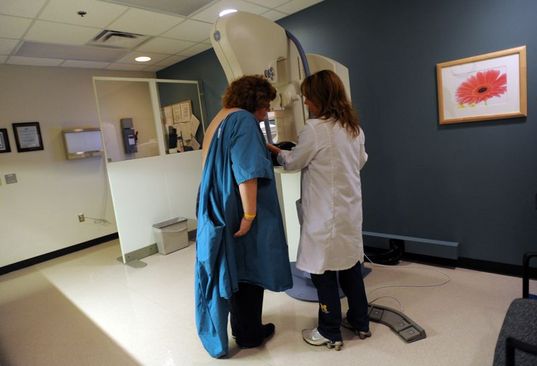
Cancer center patient Deb Chandler of Gregory stands at a mammogram machine as Diane M. Martel, a registered technician in radiology and mammography, adjusts the machine Wednesday afternoon.
Melanie Maxwell | AnnArbor.com
On Alesia Hermosillo’s 49th birthday earlier this year, she was diagnosed with an invasive form of stage 1 breast cancer.
The Belleville woman was outraged this week when she heard a government panel suggested women like her wait until they turn 50 to begin mammogram screenings for the cancer.
“If we hadn’t caught it when we did, it would’ve advanced and gone into the lymph system,” Hermosillo said, adding St. Joseph Mercy Health System doctors found the cancer after she underwent a routine mammogram.
She had a double mastectomy, but avoided chemotherapy and radiation, she said.
Hermosillo echoed the concerns expressed across the country this week by patients younger than 50 who say they've benefitted from screening and by the health professionals who for years have recommended the screenings.
|
Guest Column Fighting breast cancer
|
On Wednesday, local hospitals and U.S. Department of Health and Human Services Secretary Kathleen Sebelius said the panel’s recommendation did not signal a policy change in guidelines about when women will be screened.
“My message to women is simple. Mammograms have always been an important life-saving tool in the fight against breast cancer and they still are today," Sebelius said in a statement Wednesday. "Keep doing what you have been doing for years - talk to your doctor about your individual history, ask questions, and make the decision that is right for you.”
The U.S. Preventive Services Task Force recommended Monday routine mammogram screening for breast cancer every two years after women reach their 50s. The federal panel, which is an independent panel of health professionals, also recommended against health providers emphasizing self breast exams.
The recommendation came with a caveat that the decision of when to conduct a mammogram should be made based on an individual patient’s case and risk.
Both screening methods have limitations, and there are tangible harms involved - such as false positives and unnecessary testing without statistical improvements in health outcomes, the panel concluded. False positive results occur in approximately 10 percent of mammography tests, national statistics have shown.
Physicians at Washtenaw County's two largest hospitals said patients shouldn't expect to see any short-term changes to screening based on the panel’s findings. They say they're waiting to see how the debate plays out among larger medical organizations.
“We are still supporting recommendations from the American Cancer Society and the American College of Radiology that (women) get screened starting at age 40, unless they are at high-risk, and then it's sometime sooner,” said Joanne Barbour Walker, co-director of the breast center at St. Joseph Mercy Hospital. “It will be really interesting to see how this plays out, if it will impact how insurers will reimburse for mammograms."
The University of Michigan's policy has also been to follow guidelines recommending routine mammogram screening when women reach their 40s, and that should remain so, said Mark Helvie, director of U-M’s breast imaging division.
The recommendation and the controversy it sparked is nothing new, said U-M School of Public Health management and policy department Chairwoman Paula Lantz.
"There's always been a debate about whether screening in premenopausal women is effective," Lantz said.
Before menopause, women are less likely to develop breast cancer and have denser breast tissue, making it more difficult to find abnormalities, she said. On the other hand, women even younger than 40 do get breast cancer, and it makes sense to err on the side of caution, she said.
The question raised is whether it's a good use of resources to have every single woman screened once she reaches the age of 40, Lantz said. There's a big difference between how physicians, who have discovered breast cancer in young women and been able to treat it, and how those creating health policy feel about screening, Lantz said.
"From a public policy point of view, where you are going to get the most value is over 50," Lantz said. "It's not that it wouldn't help a single person, but it wouldn't be a wise thing to do."
Studies reaffirm findings that screening improves survival rates in breast cancer patients, Helvie said.
He and others in the health care community have questioned why the panel came to its conclusions based on data that previously led to the recommendation for routine screening of women between 40 and 49 years old. The panel appears to have given greater weight to the harms, such as extra personal stress and biopsy testing, that can result from false positives, he said.
Lantz and other physicians said it would take time to see what, if any impact, the panel's recommendation will have.
“The big issue to me is all the models showed a mortality reduction,” Helvie said. “What came out of this panel is the most efficient use of mammograms … This should be a concern among patients. I would be asking the question, ‘Do I want to be efficient as a patient?”
The findings riled some major cancer organizations, including the American Cancer Society.
“With its new recommendations, the USPSTF is essentially telling women that mammography at age 40 to 49 saves lives - just not enough of them,” Otis W. Brawley, chief medical officer of the American Cancer Society, said in a statement.
Tina Reed covers health and the environment for AnnArbor.com. You can reach her at tinareed@annarbor.com, call her at 734-623-2535 or find her on Twitter @TreedinAA.
Comments
Rork Kuick
Fri, Nov 20, 2009 : 9:02 a.m.
If my daughter were the one I might want you to give me all your money, but I figure you might not like that, and might rightly argue the same money, spent other ways, would help more, and so I should pay for relatively inefficient screening procedures if I still want them. (Another analogy is actually my own screening for lung and prostate cancer, except that there the question might become too simple - it is whether some screening procedures help at all.)
tredd
Thu, Nov 19, 2009 : 10:12 p.m.
So we are posed with an interesting dilema. Regardless of which point of view you approach this with, numbers, namely actuarial tables are going to determine the care. If you take a free market approach, insurance companies are going to use the numbers to set reimbursement levels as low as possible on the one hand while guaging the maximum they can charge companies for employee health care (this amounts to the single biggest customer group for insurance companies). Consumers (patients), being insulated from actual costs (employers still pay the lion's share of premiums, regardless of how much they have begun to pass along over the past 10 or so years) want it all, as much coverage as they can. Result: employers profits get squeezed, insurance companies maximize profit, and the majority (yes Virginia, there is a majority in this case, and it is the insured) get what they need and want (the want comes into play in the form of peace of mind from even the remotest possibility of harm, to the extent possible.) Now take the view of government responsibility. Here you have the numbers being used to determine lowest common denominators and acceptable "failure" (sometimes death) rates. The government will try and maximize return on expenditures (read this as coverage to all at a base level) and they will assign dollars to death as they determine acceptable risk levels (did I read somewhere between 3-15% in this case?). Here comes the big dilema...are you sufficiently outraged at corporate profits and 25% uninsured that you are willing to risk being in the 3-15% "acceptable risk" class? Its tough. My family to this point can afford to pay for the extra coverage the government can't pick up. I knew immediately that the whole breast cancer issue would flare up. Will the 75% of women in the U.S. with current health care coverage vote as a block for their peace of mind? Only time will tell. Once thing we can be sure of is that the members of congress are making this calculation right now as they decide how to vote on the coming legistlation. We will be able to tell how they "figure it out" by how they vote. Anyone noticed yet that no member of congress or the senate has proposed that they go on this new proposed health plan? Why leave a great plan of your own? You just want to mess with everyone elses peace of mind, not your own.
goodthoughts
Thu, Nov 19, 2009 : 7:07 p.m.
Woman in Ypsilanti- You do realize the insane amount of profits private insurance companies make annually? And do you also realize that in England the NHS, or National Health Service, was initiated and formed during that country's lowest period and one of rebuilding a major part of its infrastructure? We are the only industrialized nation that uses peoples' illnesses as a way to get rich. It is possible if cost, corruption and American's general greed and selfishness were corrected, everyone would have adequate health care. Rork Kuick- although mathematically you may have a "point", but if it were your daughter that was the expendable one?
Rork Kuick
Thu, Nov 19, 2009 : 5:06 p.m.
I reviewed more carefully: The report estimates that a median of 1 women in 1000 will avert a breast-cancer-caused death by having all get mammography at 40 rather than 50, and that it will give about 33 more life-years for the group of 1000 women. That is good but takes 10000 or 5000 additional mammograms (depends on yearly or biennial), many additional biopsies, and some extra surgeries for the other 999 women. The report did not attempt to quantify how much money that is, or cost out the extra unneeded morbidity. Allot of it is also about every-other-year vs. every year. What is best to do is a tough choice, unless one presumes that resources are unlimited, and that semi-bad things for the other 999 women don't matter. These people are not at liberty to advise on how to run a utopia where saving every woman-year is worth any cost (money and unneeded procedures), but rather to compute if you could have saved more lives/years by some other tricks. Seems cold-hearted, but it is the real world you are trying to work on, which means you presume some limitations. That we are "expendable" oversimplifies that, or presumes a utopia.
Woman in Ypsilanti
Thu, Nov 19, 2009 : 4:57 p.m.
Do any of you people blaming this on Obama or socialized medicine realize that private health insurance companies use this kind of reasoning to deny care to people right now? As well they should. We dont have unlimited resources for health care. Private insurance companies are limited by the premiums they can charge. The government is limited by the amount of taxes they can collect.
Rork Kuick
Thu, Nov 19, 2009 : 3:45 p.m.
By Lenin's liver, it's well known that only communists think that anything remotely like evidence should influence medical practice.
goodthoughts
Thu, Nov 19, 2009 : 3:22 p.m.
I agree with many of the other women in my support group who are, as well as myself, currently undergoing chemo for breast cancer. (4 of us are in the 38-42 age range) What we have determined is that essentially the new guidelines/task force want to imply that the percentage (3-15% depending on which media outlet you read/watch) of women saved by insisting on mammograms starting at 40 is/was not worth the cost. That those lives are disposable. However catching the cancer late stage doesn't make it any cheaper to treat. And, my Invasive Ductal Carcinoma couldn't be felt, ONLY a mammogram could see it because it was so deep in the tissue. If I had not had the suggested 40 year-old mammogram, and waited until I was 50 it may have very likely spread to my bones. It is ludicrous how these task forces can make such a sweeping and life altering conclusion.
Rosie
Thu, Nov 19, 2009 : 2:22 p.m.
I look at this issue from both sides. I found a lump in my breast at the age of 28. I wasn't exactly doing a self-exam, just noticed it in the shower one morning. I then went and had a mammogram and ultrasound done. The test revealed that it was a fibroadenoma (non- cancerous solid growth). The doctor said that it was benign and I could choose to leave it be or it might continue to grow and I would want to remove it. Because I was so shocked that I found this lump that seemed large to me and I had not noticed it before, I was worried that it was growing rather quickly. I decided to have it removed. Looking back I might have made a different decision. I could have chosen to leave it and "wait and see." It might not have grown any more. (I know many people who have fatty tumors or other growths that they have had for years with no change to them.) That surgery may have been unnecessary. Eliminating procedures that are not absolutely necessary is one way to streamline healthcare costs. So suggesting that each case needs to be looked at on an individual basis seems to make sense. It has been four years since my surgery and the scar is still healing so the point about harm coming from unnecessary procedures certainly will ring true for many.
Conservative
Thu, Nov 19, 2009 : 1:46 p.m.
Ok. Why don't all you libs who think mammograms are causing harm, don't get one. In the meantime, don't tell my wife, or other women under 50, that they can't get a mammogram.
Rici
Thu, Nov 19, 2009 : 1:36 p.m.
I'm surprised that everyone is so shocked by this "new" finding. My primary care doctor told me this same thing (routine mammograms not shown to significantly reduce cancer deaths in women under 50) at least 4 years ago. She also told me that the American Cancer Society recommended women start at age 40 anyway, and that their (office) policy was to recommend them at age 40 but not start really pestering women to comply until closer to 50.. The whole conversation was a bit surreal, though, because a friend of mine (who was not even 40 yet) was undergoing treatment for breast cancer at the time. But hers wasn't detected by a routine mammogram, it was detected because she paid attention to changes in her body and got to a doctor asap.
Rork Kuick
Thu, Nov 19, 2009 : 11:45 a.m.
Some of the comments: this issue is important science, stop the false politicizing of it. Quit making stuff up. And it's tricky - we can't be so simpleminded about it. The point is that for this and other cancers (famously and shockingly in lung and prostate recently - that should have been reviewed in a good article) just cause you detect more apparent "cancers" and treat them, and think you must thereby be helping people, doesn't actually prove you helped, and people are now looking at data to determine whether you really helped, or were just fooling yourself, perhaps even making things worse (but making more money doing unnecessary and harmful procedures). We don't want to be performing procedures that actually result in more harm than good. However, I agree with Brawley's summary so far. If true, the question becomes if you could have done better by screening some but not others (and exactly which ones), thereby reducing the harm part while still maintaining most of the benefits. The article gave no indication of what Ms. Hermosillo's risk was thought to be, so that leaves doubt about the truth of the statement that she would not be screened under these new recommendations. It's not certain that early detection saved her life either. The article is not doing enough to make a complicated situation clearer for people. Yes, yes, I know - that's not the purpose of such an article.
Tina Reed
Thu, Nov 19, 2009 : 10:13 a.m.
Politics aside, I do want to make sure it was clear that the U.S. Department of Health and Human Services said federal policy regarding when women should be screened is not changing as a result of the panel's recommendation: http://www.hhs.gov/news/press/2009pres/11/20091118a.html
Eric64
Thu, Nov 19, 2009 : 9:34 a.m.
Change we can believe in. We are sure getting change.It is a really shame that the federal goverment feels it needs to be in every aspect of our lives.Welcome to socialism.
walker101
Thu, Nov 19, 2009 : 9:26 a.m.
This is just a start of times to come, this administration is just letting you see a taste of how the government health care plan will run your lives.
thebuckstop
Thu, Nov 19, 2009 : 8:24 a.m.
Oh please "conservative"...ObamaCare.....really? Really? REALLY? You can do better than that.
mytwocents
Thu, Nov 19, 2009 : 7:52 a.m.
I don't want to be an "efficient patient," I want to be a proactive one!
Conservative
Thu, Nov 19, 2009 : 7:44 a.m.
ObamaCare is all about rationing/limiting medical tests. What did everyone think they were voting for when they voted for Obama? The general public will get worse medical care while Michelle O. and the elites will get whatever tests they want.
Angil Tarach-Ritchey RN, GCM
Thu, Nov 19, 2009 : 6:34 a.m.
This is an outrage, and one more excuse for health insurance companies to reduce benefits. When physicians and the American Cancer Society disagree with these recommendations, women must stand together in protest of these ridiculous recommendations!